

IT incident management is the structured process of detecting, logging, classifying, resolving and reviewing unplanned disruptions to IT services, with the primary goal of restoring normal operations as quickly as possible while minimising business impact. It is a core discipline within ITIL-aligned IT service management and modern DevOps/SRE operating models.
Every organisation running business-critical systems faces unplanned disruptions. Without a defined process, those disruptions become costly: teams duplicate effort, communication breaks down, and the same failures recur because no one captured the root cause. The result is eroded user trust, missed SLAs, and mounting technical debt. A structured IT incident management approach changes that equation. By standardising how incidents are detected, triaged, escalated and closed—and by feeding every resolution back into a knowledge base and set of playbooks—IT teams progressively shorten mean time to repair (MTTR), reduce repeat incidents, and demonstrate measurable service quality to the business. This guide covers the full lifecycle, from workflow design and prioritisation to post-incident reviews, AIOps-assisted classification and the tooling that ties it all together.
What IT Incident Management means in modern IT
IT incident management is not simply a ticketing discipline. It is the operational backbone that determines how quickly a business recovers from any unplanned disruption—whether a server outage, a security alert, a failed deployment or a degraded network link. Defined formally within ITIL 4 and embedded in ITSM platforms, it sits at the intersection of people, process and technology: the right people receive the right information at the right time, follow a documented process, and use integrated tooling to restore service with minimum delay.
In practice, the scope extends beyond the service desk. Modern IT environments—cloud-native, hybrid, microservices-based—generate incidents across layers that no single team owns end-to-end. That is why aligning incident management with both ITIL/ITSM governance and DevOps/SRE accountability models has become the standard approach for mature IT organisations.
At Impulso Tecnológico, incident handling is treated as an integral part of keeping business operations safe and predictable. With over 25 years of managed-services experience supporting organisations across Spain, Portugal and internationally, we align incident workflows with the platforms we manage for clients—including Microsoft 365 and Azure environments, and security solutions from partners such as Sophos, Fortinet and Veeam—so every incident is handled consistently, with clear communication and the right level of technical control.
| Framework / Model | Primary focus | Key contribution to incident management | Typical adoption context |
|---|---|---|---|
| ITIL 4 | Service value and governance | Standardised process, roles, SLA definitions, knowledge management | Enterprise IT, MSPs, regulated sectors |
| ITSM platforms | Workflow automation and reporting | Ticket lifecycle, escalation routing, SLA tracking, CMDB integration | Mid-to-large IT teams with dedicated service desks |
| DevOps | Speed, collaboration and continuous delivery | Shared ownership, fast feedback loops, blameless culture | Software engineering teams, cloud-native products |
| SRE (Site Reliability Engineering) | Reliability as an engineering problem | Error budgets, toil reduction, post-mortems, runbooks | Large-scale web services, SaaS platforms |
Core definition: restore service and minimise business impact
The ITIL definition is precise: an incident is any unplanned interruption to an IT service, or any reduction in the quality of that service. The goal of incident management is not to explain why it happened—that is problem management's remit—but to restore normal service operation as quickly as possible and limit the impact on business operations. This distinction matters operationally. A team that conflates incident resolution with root-cause investigation will consistently miss SLA targets because diagnosis takes longer than containment. Closing a ticket should mean service is restored and users are back to work, not that the underlying cause has been eliminated. Separating these two objectives allows parallel workstreams: one team restores service, another investigates cause. The result is faster recovery and deeper long-term prevention.
How ITIL/ITSM and DevOps/SRE complement each other
ITIL and ITSM provide the governance layer: defined roles (incident manager, resolver groups, service desk), documented processes, SLA commitments and a structured knowledge base. Without this layer, incident handling is ad hoc and inconsistent. DevOps and SRE add speed and accountability. The "you build it, you run it" principle means the engineers who know the system best are also responsible for its reliability, which shortens diagnosis time dramatically. SRE formalises this with error budgets and runbooks that pre-define response steps for known failure modes. The most resilient IT organisations combine both: ITIL/ITSM governance ensures no incident falls through the cracks and SLAs are tracked, while DevOps/SRE practices ensure the people with the deepest context are engaged quickly and that every incident feeds back into engineering improvements.
Incident vs problem vs service request: why it matters
Misrouting work between these three categories is one of the most common causes of slow triage. An incident is an unplanned disruption requiring immediate restoration. A problem is the underlying cause of one or more incidents, managed separately through root-cause analysis and permanent fixes—this is where MTTR reduction at a systemic level happens. A service request is a pre-approved, routine action (a password reset, a software installation) that follows a fulfilment workflow, not an incident process. Treating a service request as an incident wastes resolver capacity; treating a recurring incident as a one-off ticket misses the opportunity to open a problem record and prevent recurrence. Clear categorisation at the point of logging—enforced by service desk tooling and training—prevents these misroutes and keeps each queue focused on the right type of work. For IT technical support teams, this clarity is the foundation of efficient triage.

End-to-end workflow for IT Incident Management
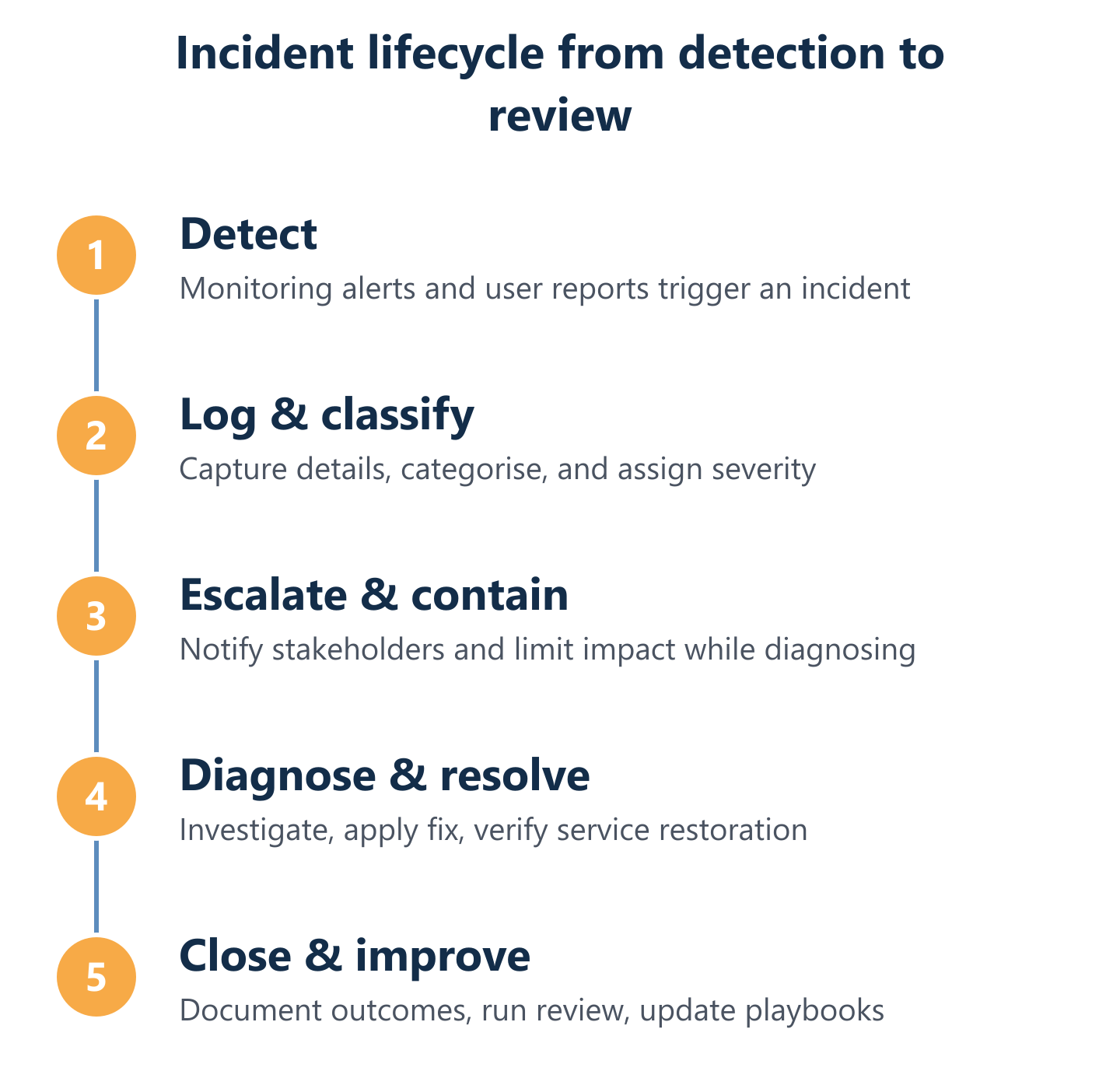
A well-designed incident workflow eliminates the ambiguity that causes delays: who acts next, what information is needed, and when to escalate. The seven phases below represent a complete, ITIL-aligned lifecycle that works equally well for a dedicated service desk and for a DevOps team running on-call rotations. Each phase has a clear input, a defined output and an owner.
In Impulso Tecnológico's managed-services model, this workflow is designed around fast context retrieval and streamlined reporting. A concrete example: in video surveillance deployments across Spain and Portugal, we centralise incident management on a cloud-managed platform that provides a unified view across all camera fleets and sites. When something goes wrong—an offline camera, an unusual activity alert—teams can search and retrieve relevant footage quickly, share live or recorded content securely, and log a structured incident record that supports consistent reporting. The same principle applies across all managed environments: the workflow is built so that when an incident occurs, the context needed to resolve it is already organised and accessible.
- Detect: Monitoring tools, user reports or automated alerts signal a potential disruption.
- Log and classify: A structured incident record is created with category, affected service, reporter and initial severity.
- Notify and escalate: The right resolver group and stakeholders are informed based on priority and SLA tier.
- Contain: Immediate actions limit the blast radius—isolating affected systems, applying workarounds, redirecting traffic.
- Diagnose: Resolver teams investigate symptoms, correlate data and identify the proximate cause.
- Resolve and restore: The fix is applied, service is verified as restored, and users are confirmed back to normal operation.
- Close and review: The record is closed with full documentation; a post-incident review is scheduled for significant events.
Detect, log and classify: make incidents searchable and actionable
The quality of an incident record at the point of creation determines how quickly every subsequent phase moves. A record that captures affected service, configuration item, user impact, initial severity and detection source gives the resolver group everything needed to begin diagnosis without a back-and-forth. Logging standards should be enforced by the service desk tool—mandatory fields, controlled category taxonomies, and auto-population from monitoring alerts where possible. Classification is equally critical: assigning the correct category and subcategory at logging time enables accurate reporting, trend analysis and, in AIOps-enabled environments, automated routing to the right resolver group. Teams that log everything—including incidents that resolve themselves—build a dataset that reveals recurring patterns and informs problem management. A single, consistent workflow reduces handover delays and improves investigation quality across the entire incident lifecycle. This is also where internal knowledge articles from the IT technical support for businesses practice become directly useful.
Notify, escalate and contain: protect users while diagnosis starts
Notification and containment should happen in parallel, not sequentially. As soon as an incident is classified and a priority assigned, the escalation matrix determines who is notified: the resolver group, the incident manager for P1/P2 events, and affected business stakeholders. Communication templates—pre-approved for each severity tier—remove the cognitive load of drafting updates during a high-pressure incident. Containment actions (isolating a compromised endpoint, failing over to a secondary system, applying a temporary configuration change) limit the blast radius while diagnosis proceeds. The principle here is that MTTR reduction depends on running these workstreams concurrently: one sub-team stabilises the environment, another investigates root cause. On-call schedules must be defined in advance, with clear escalation paths and channel standards (dedicated chat channels, bridge calls for P1 events) so that no time is lost finding the right person when an incident occurs.
Resolve, close and review: capture evidence and trigger prevention
Resolution is not complete until service is verified—not just from the resolver's perspective, but confirmed by the affected user or monitoring system. Closure requires the incident record to be updated with the resolution steps taken, the workaround or fix applied, and any configuration changes made. This documentation is the raw material for the knowledge base: a well-written resolution note can become a knowledge article that halves the diagnosis time for the next similar incident. For significant incidents (P1 and selected P2 events), a post-incident review should be scheduled within 48–72 hours of closure. The review captures what happened, what worked, what did not, and what preventive actions should follow—either as problem records, playbook updates or infrastructure changes. Closure without review is a missed opportunity to convert a costly disruption into a permanent improvement.
Prioritisation, SLAs and continuous improvement
Priority is the single most consequential classification decision in the incident workflow. It determines the SLA clock, the escalation path, the communication cadence and the resources committed to resolution. Getting it right consistently requires a model that is simple enough to apply under pressure but nuanced enough to reflect real business impact.
At Impulso Tecnológico, prevention and readiness underpin the entire incident management approach. Structured support processes, proactive monitoring and regular updates are designed to prevent incidents from reaching users in the first place. When incidents do occur, our teams resolve them within a framework that integrates with the security and infrastructure tooling we manage—Sophos and Fortinet for security events, Veeam for data protection incidents, Cisco and Aruba for network disruptions. Resolving over 4,000 IT tickets annually across our client base, we have built operational patterns that translate directly into consistent service quality and measurable client satisfaction. Incident workflows are also integrated with monthly managed-services contracts, so clients have predictable costs and no surprises when incidents require additional investigation.
- Define priority using a matrix: combine urgency (how quickly the situation will worsen) and impact (how many users or business processes are affected) to produce a four-tier priority scale (P1–P4).
- Attach SLA targets to each priority tier: response time, update frequency and resolution target should be documented and visible to both IT and the business.
- Build escalation rules into the workflow: if a P2 incident is not resolved within a defined threshold, it automatically escalates to the next resolver tier and notifies the incident manager.
- Standardise on-call schedules: define primary and secondary on-call contacts per service area, with documented handover procedures.
- Use post-incident reviews to update playbooks: every significant incident should produce at least one actionable output—a new runbook step, a monitoring alert threshold change or a problem record.
- Track MTTR and repeat-incident rate as primary KPIs: these two metrics reveal whether the incident management process is improving over time.
- Integrate AIOps where classification volume justifies it: machine learning models trained on historical incident data can suggest priority, category and resolver group at the point of logging, reducing manual triage time.
Prioritisation model: severity, impact, urgency and business context
A robust prioritisation model uses three inputs: severity (technical assessment of the failure's scope), impact (number of users or business processes affected) and urgency (how quickly the situation will deteriorate without intervention). These three dimensions combine to produce a priority level that drives everything downstream. A P1 incident—complete service outage affecting a critical business process—triggers immediate escalation, a dedicated bridge call, executive notification and a 15-minute update cadence. A P4 incident—a single user affected by a minor inconvenience—follows a standard queue with a next-business-day resolution target. Business context must also factor in: an incident affecting a payment processing system at month-end carries higher urgency than the same technical failure on a non-critical system. Priority should be re-evaluated as new information emerges during diagnosis; downgrading or upgrading mid-incident is normal and should be documented in the record. For organisations managing preventive IT maintenance programmes, incident priority data also informs which systems need more proactive attention.
SLAs and escalation rules: on-call, channels and communication standards
SLAs without escalation rules are targets without enforcement. For each priority tier, the incident management process should define: the maximum time to first response, the maximum time to update stakeholders, the resolution target, and the escalation trigger if those thresholds are breached. On-call schedules must be documented, tested and reviewed quarterly—not just maintained in someone's head. Communication standards are equally important: P1 incidents should have a dedicated channel (a named Slack or Teams channel, or a bridge call), a single incident commander responsible for updates, and a pre-approved message template so that stakeholders receive consistent, factual information rather than fragmented updates from multiple sources. For IT teams operating across multiple time zones or sites—as is common in managed-services environments spanning Spain, Portugal and international remote clients—these standards prevent the coordination failures that inflate MTTR during complex incidents.
Post-incident review: playbooks, prevention, AIOps and measurable KPIs
Post-incident reviews (also called post-mortems in SRE practice) are the mechanism that converts reactive incident handling into proactive improvement. A structured review examines the timeline, identifies contributing factors, evaluates the effectiveness of the response, and produces specific action items—not vague commitments. Those action items become playbook updates, problem records or engineering tasks. Over time, a library of playbooks built from real incidents dramatically reduces the cognitive load on resolvers: when a known failure pattern recurs, the response is documented and repeatable. AIOps tools accelerate this cycle by analysing historical incident data to identify patterns, suggest classifications at the point of logging, and flag anomalies before they become user-impacting incidents. Machine learning models trained on ticket history can reduce manual triage time and improve routing accuracy, which directly reduces MTTR. Key KPIs to track include MTTR, mean time between failures (MTBF), SLA compliance rate, repeat-incident rate and the ratio of incidents resolved at first contact. Organisations committed to corrective IT maintenance will find that post-incident data is the most reliable input for prioritising corrective work.
Building a repeatable incident operating model is not a one-time project—it is an ongoing discipline. Each incident, handled well, produces better documentation, sharper playbooks and more accurate monitoring thresholds. Each post-incident review closes the loop between reactive response and proactive prevention. For organisations that want to reduce MTTR, protect SLAs and demonstrate measurable IT service quality, the investment in a structured IT incident management process pays back quickly and compounds over time. Whether you are designing this capability from scratch or maturing an existing service desk workflow, the principles in this guide provide a practical, ITIL-aligned foundation. Impulso Tecnológico's managed-services teams are ready to help you assess your current incident management maturity and implement the processes, tooling and governance that make a measurable difference. You can also explore how IT maintenance pricing works within a managed-services model to understand the full cost picture.