

IT support in Spain covers the day-to-day technical assistance, monitoring, and maintenance that keeps business systems running — typically delivered through a combination of remote helpdesk and on-site intervention, structured by service level agreements and defined escalation tiers.
Many organisations operating in Spain discover the gap between what they expect from IT support and what a generic break-fix contract actually delivers. Devices fail, software breaks, security patches go unapplied, and without a structured provider, each incident becomes a crisis rather than a managed event. The real cost is not the repair — it is the unplanned downtime and the accumulated risk of deferred maintenance.
A well-structured IT support service solves this by combining reactive helpdesk coverage with proactive maintenance: patching, monitoring, backups, and security controls running in the background before problems surface. At Impulso Tecnológico, we have spent over 25 years building exactly this model for businesses across Spain and internationally — resolving thousands of IT tickets annually and maintaining a high client satisfaction ratio through transparent, human-first service delivery.
What "IT Support Spain" typically includes (and what it doesn't)
The phrase "IT support Spain" covers a wide operational territory, and what one provider includes as standard, another treats as a chargeable project. Before comparing quotes, it is worth mapping the real scope. At the core, IT support services in Spain should address end-user issues (password resets, software faults, device problems), device management, and basic network connectivity — this is L1 and L2 territory. Beyond that, a mature managed computer support service extends into proactive monitoring, patch management, backup verification, and security controls.
Impulso Tecnológico structures IT support around preventive maintenance: keeping computers, servers and systems available and reliable, reducing downtime through scheduled checks rather than waiting for failures. With over 4,000 IT tickets resolved annually and operations spanning 25 countries, the delivery model is built for consistency across diverse environments.
| Service Area | Typically Included | Often Excluded |
|---|---|---|
| End-user helpdesk (L1) | Password resets, software errors, printer issues | Custom application development |
| Device support (L2) | Hardware diagnostics, OS issues, driver updates | Hardware procurement and logistics |
| Monitoring | Server/network uptime alerts, performance checks | Bespoke dashboard development |
| Patching | OS and standard software updates | Legacy or unsupported systems |
| Backup | Scheduled backup verification and alerting | Data recovery from pre-contract failures |
| Security basics | Endpoint protection, firewall management | Full penetration testing (usually separate) |
| Project work | Minor configurations within scope | Office moves, migrations, new deployments |
Core coverage: end-user support, devices, and standard software
L1 support handles the highest volume of daily requests: account access, email configuration, standard software faults, and basic connectivity issues. These are resolved at first contact in most cases, typically via remote tools or phone. L2 support takes ownership of issues that require deeper investigation — OS-level faults, hardware diagnostics, network configuration errors, and application conflicts. L3 sits above both, engaging specialist engineers or vendor support for infrastructure failures, security incidents, or complex integration problems. A well-designed outsourced helpdesk in Spain defines ownership clearly at each tier, so users are not bounced between teams without resolution. Impulso Tecnológico applies this layered model to ensure that straightforward incidents are resolved quickly and that complex issues reach the right engineer without unnecessary delay.
Operations coverage: monitoring, patching, backups and security basics
Proactive IT maintenance is what separates a managed service from a break-fix contract. Monitoring covers server availability, disk capacity, network performance and security event logs — catching anomalies before they become outages. Patch management applies OS and application updates on a scheduled cycle, closing the vulnerabilities that attackers exploit most frequently. Backup verification confirms that recovery points are valid and restorable, not just that backup jobs completed. Security basics — endpoint protection, firewall rules, and access controls — run continuously in the background. Impulso Tecnológico recommends a multi-layer security approach: firewalls and secure email/web filtering at the network perimeter, endpoint protection at device level, and patch and vulnerability management to remove weaknesses systematically. Partners such as Sophos, Fortinet and Veeam underpin this stack.
Boundaries: what is usually excluded (projects, bespoke development, hardware procurement)
Standard IT support contracts in Spain rarely cover capital projects by default. Office relocations, system migrations, new network deployments, and bespoke software development are typically scoped and priced separately. Hardware procurement — sourcing, ordering and logistics for new devices — is another common exclusion, even if the provider manages the devices once deployed. Vague SLAs are a frequent problem: contracts that promise "best effort" response without defining resolution targets leave businesses exposed. Equally, break-fix-only arrangements create a perverse incentive — the provider earns more when things fail. Impulso Tecnológico addresses this with fixed monthly pricing per device that includes both remote and on-site technical assistance, aligning provider and client interests around reliability rather than incident volume. Clarity on scope boundaries before signing prevents disputes later.

Service levels, escalation, and coverage across Spain
Service level agreements define what a provider is actually committing to — not what they aspire to deliver on a good day. For IT support across Spain, where geography, office density and business criticality vary significantly, SLAs need to address response time, resolution target, and delivery channel (remote or on-site) for each priority tier. Impulso Tecnológico operates with standard business hours (Monday to Friday, 09:00–17:00 CET), providing both remote computer support and on-site intervention across Spain, with coverage extending to Portugal under agreement and remote support available internationally.
- Define priority tiers before go-live: Agree on what constitutes a P1 (critical outage), P2 (significant impact), P3 (standard fault) and P4 (request/query) — and set response and resolution targets for each.
- Separate response time from resolution time: A 30-minute response SLA means an engineer acknowledges the ticket, not that the problem is fixed. Both metrics must appear in the contract.
- Specify the delivery channel per priority: P1 and P2 incidents may require on-site attendance; P3 and P4 are typically handled remotely. Confirm which cities or regions qualify for on-site windows.
- Require regular reporting: Monthly ticket reports covering volume, resolution rate, SLA compliance and recurring issues give visibility into service health and justify the investment.
- Review escalation paths explicitly: Know exactly how an unresolved L1 ticket reaches an L2 engineer, and when an L3 specialist or vendor is engaged — with time thresholds, not just descriptions.
L1 vs L2 responsibilities: what each level should own
L1 engineers own first-contact resolution: they handle the majority of user-facing issues through remote tools, scripted diagnostics and knowledge base lookups. Their KPI is first-call resolution rate — the proportion of tickets closed without escalation. L2 engineers own escalated issues requiring system-level access, deeper diagnostics or configuration changes. Their KPI is mean time to resolution (MTTR) for escalated tickets. In a well-run outsourced helpdesk Spain model, L1 and L2 share a common ticketing platform so handover is seamless and context is never lost. IT support SLA response time targets typically sit at under four hours for L1 acknowledgement and under eight business hours for L2 first action on standard priority tickets — though critical incidents demand faster thresholds.
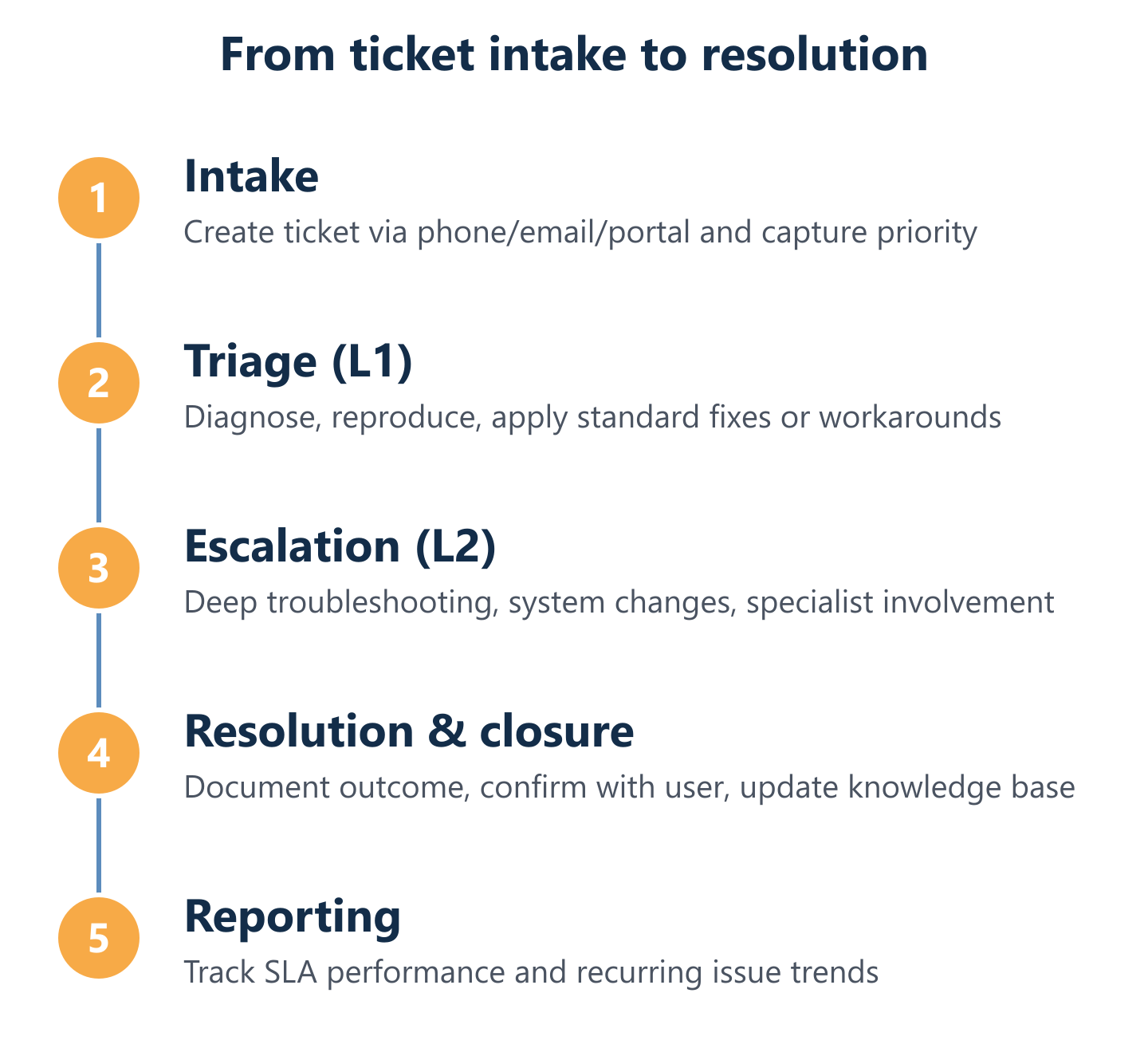
Ticket workflow: intake, triage, categorisation, escalation and closure
A structured ticket workflow starts at intake: the user submits a request via email, phone or a self-service portal. The ticket is automatically or manually triaged — assigned a priority, category and owner within a defined time window. Categorisation matters because it drives routing: a network fault goes to a different queue than a software licence request. If L1 cannot resolve within a set time threshold, the ticket escalates automatically to L2, carrying all diagnostic notes. L3 escalation triggers when L2 identifies a vendor defect, infrastructure failure, or security incident beyond standard scope. Closure requires user confirmation or automatic closure after a defined period of no response. An IT ticketing and knowledge base system underpins this entire flow, capturing resolution steps that reduce repeat incident time.
On-site, hybrid and remote: operational implications and prioritisation rules
Remote and on-site IT support in Spain serve different operational needs and should not be treated as interchangeable. Remote support resolves the majority of software, configuration and access issues faster and at lower cost — an engineer can connect to a device anywhere in Spain within minutes. On-site attendance is necessary for hardware failures, physical infrastructure work, or situations where remote access is unavailable. Hybrid models — where remote is the default and on-site is dispatched for escalated or critical issues — offer the best balance of speed and cost. Prioritisation rules must be explicit: which incident types trigger on-site dispatch, what the attendance window is (same day, next business day), and which locations are covered. Impulso Tecnológico covers Spain on-site and extends to Portugal under agreement, with remote support available for international clients.
Choosing an IT Support provider: checklist for Spain
Selecting a managed computer support provider in Spain is a commercial and operational decision with long-term consequences. The wrong choice means recurring downtime, security gaps and escalating costs. The right choice means a predictable, secure IT environment that scales with the business. Impulso Tecnológico resolves thousands of IT tickets annually across 476 active clients in 25 countries — a delivery record that reflects consistent process, not occasional good performance.
When evaluating providers, examine these criteria:
- Defined SLAs with numeric targets: Response and resolution times must be contractually specified per priority tier, not described in general terms.
- Documented escalation paths: L1 to L2 to L3 handover rules, time thresholds and specialist access should be written into the service description.
- Security posture: Ask specifically about endpoint protection, patch cadence, firewall management and backup verification — not just whether they "handle security".
- On-site coverage geography: Confirm which cities and regions qualify for physical attendance and within what time window.
- Pricing model transparency: Fixed monthly pricing per device eliminates billing surprises; per-hour or break-fix models create cost unpredictability.
- Technology partnerships: Certified partnerships with vendors such as Sophos, Fortinet, Veeam, Microsoft and Cisco indicate investment in technical competency.
- Contract flexibility: Avoid rigid multi-year lock-ins with no scope adjustment mechanism — business needs change.
- Reporting and visibility: Monthly service reports covering ticket volumes, SLA compliance and recurring issues are a baseline expectation.
- References and measurable outcomes: Ask for client satisfaction data and ticket resolution volumes, not just testimonials.
Security and compliance readiness: multi-layer controls and secure access practices
Security readiness is a non-negotiable criterion when selecting an IT support provider in Spain. A provider that manages your endpoints and network perimeter has privileged access to your infrastructure — their security posture directly affects yours. Evaluate whether the provider implements multi-layer controls: network-level filtering (firewall, secure web and email gateways), endpoint protection on every managed device, structured patch and vulnerability management, and secure remote access via VPN with encrypted storage where required. GDPR compliance is a legal requirement for organisations operating in Spain; confirm that the provider's processes and tooling support data protection obligations. Impulso Tecnológico applies this layered approach using certified technology from Sophos, Fortinet and Veeam, and supports clients with backup and compliance-oriented controls as part of the managed service scope.
Tools and workflows: ticketing, knowledge base, monitoring and endpoint protection
The tooling a provider uses determines how consistently and efficiently they deliver. A professional IT support operation runs on a centralised ticketing platform that captures every request, tracks SLA compliance in real time, and feeds a knowledge base of resolved issues — reducing repeat incident resolution time over the contract lifecycle. Monitoring tools provide continuous visibility into server health, network performance and security events, enabling proactive intervention before users are affected. Endpoint protection platforms manage antivirus, device control and threat response across the entire device estate from a single console. Remote management and monitoring (RMM) tools allow engineers to deploy patches, run diagnostics and resolve issues without physical access. Ask any prospective provider to demonstrate these tools in operation — not just list them in a proposal.
Commercial fit: contract flexibility, fixed monthly options, and scope clarity
Commercial structure matters as much as technical capability. Fixed monthly pricing per device — covering both remote and on-site assistance — gives finance teams predictable IT costs and eliminates the spike in expenditure that follows a major incident under break-fix models. Scope clarity is equally important: a well-written service description specifies exactly what is included, what triggers an out-of-scope charge, and how project work is handled separately from day-to-day support. Impulso Tecnológico offers flexible contractual models rather than rigid, one-size-fits-all arrangements — adapting scope and pricing to the client's actual operational profile. For organisations that also need structured cabling, VoIP/PBX upgrades, or broader IT project delivery, these can be integrated alongside the core support contract without switching providers. For regional examples of how this model is applied in practice, see our IT support service in Barcelona and IT support in Alicante.
Getting IT support right in Spain starts with scope, not price. When response times, escalation paths, security responsibilities and on-site coverage are defined before a contract is signed, IT support becomes a predictable operational cost rather than a recurring source of risk. Impulso Tecnológico brings over 25 years of structured IT delivery to businesses across Spain — combining preventive maintenance, clear communication, and flexible service models that adapt as your organisation grows. If you are ready to move from reactive break-fix to a managed, proactive IT support model, the next step is a conversation about your specific environment and requirements. You can also explore how our preventive IT maintenance approach underpins reliable service delivery.