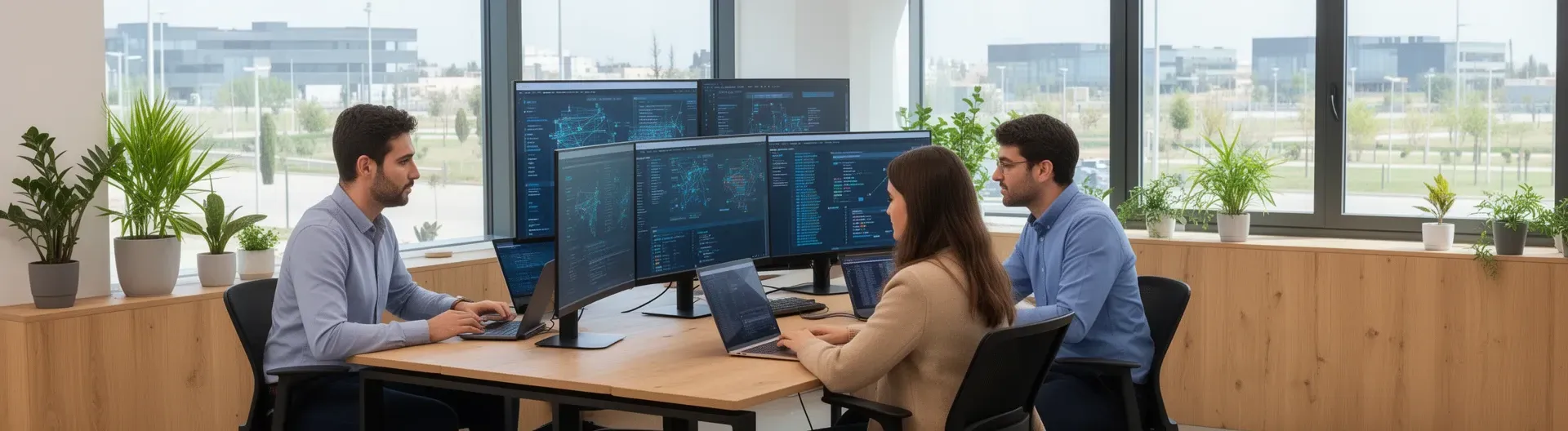

IT support in Ciudad Real covers the full management of your business technology: helpdesk and ticketing, monitoring, maintenance, cybersecurity, and on-site intervention—delivered under contractual SLAs that define exactly how quickly issues are resolved and how your systems are kept secure.
For businesses in Ciudad Real, unpredictable IT problems translate directly into lost productivity, compliance exposure, and rising costs. A server failure, a ransomware incident, or a misconfigured network can halt operations for hours—sometimes days—when there is no structured support framework in place. The difference between a reactive IT provider and a managed service partner is not just speed of response; it is the entire model: continuous monitoring that catches problems before they escalate, defined escalation paths that route issues to the right specialist, and fixed monthly pricing that removes billing uncertainty.
Impulso Tecnológico delivers IT support in Ciudad Real with over 25 years of managed services experience, combining remote-first efficiency with rapid on-site presence when physical intervention is required. Every engagement begins with an infrastructure audit to establish baselines, identify risks, and build a support framework aligned with your continuity and security priorities.
What "IT Support Ciudad Real" should include
Searching for IT support in Ciudad Real returns results ranging from one-person repair shops to regional consultancies—but the scope of what each actually delivers varies enormously. Before signing any agreement, you need to define what "support" means in practice: does it cover proactive monitoring or only reactive fixes? Does it include backup verification, patch management, and security hardening, or just password resets and hardware swaps?
A structured managed IT support framework covers five distinct areas: service desk and incident handling, continuous monitoring and alerting, preventive maintenance, cybersecurity upkeep, and escalation to specialists. When all five are contractually defined, businesses gain predictability—both operationally and financially. Impulso Tecnológico structures its IT support in Ciudad Real around this model, with fixed-price all-inclusive packages, measurable SLAs, and centralised accountability through a single provider.
| Support element | Reactive break-fix | Managed IT support (structured) |
|---|---|---|
| Incident handling | Ad hoc, billed per call | Ticketed, prioritised, SLA-governed |
| System monitoring | None (you report the problem) | Continuous, with automated alerting |
| Preventive maintenance | Rarely included | Scheduled: patching, backups, antivirus |
| Security posture | Reactive only | Ongoing hardening, GDPR-aligned practices |
| Cost model | Variable, unpredictable | Fixed monthly, all-inclusive |
| Escalation | No defined path | Documented tiers with specialist routing |
| Reporting | None | Monthly metrics and quarterly reviews |
Managed IT vs break-fix: what changes for your business
Break-fix support means you pay when something breaks. There is no ongoing relationship, no monitoring, and no accountability between incidents. Managed IT support inverts this model: the provider's incentive is to prevent problems, because unresolved issues consume their resources under a fixed-price contract.
For a business in Ciudad Real, this distinction has direct operational consequences. With a managed service, your service desk handles incident logging, triage, and escalation through a defined process. Monitoring tools flag disk space issues, performance degradation, and hardware wear before they cause downtime. Maintenance tasks—patching, backup checks, antivirus updates—happen on schedule rather than after a failure. The result is a support framework with clear scope, responsibilities, and measurable outcomes, rather than an unpredictable bill after each emergency.
Core coverage: endpoints, servers, networks, and communications
Comprehensive outsourced IT support covers the full technology stack that businesses rely on daily. Endpoints—desktops, laptops, and mobile devices—need patch management, antivirus maintenance, and configuration control. Servers require performance monitoring, backup verification, and capacity planning. Network infrastructure, including switches, wireless access points, and firewalls, must be kept updated and correctly configured to maintain both performance and security.
Impulso Tecnológico's managed support extends across all these layers, using certified technologies from partners including Cisco, Aruba, Fortinet, Sophos, and Veeam. Communications infrastructure—VoIP, connectivity, and collaboration platforms such as Microsoft 365—is also included within the support perimeter. This breadth matters for business continuity: a network failure or a compromised endpoint can cascade into wider operational disruption if the support model does not cover the full environment.
Support outcomes: uptime targets, faster resolution, fewer surprises
The measurable outcomes of structured IT support are straightforward: fewer unplanned outages, faster resolution when incidents do occur, and predictable monthly costs. Continuous monitoring and preventive maintenance reduce the frequency of critical failures. Defined SLA response targets—under eight hours for standard issues and under four hours for critical server problems at Impulso Tecnológico—mean that when something does go wrong, there is a contractual commitment governing the response.
Local responsiveness reinforces these outcomes. Remote support resolves the majority of incidents without travel delays, but when physical intervention is required—hardware replacement, cabling, on-site server work—having a provider capable of rapid on-site support in Ciudad Real eliminates the delays that remote-only providers cannot avoid. The combination of remote-first delivery and on-site capability is what keeps resolution times realistic rather than aspirational.
Service desk and contact channels (single point of contact)
A service desk is only as effective as the process behind it. Many businesses in Ciudad Real have experienced the frustration of reporting an IT issue and receiving no acknowledgement, no ticket reference, and no clear timeline. A properly structured service desk eliminates this uncertainty by giving every interaction a defined workflow, from first contact to resolution confirmation.
Impulso Tecnológico operates a single point of contact model, available in both Spanish and English, covering the full incident lifecycle. The process works as follows:
- Issue reported — via phone, email, or ticketing portal; a ticket is created immediately with a reference number and initial priority classification.
- Triage and severity assessment — the support team evaluates impact and urgency to assign the correct priority level and SLA clock.
- Remote diagnosis — a technician connects remotely to diagnose the root cause and begin resolution without travel delay.
- Resolution or escalation — if the issue is resolved remotely, the ticket is closed with documentation; if specialist knowledge or physical presence is required, the ticket is escalated with full context passed to the next tier.
- Communication throughout — the client receives status updates at defined intervals; no issue goes silent.
- Ticket closure and documentation — resolution details are recorded for trend analysis and future reference, feeding into monthly reporting.
This structured approach means businesses always know the status of their issues and can hold their provider accountable against agreed timelines.
How tickets are triaged: severity, impact, and routing to the right team
Effective triage determines whether a reported issue is treated as a minor inconvenience or a business-critical emergency. At the point of ticket creation, two factors are assessed: severity (how serious is the technical failure?) and impact (how many users or processes are affected?). A single user unable to access email is a different priority from a server outage affecting the entire organisation.
Once priority is assigned, the ticket is routed to the appropriate team—first-line support for common issues, second-line for infrastructure and server problems, and specialist escalation for complex security or network incidents. This routing happens within the ticketing system, ensuring no issue falls between teams or waits unnecessarily. Impulso Tecnológico's helpdesk and ticketing process is designed so that critical issues trigger immediate action, not a queue.
Escalation paths: when specialists get involved and how you are kept informed
Not every IT issue can be resolved at first-line support level, and a transparent escalation process is one of the clearest indicators of a mature managed service provider. When an incident exceeds first-line capability—whether due to technical complexity, security implications, or infrastructure scope—it should escalate automatically to a specialist with full context already documented.
At Impulso Tecnológico, escalation paths are defined within the SLA framework. Clients are informed when escalation occurs, who is handling the issue, and what the revised resolution timeline is. This prevents the common frustration of an issue disappearing into a back-office queue with no visibility. For security incidents involving Sophos or Fortinet-protected environments, or backup and disaster recovery issues managed through Veeam, specialist engineers with direct vendor knowledge handle the escalation—not generalists attempting to improvise.
Hybrid delivery: remote support plus rapid on-site intervention when required
Remote support resolves the majority of IT incidents faster and more cost-effectively than dispatching a technician for every call. Diagnosis, configuration changes, software deployment, and user assistance can all be handled remotely without travel delays. For businesses in Ciudad Real, this means faster resolution times and lower operational costs under a fixed monthly model.
However, certain tasks genuinely require physical presence: hardware installations, structured cabling, server maintenance, network infrastructure work, and complex troubleshooting where remote access is not sufficient. Impulso Tecnológico's hybrid delivery model ensures that on-site IT support in Ciudad Real is available when the situation demands it—without the delays that affect providers operating solely from a remote service centre. This mirrors the approach used by our teams supporting businesses across Spain, including clients who also benefit from [IT support services for companies in Madrid](https://www.impulsotecnologico.com/it-support-services-for-companies-in-madrid) and [IT maintenance services in Barcelona](https://www.impulsotecnologico.com/it-maintenance-services-for-companies-in-barcelona).
SLAs, priorities, reporting, and security maintenance
Service level agreements are only valuable when they contain specific, verifiable commitments. Vague promises of "fast response" or "dedicated support" are not SLAs—they are marketing language. When comparing IT support providers in Ciudad Real, the SLA document should answer four concrete questions: What are the response time targets by priority level? What are the resolution targets? What happens when an SLA is breached? How is performance measured and reported?
Impulso Tecnológico builds SLAs around how downtime actually affects each client's business, rather than applying a generic template. Key elements that a robust SLA for managed IT support should contain include:
- Defined priority tiers — at minimum, critical (server/infrastructure down, business halted) and standard (individual user affected, workaround available).
- Contractual response time targets — for example, under four hours for critical issues and under eight hours for standard ones.
- Resolution time targets — separate from response, covering when the issue should be fully resolved or escalated.
- Escalation procedures — documented paths specifying when and how issues move to specialist teams.
- Communication protocols — how and when the client is updated during an open incident.
- Performance measurement — ticket response rates, resolution rates, and system uptime targets tracked and reported monthly.
- Fixed monthly pricing — all-inclusive packages that prevent unexpected billing when incident volumes rise.
Security and preventive maintenance are embedded within this framework, not treated as optional add-ons. Continuous monitoring detects early warning signs—disk space thresholds, performance degradation, hardware wear patterns, and security anomalies—before they become incidents.
SLA examples you can verify: response times and what "critical" means
The word "critical" means different things to different providers unless it is contractually defined. In Impulso Tecnológico's SLA framework, a critical incident is one where a server or core infrastructure component is down, business operations are directly halted, or a security breach is active or suspected. The contractual response target for critical issues is under four hours; for standard issues—where a workaround exists and individual productivity is affected rather than the whole organisation—the target is under eight hours.
These targets apply during business hours (Monday to Friday, 09:00–17:00 CET). Understanding the coverage window is as important as the response time itself: a provider promising fast response must also be clear about when that clock starts. Impulso Tecnológico's SLAs are transparent on this point, avoiding the ambiguity that leads to disputes when an incident occurs outside standard hours.
Reporting and business review: what you should receive monthly and quarterly
Transparent reporting transforms IT support from a cost centre into a managed business function. Monthly reports should cover ticket volume by priority, average response and resolution times against SLA targets, system uptime figures, and any recurring issues that indicate underlying infrastructure problems. This data gives IT decision-makers the evidence they need to justify investment, identify trends, and hold their provider accountable.
Beyond monthly reporting, a quarterly business review gives both parties the opportunity to assess the overall health of the IT environment, review security posture, plan capacity changes, and align upcoming projects with business priorities. Impulso Tecnológico includes this structured review cycle within its managed service engagements, ensuring that IT support remains aligned with operational needs rather than drifting into a purely reactive mode. Businesses looking at similar models in nearby regions can also review how [IT support for businesses in Albacete](https://www.impulsotecnologico.com/it-support-albacete-for-businesses-reliable-helpdesk) is structured for comparable environments.
Preventive security and maintenance: monitoring, backups, patching, and hardening
The majority of IT incidents that disrupt business operations are preventable. Ransomware infections frequently exploit unpatched software vulnerabilities. Backup failures go undetected until a recovery is attempted. Hardware failures are often preceded by weeks of warning signals that go unmonitored. A structured preventive maintenance programme addresses all three.
Impulso Tecnológico's cybersecurity maintenance programme includes continuous IT monitoring and alerting for performance and security anomalies, scheduled patch deployment for operating systems and applications, regular antivirus definition updates using Sophos and Fortinet endpoint technologies, backup integrity verification through Veeam to confirm that recovery points are valid, and configuration hardening aligned with GDPR requirements. This preventive layer is what separates a managed IT support contract from a helpdesk subscription—and it is where the measurable reduction in unplanned outages is actually achieved. For organisations also managing Windows Server environments, our guidance on [Windows Server maintenance to prevent downtime](https://www.impulsotecnologico.com/windows-server-maintenance-prevent-downtime) provides additional context on proactive server care.
Choosing an IT support provider in Ciudad Real comes down to one practical test: can they show you, in writing, exactly what they will do, how fast they will respond, and how they will prove it every month? Scope, SLAs, and reporting are not negotiable extras—they are the foundation of a support relationship that actually protects your business. Impulso Tecnológico brings over 25 years of managed services experience, certified partnerships with leading technology vendors, and a support model built around your continuity and security priorities. The next step is a conversation about your current environment.