

IT support in Barcelona covers the full range of technical assistance a business needs to keep systems running: helpdesk ticket handling, remote troubleshooting, on-site intervention, server maintenance, and endpoint protection—all delivered under agreed service levels so you know exactly what to expect when something goes wrong.
Most Barcelona businesses don't struggle to find someone who can fix a computer. The real challenge is finding a provider that prevents problems before they escalate, responds within a defined window, and keeps costs predictable month after month. Break-fix arrangements leave you exposed: when a server goes down or a security incident hits, you're negotiating response times under pressure. Managed IT support changes that dynamic entirely.
At Impulso Tecnológico, we've spent over 25 years building IT support models that work as an operational extension of your team. Every engagement starts with an audit of your current environment—antivirus, backup, desktops, servers, and communications—so the service we propose matches your real complexity, not a generic template. The result is fewer unplanned outages, clearer incident handling, and a monthly cost you can budget for.
What IT Support in Barcelona Should Include (Helpdesk to Onsite)
Searching for IT support in Barcelona returns thousands of job listings—but if you're a business looking to hire a provider rather than an employee, the criteria are entirely different. Effective IT support is not a single service; it's a layered model that starts with a helpdesk capable of resolving most issues remotely and extends to on-site engineers when physical intervention is required.
The scope should cover endpoints (laptops, desktops, and mobile devices), servers (physical and virtual), core communications (email, connectivity, and collaboration tools), and security configurations. A provider that only handles "computers" leaves your server infrastructure and network unmanaged—a gap that becomes critical the moment a business-wide incident occurs.
Impulso Tecnológico structures support as an operational extension of your team. Rather than waiting for calls, we apply proactive monitoring and preventive maintenance so issues are identified before they affect productivity. Our packages—Fixed Price All Inclusive, Hourly, and full Computer Support Outsourcing—are sized to your device count and environment complexity, determined after an initial audit.
| Support scope | Basic break-fix | Managed IT support |
|---|---|---|
| Helpdesk ticket handling | Ad hoc, on request | Structured intake, triage, and tracking |
| Endpoint coverage | Desktops and laptops only | Desktops, laptops, servers, and peripherals |
| Server support | Rarely included | Included with faster SLA targets |
| Security configuration | Not typically included | Antivirus, patching, backup, and access controls |
| Proactive monitoring | No | Continuous, with preventive alerts |
| Cost model | Variable, unpredictable | Fixed monthly, budgetable |
Helpdesk coverage: ticket intake, triage, and first-time resolution
A functional helpdesk is the entry point for every IT issue in your organisation. When an employee reports a problem—whether by phone, email, or a ticketing portal—the first task is structured intake: capturing the right information (device, user, symptoms, business impact) so the technician assigned can begin triage immediately rather than spending time gathering context.
First-time resolution rate is the metric that matters most at this stage. A well-run helpdesk resolves the majority of incidents remotely without escalation, which keeps costs down and minimises disruption. At Impulso Tecnológico, every support request is followed by a proactive review to identify whether the underlying cause could trigger further incidents—turning each ticket into an opportunity to prevent the next one. This is the operational difference between a reactive helpdesk and a managed support model.
Remote vs on-site support: when each is the best fit
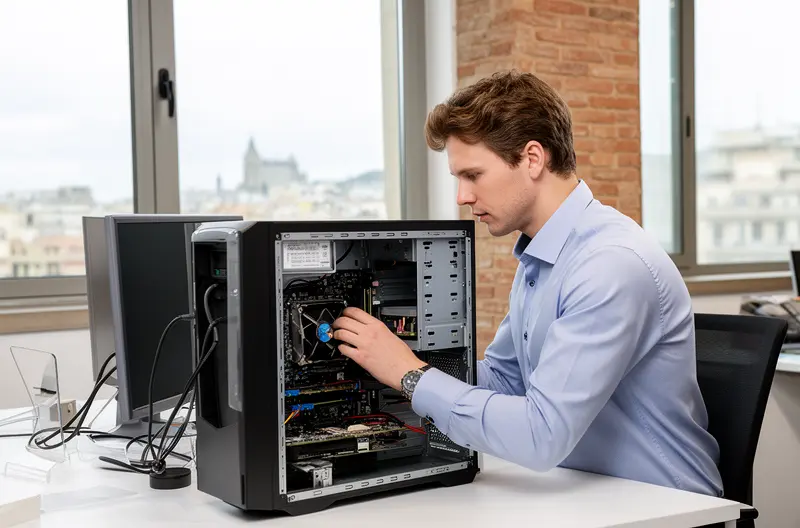
Remote support handles the majority of day-to-day incidents efficiently: software errors, configuration issues, connectivity problems, email access, and most server alerts can be diagnosed and resolved without a technician visiting your premises. For Barcelona businesses with distributed teams or hybrid working arrangements, remote resolution keeps response times short and avoids unnecessary travel costs.
On-site support becomes necessary when hardware requires physical intervention—a failed drive, a network switch replacement, a new workstation deployment, or a cabling issue. It's also the right model for initial audits, infrastructure installations, and situations where remote access is unavailable. Impulso Tecnológico provides both remote and on-site technical assistance across Barcelona, with on-site visits scheduled according to incident severity and SLA commitments. For businesses that also operate in other Spanish locations, our coverage extends nationally, as with our IT support services in Alcobendas and other cities.
Managed support vs break-fix: what changes in day-to-day operations
Break-fix support means you call when something breaks and pay for the time it takes to fix it. There are no guarantees on response time, no proactive monitoring, and no incentive for the provider to prevent future problems—in fact, the opposite is true. Every additional incident is additional revenue for a break-fix supplier.
Managed support inverts that model. Under a fixed-price managed contract, the provider's interest is aligned with yours: fewer incidents mean lower operational costs and a healthier client relationship. Impulso Tecnológico's Fixed Price All Inclusive option includes unlimited remote and on-site hours, proactive maintenance, SLA-backed response targets, and detailed resolution reports. For businesses that need flexibility, Hourly Packages cover reactive needs without a monthly commitment. Full Computer Support Outsourcing is suited to organisations that want to hand off all IT operations entirely, freeing internal resources to focus on core business activities.
Service Levels (SLA) and Response Times: How We Guarantee Resolution
An SLA without clear severity definitions is just a number on a contract. Effective IT incident response SLA design starts by categorising incidents according to their business impact—not their technical complexity—so that a server outage affecting the entire company is never queued behind a password reset.
At Impulso Tecnológico, our SLA framework is built around operational reality. Most standard requests are handled within an 8-working-hour window. Server issues and urgent incidents with business-wide impact carry a 4-working-hour response target. Every closed ticket includes a resolution report and a proactive review, so the same issue doesn't recur the following week.
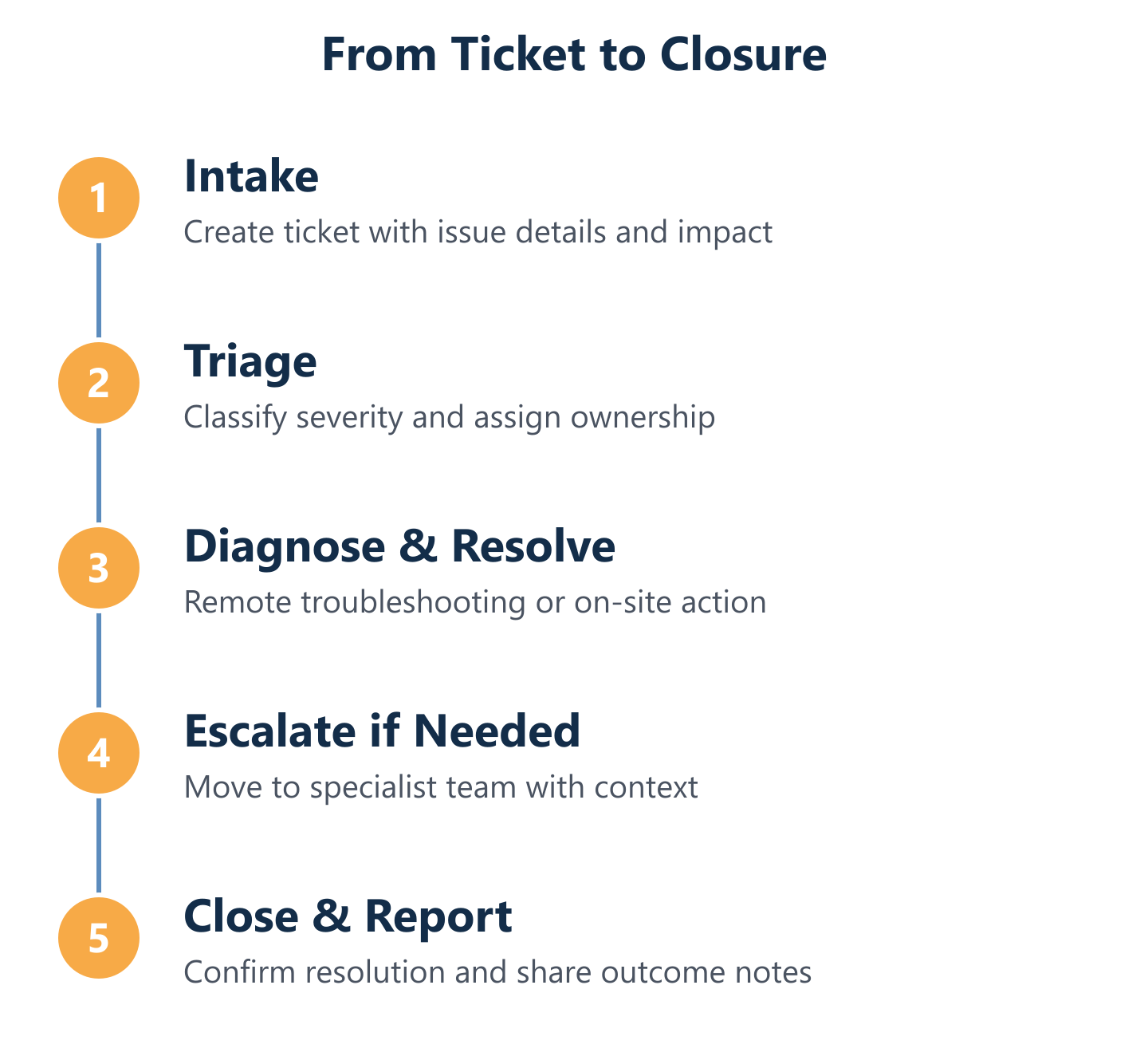
- Incident intake: the ticket is logged with full context—device, user, symptoms, and business impact—so triage begins immediately.
- Severity classification: the incident is assigned a priority level (standard, high, or critical) based on scope of impact, not just technical difficulty.
- Response commitment: the assigned SLA target is communicated to the client, with a named technician taking ownership of the case.
- Remote diagnosis: first-line support attempts remote resolution; if successful, the ticket moves to closure with a resolution report.
- Escalation trigger: if remote resolution is not possible within the SLA window, the incident is escalated to second-line or on-site support automatically.
- On-site intervention: a technician is dispatched with the context already captured, avoiding repeated diagnosis on arrival.
- Closure and proactive review: the ticket is closed with a documented resolution and a review to identify whether preventive action is needed.
SLA design: severity, priority, and target response windows
Severity classification is the foundation of any credible SLA. Without it, every incident competes for the same queue regardless of its operational impact. A three-tier model covers most business environments: standard (single-user, non-critical), high (multiple users affected or business process impaired), and critical (server down, network outage, or security incident with business-wide impact).
Target response windows should be expressed in working hours, not calendar hours, to reflect realistic staffing capacity. Impulso Tecnológico applies an under-8-working-hour target for standard requests and an under-4-working-hour target for server issues and critical incidents. These targets are contractually defined, not aspirational—which means they can be tracked, reported, and improved over time. For businesses comparing IT support companies in Barcelona, asking for documented SLA tiers and historical compliance data is the single most useful qualification step.
Escalation and closure: from triage to confirmed resolution
Escalation is not a failure—it's a designed part of the support workflow. When first-line support cannot resolve an incident within the defined window, a clear escalation path prevents the ticket from stalling. The escalation should be automatic, not dependent on the client chasing for an update.
At Impulso Tecnológico, escalation moves from remote first-line to second-line technical specialists, and then to on-site intervention if physical access is required. At each stage, the ticket retains its full history so the incoming technician doesn't repeat diagnostic steps. Closure is only confirmed once the client has verified that the issue is resolved—not when the technician considers the work done. Every closed ticket is accompanied by a resolution report that documents the root cause, the action taken, and any recommended preventive measures, creating an auditable record of your IT support history.
Operational reporting: how SLAs are tracked and improved over time
SLA compliance is only meaningful if it's measured. A provider that cannot show you ticket volume, response time distribution, and resolution rates by severity tier is operating without accountability. Weekly or monthly reporting should be a standard deliverable, not an optional add-on.
Useful reporting covers: total tickets opened and closed in the period, average response and resolution times by severity, recurring incident categories (which often indicate an underlying infrastructure problem), and any open items with their current status. Impulso Tecnológico resolves thousands of IT tickets annually across its active client base, and that volume generates the pattern recognition needed to identify systemic issues before they become critical. For businesses reviewing their current outsourced IT support in Barcelona, comparing your provider's reporting format against these criteria is a practical starting point. You can also explore how we approach preventive IT maintenance as a complement to reactive support.
How to Choose an IT Support Provider in Barcelona (Security, Tools, and Fit)
Choosing an IT support company in Barcelona is a procurement decision with long-term operational consequences. A provider that looks competitive on price but lacks structured escalation, security coverage, or transparent reporting will cost more in downtime and rework than the saving on the monthly invoice.
The evaluation should cover five dimensions: technical scope, security posture, service levels, tooling and visibility, and commercial fit. Impulso Tecnológico differentiates on the first two: every engagement begins with an audit that maps your current environment—antivirus status, backup integrity, server health, and network configuration—before a service model is proposed. This prevents the common problem of paying for a generic package that either over-provisions or under-covers your actual environment.
Key criteria to apply when shortlisting providers:
- Audit-first approach: does the provider assess your environment before quoting, or do they apply a standard price list regardless of complexity?
- Security alignment: are endpoint protection, patching, and backup explicitly included in the contract, or treated as optional extras?
- Documented SLAs: are response and resolution targets defined by severity tier and contractually binding?
- Escalation path: is there a documented second-line and on-site escalation process, or does everything depend on a single technician?
- Reporting cadence: will you receive regular performance data, or only hear from the provider when something goes wrong?
- Language and communication: for international teams operating in Barcelona, bilingual support (Spanish and English) avoids communication gaps during incidents.
- Partner certifications: does the provider hold certifications from the vendors they deploy—Sophos, Fortinet, Microsoft, Cisco—or are they self-declared experts?
- Contract flexibility: can you scale the service up or down as your organisation changes, without punitive exit clauses?
Security and compliance: protecting endpoints, servers, and access controls
Endpoint security and patching are not optional layers on top of IT support—they are part of the support contract itself. Every unpatched device is a potential entry point for ransomware or data theft, and a provider that doesn't manage patch cycles is leaving your business exposed between visits.
Impulso Tecnológico installs and configures security software as part of its support packages, including antivirus and endpoint protection (Sophos), firewall management (Fortinet), and backup and disaster recovery (Veeam). Access controls—who can reach which systems and with what permissions—are configured to industry standards and reviewed as part of the ongoing service. For businesses subject to GDPR obligations, this security baseline is also a compliance requirement, not just an operational preference. Server support Barcelona engagements specifically include hardening reviews to ensure server configurations don't carry unnecessary risk.
Tools and reporting: what you should see every week (without guesswork)
Visibility into your IT support performance should not require chasing your provider for updates. A well-structured managed service delivers regular reporting as a default output, covering ticket volumes, response time compliance, open incidents, and recurring issue categories.
At Impulso Tecnológico, helpdesk ticket management is tracked through a centralised system that gives clients a clear view of their incident history, resolution status, and any pending actions. This data serves two purposes: operational accountability (did the provider meet its SLA targets?) and strategic insight (are there recurring infrastructure problems that warrant a preventive investment?). Weekly summaries and detailed resolution reports mean you're never making IT decisions based on instinct. For businesses that have previously operated without structured reporting, the contrast is immediate—decisions about hardware refresh cycles, software licensing, and security upgrades become evidence-based rather than reactive.
Quote readiness: what we need to estimate scope, users, locations, and stack
A meaningful IT support quote requires more than a headcount. To prepare an accurate estimate, Impulso Tecnológico needs to understand: the number of devices (desktops, laptops, servers, and mobile devices), your office locations and whether on-site visits are required, your current software stack (operating systems, productivity tools, line-of-business applications), existing security tools and their status, and whether you have an internal IT resource or need fully outsourced support.
For businesses with multiple locations—for example, a Barcelona headquarters with regional offices—our computer support Barcelona model can be extended to cover additional sites, as we do for clients across Spain. The initial audit, which is included in our Fixed Price All Inclusive package, produces a written report that documents the current state of your environment and forms the basis for the service proposal. Non-binding estimates are available before committing to a full audit, giving you a budget range to work with during the evaluation process.
Selecting an IT support provider in Barcelona comes down to three verifiable commitments: documented SLAs with severity tiers, security coverage that includes endpoint protection and patching as standard, and regular reporting that shows performance rather than just promising it. Before signing any contract, ask for a sample SLA document, a sample weekly report, and a description of the escalation path when first-line support cannot resolve an incident. If a provider cannot produce all three, the gap will show up in your operations. Impulso Tecnológico offers non-binding estimates and an audit-first approach—so the service you receive is sized to your actual environment, not a generic package.