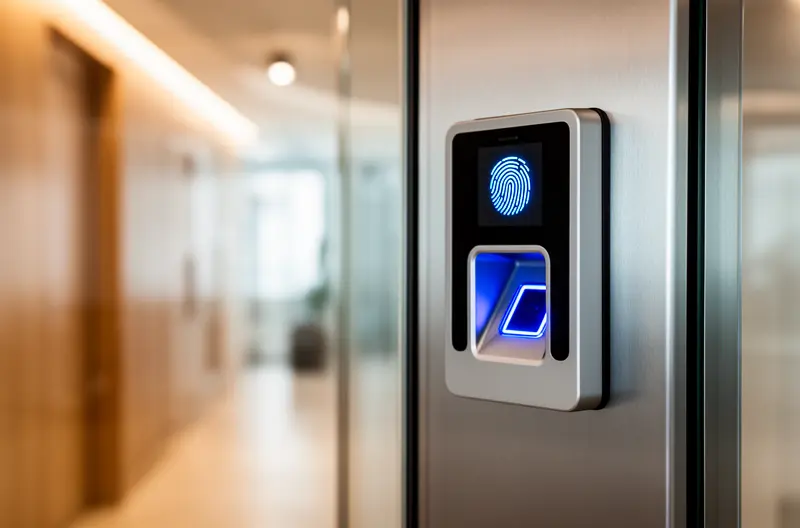

Access control systems in Spain and Portugal combine credential readers, door hardware, and management software to restrict and audit entry across your sites. The right system matches your credential type, integration requirements, and operating model to your specific risk profile and compliance obligations—including GDPR.
Organisations operating across Spain and Portugal face a challenge that goes well beyond fitting a card reader to a door. Multi-site deployments, mixed workforces of permanent staff, contractors, and visitors, and the need to integrate with existing CCTV, alarms, and HR platforms all create complexity that generic installers rarely address. The result is often a patchwork of isolated systems that generate administrative overhead rather than operational clarity.
A properly designed access control architecture solves this by defining who can go where and when, enforcing those policies automatically, and producing audit trails that support both security investigations and regulatory compliance. When access control is connected to visitor management, time and attendance, and remote monitoring, organisations see measurable reductions in unauthorised entry events and a significant drop in manual administration. This guide walks through every decision point—from credential selection to provider evaluation—so you can build a shortlist grounded in real operational requirements.
Access Control Systems in Spain & Portugal: what organisations typically need
Most access control projects in Spain and Portugal are triggered by one of three events: a security incident, a regulatory audit, or a planned office or warehouse expansion. In each case, the underlying requirement is the same—reliable, auditable control over who enters which area, combined with the ability to revoke access instantly when employment or contractor status changes.
Iberian organisations also face specific compliance pressures. GDPR-compliant access control means that biometric data and access logs must be handled with documented legal bases, data minimisation principles applied to retention periods, and appropriate technical safeguards in place. Ignoring this during system design creates liability that surfaces during Data Protection Authority inspections.
At Impulso Tecnológico, we help clients move from basic access control to an integrated physical security architecture—combining access control with video surveillance, intrusion detection, and environmental monitoring while keeping compliance fully in scope. The table below maps the most common organisational contexts to their typical access control requirements:
| Organisation type | Primary driver | Key requirement | Compliance consideration |
|---|---|---|---|
| Corporate office (multi-site) | Workforce management | Role-based access levels, time and attendance access integration | GDPR data retention for access logs |
| Industrial / warehouse | Asset protection | Vehicle access control, anti-tailgating, perimeter readers | Health & safety audit trails |
| Bank / financial services | Regulatory compliance | Biometric access control for server rooms, dual-factor entry | PCI-DSS, ENS (Spain), GDPR |
| Healthcare facility | Patient and data safety | Zone-based access, visitor management integration | GDPR special-category data handling |
| Public building / education | Duty of care | Visitor management integration, temporary access for events | LOPD-GDD (Spain), GDPR |
Common Iberian scenarios: offices, warehouses, banks, public buildings
Defining who needs access, where they go, and when access must be granted or revoked sounds straightforward—until you map it across a real building. A logistics warehouse in Valencia operates very differently from a bank branch in Lisbon or a university campus in Madrid. Each has distinct entry points, shift patterns, and visitor flows that the access control architecture must accommodate from day one.
In office environments, the primary concern is usually separating public reception areas from staff zones and server rooms. In warehouses, perimeter control and vehicle access control become critical, with number-plate recognition and barriers managing goods-in and goods-out. Banks and financial institutions typically require dual-factor authentication on high-security zones. Public buildings and educational campuses need flexible visitor management integration that can handle large, unpredictable flows without creating bottlenecks at reception.
Operational goals: reduce unauthorised entry and improve workflow efficiency
Planning for multi-site consistency across Spain and Portugal is the single most effective way to avoid policy drift and administrative overhead. When each site runs a different access control platform with its own credential database, adding a new employee or revoking a leaver's access becomes a manual, error-prone process multiplied across every location.
A unified access control system with centralised remote access control management eliminates this fragmentation. Administrators set a policy once and it propagates automatically. Audit reports can be generated across all sites simultaneously, which is essential for both internal security reviews and regulatory inspections. Operationally, organisations that integrate access control with HR provisioning workflows report significantly fewer cases of former employees or contractors retaining active credentials—one of the most common causes of preventable security incidents in multi-site environments.
Identity and credential strategy: cards, mobile credentials, biometrics
Choosing a credential strategy means aligning access control with both your physical security requirements and your IT governance framework. Smartcards remain the most widely deployed option in Spain and Portugal due to their low cost and familiarity, but they carry an inherent risk: cards can be lost, shared, or cloned if the underlying technology is outdated (legacy 125 kHz proximity cards, for example, offer minimal security).
Mobile credentials—delivered via smartphone app—reduce card management overhead and support remote provisioning, making them well suited to distributed workforces. Biometric access control (fingerprint, facial recognition) adds a factor that cannot be shared or forgotten, but introduces GDPR obligations around special-category data that must be addressed in your data protection impact assessment before deployment. A layered approach—mobile or card for standard areas, biometrics for high-security zones—is often the most pragmatic balance between security, usability, and compliance.

Key components: badges, biometrics, readers, and secure access points
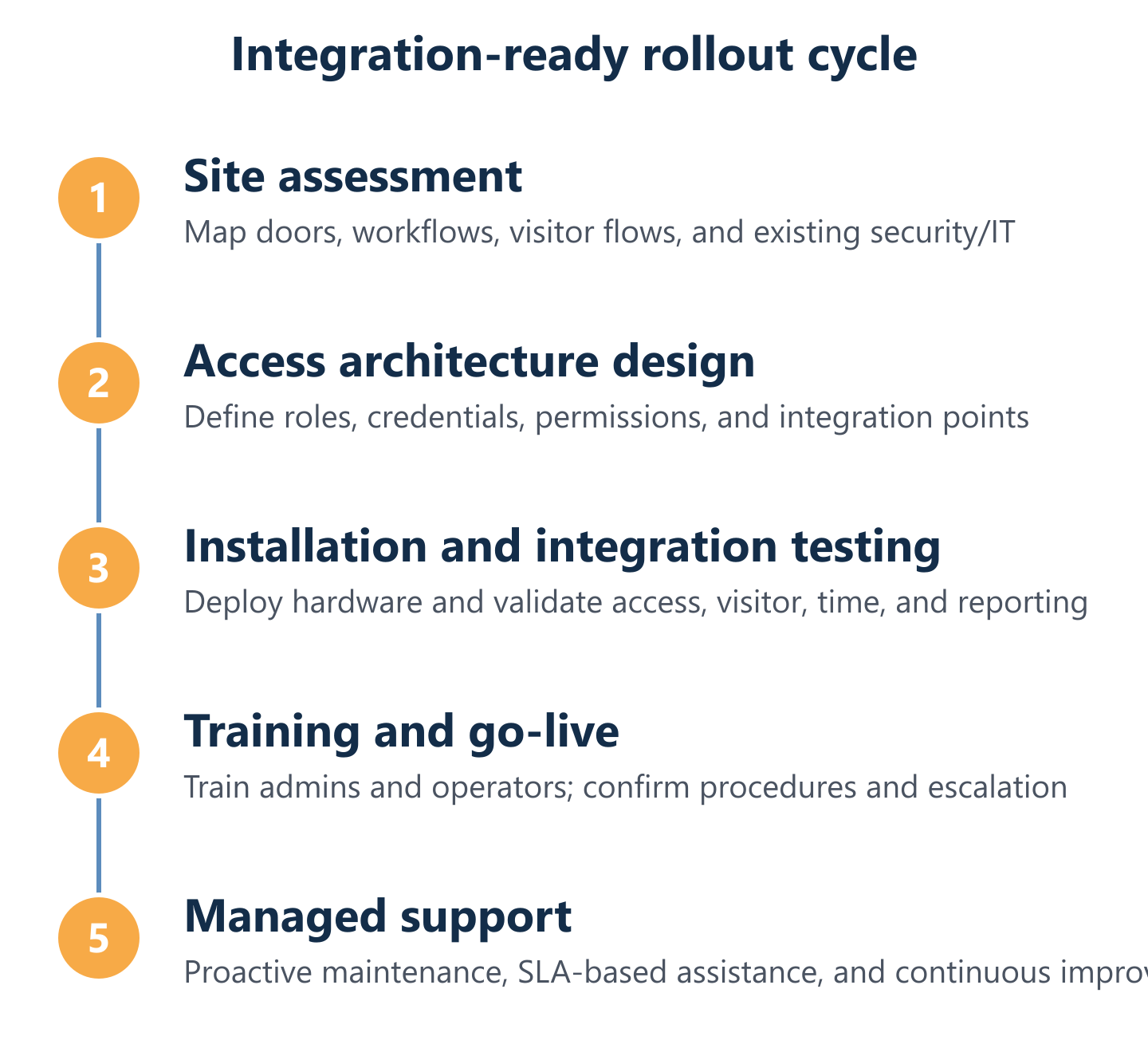
Every access control system is built from the same core components, but the specification of each component determines whether the system performs reliably under real-world conditions or becomes a maintenance burden within two years. At Impulso Tecnológico, we design access control as part of an end-to-end solution, ensuring the chosen components integrate cleanly with your existing security infrastructure and can be managed efficiently over time.
The component selection process follows a clear sequence:
- Site risk assessment: Classify each access point by risk level (public, semi-restricted, restricted, high-security) to define the minimum authentication factor required at each door or gate.
- Credential selection: Choose the credential technology—MIFARE DESFire smartcard, mobile credential, or biometric—based on the risk classification and the user population at each zone.
- Reader specification: Select access control readers that match the chosen credential technology, with IP-rated enclosures for external or industrial environments and tamper-detection outputs wired to the alarm panel.
- Door hardware and controllers: Specify electric strikes, magnetic locks, or electromechanical locks appropriate to the door type and fire-exit regulations applicable in Spain and Portugal.
- Management platform: Confirm that the chosen hardware is supported by the access control software platform, whether cloud-based or on-premise, and that it exposes APIs for integration with HR, visitor management, and CCTV systems.
- Failsafe and power resilience: Define the fail-safe or fail-secure behaviour for each door during a power outage, and specify UPS or PoE backup to maintain critical access points during incidents.
Credentials and authentication: smartcards vs biometrics vs mobile
Matching credential type to security needs and user convenience is a practical engineering decision, not a marketing one. MIFARE DESFire EV3 smartcards offer strong encryption and are the current minimum recommended standard for new deployments in Spain and Portugal—legacy 125 kHz cards should be migrated as a priority. Mobile credentials using Bluetooth Low Energy or NFC are increasingly adopted in corporate environments because they integrate with identity management platforms and support remote provisioning without physical card issuance.
Biometric access control—fingerprint readers, facial recognition terminals—is the right choice for server rooms, pharmaceutical storage, and financial back-office areas where sharing or cloning a credential would represent an unacceptable risk. Before deploying biometrics, organisations must complete a GDPR Data Protection Impact Assessment, establish a legal basis (typically explicit consent or legitimate interest with documented necessity), and define a data retention and deletion policy. Combining mobile credentials for general areas with biometrics at high-security zones gives the best balance of convenience and protection.
Readers and door-side hardware: reliability, tamper protection, and usability
Selecting access control readers for reliability, tamper resistance, and maintainability requires looking beyond the product datasheet. Readers installed in external or semi-exposed locations in Spain—where summer temperatures in Andalusia or Extremadura regularly exceed 40 °C—must carry at minimum an IP65 rating and an operating temperature range that covers local conditions. Vandal-resistant housings with tamper-switch outputs are mandatory for any reader accessible to the public or positioned in unmanned areas.
On the door-side, the choice between electric strikes and magnetic locks affects both security and fire-safety compliance. In Spain, the Reglamento de Instalaciones de Protección Contra Incendios (RIPCI) and equivalent Portuguese legislation require that locked doors on evacuation routes release automatically on fire alarm activation. This means every door controller must be integrated with the fire alarm panel, a step that is frequently overlooked by installers focused solely on the access control system itself.
Access levels and permissions: role-based control for staff, visitors, and contractors
Designing access points to support controlled entry and exit, anti-tailgating, and auditability means thinking in terms of user roles, not just physical doors. A well-structured permission model assigns each credential holder to one or more access groups—permanent staff, temporary contractors, cleaning crews, senior management—each with its own time schedules and zone permissions.
Anti-tailgating measures, such as interlocked airlock vestibules or optical turnstiles, are relevant for high-security zones in banks, data centres, and pharmaceutical facilities. For most commercial environments, video verification at entry points—where the access control system triggers a CCTV snapshot on each credential presentation—provides a cost-effective audit trail without the capital cost of full airlock infrastructure. All entry and exit events should be logged with timestamp, credential identifier, and door ID, creating the audit trail required for both security investigations and GDPR accountability obligations.
Integration that removes silos: access, visitor management, time tracking, and reporting
Isolated access control systems create more work than they save. When the access control database, the visitor management platform, the time and attendance system, and the CCTV recording infrastructure all operate independently, every HR change requires manual updates in multiple systems—and every security incident requires correlating data from separate interfaces. The integration layer is where access control delivers its real operational value.
At Impulso Tecnológico, our managed services approach treats access control as an ongoing service: we assess your environment, document and test integrations, and support clients with proactive maintenance and SLA-based assistance in both Spanish and English. The key integration points that eliminate silos in a typical Iberian deployment are:
- HR system → access control provisioning: New starters receive credentials automatically on their first day; leavers are revoked within minutes of HR updating their status—no manual intervention required.
- Visitor management integration: Pre-registered visitors receive time-limited credentials that expire automatically at the end of their scheduled visit, eliminating the need for a receptionist to manually deactivate badges.
- Time and attendance access: Access control reader events feed directly into the time and attendance platform, removing the need for separate clocking terminals and providing a single source of truth for payroll and compliance reporting.
- CCTV and alarm correlation: Access events trigger associated camera recordings, so a forced-entry alarm automatically surfaces the relevant footage in the security monitoring centre without manual searching.
- Reporting and audit trails: A unified dashboard shows access events, visitor flows, and anomalies across all sites in Spain and Portugal, with exportable reports formatted for regulatory submissions.
- Automation platforms: Where workflow complexity demands it, tools such as n8n or Make.com can orchestrate provisioning logic across platforms that lack native API integration, reducing administrative overhead further.
Integration map: access + visitor management + time & attendance + CCTV/alarms
Connecting access control with visitor management and time tracking reduces the manual checks that consume security and HR staff time every day. The practical integration map for a mid-sized organisation with sites in Spain and Portugal typically looks like this: the HR platform is the master identity source; it feeds the access control management software, which in turn provisions credentials and synchronises time and attendance access records. The visitor management integration sits alongside this, handling pre-registration, badge printing, and automatic expiry.
CCTV and alarm systems connect to the access control platform via API or hardware relay outputs, so that a door forced open outside permitted hours triggers both an alarm event and a camera recording bookmark simultaneously. This correlation capability is what transforms a collection of separate security tools into a coherent security monitoring centre function—whether that centre is staffed internally or managed remotely.
Provisioning workflows: temporary access, contractor onboarding, and revocation
Using reporting and audit trails to support operational oversight and incident investigation requires that provisioning workflows are designed with auditability in mind from the outset. Temporary access for contractors, maintenance crews, and event staff is one of the highest-risk areas in any access control deployment—credentials issued for a specific project often remain active long after the work is complete.
A structured provisioning workflow assigns every temporary credential an automatic expiry date and links it to a named requester who is accountable for the access grant. When the credential expires, the system logs the revocation automatically. If the contractor needs an extension, the requester must explicitly re-authorise it—creating a documented approval chain. This approach, combined with monthly access rights reviews exported from the access control platform, satisfies both internal audit requirements and the accountability principle under GDPR without generating significant administrative overhead.
Managed vs self-managed: remote administration, support, and incident response
Choosing an operating model—managed services with SLA-based support or self-managed control—is a decision that affects both your total cost of ownership and your operational resilience. Self-managed systems give your internal IT team full control over configuration and reporting, but require that team to maintain competency across the access control platform, the integration layer, and the underlying hardware as it ages.
A managed access control service transfers day-to-day administration, firmware updates, and first-line incident response to a specialist provider. Remote access control management means that credential changes, policy updates, and system health checks can be performed without an on-site visit—important for organisations with sites spread across Spain and Portugal. Impulso Tecnológico delivers this through transparent monthly service arrangements with documented SLAs, so clients have predictable costs and a clear escalation path when incidents occur, without the overhead of building and retaining specialist in-house expertise.
The most effective next step is to translate your site requirements into a structured shortlist before speaking to any provider. Document your access points by risk level, your credential preferences, the integrations you need on day one versus those you plan to add later, and your preferred operating model. With that information in hand, a site assessment with a qualified installer—such as the Impulso Tecnológico team, who have delivered access control projects across Spain, Portugal, and internationally—will produce a validated design rather than a generic proposal. If you would like to explore how access control fits into a broader managed IT and physical security strategy, our guide on becoming a professional access control systems installer provides additional technical context, and our resources on preventive IT maintenance for businesses explain how ongoing service contracts keep security infrastructure reliable over time.