
Air quality control systems installation covers the full process of deploying sensors, ductwork, filtration, dampers, controls, and monitoring infrastructure to measure and manage indoor air conditions. A complete installation delivers a verified, documented system that meets regulatory requirements and supports ongoing operational management.
Poor indoor air quality is a measurable operational problem. Elevated CO₂, particulate matter, volatile organic compounds (VOCs), and humidity affect staff performance, trigger regulatory scrutiny, and—in industrial settings—create safety and compliance exposure. Yet many organisations approach installation reactively, procuring equipment without a clear scope of works, defined commissioning criteria, or a documented handover pack. The result is systems that are technically installed but operationally incomplete: no baseline performance data, no alert thresholds, and no integration with existing building or security infrastructure.
A structured installation approach resolves this. Starting from a site survey and requirements capture, through mechanical, electrical, and controls works, to commissioning and performance verification, a well-managed project delivers a system that is operational from day one—with remote monitoring, instant alerts, and a clear maintenance plan. At Impulso Tecnológico, we treat air quality control systems installation as part of an integrated managed services ecosystem, combining quick physical deployment with the monitoring and remote management capabilities that keep environments healthy and compliant over time.
What "Air Quality Control Systems Installation" Includes (Scope & Deliverables)
An air quality control systems installation project is not a single activity—it is a coordinated sequence of engineering, mechanical, electrical, controls, and documentation works that together produce a verified, operational environment. Buyers who treat it as a product purchase rather than a managed project consistently encounter the same problems: incomplete ductwork sealing, unconfigured alert thresholds, missing test evidence, and no clear owner for ongoing maintenance.
Setting scope expectations before procurement protects against these gaps. A complete project should cover physical installation of sensors and filtration equipment, ductwork design and installation, damper and enclosure works, electrical and cabling works, controls and monitoring integration, commissioning and performance verification, and a formal documentation handover. The table below maps typical scope elements against what buyers should verify is included in any proposal.
| Scope Element | What to Confirm Is Included | Common Gap in Proposals |
|---|---|---|
| Site survey and design | Airflow mapping, sensor placement plan, power/network routes | Generic layout reused without site-specific assessment |
| Ductwork and filtration | Design, manufacture, installation, sealing, and airflow testing | Installation only—no performance verification of airflow rates |
| Dampers and enclosures | Isolation, fire, and tee dampers; permanent enclosures where required | Fire dampers omitted or not tested post-installation |
| Electrical and cabling | Power distribution, PoE infrastructure, labelled cabling to standards | Cabling installed but not documented or labelled |
| Controls and monitoring integration | Sensor configuration, alert thresholds, platform integration | Sensors installed but not integrated with management platform |
| Commissioning and testing | Functional tests, baseline readings, acceptance sign-off | No formal commissioning record provided |
| Documentation handover | As-built drawings, test reports, operational guidance | Verbal handover only—no written evidence pack |
At Impulso Tecnológico, installation is planned as the starting point of an ongoing managed relationship. Using Power over Ethernet (PoE) sensors that are operational within minutes, we enable quick deployment across single or multiple environments while ensuring that monitoring, remote management, and alert configuration are active from the moment the system goes live—not added as an afterthought.
Core system components and how they fit together
An air quality control system is an assembly of interdependent components, and installation quality depends on understanding how they interact. At the physical layer, sensors measure parameters such as PM2.5, PM10, CO₂, temperature, relative humidity, VOCs, and—in industrial contexts—specific chemical or particulate concentrations. These sensors feed data to a controls layer, which may include building management system (BMS) integration, standalone monitoring platforms, or unified security and environmental dashboards.
Between the air-handling equipment and the occupied space sit the mechanical elements: air handling units (AHUs), filtration stages (pre-filters, HEPA, activated carbon), ductwork distribution networks, and dampers that regulate airflow and provide fire compartmentalisation. The engineering deliverables that govern how these components are installed—system layout drawings, ductwork strategy, electrical and mechanical interface schedules, and a controls integration plan—must be produced before physical works begin. Without them, installation becomes reactive and difficult to verify or maintain.
Typical project deliverables buyers should request
Before accepting a proposal, buyers should request a defined deliverables list rather than a generic scope statement. The following outputs should be standard on any credible air quality control systems installation project:
- Site survey report — documented assessment of airflow paths, mounting constraints, power and network availability, and any access or structural considerations.
- System design drawings — including sensor placement, ductwork routing, damper positions, and electrical schematics.
- Installation completion record — confirming all physical works (ducting, dampers, enclosures, cabling, sensor mounting) are complete to specification.
- Commissioning test report — baseline readings for all monitored parameters, functional test results for dampers and controls, and confirmation of alert threshold configuration.
- As-built documentation pack — updated drawings reflecting any on-site changes, plus equipment schedules and warranty records.
- Operational handover guide — step-by-step guidance for facilities or IT teams covering daily monitoring, alert response, and scheduled maintenance tasks.
Requesting these deliverables upfront filters out suppliers who treat installation as a one-time event rather than the foundation of long-term system performance.
Common scope gaps that cause delays or rework
Scope gaps in air quality control systems installation rarely appear during the works themselves—they surface weeks or months later, when a system fails to perform as expected or a compliance audit reveals missing documentation. The most frequent gaps observed across commercial and industrial projects include:
- No baseline performance data — sensors installed without capturing pre-installation readings, making it impossible to demonstrate improvement or identify drift over time.
- Unconfigured alert thresholds — monitoring platforms deployed with default settings rather than thresholds calibrated to the specific environment and occupancy type.
- Missing fire damper test records — dampers installed but not functionally tested post-installation, creating both safety and compliance exposure.
- Isolated monitoring dashboards — air quality data siloed in a separate platform rather than integrated with existing security or building management systems, increasing operational overhead.
- No maintenance schedule agreed at handover — filter replacement intervals, sensor calibration cycles, and damper inspection frequencies left undefined, leading to performance degradation within months.
Addressing these gaps at the scoping stage—not after installation—is the single most effective way to protect project outcomes and avoid costly rework.
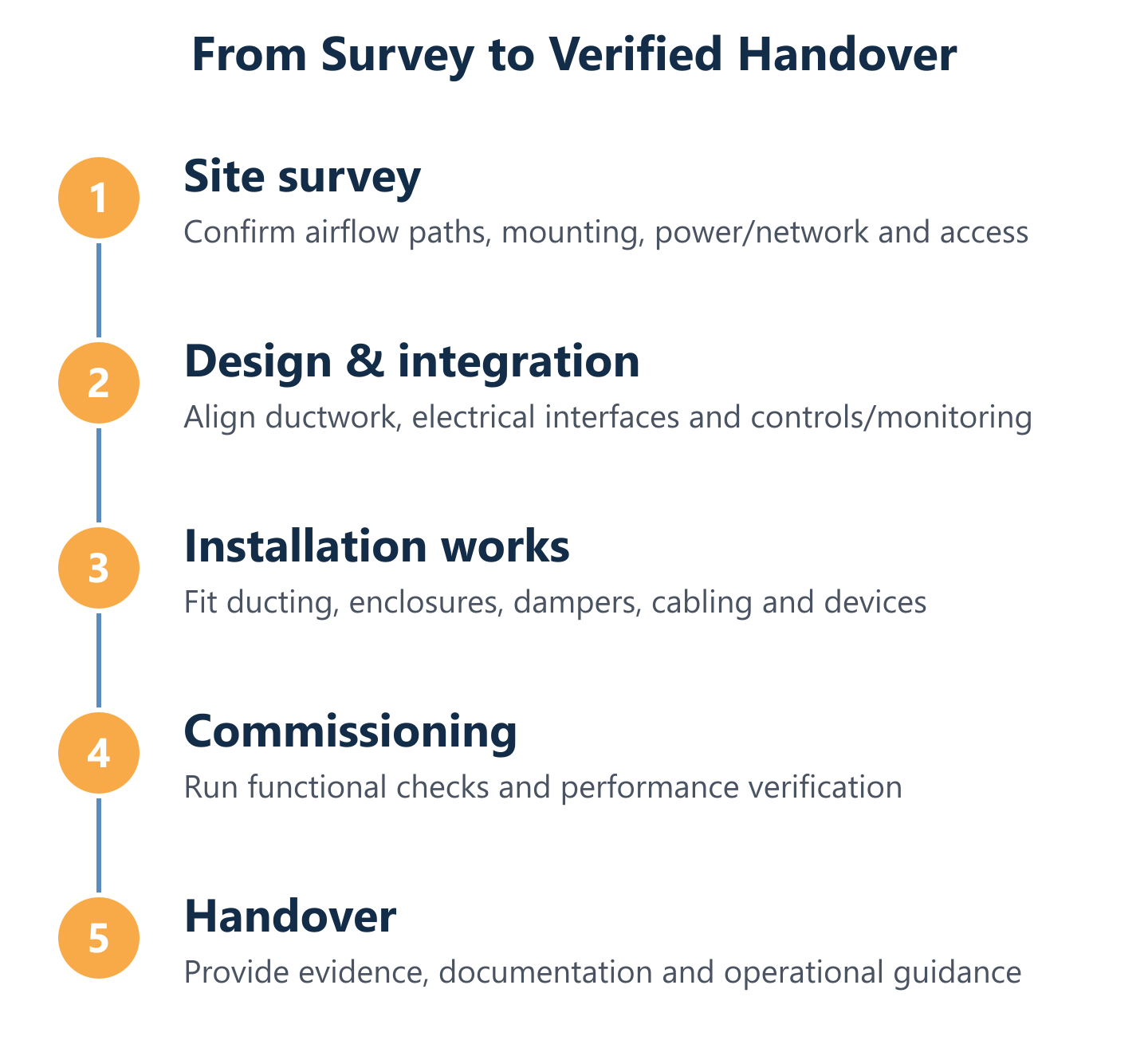
Engineering Design-to-Installation Workflow (From Site Survey to Handover)
A repeatable installation workflow reduces risk, clarifies responsibilities, and produces the evidence needed for regulatory compliance and ongoing management. The stages below reflect best practice for commercial and industrial air quality control systems installation projects, from initial requirements capture through to a verified, documented handover.
- Requirements capture and site survey — define monitored parameters, occupancy types, regulatory obligations, and integration requirements; conduct physical site survey to map airflow paths, mounting options, power and network availability.
- System design and engineering review — produce sensor placement plans, ductwork routing drawings, electrical schematics, and a controls integration specification; align mechanical, electrical, and IT/controls disciplines before works begin.
- Procurement and pre-installation testing — source equipment to specification; where possible, bench-test control panels and sensor assemblies before delivery to site to reduce on-site fault-finding time.
- Mechanical and ductwork installation — install AHUs, filtration stages, ductwork, dampers, and enclosures to design drawings; conduct interim airflow checks before closing access points.
- Electrical and cabling works — install power distribution, PoE infrastructure, and signal cabling; label all circuits and connections to agreed standards.
- Controls and monitoring integration — mount and configure sensors; integrate with monitoring platform, BMS, or security infrastructure; set alert thresholds and remote management access.
- Commissioning and performance verification — conduct functional tests across all system components; capture baseline air quality readings; verify alert and response workflows operate correctly.
- Documentation and handover — compile as-built drawings, test reports, equipment schedules, and operational guidance; formally hand over to facilities, IT, or operations teams with a structured briefing.
At Impulso Tecnológico, this workflow is designed around operational readiness from day one. PoE-based sensors are typically operational within minutes of physical installation, and our unified platform enables remote management and instant alert configuration before the installation team leaves site—so handover is a live, verified state, not a paper exercise.
Site survey and requirements capture for commercial buildings
A site survey for an air quality monitoring system installation in a commercial building covers more ground than a simple floor-plan walkthrough. The survey must document existing airflow paths—including supply and return air locations, natural ventilation points, and any sources of pollutant ingress such as car parks, loading bays, or adjacent industrial processes. Mounting constraints matter: sensor placement must balance measurement accuracy (away from direct supply air diffusers, at breathing-zone height where possible) against practical access for maintenance and cabling routes.
Power and network availability assessment is equally important. PoE-capable network infrastructure simplifies deployment significantly, but the survey must confirm switch port availability, cable run distances, and whether existing network segments can support additional devices without performance impact. Access planning—including working at height requirements, asbestos registers for older buildings, and any permit-to-work procedures—should be documented before works are scheduled, not discovered on the day. A thorough survey at this stage prevents the majority of on-site delays.
Integration steps: controls, monitoring, and existing security infrastructure
Integrating air quality monitoring with existing controls and security infrastructure is where many installations fall short. The default approach—deploying a standalone monitoring platform with its own dashboard—creates operational silos that increase the burden on facilities and IT teams. A more effective model connects air quality data to the same management layer used for physical security, access control, and network monitoring, providing a unified view across sites.
At Impulso Tecnológico, we leverage Verkada's integrated platform to achieve exactly this. Air quality sensors sit alongside cameras, access control readers, and environmental sensors within a single management interface, enabling teams to correlate events—for example, identifying whether a spike in particulate readings coincides with a specific access event or operational activity. Integration steps include confirming API or platform compatibility with existing security infrastructure, configuring shared alert workflows, and establishing role-based access so the right teams receive the right notifications. This approach aligns directly with our broader managed services philosophy: centralising services, reducing complexity, and preventing issues before they affect operations.
Commissioning approach and acceptance evidence
Commissioning is the stage that separates a technically installed system from a verified, operational one. For air quality control systems, commissioning should include functional testing of every sensor and monitoring point, confirmation that readings fall within expected ranges for the environment type, and verification that alert thresholds trigger correctly and route notifications to the right recipients.
Acceptance evidence should be tangible and transferable. At minimum, the commissioning record should include: a dated log of baseline readings for all monitored parameters (CO₂, PM2.5, temperature, humidity, and any site-specific pollutants); functional test results for dampers, AHU controls, and filtration stages; confirmation of remote management access and alert configuration; and sign-off by both the installation team and the client's designated responsible person. Where regulatory compliance is a project driver—for example, workplace exposure limits or green building certification targets—the commissioning record forms part of the compliance evidence pack and must be retained accordingly. Impulso Tecnológico provides this documentation as standard, ensuring that the system's operational readiness is evidenced from the first day of live operation.

Mechanical, Electrical, Ductwork, and Controls: What Gets Installed
The physical installation works in an air quality control systems project span four distinct disciplines, each with its own quality criteria and long-term maintainability implications. Buyers evaluating proposals should look beyond headline price to assess technical competence in each area—because a weakness in any single discipline undermines the performance of the whole system.
Key quality indicators to evaluate across proposals:
- Ductwork design credentials — does the installer design and manufacture ductwork to specification, or subcontract without design oversight? In-house design-to-installation capability reduces interface risk and accountability gaps.
- Damper specification and testing — are fire, isolation, and tee dampers specified to relevant standards (e.g., EN 1366-2 for fire dampers in European installations), and is post-installation functional testing included in scope?
- Electrical standards compliance — are cabling and power distribution works carried out to applicable wiring regulations, with labelled circuits and documented test results?
- PoE infrastructure readiness — for sensor-based monitoring systems, is the existing network infrastructure assessed and upgraded where necessary to support reliable PoE delivery?
- Controls integration depth — are sensors configured with environment-specific alert thresholds, or deployed with factory defaults? Is the monitoring platform integrated with existing security or BMS infrastructure?
- Scalability planning — is the installation designed to accommodate additional sensors or zones without significant rework, supporting phased rollouts across multiple rooms or buildings?
- Maintenance access — are filter housings, damper access panels, and sensor mounting positions designed for practical maintenance access, with service intervals documented at handover?
Impulso Tecnológico's installation approach is built around operational outcomes: instant alerts, scalable deployment across rooms and environments, and native integration with existing security systems through the Verkada platform—so each installation delivers a complete site view rather than an isolated air quality dashboard.
Ductwork, enclosures, and isolation/fire damper installation quality checks
Ductwork quality determines whether an air handling and filtration integration actually delivers the designed airflow rates to occupied spaces. Common installation failures include inadequate sealing at joints (leading to air leakage that reduces filtration efficiency), incorrect duct sizing that creates excessive static pressure, and routing decisions made on site without reference to design drawings. A credible installer will conduct interim airflow checks before closing access points—not simply complete the physical installation and move on.
Permanent total enclosures (PTEs), used in industrial applications to capture emissions at source, require careful design to balance negative pressure maintenance against worker access requirements. Isolation dampers must be positioned to allow safe maintenance isolation of individual system sections without shutting down the entire installation. Fire dampers require both correct specification to the relevant standard and documented functional testing after installation—a step that is frequently omitted and creates compliance exposure during building inspections or insurance assessments. Requesting test records for every damper installed is a straightforward quality check that separates thorough installers from those cutting corners.
Electrical and cabling standards for reliable operation
Electrical works for air quality control systems installation cover power distribution to AHUs, fans, and control panels, as well as signal and data cabling for sensors and monitoring equipment. The quality of this work directly affects long-term reliability: poorly terminated connections, unlabelled circuits, and inadequate cable management create fault-finding difficulties that inflate maintenance costs over the system's lifetime.
For sensor-based indoor air quality monitoring systems, Power over Ethernet (PoE) cabling simplifies the electrical scope significantly—a single Cat6 or Cat6A cable per sensor carries both power and data, reducing the number of trades required and the overall installation time. However, PoE delivery requires correctly specified switches with adequate power budgets, and cable runs must remain within the 100-metre limit for reliable operation. All cabling should be installed to the applicable wiring regulations for the jurisdiction, with circuits clearly labelled at both ends, cable routes documented in as-built drawings, and continuity and insulation resistance tests recorded before the system is energised. This documentation is not administrative overhead—it is the evidence base for any future fault diagnosis or system extension.
Controls integration: from monitoring signals to actionable air quality response
Sensors generate data; controls integration determines whether that data produces action. An air quality monitoring system installation that delivers readings to a dashboard without configured alert workflows, escalation paths, or integration with ventilation controls is operationally incomplete—it requires a human to check the dashboard and decide what to do, rather than prompting an automated or semi-automated response.
Effective controls integration at installation stage includes: configuring sensor alert thresholds calibrated to the specific environment (office CO₂ thresholds differ from those appropriate for a laboratory or manufacturing floor); establishing alert routing so notifications reach facilities managers, IT teams, or health and safety leads as appropriate; and—where BMS integration is in scope—mapping air quality signals to ventilation control responses such as increased fresh air supply when CO₂ rises above threshold. At Impulso Tecnológico, we configure remote management capabilities and instant alerts as part of the installation process, using the Verkada platform to enable teams to access and act on air quality data from any device. This is also where integration with existing security infrastructure adds value: correlating air quality events with occupancy or access data supports faster root-cause identification and more targeted operational responses. For organisations exploring how proactive monitoring fits within a broader IT managed services model, our approach to preventive IT maintenance provides useful context on the principles we apply across all managed environments.
Air quality control systems installation delivers lasting value only when scope, evidence, and integration are defined before works begin—not resolved during or after. Use the scope map, workflow stages, and quality checks in this guide to compare proposals objectively: confirm that commissioning records, as-built documentation, and alert configuration are included as standard deliverables, not optional extras. Align on rollout strategy—whether a single-site pilot or a multi-building programme—and ensure your installation partner can support remote management and ongoing monitoring from day one. For organisations looking to understand how this fits within a broader managed IT and security strategy, Impulso Tecnológico's team is available to discuss requirements and help structure an installation plan that delivers operational readiness from the outset.