
Madrid IT maintenance covers the ongoing support, monitoring, and protection of a company's computers, servers, and core systems — combining preventive routines to stop problems before they start with corrective response to restore operations when incidents occur.
For most businesses in Madrid, the real cost of IT failure is not the repair itself — it is the lost productivity while employees wait for systems to come back online. A single unplanned server outage can halt an entire department for hours. The right maintenance model prevents most of those situations through scheduled checks, security hardening, and proactive monitoring, while guaranteeing a defined response window when something does go wrong. Impulso Tecnológico, a Managed Services Provider with over 25 years of experience, delivers exactly this: a structured maintenance service that acts as an extension of your IT department, adapting scope and response targets to the complexity of your infrastructure. The result is a more stable, secure, and predictable IT environment — and fewer unplanned interruptions to your working day.
What Madrid IT Maintenance Includes for Businesses
Before signing any maintenance agreement, it is worth establishing exactly what is covered — because "IT maintenance" means different things to different providers. Some limit themselves to break-fix support on end-user devices; others extend to servers, networks, security configuration, and backup management. The gap between those two models can determine whether your business recovers from an incident in minutes or in days.
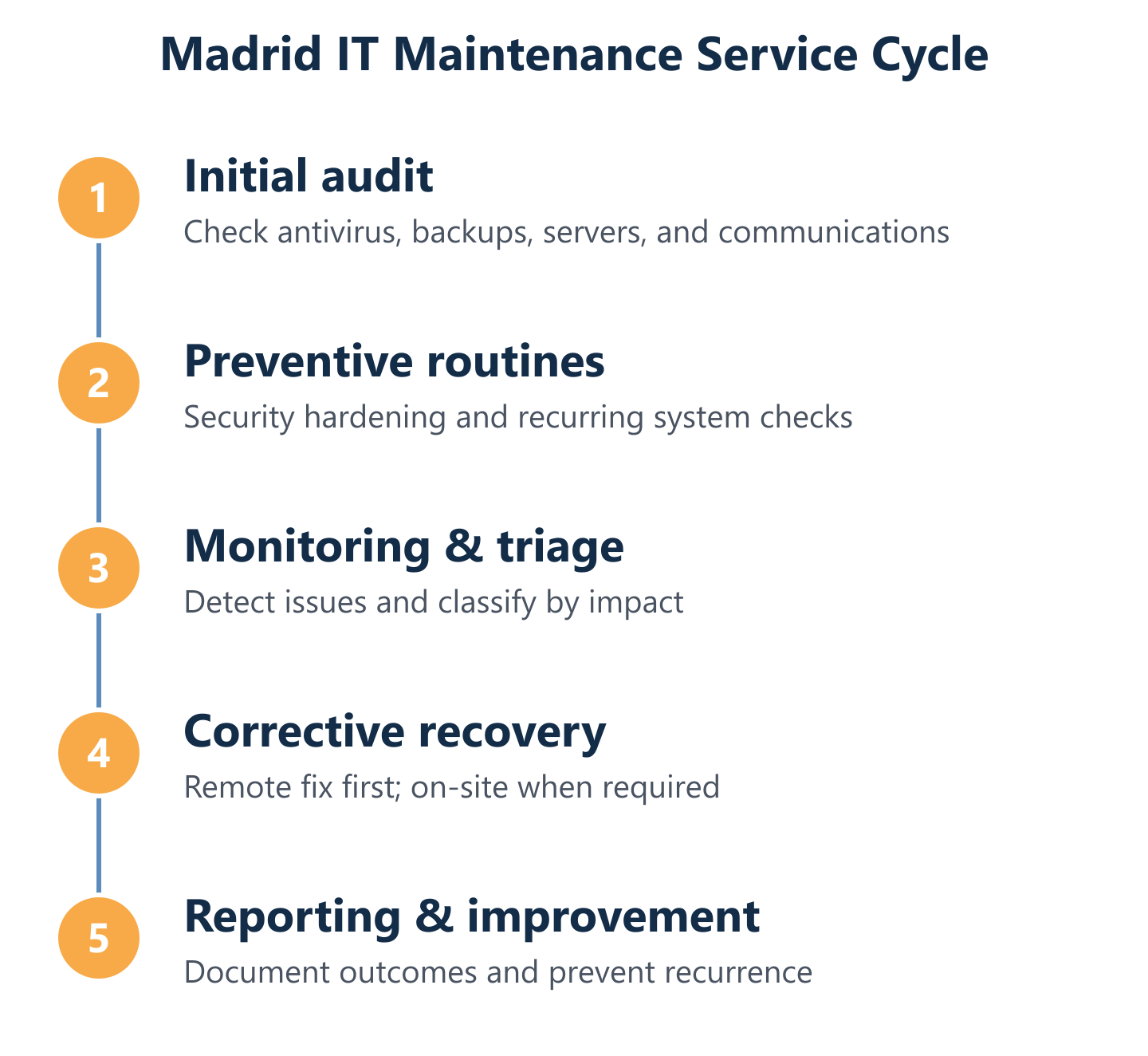
At Impulso Tecnológico, the starting point for any Madrid IT maintenance engagement is a complete audit of the relevant systems: antivirus status, backup copies, server health, and communications infrastructure. This audit produces an accurate inventory of the devices under contract, so scope is defined before the service begins — not discovered mid-incident.
The table below summarises the main dimensions to evaluate when comparing managed IT maintenance providers in Madrid:
| Evaluation Criterion | Basic Provider | Managed MSP (e.g. Impulso Tecnológico) |
|---|---|---|
| Initial systems audit | Rarely included | Included before contract start |
| Devices covered | Workstations only | Workstations, servers, network devices |
| Support channels | On-site only or email | Remote + on-site with defined response targets |
| Security configuration | Ad hoc on request | Included as standard routine |
| Backup management | Not included | Included, aligned with safety criteria |
| Reporting | None or invoice only | Detailed reports per intervention |
| Contract flexibility | Fixed annual terms | Hourly, monthly, or flat-rate options |
Managed support scope: devices, servers, and day-to-day systems
A well-defined maintenance contract specifies every category of asset under management. For most Madrid businesses, that means end-user workstations and laptops, on-premise or cloud-connected servers, operating systems, and the core business applications employees rely on daily — email clients, productivity suites, line-of-business software.
Impulso Tecnológico covers this full stack. After the initial inventory, each device is registered under the remote maintenance system, enabling support to begin without delay when a user logs an issue. Operating system updates, driver management, and application-level troubleshooting are handled as part of the standard scope — not billed separately as project work. For businesses without a dedicated internal IT team, this means every layer of the technology stack has a named responsible party.
Network and connectivity support: email, internet access, and access control
Network reliability is often the silent dependency behind every other IT function. When internet connectivity drops or email routing fails, productivity stops across the entire organisation — yet network administration is frequently excluded from basic maintenance contracts.
Impulso Tecnológico includes network administration and access settings for internet and email as part of its Madrid IT maintenance scope. This covers configuration and monitoring of routing, DNS, and firewall rules, as well as access control policies that determine which users and devices can reach which resources. For organisations with wireless infrastructure built on Cisco or Aruba equipment, or perimeter security running on Fortinet, these settings are reviewed and maintained as part of the ongoing service — not treated as separate billable projects when something goes wrong.
Service boundaries: what is included vs what is handled separately
Transparency about service boundaries prevents disputes and sets realistic expectations. A managed IT maintenance contract should clearly distinguish between what is resolved through the standard remote maintenance system, what triggers an on-site visit, and what falls outside the contract scope entirely — such as major infrastructure projects or bespoke software development.
With Impulso Tecnológico, remote IT support in Madrid is the first response channel for the majority of incidents, resolving most issues without requiring a physical visit. When remote resolution is not possible, on-site support is available with a response target of under four hours for server-related breakdowns and under eight business hours for other devices, as defined in the general service conditions. Project work — such as a full network redesign or a cloud migration — is scoped and quoted separately, keeping the maintenance contract predictable and cost-controlled.

Preventive vs Corrective Maintenance: How Downtime Is Reduced
The distinction between preventive and corrective maintenance is not just semantic — it determines how much unplanned downtime your business absorbs each year. Preventive work reduces the frequency of incidents; corrective work determines how fast you recover when they happen anyway. A mature managed service combines both in a structured methodology.
At Impulso Tecnológico, every maintenance intervention follows a consistent sequence that reinforces both modes:
- Scheduled preventive review: Recurring checks on system health, security configuration, and backup integrity are carried out before problems emerge, reducing the probability of unplanned failures.
- Incident triage: When a fault is reported, the support team categorises severity and assigns the appropriate response channel — remote resolution for the majority of cases, on-site dispatch when hardware or physical access is required.
- Corrective resolution: The incident is resolved with business continuity as the priority — restoring the affected system or switching to a contingency path while a permanent fix is applied.
- Post-intervention system review: After resolving the immediate issue, the wider environment is checked to identify related risks that could cause a secondary incident — a step that most break-fix providers skip entirely.
- Detailed reporting: A written report documents the solution or repair, creating a traceable record that informs future preventive planning and supports decision-making.
This methodology, applied consistently across roughly 4,000 annual IT tickets resolved by Impulso Tecnológico, is what converts reactive support into a genuinely managed service.
Preventive maintenance in Madrid: recurring checks that keep systems stable
Preventive maintenance is the discipline of finding and correcting small problems before they become outages. For a Madrid business, this means scheduled reviews of operating system patch status, antivirus definition currency, disk health indicators, server event logs, and backup completion records — carried out on a defined cadence rather than waiting for a user to report a fault.
Impulso Tecnológico's preventive routines include security hardening as a standard component: firewall rules are reviewed, unnecessary services are disabled, and access permissions are validated against current staffing. This is particularly relevant for businesses using Microsoft 365 or Azure environments, where misconfigured permissions are a common and avoidable vulnerability. The output of each preventive cycle feeds directly into the maintenance record, giving the IT team a clear picture of system health over time. For further guidance on structured computer maintenance practices, our complete guide to computer maintenance covers the underlying methodology in detail.
Corrective maintenance workflow: triage, restore, and verify stability
When an incident does occur, the speed and structure of the corrective response determines how much business impact it causes. A well-designed corrective workflow starts with accurate triage — understanding whether the problem is isolated to one user, affects a shared system, or signals a wider infrastructure failure — because the answer changes the priority and the response path.
For Madrid businesses under an Impulso Tecnológico maintenance contract, the corrective sequence begins the moment a ticket is registered. Remote IT support is the first line of response, resolving the majority of incidents without a site visit. For server-related failures, the on-site response target is under four hours. Once the immediate fault is resolved, the team verifies that the affected system has returned to stable operation before closing the ticket — preventing the common scenario where a "fixed" device fails again within hours because the root cause was not fully addressed.
Reporting and continuous review: turning tickets into measurable improvements
A maintenance contract that produces no documentation is a missed opportunity. Each resolved incident contains information about where your infrastructure is weakest — and that information only becomes useful if it is captured, reviewed, and acted upon.
Impulso Tecnológico delivers a detailed report for each solution or repair, documenting the fault, the resolution steps, and any systemic risks identified during the post-intervention review. Over time, these reports reveal patterns: a device category with recurring failures, a network segment generating disproportionate tickets, or a security configuration that needs updating across multiple endpoints. This data supports the permanent consultancy that is included in the service — enabling clients to make informed decisions about hardware refresh cycles, software upgrades, or infrastructure investments, rather than reacting to crises without context. Businesses operating in the Madrid metropolitan area, including locations such as Arganda del Rey or San Fernando de Henares, benefit from the same reporting structure under a unified managed service.
Security, Backups, Monitoring and Reporting: The Decision Criteria
When evaluating Madrid IT maintenance providers, three operational areas separate genuinely managed services from basic break-fix support: security configuration, backup management, and monitoring transparency. These are not optional extras — they are the mechanisms that determine whether your business can recover from a serious incident or is left exposed.
Use the following criteria to assess any provider you are considering:
- Security configuration is proactive, not reactive: Operating system hardening, antivirus deployment, and firewall rule management should be included as standard — not triggered only after a breach.
- Backup management is explicit and tested: The contract should specify what is backed up, how frequently, where copies are stored, and how restoration is verified. Vague references to "backup support" are insufficient.
- Monitoring covers systems before users notice problems: Reactive support waits for a user to report a fault; genuine monitoring identifies anomalies in server performance, disk health, or network traffic before they cause downtime.
- Reporting gives you visibility, not just invoices: Each intervention should produce a written record. Aggregate reporting should reveal ticket trends, recurring fault categories, and resolution times.
- Incident volume is a proxy for operational capacity: A provider resolving thousands of tickets annually has tested processes and escalation paths — not improvised responses.
- Technology partnerships matter for security tooling: Providers certified with Sophos, Fortinet, or Veeam have access to enterprise-grade security and backup platforms, and the training to configure them correctly.
Impulso Tecnológico addresses each of these criteria as part of its standard Madrid IT maintenance offering, backed by certified partnerships with Sophos, Fortinet, and Veeam.
Security and data protection: configuration, hardening, and operational safeguards
Security configuration is not a one-time project — it is an ongoing operational discipline. Operating systems accumulate vulnerabilities between patch cycles; user permissions drift as staff change roles; firewall rules become outdated as business processes evolve. Each of these gaps represents an exploitable weakness if left unaddressed.
Impulso Tecnológico applies security hardening as a standard component of its Madrid IT maintenance service. This includes installation and configuration of endpoint protection, review of operating system security settings, and management of network access controls aligned with current safety criteria and market standards. For businesses subject to GDPR obligations, the security configuration is also designed to support data protection compliance — covering access logging, permission management, and protection measures for sensitive data. Sophos and Fortinet technologies underpin the endpoint and perimeter security layers, providing enterprise-grade protection calibrated to each client's environment.
Backup strategy: copies, restore readiness, and resilience planning
A backup that has never been tested is not a backup — it is an assumption. Many businesses discover this only when they need to restore data after a ransomware attack or hardware failure, and find that their copies are incomplete, corrupted, or stored in a location that is also affected by the incident.
Impulso Tecnológico manages backup configuration and monitoring as part of its maintenance scope, aligned with defined safety criteria. This means verifying that backup jobs complete successfully, that copies are stored in a location independent of the primary system, and that restoration procedures are documented and periodically validated. For businesses requiring a more structured disaster recovery posture, Veeam-based solutions provide granular recovery point objectives and tested restore workflows. The backup strategy is reviewed during each preventive maintenance cycle, ensuring it remains aligned with changes in the data environment — new servers, additional applications, or expanded storage requirements.
Monitoring and reporting: KPIs, ticket trends, and escalation clarity
Monitoring without reporting is noise; reporting without monitoring is guesswork. The combination of both gives a Madrid business genuine visibility over its IT environment — not just awareness that something broke, but understanding of why it broke and what the trend looks like over time.
Impulso Tecnológico's monitoring covers system performance indicators, backup completion status, and security event flags across the managed device estate. When an anomaly is detected, the escalation path is defined: remote assessment first, on-site intervention if required, with response targets documented in the service conditions. On the reporting side, each intervention generates a detailed record of the fault and resolution. Across a maintenance period, these records aggregate into a picture of ticket volume by category, resolution method, and recurrence rate — the KPIs that allow a business to make evidence-based decisions about infrastructure investment rather than reacting to the next unplanned failure.
The right Madrid IT maintenance model depends on three variables: your risk tolerance for unplanned downtime, the response times your operations genuinely require, and the level of internal IT expertise already available in your organisation. A business with no IT staff needs a different contract structure than one with an internal team that needs occasional specialist backup. Impulso Tecnológico offers hourly packages, monthly hour rates, and flat-rate models — including options with unlimited remote and on-site assistance — so the service can be calibrated to your actual situation rather than a generic template. The process starts with a free, non-binding quote and, where useful, an initial IT audit to establish a clear baseline before any commitment is made.