

An IT systems audit is a structured, evidence-based evaluation of an organisation's technology environment—covering infrastructure, applications, access controls, backup processes and operational procedures—to verify that controls are effective, risks are identified and systems support business continuity reliably.
Most organisations discover the gaps in their IT environment only after an incident: a ransomware attack that bypassed an unpatched endpoint, a data breach traced to excessive user privileges, or a failed recovery test that exposed a backup process that had never actually been validated. By that point, the cost of remediation far exceeds what a proactive audit would have required.
An IT systems audit changes that dynamic. Rather than waiting for failure, it maps the current state of your technology environment against defined control objectives—access management, change control, vulnerability patching, backup integrity and more—and produces evidence-backed findings that can be prioritised and acted upon. The result is a clearer picture of where risk is concentrated, what controls are working and what needs to change before the next incident occurs. At Impulso Tecnológico, we treat the audit not as a one-off report but as a practical input to ongoing managed IT services, ensuring that findings translate directly into enforceable improvements.
What an IT systems audit is (and how it differs from a financial audit)
An information technology audit—sometimes called an IT systems audit or information systems audit—evaluates the management controls within an organisation's IT infrastructure and applications. The goal is to determine whether those controls protect data confidentiality, maintain processing integrity and ensure service availability. Unlike a financial statement audit, which uses IT evidence primarily to validate the accuracy of accounting records, an IT systems audit treats the technology environment itself as the subject under review: how it is designed, how it is operated and whether the controls in place actually work as intended.
The distinction matters because the risks are fundamentally different. A financial audit asks whether the numbers are correct. An IT systems audit asks whether the systems producing those numbers—and every other critical business process—are secure, resilient and properly governed. Evidence is gathered from configurations, access logs, backup reports, patch histories and direct technical testing, not from ledgers or transaction samples.
At Impulso Tecnológico, with over 25 years of IT consultancy experience, we approach the audit as a practical input to ongoing service delivery. Our security-led checks span network architecture, server room conditions, endpoint protections, user access posture and backup integrity—so findings do not remain theoretical but translate directly into enforceable controls.
| Dimension | IT Systems Audit | Financial Statement Audit |
|---|---|---|
| Primary subject | Technology controls, infrastructure and applications | Accuracy and completeness of financial records |
| Key objectives | Confidentiality, integrity, availability, accountability | Materiality, fair presentation, regulatory compliance |
| Evidence types | Configurations, logs, patch reports, access reviews, technical tests | Ledger entries, transaction samples, reconciliations |
| Risk focus | Security incidents, downtime, data loss, unauthorised access | Misstatement, fraud, regulatory non-compliance |
| Output | Control findings, risk register, remediation roadmap | Auditor's opinion on financial statements |
| Frequency driver | Risk posture, regulatory requirements, change events | Annual statutory obligation |
Core objectives: safeguarding assets, data integrity and service availability
The three foundational objectives of any IT systems audit map directly to the CIA triad: confidentiality (ensuring data is accessible only to authorised parties), integrity (ensuring data and processing outputs are accurate and unaltered) and availability (ensuring systems and services are accessible when the business needs them). These are not abstract principles—they translate into specific control tests. Confidentiality is tested through access control reviews and encryption validation. Integrity is tested through change management controls and data validation procedures. Availability is tested through backup and recovery validation, redundancy checks and incident response capability assessments. Together, these objectives define what the audit is trying to protect and provide the framework against which every finding is measured and prioritised.
IT systems vs financial audits: different risks, different evidence
Where a financial audit samples transactions to form an opinion on statements, an IT systems audit examines the infrastructure and applications that generate, process and store business-critical data. The scope spans physical infrastructure (server rooms, cabling, power and cooling), logical infrastructure (network segmentation, firewall rules, patch levels), application controls (authentication, authorisation, input validation, logging) and processing flows (how data moves between systems, where it is transformed and where it is stored or transmitted). Evidence is technical and operational: configuration exports, access logs, vulnerability scan results, backup job reports and interview responses validated against observed reality. This breadth means the audit reflects actual operating conditions rather than a point-in-time document review—which is precisely why it requires a different skill set and methodology from financial assurance work.
CIA plus: accountability and auditability as practical audit targets
Beyond the classic CIA triad, two additional properties are increasingly treated as first-class audit objectives: accountability and auditability. Accountability requires that every action within a system can be traced to an identified individual or process—this is tested through user activity logging, privileged access management reviews and segregation of duties checks. Auditability requires that the systems themselves generate sufficient, tamper-resistant records to support future investigations or compliance reviews. In practice, this means evaluating whether logging is enabled and centralised, whether log retention periods meet regulatory requirements and whether audit trails cannot be modified by the accounts they are designed to monitor. These two properties are what transform a security audit from a snapshot assessment into a foundation for continuous assurance—and they are central to the evidence-based approach that Impulso Tecnológico applies across its managed IT environments.

Scope and control testing: systems boundaries, objectives and evidence
Defining scope is where most IT systems audits succeed or fail. Scope that is too narrow misses critical dependencies; scope that is too broad produces a report too diffuse to act on. The practical approach is to anchor scope to business risk: which systems, if compromised or unavailable, would cause the most significant operational or reputational damage? From that starting point, the audit boundary expands to cover the infrastructure and applications that support those systems, the users and processes that interact with them, and the controls that are supposed to protect them.
At Impulso Tecnológico, our computer network auditing service illustrates this principle in practice. Scope definition begins with the corporate network design—both physical and functional—then extends to structured cabling, server room conditions (power, cooling, physical access), backup configurations, user profile security, antivirus deployment, system update status and endpoint privilege management. The result is an audit that reflects day-to-day operating reality rather than a theoretical architecture diagram.
- Define the business-critical systems inventory — identify which applications, servers and network segments are in scope based on risk and operational dependency.
- Map physical infrastructure — inspect server room conditions, structured cabling, power and cooling, and physical access controls.
- Assess logical infrastructure — review network segmentation, firewall rules, remote access configurations and patch levels across servers and endpoints.
- Evaluate application and user controls — test authentication mechanisms, user privilege assignments, access provisioning and deprovisioning processes.
- Validate backup and recovery controls — verify backup job completion, test restoration procedures and confirm offsite or cloud copy integrity.
- Collect and document evidence — gather configuration exports, logs, scan results and policy documents to support each finding with verifiable proof.
- Align findings to operational reality — cross-reference documented controls with observed practice to identify gaps between policy and actual behaviour.
Scope and systems boundaries: infrastructure, applications and processing flows
A well-defined IT systems audit scope covers three interconnected layers. The first is physical and logical infrastructure: servers, storage, network devices, cabling, power systems and the security controls that protect them. The second is the application layer: the software systems that process business data, including their authentication mechanisms, data validation routines and integration points with other platforms. The third is processing flows: the paths data takes as it enters, moves through and exits the organisation's systems—including interfaces with cloud services, third-party platforms and remote access channels. Defining scope across all three layers ensures the audit captures not just individual components but the dependencies between them. A vulnerability in a network device may be irrelevant in isolation but critical when it sits on the path between an application and an external partner system. Scope documentation should explicitly state what is included, what is excluded and why.
Control objectives and what auditors test: access, change, backup, patching and endpoint protections
Each control objective within an IT systems audit maps to a set of concrete tests. Access control audits verify that user accounts are provisioned on a least-privilege basis, that multi-factor authentication is enforced for privileged and remote access, and that stale or orphaned accounts have been removed. Change management controls are tested by reviewing whether changes to systems follow an approved, documented process with rollback capability. Backup and recovery validation confirms that backups complete successfully, that restoration has been tested under realistic conditions and that recovery time objectives are achievable. Vulnerability management assessment examines patch currency across servers and endpoints, the frequency and coverage of vulnerability scans, and whether identified vulnerabilities are remediated within defined timeframes. Endpoint protection controls are tested by verifying antivirus deployment, configuration and update status across the device estate—a specific area covered in Impulso Tecnológico's network auditing methodology.
Evidence and reporting: what "good evidence" looks like and how findings are prioritised
Audit findings are only as credible as the evidence supporting them. Good evidence in an IT systems audit is specific, verifiable and directly linked to the control objective being tested. Configuration exports from firewalls and servers demonstrate the actual security posture, not the intended one. Access logs and privilege reports show who can do what, not who should be able to. Backup job reports with restoration test results confirm recovery capability rather than assuming it. Vulnerability scan outputs provide a timestamped record of exposure. Policy documents and interview responses are useful context but should always be validated against technical evidence—a policy stating that patches are applied within 30 days means nothing if the scan shows systems running software released two years ago. Findings are typically prioritised using a risk-based framework that considers likelihood and business impact, producing a tiered remediation roadmap: critical issues requiring immediate action, significant issues to be addressed within a defined window, and lower-risk observations for longer-term improvement planning. For more on structuring a security-focused audit, see our detailed guide on security IT audit methodology.
Audit methodology and decision criteria: compliance vs controls, pitfalls and next steps
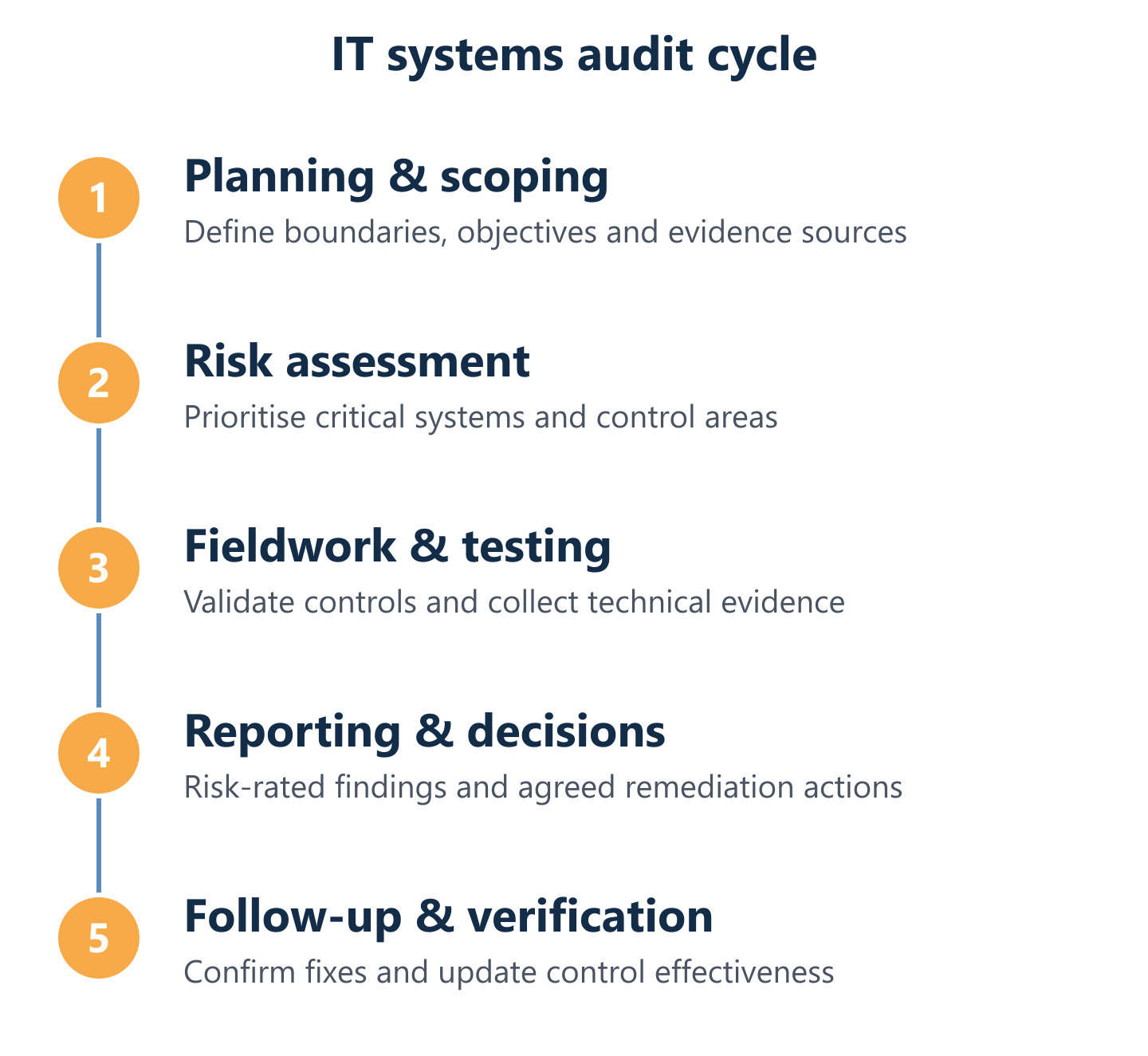
A structured IT systems audit methodology prevents the two most common failure modes: audits that are too narrow to surface real risk, and audits that produce findings too vague to act on. The methodology needs to be end-to-end—from initial planning and risk-based scoping through fieldwork and evidence collection to a prioritised report and a follow-up remediation cycle.
At Impulso Tecnológico, we apply a layered security approach that mirrors this methodology in practice. Audit findings feed directly into enforceable controls: firewall configuration reviews translate into updated rulesets; access control findings trigger privilege reviews; backup validation gaps trigger process changes backed by our managed services monitoring. The goal is not a report that sits in a drawer but a set of improvements that reduce downtime and strengthen security posture across the client's environment.
Key criteria for a methodology that delivers actionable results:
- Risk-based scoping: prioritise systems and controls by business impact, not by what is easiest to audit.
- Independence: the auditor should not be responsible for the controls they are testing—internal teams can support data gathering, but assessment requires objective review.
- Technical validation over documentation reliance: policies and procedures must be verified against observed system configurations and logs.
- Defined evidence standards: agree upfront what constitutes sufficient evidence for each control objective to avoid disputes at reporting stage.
- Prioritised, actionable findings: every finding should include a risk rating, the evidence supporting it and a specific recommended remediation action.
- Remediation follow-up: schedule a follow-up review to verify that critical findings have been addressed—a single point-in-time audit without follow-up provides limited assurance.
- Continuous monitoring as a complement: use the audit as a baseline, then support it with ongoing monitoring to detect drift between audit cycles.
End-to-end methodology: planning → fieldwork → reporting → follow-up
A robust IT systems audit follows four sequential phases. In the planning phase, the auditor defines scope, identifies key stakeholders, documents the systems inventory and performs an initial risk assessment to focus testing effort where exposure is highest. In the fieldwork phase, auditors collect technical evidence—configuration reviews, log analysis, vulnerability scans, access control testing and interviews—against each control objective. Evidence is documented contemporaneously to maintain an auditable record of what was tested, when and by whom. In the reporting phase, findings are structured by risk tier, each supported by specific evidence and accompanied by a recommended remediation action. The report should distinguish between design failures (a control that was never implemented correctly) and operating failures (a control that exists but is not functioning as intended). In the follow-up phase, critical and significant findings are tracked to closure, with verification testing confirming that remediation has been effective rather than assumed.
Compliance vs controls assessments: pros, cons and when to choose each
Organisations typically face a choice between two audit orientations. A compliance assessment measures the IT environment against a specific external standard—ISO/IEC 27001, NIST Cybersecurity Framework, GDPR technical requirements, SOC 2 criteria or sector-specific regulations. It answers the question: are we meeting the requirements of this framework? A controls effectiveness assessment takes a broader view, evaluating whether the controls in place—regardless of which framework they map to—are actually working to reduce risk. Choose a compliance assessment when you have a contractual, regulatory or certification obligation that requires demonstrated conformance with a named standard. Choose a controls assessment when your primary concern is operational risk reduction and you want an honest picture of control effectiveness rather than a checklist pass/fail. Many organisations benefit from both: a controls assessment first to identify and remediate gaps, followed by a compliance assessment once the environment is sufficiently mature. Impulso Tecnológico can support both orientations as part of its broader cybersecurity services for businesses.
Selecting an auditor and building an audit-ready roadmap
The most common pitfalls in IT systems auditing are avoidable with the right preparation. Unclear scope produces findings that cannot be prioritised because it is not clear which systems or controls they relate to. Weak risk-based prioritisation means audit effort is distributed evenly rather than concentrated where exposure is highest—resulting in thorough coverage of low-risk areas and superficial treatment of critical ones. Reliance on incomplete or unvalidated data produces findings that the auditee can dispute, undermining the report's credibility. To build an audit-ready posture, start by maintaining an accurate, up-to-date inventory of systems and their business criticality. Document existing controls and the policies that govern them. Ensure that logging is enabled and that logs are retained for a sufficient period. Test backup restoration regularly and document the results. When selecting an auditor—whether an internal team or an independent third party such as Impulso Tecnológico—verify that they have hands-on technical expertise in the specific environments being assessed, not just familiarity with audit frameworks. For a structured starting point, our guide to building an IT security plan provides a complementary framework for closing the gaps that an audit typically surfaces.
The scope definition, control objectives and evidence standards covered in this guide provide a practical foundation for turning IT systems audit findings into a prioritised remediation roadmap. The key is to treat the audit not as a compliance exercise but as a risk reduction tool: identify what is exposed, validate it with technical evidence, prioritise by business impact and track remediation to closure. Organisations that follow this cycle consistently find that their security posture improves measurably between audit cycles—and that incidents, when they do occur, are contained more quickly because the controls and response procedures have already been tested and validated.