

Network security is the combination of policies, controls, and technologies that protect the confidentiality, integrity, and availability of data and systems as traffic moves across your infrastructure. It covers everything from firewalls and intrusion detection to access rules, segmentation, and monitoring.
Most organisations recognise they need network security, but many still rely on a single perimeter control—typically a firewall—and assume that is sufficient. It rarely is. Attackers today move laterally once inside, exploit misconfigured access rules, and dwell undetected for weeks before causing visible damage. The result is data loss, operational disruption, and regulatory exposure that a single control cannot prevent.
A layered approach changes that equation. By combining network intrusion detection, firewall access control, segmentation and least privilege, and continuous security monitoring and incident response, organisations reduce both the likelihood and the impact of a breach. At Impulso Tecnológico, we deliver this as a managed, end-to-end framework—starting with a security audit to identify gaps, then embedding controls into ongoing managed services so protection improves continuously rather than degrading between projects.
What Network Security Means in Practice
Network security is not a product category—it is a programme of controls that governs how traffic is permitted to flow, who can access what, and how quickly threats are detected and contained. For a business, that translates into three operational responsibilities: keeping sensitive data away from unauthorised parties, ensuring that data and systems remain accurate and unaltered, and maintaining service availability even under attack or failure.
At Impulso Tecnológico, we frame network security as end-to-end protection of business traffic—from the local network through endpoints and remote access paths to cloud workloads. Rather than deploying isolated products, we connect network protection, endpoint security, vulnerability management, and access security into one layered framework that can be tailored to each client's environment and scaled as the organisation grows.
| Security Outcome | Business Responsibility | Primary Controls | Failure Impact |
|---|---|---|---|
| Confidentiality | Restrict data access to authorised users and systems | Firewall access control, encryption, VPN, NAC | Data breach, GDPR penalty, reputational damage |
| Integrity | Ensure data and configurations are not altered without authorisation | IDS/IPS, file integrity monitoring, patch management | Corrupted records, compliance failures, operational errors |
| Availability | Maintain service continuity under attack or failure | DDoS mitigation, redundancy, backup and disaster recovery | Revenue loss, SLA breach, customer churn |
| Governance | Demonstrate control effectiveness to auditors and regulators | Logging, monitoring, policy documentation, incident response plans | Audit findings, regulatory action, insurance disputes |
CIA triad outcomes: confidentiality, integrity, availability
The CIA triad gives network security its operational logic. Confidentiality means that only authorised users and systems can read sensitive data—enforced through firewall access control, encryption in transit and at rest, and strong authentication before any session is established. Integrity means that data and system configurations remain accurate and unaltered; controls such as network intrusion detection systems and patch management catch unauthorised changes before they propagate. Availability means that legitimate users can reach the services they need, even during a DDoS attempt or hardware failure—requiring redundancy, traffic filtering, and tested recovery procedures. When one pillar is neglected, the others weaken: an availability-focused design that skips encryption sacrifices confidentiality, while an overly restrictive access policy can undermine availability. Balancing all three is the practical work of network security programme design.
Defence in depth: layered controls across the traffic path
Defence in depth is the principle that no single control should be the last line of defence. In practice, it means placing controls at every point where traffic flows: at the network perimeter (next-generation firewalls, gateway antivirus, spam filtering), inside the network (segmentation, internal IDS/IPS, network access control), at the endpoint (personal antivirus, host-based firewall, patch enforcement), and at the access layer (VPN, multi-factor authentication, Zero Trust Network Access policies). When one layer is bypassed—for example, a phishing email that evades gateway filtering—the endpoint control and the segmentation policy still limit the damage. This is not redundancy for its own sake; each layer addresses a different attack vector and a different phase of the attack lifecycle, from initial access through lateral movement to data exfiltration. Impulso Tecnológico designs these layers to work together, not as independent products.
Security governance: policies, roles, and measurable objectives
Technical controls without governance are incomplete. A firewall with no documented access policy review cycle will accumulate stale rules; an IDS with no alert triage process generates noise rather than intelligence. Governance means defining who owns each control, what the acceptable-use and access policies say, how incidents are escalated, and what metrics prove the programme is working. Measurable objectives might include mean time to detect (MTTD), mean time to respond (MTTR), patch compliance rates, and the number of unreviewed firewall rules. Impulso Tecnológico embeds governance into its managed services model: proactive monitoring, scheduled maintenance windows, and regular reporting give clients visibility into their security posture without requiring an internal security operations team. For organisations subject to GDPR, this documented, measurable approach also supports the accountability obligations required by the regulation.

The Threats Network Security Must Stop
Understanding the threat landscape before selecting controls prevents the common mistake of over-investing in perimeter defences while leaving internal paths unprotected. Threats arrive in two broad categories—passive and active—and each demands a different control response. Impulso Tecnológico typically begins an engagement with a customised security audit for SMEs, mapping the most likely attack vectors in the client's specific environment before recommending improvements.
- Reconnaissance and passive interception: Attackers observe traffic, scan for open ports, or capture unencrypted data without triggering obvious alerts—addressed by encryption, network visibility and analytics, and reducing the exposed attack surface.
- Exploitation of perimeter weaknesses: Unpatched vulnerabilities or misconfigured firewall rules allow initial access—addressed by vulnerability management, firewall access control review, and gateway-level intrusion prevention.
- Lateral movement inside the network: Once inside, attackers pivot between systems using stolen credentials or unprotected internal paths—addressed by segmentation and least privilege, internal IDS/IPS, and network access control.
- Data exfiltration or ransomware deployment: The attacker's objective phase—addressed by egress filtering, endpoint protection, and tested backup and disaster recovery procedures.
- Denial-of-service and availability attacks: Flooding services to disrupt operations—addressed by DDoS mitigation, traffic rate limiting, and redundant connectivity.
Mapping controls to these phases ensures budget is allocated where risk is highest, not where marketing is loudest. Our security audit deliverable identifies which phases are currently under-controlled in your environment and sequences remediation accordingly.
Passive vs active attacks: what changes in your controls
Passive attacks—eavesdropping, traffic analysis, port scanning—are designed to gather information without being detected. They do not modify data or disrupt services, which means traditional availability monitoring will not catch them. The primary defences are encryption (so captured traffic is unreadable), network visibility and analytics (to detect anomalous scanning patterns), and minimising what is exposed on the network in the first place. Active attacks, by contrast, involve direct interaction: exploiting vulnerabilities, injecting malicious traffic, deploying ransomware, or flooding a service. These generate observable signals—connection anomalies, failed authentication spikes, unusual outbound traffic—that network intrusion detection systems and SIEM platforms are designed to surface. The control implication is that passive threats require a confidentiality-first posture, while active threats require detection speed and containment capability. A mature network security programme addresses both simultaneously.
Control mapping: firewalls, IDS/IPS, and segmentation policies
Firewalls enforce access policy at traffic boundaries—deciding which connections are permitted based on source, destination, port, and application. Next-generation firewalls (NGFWs), such as those from Fortinet and Sophos that Impulso Tecnológico deploys, add deep packet inspection, application awareness, and integrated threat intelligence to that decision. IDS/IPS systems sit inline or passively on the network to detect and block known attack signatures and behavioural anomalies—catching threats that pass through the firewall by appearing legitimate. Segmentation policies divide the network into zones (for example, separating production servers, user workstations, guest Wi-Fi, and OT/ICS systems) so that a compromised device in one zone cannot directly reach assets in another. Together, these three controls implement the principle of least privilege at the network layer: traffic is only permitted where there is a documented business reason, and everything else is denied by default. This containment approach directly limits the blast radius of any successful intrusion.
Deception and resilience: reducing attacker dwell time
Attacker dwell time—the period between initial compromise and detection—is one of the most consequential metrics in network security. The longer an attacker remains undetected, the more systems they can access and the more data they can exfiltrate. Deception technologies such as honeypots and honeynets place decoy assets inside the network; any interaction with them is a high-confidence indicator of compromise, because legitimate users have no reason to access them. Alongside deception, continuous logging and alert triage through security monitoring and incident response processes ensure that signals from IDS/IPS, firewall logs, and endpoint telemetry are reviewed and acted upon rather than accumulating unseen. Impulso Tecnológico's managed services model includes proactive monitoring as a standard component, so anomalies are flagged and investigated during business hours rather than discovered retrospectively during an incident. Shorter dwell time directly reduces the cost and scope of a breach.
Core Building Blocks and a Decision Roadmap
Selecting the right network security controls requires matching each building block to your environment's risk profile, architecture, and operational capacity. The four foundational layers are identity and access, policy and segmentation, detection and monitoring, and resilience and recovery. Impulso Tecnológico operationalises these through managed services—proactive monitoring, scheduled maintenance, vulnerability management including patching and penetration testing—aligned with the client's network, endpoints, and backup infrastructure so that security and continuity reinforce each other.
Use the following criteria to prioritise your control investments:
- Where is your highest-value data? Start with controls that protect the systems storing or transmitting that data—segmentation, encryption, and strict firewall access control around those assets.
- How do your users connect? Remote workers and distributed locations require VPN or Zero Trust Network Access policies; on-site-only environments have different perimeter priorities.
- What is your patch latency? Organisations with slow patch cycles need compensating controls (IPS signatures, network segmentation) to reduce exposure during the window between vulnerability disclosure and remediation.
- Do you have OT, IoT, or industrial systems? These require dedicated segmentation zones and specialised monitoring, as standard IT controls may disrupt operational technology protocols.
- What are your compliance obligations? GDPR, ISO 27001, and sector-specific frameworks each imply specific control requirements—governance documentation, incident response plans, and demonstrable access control are common threads.
- What is your internal security capacity? Organisations without a dedicated security team benefit most from a managed services model that embeds monitoring and maintenance rather than relying on periodic reviews.
Identity and policy: authentication, access rules, and secure remote connectivity
Identity is the new perimeter. When users connect from home, coffee shops, or partner sites, the network boundary is no longer a reliable control point—what matters is whether the user and device are who they claim to be, and whether the access they are requesting is authorised. Multi-factor authentication (MFA) is the minimum baseline; it blocks the majority of credential-based attacks at negligible cost. Beyond MFA, access rules should follow least privilege: users receive only the permissions required for their role, reviewed regularly and revoked promptly when roles change. For remote connectivity, VPN remains appropriate for many SME environments, while Zero Trust Network Access provides more granular, session-level control for organisations with distributed workforces or sensitive workloads. Impulso Tecnológico implements secure password practices, VPN deployment, and encryption for remote access paths as part of its standard user access security layer, ensuring that remote sessions do not become the weakest link in an otherwise well-controlled network.
Segmentation and least privilege: designing zones and traffic boundaries
Network segmentation divides infrastructure into logical zones with controlled traffic boundaries between them. A practical segmentation model for a mid-sized organisation typically includes at minimum: a DMZ for internet-facing services, a user workstation zone, a server zone for internal applications and data, a management zone for administrative access, and isolated zones for guest Wi-Fi, IoT devices, and any OT or industrial systems. Traffic between zones is permitted only where there is an explicit, documented business requirement—everything else is denied. This design means that a ransomware infection on a workstation cannot directly reach the backup server or the finance application, because the segmentation policy blocks that path. Least privilege extends this logic to user accounts and service accounts: no account should have broader access than its function requires. Impulso Tecnológico designs segmentation architectures using Fortinet and Cisco technologies, with policy documentation that supports both operational management and compliance audit requirements.
Monitoring and readiness: telemetry, alerting, and incident response readiness
Controls without visibility are assumptions. Security monitoring and incident response readiness transform your control stack from a static configuration into an active defence. Telemetry sources—firewall logs, IDS/IPS alerts, endpoint events, authentication logs, and DNS query data—feed into a centralised platform where anomalies can be correlated and prioritised. Network visibility and analytics tools identify behavioural deviations: a workstation suddenly scanning internal subnets, an account authenticating at an unusual hour, or a server establishing outbound connections to an unfamiliar geography. AI-assisted alert prioritisation reduces the noise burden on analysts by surfacing high-confidence indicators ahead of low-priority events. Incident response readiness means having a documented plan, tested regularly, so that when an alert escalates to a confirmed incident, the response is structured rather than improvised. Impulso Tecnológico's managed services include proactive monitoring as a core component, with 4,000 annual solved IT tickets reflecting the operational depth behind the security approach. For further context on building a structured security programme, our guide to IT security planning and implementation covers the governance and programme design layer in detail.
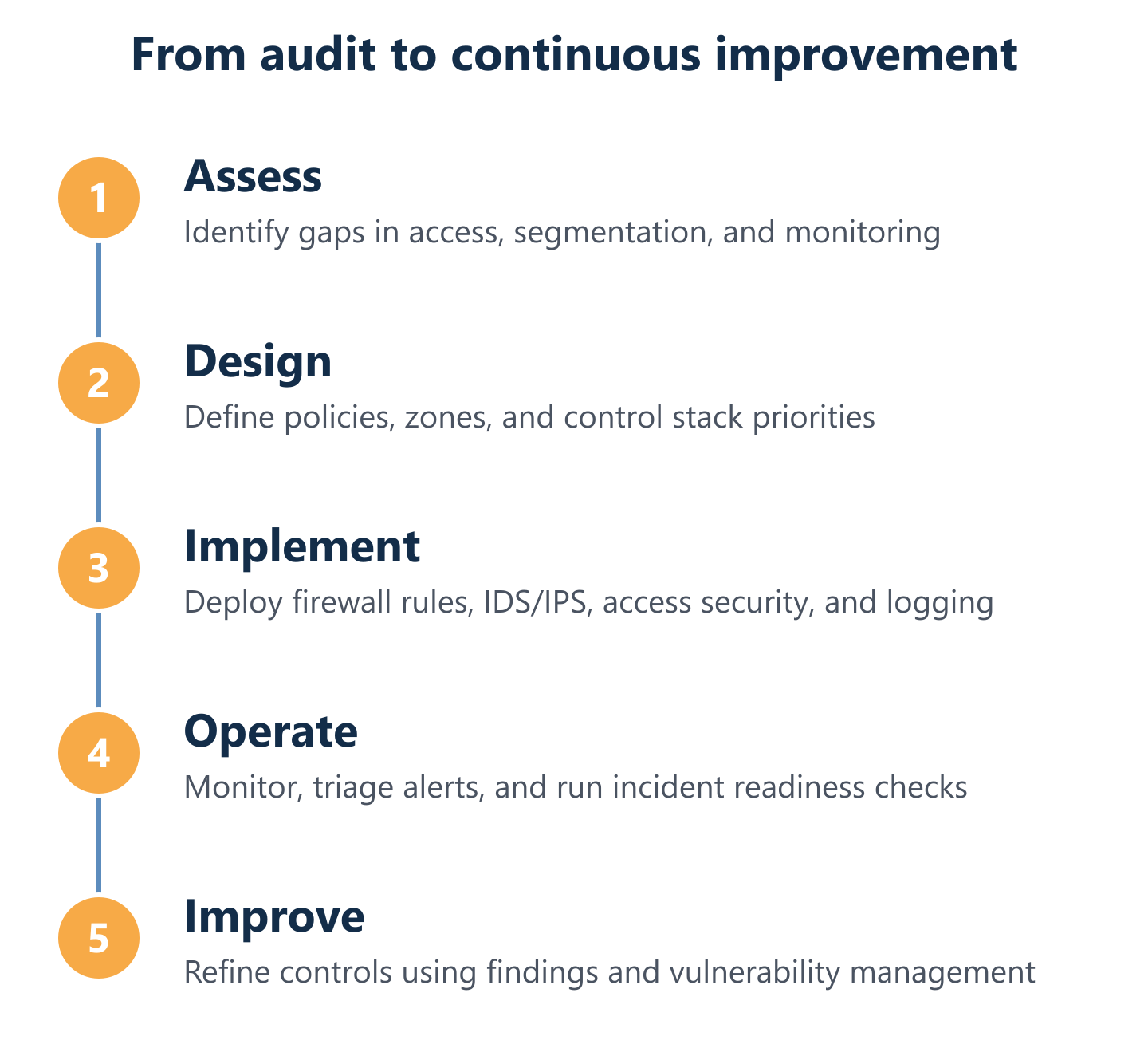
Building effective network security is a sequenced process, not a one-time purchase. Start by identifying your highest-risk traffic paths and the assets most likely to be targeted, then apply controls in layers—perimeter, internal, access, and endpoint—before investing in advanced monitoring and analytics. Prove effectiveness through measurable metrics: patch compliance rates, mean time to detect, and firewall rule review cycles. Continuous improvement, supported by regular vulnerability assessments and penetration testing, ensures your posture keeps pace with evolving threats. If you are ready to assess where your network security programme stands today, Impulso Tecnológico's security audit is the practical starting point—identifying gaps and sequencing remediation so that every investment reduces real risk. You may also find value in our detailed guide to security IT audits and our overview of cybersecurity for businesses to complement the network-level controls covered here.