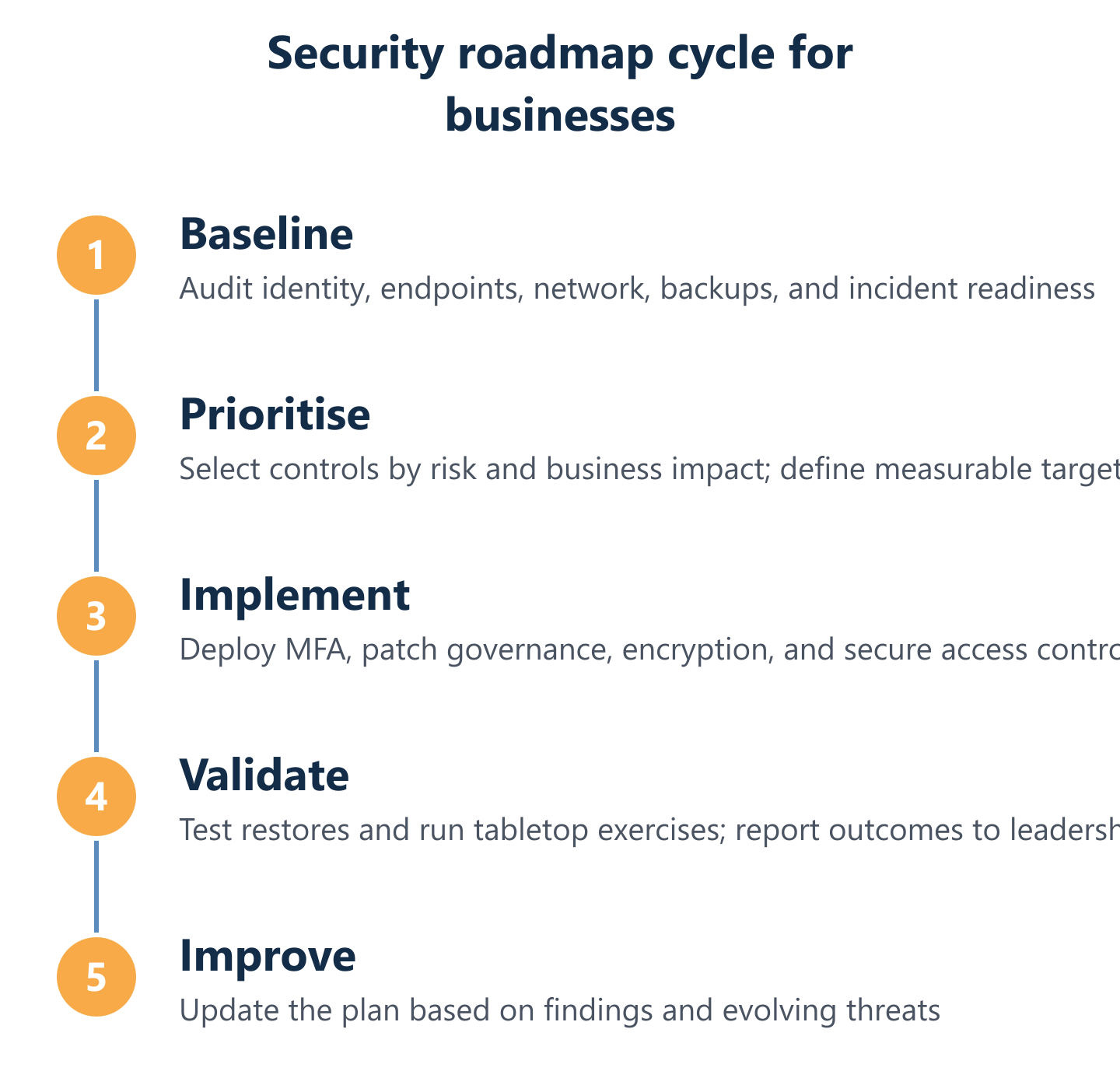

IT security for businesses means identifying your critical assets, applying the controls that reduce your most likely risks, and running security as an ongoing operational programme—not a one-off project. Businesses that treat it this way suffer fewer costly incidents and recover faster when something does go wrong.
Most organisations understand that a data breach or ransomware attack can halt operations, damage customer trust, and trigger regulatory consequences. Yet many still approach IT security reactively—patching after problems surface, backing up without testing restores, or deploying tools without governance to ensure they are actually working. The result is a false sense of protection.
The practical alternative is a structured programme: map your assets, assign ownership, enforce controls such as MFA and patch management, and test your incident response before you need it. At Impulso Tecnológico, we have seen across more than 25 years of managed IT services that the businesses with the fewest serious incidents are those that treat security as an operational discipline—monitored, measured, and continuously improved. This blueprint gives you the framework to do exactly that.
Define business risk and what "secure" means for your organisation
Before deploying any tool or writing any policy, your organisation needs a shared definition of what "secure" actually means in your context. Without it, security budgets get spent on controls that address theoretical risks while the real exposures—unpatched servers, untested backups, accounts with no MFA—remain open. The starting point is a structured security audit that maps your critical assets, identifies your most likely threat scenarios, and translates those into prioritised controls.
At Impulso Tecnológico, every managed IT engagement begins with an initial audit covering antivirus status, backup posture, desktop and server readiness, and communications infrastructure. This baseline makes security measurable: you know what you have, what is exposed, and what needs to change first. For businesses in Spain and Portugal, this is particularly relevant because operational environments vary significantly between sectors—a logistics company faces different exposure than a professional services firm.
The table below illustrates how the definition of "secure" shifts depending on your organisation's profile:
| Business profile | Primary risk | Key security definition | Priority controls |
|---|---|---|---|
| SME (10–50 users) | Ransomware, phishing | No single incident halts operations for more than 4 hours | MFA, endpoint protection, tested backups |
| Mid-market (50–250 users) | Insider threat, supply chain | Access is least-privilege; third-party risk is assessed | Identity governance, patch management, vendor controls |
| Regulated sector (healthcare, finance) | Data breach, GDPR breach | Data is encrypted, access is audited, breaches are notifiable within 72 hours | Encryption, audit logging, incident response plan |
| Multi-site or international | Network perimeter gaps, remote access | Consistent controls across all sites; remote access is secured | Firewall management, VPN/ZTNA, centralised monitoring |
Security outcomes: fewer incidents, faster containment, reliable recovery
Security investment only makes sense when it is tied to outcomes your business actually cares about. Three metrics matter most: how often incidents occur, how quickly they are contained, and how reliably you can recover. A ransomware attack that encrypts your file server is not primarily a technical problem—it is a business continuity problem measured in hours of downtime, lost revenue, and customer confidence.
When Impulso Tecnológico structures a managed IT security engagement, response times are contractually defined: under eight working hours for standard requests and under four hours for urgent issues affecting servers or the whole business. These SLAs exist precisely because containment speed determines the blast radius of any incident. Translate your security controls into these three outcome categories—reduction in incident frequency, mean time to contain, and recovery time objective—and you have a language that board-level stakeholders understand and can act on.
Asset and data mapping for realistic protection planning
You cannot protect what you have not inventoried. Asset and data mapping means identifying every endpoint, server, identity system, network segment, and cloud service your business relies on—then understanding what data flows through each. This is not a one-time exercise; it needs to be reviewed whenever infrastructure changes, a new cloud service is adopted, or a supplier is onboarded.
For practical purposes, start with five categories: endpoints (laptops, desktops, mobiles), servers (on-premise and cloud), identity systems (Active Directory, Azure AD, SSO), network infrastructure (firewalls, switches, wireless), and data stores (file servers, databases, Microsoft 365 tenants, backup repositories). For each, record who owns it, what data it holds or processes, and what would happen to the business if it were unavailable for 24 hours. This exercise consistently reveals assets that are unmanaged, unpatched, or outside any backup scope—which is where breaches tend to start. A formal IT systems audit provides the structured methodology to complete this mapping reliably.
Risk baseline to prioritise controls and budgets
Compliance checklists tell you what controls exist; risk assessment tells you which ones matter most for your organisation. A risk baseline combines likelihood (how probable is this threat given your environment?) with impact (what would it cost if it happened?) to produce a prioritised list of actions—not an alphabetical inventory of every possible safeguard.
The NIST Cybersecurity Framework and CISA's Known Exploited Vulnerabilities (KEV) catalogue are two practical tools for establishing this baseline without building a bespoke methodology from scratch. The KEV catalogue, for instance, identifies vulnerabilities that are actively being exploited in the wild—patching those first is a direct risk reduction, not just a compliance tick. Budget allocation should follow the same logic: controls that reduce your highest-probability, highest-impact risks get funded first. Controls that address theoretical scenarios at the margins get deferred. A well-structured security IT audit gives you the evidence base to make these decisions defensibly.

Build a leadership-owned security culture with measurable objectives
Security culture fails when it is delegated downward without genuine ownership at the top. When leadership treats security as an IT department concern rather than a business priority, enforcement weakens, budgets shrink at the wrong moments, and employees learn that security policies are optional. The result is predictable: controls exist on paper but are not consistently applied.
Building a leadership-owned security culture requires four concrete steps:
- Assign executive accountability. The CEO or a designated board-level sponsor must own the security programme—not merely approve it. This means reviewing the incident response plan, receiving regular security metrics, and visibly championing MFA enforcement and patching targets.
- Appoint a Security Programme Manager or IT lead. Someone must be accountable for day-to-day delivery, reporting, and escalation. In smaller businesses this may be an external managed service provider; in larger organisations it is an internal role with clear authority.
- Set measurable targets, not aspirations. Define specific objectives: MFA enabled for all privileged accounts by a set date, critical patches applied within 72 hours of release, backup restores tested quarterly. Vague goals produce vague outcomes.
- Embed security into operations, not alongside them. Security reviews happen at every change, not only after incidents. At Impulso Tecnológico, proactive review is built into every support ticket—each interaction is an opportunity to prevent further damage or identify an emerging risk before it escalates.
With SLAs aligned to real business needs and a human, technically expert team, Impulso Tecnológico supports organisations in making security a measurable operational discipline rather than a periodic project.
Turn culture into targets: MFA, patching, backup testing, and access hygiene
Measurable security objectives are what separate a genuine programme from a policy document. Four targets should be non-negotiable for any business serious about IT security. First, MFA adoption: every privileged account and every externally accessible system must have multi-factor authentication enforced—not encouraged. Microsoft data consistently shows that MFA blocks the overwhelming majority of credential-based attacks. Second, patch coverage: define a maximum time-to-patch for critical vulnerabilities (72 hours is a defensible target for actively exploited flaws) and track compliance weekly. Third, backup testing: a backup that has never been restored is an assumption, not a control—quarterly restore drills should be a standing agenda item. Fourth, access hygiene: review user accounts and permissions quarterly, remove leavers immediately, and enforce least-privilege. These four targets, tracked and reported to leadership, give your security culture measurable teeth. Effective IT security plan implementation structures these targets into a coherent programme.
Role-based governance: who approves, who implements, who escalates
Role clarity is the structural foundation of a functioning security programme. Without it, critical decisions—whether to isolate a compromised system, when to notify affected customers, who authorises emergency access—get delayed or made by the wrong person under pressure. Define three layers before an incident occurs.
The approver (CEO or board sponsor) sets risk appetite, approves the incident response plan, and makes decisions with business-wide consequences. The implementer (Security Programme Manager, IT lead, or MSP) executes controls, manages vendors, monitors systems, and reports metrics upward. The escalation path defines precisely when and how the implementer escalates to the approver—for example, any incident affecting more than ten users or involving confirmed data exfiltration triggers immediate executive notification. Document these roles in your incident response plan and test them in tabletop exercises so they are instinctive, not improvised. For businesses without internal IT capacity, a managed service provider with defined SLAs effectively fills the implementer and escalation roles.
Operational adoption: training, reporting, and measurable compliance
Training works when it changes behaviour, not when it satisfies an annual compliance requirement. The most effective security training programmes are short, frequent, and tied to real scenarios your employees actually encounter—phishing simulations based on current attack patterns, for instance, rather than generic e-learning modules. Track completion rates and, more importantly, click rates on simulated phishing campaigns over time: a downward trend in clicks is evidence that training is working.
Reporting closes the loop between training and governance. Monthly security metrics—MFA adoption rate, outstanding critical patches, backup restore results, open access review items—should be visible to leadership, not buried in an IT ticketing system. When employees see that security metrics are reviewed at the top, they understand that secure behaviour is expected and enforced. Pair reporting with a clear, low-friction way for staff to report suspicious activity: a dedicated email alias or a single-click button in the email client removes the friction that causes incidents to go unreported.

Implement core controls and operational resilience using NIST CSF
The NIST Cybersecurity Framework (CSF) 2.0 provides a free, voluntary, and sector-agnostic structure for managing IT security as a continuous programme. Its six functions—Govern, Identify, Protect, Detect, Respond, Recover—map directly onto the controls and processes that stop common compromises and enable reliable recovery. Using it as a management layer means you can track progress, identify gaps, and report maturity to stakeholders in a language that is internationally recognised.
Before applying the framework, however, you need the core technical controls in place. At Impulso Tecnológico, our managed-security approach centralises IT, backup, and support so these controls are maintained continuously rather than configured once and forgotten. Key elements of our security delivery include:
- Endpoint and perimeter protection using Sophos and Fortinet solutions, deployed and actively managed—not just installed.
- Backup and disaster recovery underpinned by Veeam, with restore validation built into the service cycle rather than treated as optional.
- Identity and access management across Microsoft 365 and Azure environments, including MFA enforcement and licensing governance.
- Network security designed around Cisco, Aruba, and Fortinet infrastructure, with secure wireless configurations and access control systems.
- Proactive monitoring that identifies anomalies before they become incidents, with defined escalation paths and contractual response times.
- Third-party risk management considerations built into vendor selection and supplier access controls, addressing a gap that most generic checklists overlook.
This integrated approach means security is not a layer added on top of IT operations—it is embedded within them.
The practical control checklist: identity, endpoints, networks, and data protection
A prioritised IT security checklist for SMEs should address four domains in order of attack-path frequency. Identity: enforce MFA on all accounts with administrative privileges and all externally accessible services; audit accounts quarterly and remove leavers within 24 hours; use unique, long passwords (minimum 16 characters) stored in a password manager. Endpoints: deploy endpoint protection (EDR, not legacy antivirus) on every managed device; apply critical patches within 72 hours using a formal patch management prioritisation process aligned to the CISA KEV catalogue; disable unused services and ports. Networks: segment networks so that a compromised endpoint cannot reach your entire environment; enforce WPA3 on wireless; change default router credentials; isolate guest and payment card networks. Data protection: encrypt data at rest and in transit; maintain at least three backup copies on two different media types, with one offsite or cloud-based; test restores quarterly and document the results. These controls, consistently applied, eliminate the attack paths responsible for the majority of business-impacting incidents. For a broader view of network-layer protections, our network security guidance covers perimeter and internal controls in depth.
Incident response that works: tabletop cadence and restore verification
An incident response plan that has never been tested is a document, not a capability. Tabletop exercises—structured simulations where your team walks through a realistic attack scenario—reveal gaps in roles, communication, and decision-making before a real incident exposes them under pressure. Run at least two tabletop exercises per year: one for a ransomware scenario (the most common business-impacting attack type) and one for a data breach requiring GDPR breach notification within 72 hours.
Restore verification is the operational equivalent of a tabletop exercise for your backup system. Schedule quarterly restore drills: select a representative set of files or a full system image, restore to an isolated environment, and verify that the data is complete and usable. Document the result—restore time, data integrity, any failures—and report it to leadership. If a restore fails in a drill, it would have failed during a ransomware recovery. Catching that failure in a controlled test is the difference between a managed recovery and a business-critical outage.
NIST CSF delivery model: track improvements and reporting for stakeholders
NIST CSF implementation for IT security gives organisations a structured way to move from reactive firefighting to a managed programme with visible progress. The six functions provide a natural reporting structure: Govern (policies, roles, risk appetite defined); Identify (asset inventory and risk assessment complete); Protect (controls deployed and enforced); Detect (monitoring active and alerting); Respond (incident response plan tested); Recover (backups verified, recovery procedures documented). For each function, assign a maturity level—from initial (ad hoc) to optimised (continuously improved)—and set a target maturity for the next review cycle. This gives leadership a clear, honest picture of where security stands and what investment is needed to improve it. Quarterly reporting against these six functions replaces vague assurances with evidence-based governance, which is increasingly expected by insurers, customers, and regulators alike.
IT security for businesses is not a destination—it is an operational discipline that requires consistent ownership, measurable targets, and regular testing. Organisations that align their security programme to business outcomes, assign genuine accountability, and validate their controls through exercises and restore drills are the ones that contain incidents quickly and recover reliably. The controls exist; the frameworks exist; what separates effective security from expensive theatre is the rigour with which they are applied and maintained. If you are ready to move from a reactive posture to a structured, managed security programme, the next step is a structured assessment of where you stand today.