
Businesses in San Sebastián de los Reyes need IT support that resolves incidents quickly, keeps systems secure, and prevents problems before they disrupt operations. A managed IT support model — combining remote assistance, on-site intervention when needed, and proactive maintenance — delivers exactly that: fewer breakdowns, faster recovery, and predictable monthly costs.
For many companies in the area, the real challenge is not a single dramatic failure but the accumulation of small disruptions: a user locked out of their account, a server backup that silently stopped running, a workstation slowing down production. Without a dedicated IT partner, these issues pile up and erode productivity. Impulso Tecnológico addresses this by acting as an external IT department — conducting an initial audit of your infrastructure, building a full device inventory, and then delivering structured support through remote assistance and on-site visits with documented response targets. The result is a stable, secure environment where your team can focus on the work that matters, not on chasing technical problems.
IT Support San Sebastian de los Reyes: what's included and who it's for
IT support is not a single service — it is a structured set of activities that keeps your people working and your infrastructure healthy. For businesses in San Sebastián de los Reyes, the scope typically spans three layers: user-facing helpdesk (resolving day-to-day incidents with devices, applications, and connectivity), infrastructure management (servers, networks, backups, and endpoint health), and proactive maintenance (patching, antivirus checks, and performance reviews before problems appear).
Impulso Tecnológico enters every engagement with an initial, complete audit of the systems that affect smooth performance — antivirus status, backup integrity, server condition, and communications — alongside a full inventory of the devices to be maintained. This baseline removes guesswork and allows the team to prioritise interventions by real risk rather than assumption. The model suits companies that lack an internal IT team entirely, as well as those with one or two internal staff who need specialist coverage for complex incidents or planned projects.
| Service layer | Typical activities | Who benefits most |
|---|---|---|
| Helpdesk & user support | Password resets, application errors, printer issues, connectivity faults | All staff; companies with no internal IT |
| Infrastructure management | Server monitoring, backup verification, network health checks, endpoint updates | SMEs with servers or multi-site setups |
| Preventive maintenance | Patch management, antivirus health, disk and performance reviews | Any business wanting to reduce recurring incidents |
| Security layer | Firewall management, access hygiene, vulnerability scanning, backup policy | Companies handling sensitive data or subject to GDPR |
| Consultancy & reporting | Post-incident reports, technology roadmap advice, licence management | Growing businesses planning infrastructure changes |
Core services: helpdesk, incidents, and preventive maintenance
The helpdesk is the first point of contact when something stops working: a user cannot access a shared drive, an application throws an error mid-workflow, or a peripheral fails during a busy period. Impulso Tecnológico handles these requests through a structured ticketing system that logs, prioritises, and tracks every interaction to resolution. Beyond reactive fixes, the same team runs scheduled preventive maintenance — reviewing antivirus status, confirming backup jobs completed successfully, and applying operating system and application patches before vulnerabilities become exploitable. This combination of reactive helpdesk and proactive maintenance is what separates a managed IT support model from a simple break-fix arrangement, and it directly reduces the frequency and severity of incidents over time.
Managed IT coverage for 3 to 150 users/PCs (with or without internal IT)
Impulso Tecnológico's managed IT support is designed for organisations ranging from small offices with three workstations to mid-sized companies running 150 endpoints across multiple departments. The service scales in both directions: for businesses without any internal IT staff, it functions as a complete external IT department; for those with one or two internal technicians, it provides specialist depth and on-site capacity that an in-house generalist cannot always cover alone. Device management covers Windows workstations, laptops, peripherals, and connectivity — ensuring each endpoint is patched, monitored, and performing within expected parameters. This structured coverage means that as your team grows or your infrastructure evolves, the support model adapts without requiring a new contract from scratch.
Reporting and continuous improvement after each intervention
After every intervention — whether a remote fix or an on-site visit — Impulso Tecnológico provides a detailed report documenting the problem identified, the solution applied, and any secondary findings observed during the session. This is not administrative box-ticking: it creates a traceable history of your infrastructure's health, surfaces recurring patterns that point to deeper issues, and gives management a clear view of IT activity without needing technical expertise to interpret it. The continuous improvement mindset means that each visit also includes a review of adjacent systems — if a technician resolves a server issue, they check backup integrity and network performance at the same time — preventing the knock-on failures that typically follow undetected secondary problems.

Remote and on-site support: response times and working method
Delivering IT support in San Sebastián de los Reyes follows a structured sequence that balances speed with the right level of intervention. Remote resolution handles the majority of incidents faster and at lower cost; on-site dispatch is reserved for situations where physical access to hardware or the local network is genuinely required. The process works as follows:
- Initial audit and inventory: Before support begins, Impulso Tecnológico conducts a complete assessment of your systems — servers, workstations, backups, antivirus, and communications — to establish a reliable baseline and eliminate unknown risks.
- Ticket registration: Every incident is logged in the ticketing system with a timestamp, initial severity classification, and assigned owner, ensuring nothing is handled informally or forgotten.
- Remote-first triage: The support team connects remotely to diagnose and resolve the issue. Most user-facing incidents — application errors, access problems, configuration faults — are resolved at this stage without any travel time.
- On-site escalation when required: When remote resolution is not sufficient — hardware failure, physical network fault, or a situation requiring hands-on intervention — a technician is dispatched to the client's premises in San Sebastián de los Reyes or the surrounding Madrid area.
- Resolution confirmation and report: The incident is closed only after the user or responsible contact confirms the issue is resolved, and a written report is issued documenting findings and actions taken.
- Post-incident system review: The technician reviews adjacent systems to catch secondary issues before they escalate, reducing the likelihood of a follow-up incident within the same maintenance cycle.
This structured approach, backed by Impulso Tecnológico's experience across clients in Spain, Portugal, and international markets, gives businesses in San Sebastián de los Reyes a predictable, documented support experience rather than an ad-hoc reaction to each crisis.
How we triage issues: severity, impact, and fastest path to resolution
Not all incidents carry the same weight. A single user unable to print is a different priority from a server that has stopped responding or a backup job that has failed silently for three days. Impulso Tecnológico classifies incoming tickets by severity — based on the number of users affected, the business process at risk, and the potential for data loss or extended downtime — and routes each one to the appropriate response path. Critical incidents affecting core infrastructure or multiple users are escalated immediately; lower-severity requests are queued and resolved within the agreed service window. This triage logic, built into the ticketing workflow, ensures that unlimited remote support capacity is directed where it has the greatest operational impact rather than handled on a first-come, first-served basis.
Typical response targets: servers within 4 hours and other PCs within 8 business hours
Impulso Tecnológico's maintenance conditions establish clear on-site response targets: for server incidents, a technician is dispatched within four hours of the breakdown being registered; for other workstations and devices, on-site attendance is provided within eight business hours. These targets apply after remote resolution has been attempted and ruled out, meaning the clock starts from ticket registration rather than from the moment a technician is assigned. For businesses in San Sebastián de los Reyes — located within the Madrid metropolitan area — these timelines are operationally achievable and give operations managers a concrete basis for business continuity planning. Knowing that a critical server failure will receive physical attention within half a working day changes how a company can design its contingency procedures and staff communication protocols.
Contract options: hourly, monthly hours, or flat-rate models with structured coverage
Impulso Tecnológico offers three principal contract structures so that businesses in San Sebastián de los Reyes can match their support model to their actual risk profile and budget:
- Hourly packages: Suitable for companies with low incident frequency that need reliable access to expert support without committing to a monthly retainer. Hours are consumed as needed.
- Monthly hour rate: A fixed block of hours each month, providing predictable cost and priority access to the support team — a practical fit for growing SMEs managing 10–50 users.
- Flat-rate model: Combines unlimited remote assistance within the agreed scope with structured on-site coverage and defined SLAs. This eliminates per-incident billing and is the preferred model for companies where IT availability is directly tied to revenue or operational output.
All models include documented SLAs to remove uncertainty around response expectations. If you want to understand the cost implications of each model before committing, our IT maintenance pricing guide breaks down the key variables and typical investment ranges.
Incident tickets, maintenance, and security: from diagnosis to protection
An IT support service that only reacts to incidents is, by definition, always behind the problem. The operational cycle that Impulso Tecnológico applies in San Sebastián de los Reyes integrates three connected disciplines — structured ticket handling, scheduled preventive maintenance, and a layered security posture — so that each reinforces the others.
- Every incident generates documented evidence: Tickets are not closed until the resolution is confirmed and a report is issued, creating an auditable trail of infrastructure health over time.
- Preventive tasks run on a fixed schedule: Antivirus health checks, backup verification, patch deployment, and disk performance reviews happen regardless of whether an incident has been raised — catching degradation before it becomes failure.
- Security is embedded, not bolted on: Firewall configuration, endpoint protection, and access hygiene are reviewed as part of the standard maintenance cycle, not treated as a separate project.
- Patch management closes known vulnerabilities systematically: Operating system and application updates are tested and deployed within the agreed maintenance window, reducing the attack surface without disrupting business hours.
- Backup integrity is verified, not assumed: A backup that has never been tested is not a backup. Impulso Tecnológico confirms that recovery procedures work before they are needed, using solutions from partners including Veeam.
- Security settings adapt to your environment: Access controls, remote access policies, and endpoint configurations are adjusted according to market standards, GDPR requirements, and each client's specific operational context.
For businesses handling sensitive data or operating in regulated sectors — healthcare, logistics, professional services — this integrated approach is not optional; it is the minimum viable standard for responsible IT management.
Ticket lifecycle: diagnosis to resolution with clear closure criteria
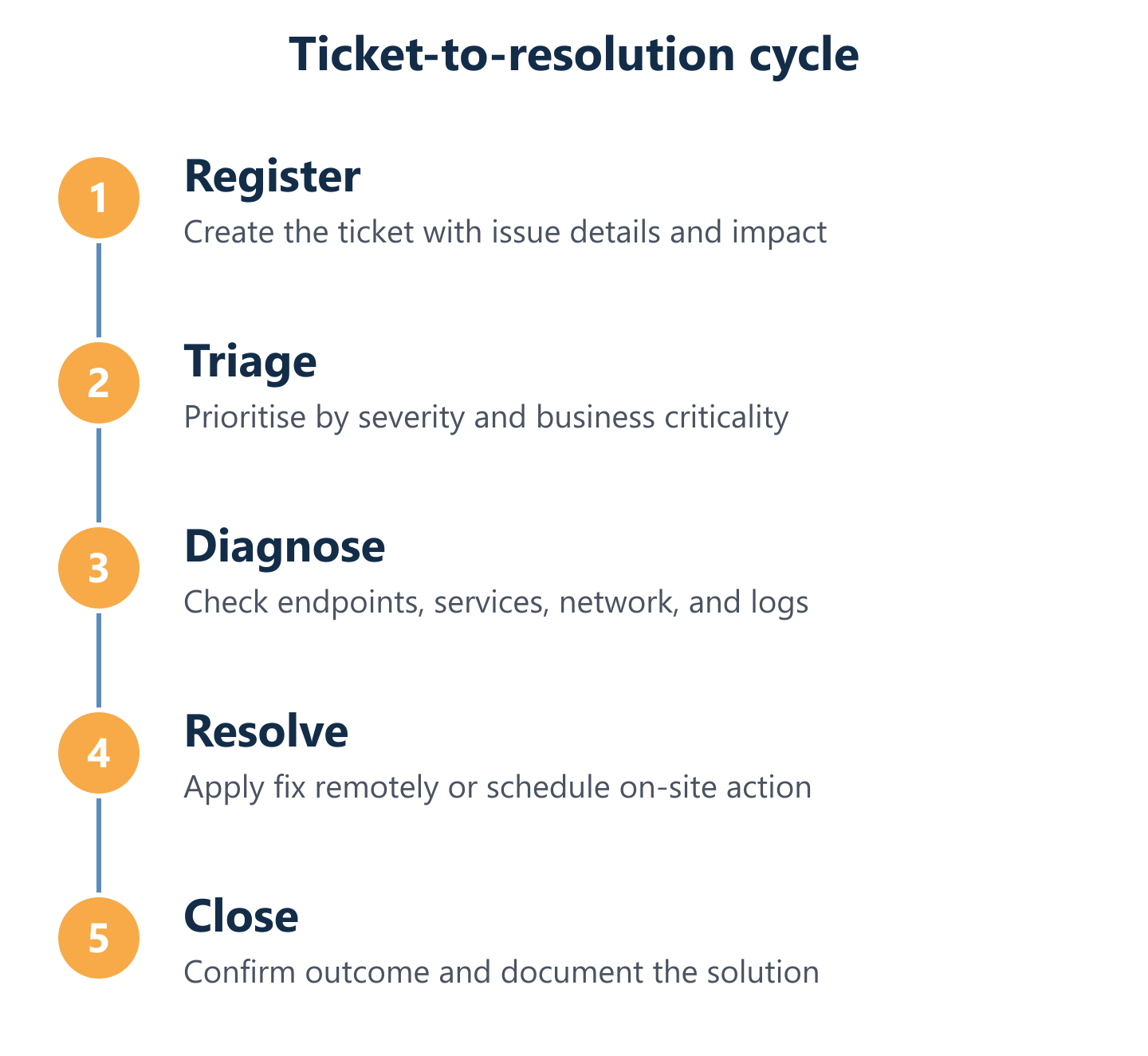
A ticket at Impulso Tecnológico follows five defined stages: registration, prioritisation, diagnosis, resolution, and closure with evidence. Registration captures the incident details, affected user or system, and timestamp. Prioritisation assigns a severity level based on operational impact. Diagnosis — conducted remotely in the first instance — identifies root cause rather than just surface symptoms, which is critical for preventing recurrence. Resolution applies the fix and, where relevant, reviews adjacent systems for secondary risks. Closure requires confirmation from the client contact that the issue is resolved, followed by a written report documenting what was found and what was done. This closure discipline is what transforms a support interaction into a data point for continuous infrastructure improvement, and it gives management visibility without requiring technical expertise to interpret the outcomes.
Preventive maintenance and optimisation: backups, antivirus health, and system checks
Preventive maintenance is the discipline that reduces the frequency and cost of reactive incidents. Impulso Tecnológico's scheduled maintenance activities cover the areas most likely to cause silent failures: backup job verification (confirming that data is actually being captured and is recoverable), antivirus and endpoint protection health checks (ensuring definitions are current and no threats are quarantined but unresolved), operating system and application patch deployment, disk health and storage capacity monitoring, and server performance reviews. Each of these tasks runs on a defined schedule, independent of whether an incident has been raised. The cumulative effect is measurable: fewer emergency callouts, shorter recovery times when incidents do occur, and a documented record of infrastructure health that supports both internal governance and external compliance requirements such as GDPR.
Security and good practices for companies: hardening, vulnerability management, and secure remote access
Impulso Tecnológico applies a defence-in-depth security model that layers controls across the infrastructure rather than relying on a single product. At the perimeter, firewall configuration — using technologies from partners including Fortinet and Sophos — filters traffic and blocks known threat vectors. At the endpoint, antivirus and EDR tools provide real-time protection against malware and ransomware. Vulnerability and patch management closes known weaknesses on a scheduled basis. Secure remote access policies ensure that staff connecting from outside the office do so through authenticated, encrypted channels rather than exposed RDP ports. Access hygiene — reviewing who has administrative privileges and removing unnecessary accounts — reduces the blast radius of any credential compromise. For companies in San Sebastián de los Reyes managing sensitive business data, this layered approach aligns with GDPR obligations and provides a defensible security posture without blocking day-to-day productivity. You can explore how this connects to broader preventive IT maintenance practices for a more complete picture.
Keeping your systems stable in San Sebastián de los Reyes starts with understanding what you actually have and where the real risks sit. Impulso Tecnológico begins every engagement with a thorough infrastructure audit — no assumptions, no generic recommendations. From there, you choose the support model that fits your team: remote-only, structured on-site coverage, or a flat-rate managed service with defined SLAs. Whether you are a ten-person office or a mid-sized company with complex infrastructure, the goal is the same: fewer incidents, faster resolution, and IT costs you can plan around. Contact Impulso Tecnológico to request an initial assessment and get a proposal tailored to your environment. You may also find it useful to compare approaches across the region by reviewing our IT support coverage for Madrid businesses.