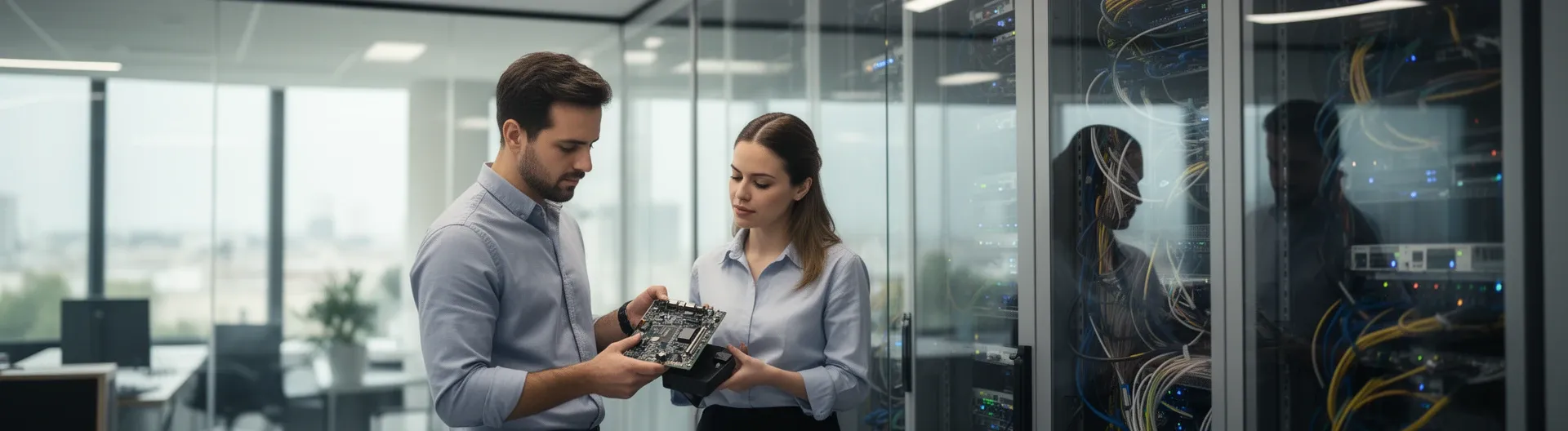

IT Support in Rivas-Vaciamadrid means keeping your business systems available, secure, and productive every working day. It covers helpdesk assistance, device maintenance, network stability, and security basics — delivered remotely or on-site, with defined response times and a structured service model.
For SMEs operating in Rivas-Vaciamadrid, technology failures translate directly into lost productivity and revenue. Whether your team relies on a handful of workstations or a multi-server environment with 150 users, the underlying challenge is the same: incidents happen without warning, and without a reliable support partner, resolution drags on. Impulso Tecnológico addresses this through a managed IT support model that begins with a full audit of your existing infrastructure — covering antivirus status, backup copies, servers, and communications — before any contract is signed. This baseline assessment means support is calibrated to your actual environment, not a generic template. The result is fewer unplanned outages, faster resolution when issues do occur, and a predictable monthly cost that scales with your business.
IT Support in Rivas-Vaciamadrid: what's included for businesses
Most businesses in Rivas-Vaciamadrid do not need a full-time internal IT department — they need a reliable partner who knows their systems, responds quickly, and prevents problems before they escalate. IT Support, in practical terms, covers the full technology stack that keeps daily operations running: workstations and laptops, servers, printers and peripherals, business software, network connectivity, and the security layer that protects all of it.
At Impulso Tecnológico, the starting point is always a complete and real audit of the client's environment. This includes reviewing antivirus status, backup copies, server health, and communications infrastructure. From that audit, an equipment inventory is created, which becomes the foundation for a maintenance plan tailored to the actual number of users and devices — typically between 3 and 150 PCs. Every intervention also includes a review of adjacent systems to catch secondary issues before they become costly incidents.
| Support Area | What It Covers | Delivery Method |
|---|---|---|
| Endpoints | PCs, laptops, operating system, business apps | Remote + on-site |
| Servers | Server health, updates, access control | Remote + on-site (<4 h SLA) |
| Network & WiFi | Connectivity, router/switch config, stability | Remote + on-site |
| Security baseline | Antivirus, firewall, backup verification | Remote managed |
| Printers & peripherals | Configuration, drivers, workplace productivity | Remote + on-site |
| Cloud services | Microsoft 365, email, identity management | Remote managed |
What "IT Support" covers: helpdesk, devices, and software
The day-to-day reality of IT support in a Rivas-Vaciamadrid office revolves around keeping endpoints functional and business software accessible. This means resolving issues with Windows and macOS workstations, laptops, and the applications your teams depend on — from Microsoft 365 and email clients to sector-specific tools and ERP platforms.
Helpdesk support handles the full incident lifecycle: logging the request, triaging severity, diagnosing root cause, and resolving or escalating as needed. For Impulso Tecnológico clients, this process is backed by a ticketing system that tracks every interaction, ensuring nothing falls through the cracks. The helpdesk ticketing approach also generates the data needed to identify recurring problems — a critical input for preventive maintenance planning. Software configuration, licence management, and user access setup are all within scope.
Printers, peripherals, and workplace productivity support
Printers and peripherals are responsible for a disproportionate share of daily IT friction. A misconfigured network printer or a driver conflict can stall an entire department, yet these issues are often treated as low priority by providers focused only on servers and core infrastructure.
Impulso Tecnológico includes printer configuration, driver management, and peripheral troubleshooting as standard elements of IT support. This extends to scanners, docking stations, and any connected device that affects workplace productivity. Network and WiFi support also falls within this scope: connectivity configuration, signal stability checks, and router or switch adjustments that ensure employees in every corner of the office maintain reliable access. For Rivas-Vaciamadrid offices running on Cisco or Aruba infrastructure, our certified engineers handle both configuration and ongoing stability monitoring.
Security foundations: antivirus, firewall baseline, and backup protection
A cybersecurity baseline is not optional — it is the minimum viable protection for any business operating today. At Impulso Tecnológico, every IT support engagement includes a review of three non-negotiable layers: endpoint antivirus status, firewall configuration, and verified backup copies.
Antivirus and endpoint protection are configured and monitored as part of the managed service, using solutions from partners including Sophos and Fortinet. Where firewall installation is required, we have hands-on experience with WatchGuard deployments. Backup and disaster recovery verification ensures that copies are not only running but actually restorable — a distinction that matters enormously when an incident occurs. Secure remote access practices and vulnerability management round out the baseline, aligning with GDPR compliance requirements. This security-first approach is built into support contracts from day one, not sold as an add-on.

How our IT Support works: remote helpdesk to on-site intervention
Operational discipline separates a genuine managed IT support service from ad-hoc break-fix. For businesses in Rivas-Vaciamadrid, what matters is knowing exactly what happens between the moment an incident is reported and the moment it is resolved — and having confidence that the process is consistent every time.
Impulso Tecnológico follows a structured support workflow that begins before any incident occurs. The initial audit establishes the baseline: antivirus status, backup copies, server health, and communications infrastructure are all reviewed and documented. An equipment inventory is created from that audit, forming the reference point for all subsequent interventions. When an incident is raised, the response follows defined SLA targets: less than 4 business hours for registered server breakdowns, and less than 8 business hours for other computers. Every intervention includes a review of adjacent systems to catch secondary issues early.
- Initial audit: Full review of antivirus, backups, servers, and communications to establish a verified baseline.
- Equipment inventory: Every maintained device is catalogued, creating a reference for faster diagnosis during incidents.
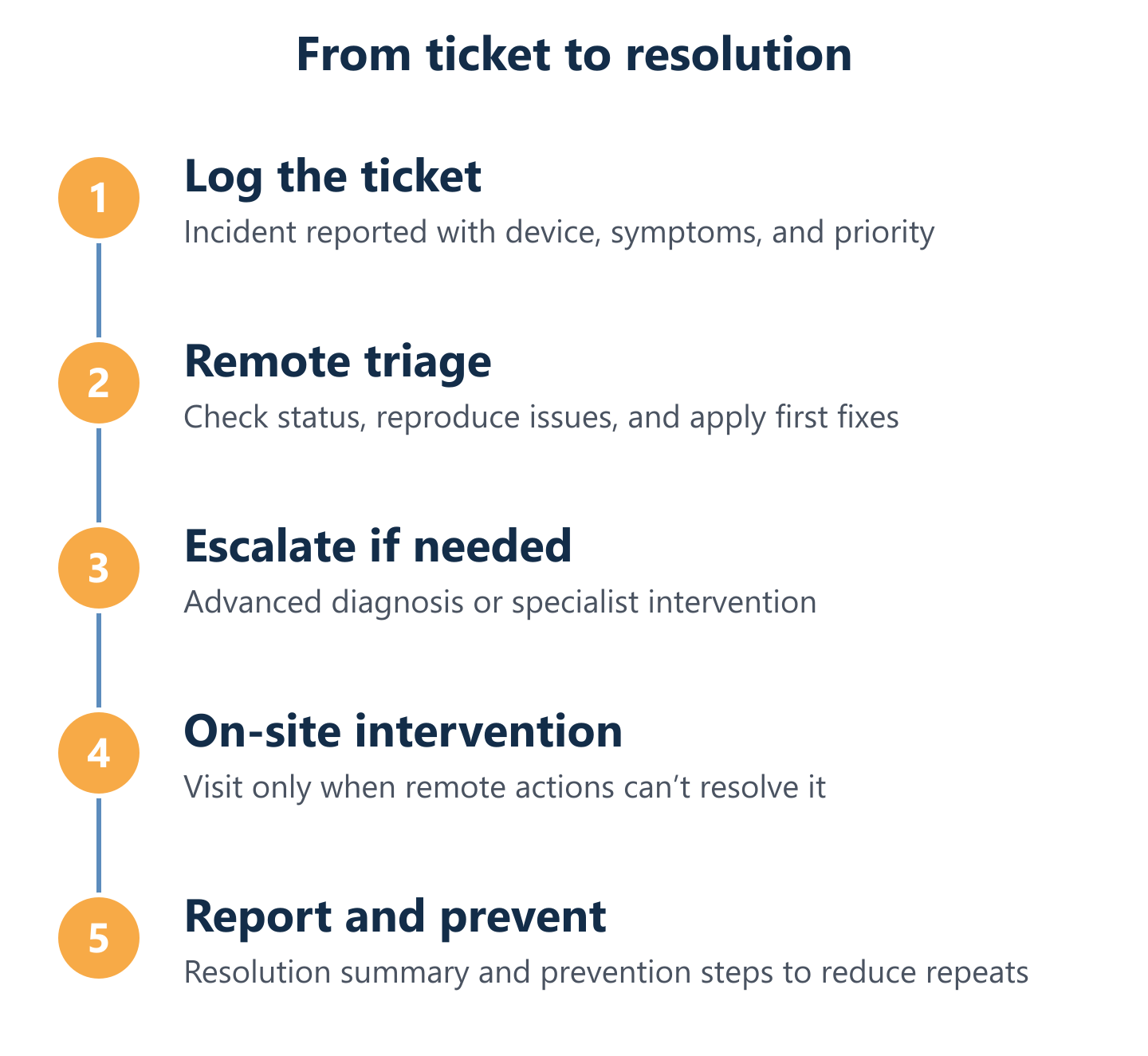
- Incident logging: The user raises a ticket via the helpdesk; severity is assigned immediately.
- Remote triage: The engineer diagnoses remotely, resolving the majority of issues without a site visit.
- Escalation or on-site visit: If remote resolution is not possible, an engineer attends within the agreed SLA window.
- Adjacent system review: During every intervention, related systems are checked to prevent secondary incidents.
- Detailed reporting: A written report documents the solution or repair and any recommendations to prevent recurrence.
Step-by-step support cycle: ticket, triage, diagnosis, escalation
Before the first ticket is ever raised, Impulso Tecnológico conducts a complete initial audit of the client's IT environment. This covers antivirus status, backup copies, server configuration, and communications infrastructure. The resulting equipment inventory means that when an incident is logged, the engineer already has accurate context — device age, software versions, recent changes — rather than starting from zero each time.
The ticket itself captures the incident description, affected user, and initial severity assessment. Triage determines whether the issue can be resolved remotely or requires escalation. Diagnosis follows a structured path: isolate the fault, identify root cause, apply fix, and verify resolution. Where the issue exceeds first-line capability, escalation to a senior engineer is automatic and documented, ensuring continuity without the client needing to re-explain the problem.
Remote vs on-site: when each approach is used
Remote support resolves the majority of day-to-day incidents faster than any on-site visit could. Software faults, configuration errors, user access issues, and most network problems can be diagnosed and fixed within minutes via secure remote access — with no travel time and no disruption to the rest of the office.
On-site intervention is reserved for situations where physical presence adds clear value: hardware replacements, cabling work, complex network reconfigurations, or incidents where remote access itself is unavailable. For Impulso Tecnológico clients in Rivas-Vaciamadrid, on-site visits are included in applicable contract plans and governed by defined response times — less than 4 business hours for server breakdowns. This remote-first, on-site-when-needed model keeps resolution times short while controlling costs for the client.
Reporting and prevention: how we reduce repeat downtime
Every intervention carried out by Impulso Tecnológico generates a detailed report documenting the fault, the resolution applied, and any observations about related systems. This is not administrative formality — it is the primary tool for identifying patterns that lead to repeat downtime.
When the same type of incident recurs across multiple devices or users, the reporting data surfaces that trend quickly, allowing the maintenance plan to be adjusted before it becomes a wider outage. Clients receive clear, readable summaries rather than technical logs, so decision-makers understand what happened and what has been done to prevent recurrence. This feedback loop — incident, resolution, report, plan adjustment — is what distinguishes proactive IT monitoring from reactive break-fix support, and it is central to how we reduce idle time for businesses in Rivas-Vaciamadrid.
SLAs, proactive monitoring, and contract options for IT Support in Rivas-Vaciamadrid
Choosing an IT support provider without understanding the service model behind it is a common and costly mistake. A contract that looks comprehensive on paper may offer no guaranteed response times, no proactive monitoring, and no flexibility as your team grows. The criteria below are the ones that actually determine whether IT support delivers measurable business continuity.
Impulso Tecnológico supports environments from 3 to 150 users and PCs, with contract models designed to match different operational profiles. Whether your organisation has its own internal IT resource or none at all, the plan can be structured accordingly — with unlimited remote assistance, defined on-site visit frequency, and proactive monitoring as standard or optional components depending on the chosen tier.
- Defined SLA response times: Less than 4 business hours for server breakdowns; less than 8 business hours for other computers — both measured from the moment the incident is registered.
- Proactive monitoring: Continuous system monitoring to detect anomalies before they cause outages, reducing reactive incidents over time.
- Preventive maintenance visits: Scheduled on-site reviews to update systems, verify backups, and check hardware health — not just reactive call-outs.
- Unlimited remote assistance: Available on flat-rate plans, removing the uncertainty of hourly billing for day-to-day helpdesk requests.
- Scalable scope: Contracts cover environments from small offices to mid-size companies, with the ability to add users, devices, or service layers as the business evolves.
- No rigid lock-in: Flexible contract structures without the permanence requirements that make switching providers unnecessarily complex.
- Multilingual support: Service delivered in both Spanish and English, relevant for international teams operating from Rivas-Vaciamadrid.
SLAs and response times: incident resolution that fits business reality
An SLA is only meaningful if the response time it commits to reflects how your business actually operates. For most SMEs in Rivas-Vaciamadrid, a server failure at 9 a.m. on a Monday is a critical event — and waiting until the afternoon for a first response is not acceptable.
Impulso Tecnológico publishes clear SLA targets: less than 4 business hours for registered server breakdowns, and less than 8 business hours for other computers. These targets apply from the moment the incident is logged in the ticketing system, not from when an engineer happens to pick it up. This distinction matters. SLA response time is also tracked across all tickets, providing clients with objective data on service performance over time — not just a promise on paper. For businesses comparing providers, asking for documented SLA metrics is the single most revealing question.
Proactive monitoring and preventive maintenance to stop issues early
Reactive IT support — waiting for something to break before acting — is the most expensive model available, even when the per-incident cost appears low. The real cost is measured in lost working hours, missed deadlines, and the compounding effect of deferred maintenance.
Proactive IT monitoring means that Impulso Tecnológico's systems are watching your infrastructure continuously, flagging anomalies — unusual CPU load, storage thresholds, failed backup jobs, connectivity drops — before they cause a visible outage. Preventive maintenance visits complement this by physically reviewing hardware health, applying updates, and verifying that backup and disaster recovery processes are functioning correctly. Together, these two elements — remote monitoring and scheduled preventive visits — are what allow us to resolve 4,000 IT tickets annually while keeping client downtime to a minimum. For Rivas-Vaciamadrid businesses, this translates directly into more predictable operations.
Choosing a contract: flat-rate, unlimited remote assistance, and tailored plans
Three contract structures cover the majority of IT support needs for businesses in Rivas-Vaciamadrid. The right choice depends on the size of your team, the complexity of your infrastructure, and how much internal IT capability you already have.
A flat-rate plan provides a fixed monthly cost that includes unlimited remote assistance and defined on-site visit entitlements — ideal for organisations that want complete cost predictability. A monthly hour package suits businesses with lower incident frequency that still want guaranteed access to engineers when needed. A tailored plan is built around a specific environment: the initial IT audit determines the optimal service scope, and the contract is priced accordingly. All models can incorporate proactive monitoring, preventive maintenance, and security baseline management. Impulso Tecnológico also offers a free, non-binding maintenance quote following an IT audit, so there is no commitment required to understand what the right plan looks like for your organisation. You can explore similar service structures in our IT maintenance coverage for Arganda del Rey and IT support model for Aranjuez.
Fewer interruptions start with the right support structure — one built around prevention, measurable response times, and a clear escalation path when issues exceed first-line resolution. If your business in Rivas-Vaciamadrid is still relying on ad-hoc IT fixes or an overloaded internal resource, the gap between where you are and where you need to be is smaller than it looks. Impulso Tecnológico offers a free IT audit and a non-binding maintenance quote as the first step. There is no obligation — only a clearer picture of what your infrastructure actually needs. Get in touch and let us assess your current IT situation before proposing anything. You can also review how we approach preventive IT maintenance for businesses to understand the full methodology behind our service model.