

IT support in Portugal covers remote helpdesk assistance, on-site technical intervention, proactive monitoring, and managed services — delivered by a provider with local coverage and defined response times. Businesses that need reliable day-to-day IT operations without building an internal team rely on this model to keep systems running, secure, and recoverable.
For companies operating in Portugal, the challenge is rarely a single incident. It is the accumulation of unresolved tickets, slow response times, and reactive fixes that erode productivity and expose systems to risk. A structured IT support model addresses this by combining a ticketed helpdesk for routine issues, remote resolution for the majority of requests, and on-site attendance for critical failures that cannot be fixed remotely. Impulso Tecnológico delivers this model across Portugal and Spain, with bilingual support, guaranteed SLAs, and detailed post-service reporting — so organisations always know what was done, why, and what comes next.
What "IT Support Portugal" typically includes
Searching for IT support in Portugal returns many different providers — from single-person helpdesks to full managed service providers (MSPs). Before comparing quotes, it is worth understanding what a professional IT support contract should actually deliver. At minimum, expect a structured ticketing system, defined response windows, remote resolution capability, and a clear escalation path for critical incidents. Beyond that, a mature provider adds proactive monitoring, preventive maintenance, security management, and regular reporting.
Impulso Tecnológico covers the full spectrum: practical IT maintenance and managed services for organisations across Portugal and Spain, with bilingual support in Spanish and English, a multidisciplinary team capable of resolving issues remotely or attending on-site within hours for critical problems, and in-depth post-service reports that give teams full visibility of what was done and why.
| Service Component | Basic IT Support | Managed IT Support (MSP) |
|---|---|---|
| Helpdesk & ticketing | Email/phone, reactive only | Structured ticketing, SLA-tracked |
| Remote support | Ad hoc, when available | Defined response windows, priority triage |
| On-site support | Billable per visit, unscheduled | Included or contracted, planned & reactive |
| Proactive monitoring | Not included | Continuous, with alerts and reporting |
| Security & backups | Separate contract or none | Integrated into support scope |
| Reporting | None or on request | Regular post-service reports |
| Asset & inventory management | Not included | Included, updated continuously |
Helpdesk, incidents and service requests: what gets logged
A professional IT helpdesk logs every interaction — whether it is a password reset, a connectivity issue, a software fault, or a hardware failure. This matters because unlogged requests become invisible problems: no tracking, no resolution confirmation, and no data for future improvement. In a managed IT support model, incidents (unplanned disruptions) and service requests (planned changes or access needs) are handled through separate queues with different priority levels. Impulso Tecnológico manages over 4,000 IT tickets annually across its client base, which means the triage and resolution processes are tested at scale. Every ticket generates a record that feeds into post-service reporting, giving clients a clear picture of recurring issues and resolution times.
Remote vs on-site support: when each is used
Remote support resolves the majority of IT incidents — connectivity problems, software errors, user access issues, and configuration changes can all be handled without a technician travelling to site. This keeps response times short and costs predictable. On-site support is reserved for hardware failures, physical network issues, new equipment deployment, or situations where remote access is unavailable. The key is having a provider that can make the transition between remote and on-site without delay. Impulso Tecnológico operates with a team structured for both modes: remote IT support for Portugal-based clients covers fast issue resolution during business hours, while on-site assistance is coordinated for critical problems that require physical intervention — with visit planning built around the client's operational schedule.
Reporting and transparency: what you receive after support
Transparency is one of the most overlooked differentiators in IT support. After a ticket is resolved, clients should receive a clear record of what the problem was, what was done to fix it, and whether any follow-up action is needed. Impulso Tecnológico provides in-depth post-service reports as a standard part of its managed IT services — not as an optional extra. These reports serve two purposes: they confirm that the agreed work was completed, and they identify patterns that can be addressed proactively before they cause further disruption. For businesses managing IT across multiple sites in Portugal, this level of reporting also supports internal accountability and compliance documentation, particularly where GDPR obligations apply to data handling and system access.

Support coverage across Portugal: how on-site works
Coverage across Portugal is not simply a question of geography — it is a question of how remote and on-site resources are coordinated to deliver consistent response times regardless of where a business operates. A provider that only serves Lisbon cannot reliably commit to on-site attendance in Porto, the Algarve, or the interior regions without a structured field service model. Impulso Tecnológico supports organisations across Portugal alongside Spain, with flexible outsourcing models designed to match each client's operational timeline — whether that means coverage by days, weeks, or months, indefinite outsourcing, or temporary cover during staff absences.
- Initial audit: A non-binding IT audit maps all assets, systems, and locations before any support contract is agreed.
- Coverage mapping: Remote support is configured as the primary channel; on-site visits are planned for priority cases and scheduled maintenance windows.
- Staff profile matching: Junior systems technicians, senior engineers, and network specialists are assigned based on the complexity of the environment.
- Flexible scheduling: On-site visits are coordinated around the client's business hours (support operates Monday to Friday, 09:00–17:00 CET) to minimise operational disruption.
- Ongoing review: Coverage models are reviewed regularly and adjusted as the business grows or adds new locations.
Regional coordination: planning on-site visits efficiently
Effective on-site IT support across Portugal requires more than a technician with a toolkit — it requires advance knowledge of the client's environment. Impulso Tecnológico maintains IT asset inventories and system documentation for each managed client, which means that when an on-site visit is needed, the attending technician already knows the hardware in use, the network topology, and the history of recent incidents. This preparation reduces resolution time significantly compared to a provider arriving on site without context. For clients with multiple locations across Portugal, visit schedules are coordinated to combine planned maintenance with reactive interventions, reducing travel costs and minimising the number of disruptions to the working day. Our managed IT services for businesses follow the same structured approach across every region we cover.
SLA expectations: aligning response times with business impact
Service Level Agreements (SLAs) in IT support define how quickly a provider must respond to and resolve different types of incidents. A critical server failure carries a different SLA than a printer configuration issue, and a professional managed service provider structures these tiers clearly in the contract. Impulso Tecnológico guarantees SLAs across its managed services contracts, with response and resolution targets matched to incident severity. This means clients in Portugal know in advance how long they will wait for a response to a high-priority incident versus a routine request — and there is a documented escalation path if those targets are not met. Predictable monthly costs with no surprise charges are part of the same commitment to transparency that underpins the SLA structure.
Managed service staffing: junior/senior profiles and network support
Not every IT issue requires the same level of expertise. A well-structured managed IT support operation assigns tickets to the appropriate technical profile — junior systems technicians handle routine requests and first-line triage, while senior engineers take ownership of complex infrastructure problems, security incidents, and architecture decisions. Network technicians are a separate specialism, covering LAN/WAN configuration, wireless infrastructure, and firewall management. Impulso Tecnológico offers all three profiles within its outsourcing model, with technology partners including Cisco, Aruba, and Fortinet underpinning network support, and Microsoft, HP, Lenovo, and Dell covering endpoint and server environments. Clients can request specific profiles for project-based work or ongoing coverage, with staffing adjusted as needs change — without renegotiating the entire contract.
Incident management and proactive IT support (security-first)
Most IT incidents are predictable. Disk failures, expired certificates, unpatched software, and misconfigured backups all generate warning signals before they cause an outage — but only if someone is watching. A security-first managed IT support model treats monitoring and preventive maintenance as the primary layer of defence, with reactive incident management as the safety net for what monitoring cannot prevent.
Impulso Tecnológico combines proactive managed services with security-first maintenance across its Portugal and Spain client base. The approach covers:
- Continuous system monitoring: Automated alerts flag performance degradation, security anomalies, and hardware stress before they escalate to incidents.
- Preventive maintenance schedules: Periodic inspections check for early wear, outdated firmware, and configuration drift — reducing the frequency of reactive callouts.
- Security configuration management: Endpoint protection, firewall rules, and access controls are maintained using Sophos and Fortinet technologies, with configurations reviewed regularly.
- Backup and recovery validation: Backup solutions powered by Veeam are tested to confirm recoverability — not just scheduled to run.
- Post-incident reporting: Every resolved incident generates a technical report that documents root cause, resolution steps, and recommended preventive actions.
- GDPR-aligned processes: Data handling within support workflows follows GDPR requirements, which is particularly relevant for clients in regulated sectors such as healthcare, education, and financial services.
How tickets move from triage to resolution (and who escalates)
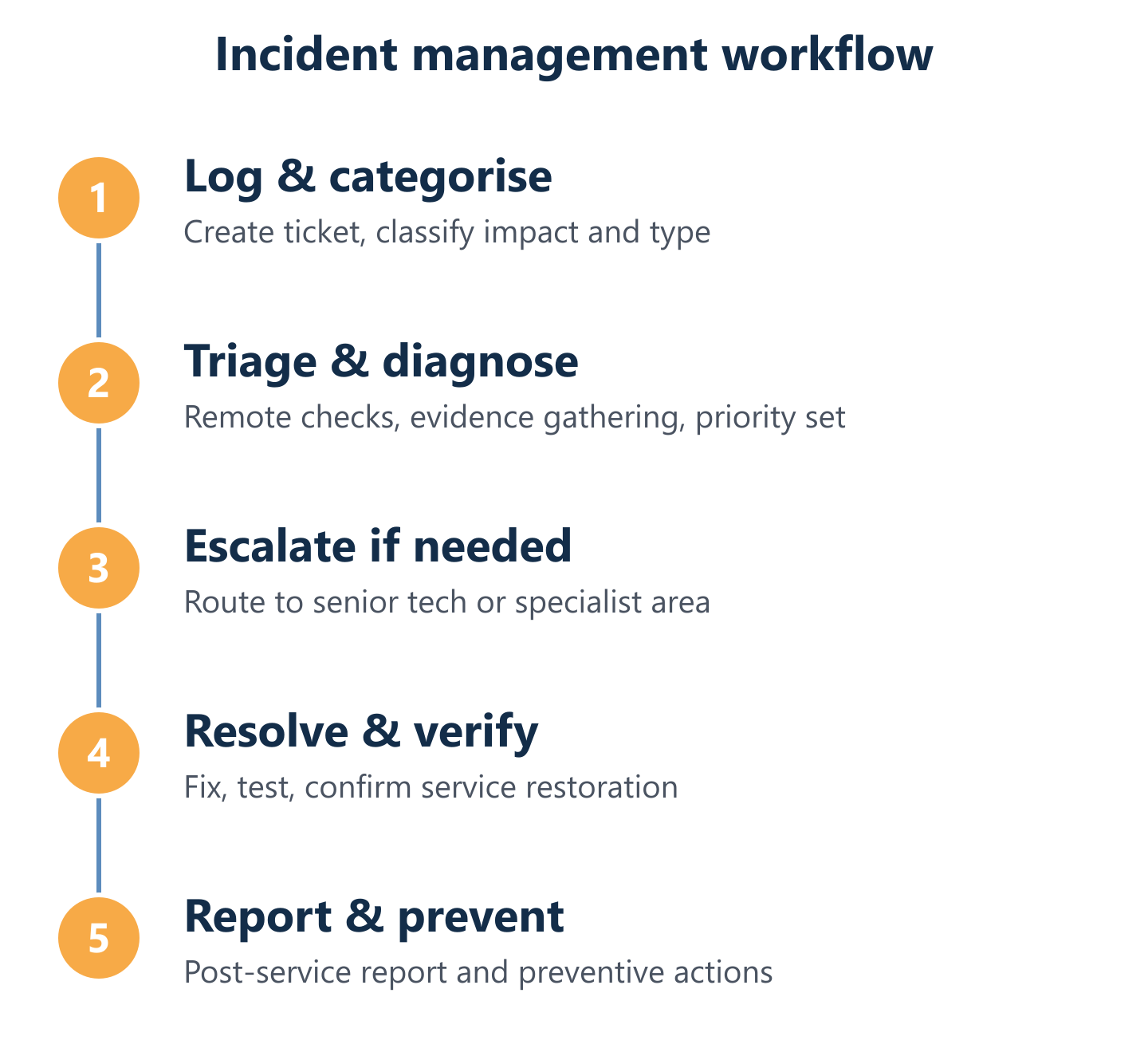
A ticket enters the system and is immediately categorised by type (incident or service request) and severity (critical, high, medium, low). First-line support attempts remote resolution within the SLA window for that severity level. If the issue cannot be resolved remotely — or if it requires specialist knowledge — the ticket is escalated to a second-line engineer with the full context already attached. Critical incidents that affect business continuity trigger an immediate escalation path, bypassing the standard queue. Throughout this process, the client receives status updates at defined intervals so there is no ambiguity about where their issue stands. Impulso Tecnológico's IT helpdesk and ticketing workflow is designed so that escalation is a structured process, not a last resort — which means fewer incidents stall between tiers.
Proactive monitoring and preventive maintenance: what changes day-to-day
The practical difference between reactive and proactive IT support shows up in downtime frequency. Organisations that rely solely on reactive support average more incidents per quarter than those with continuous monitoring and scheduled maintenance — because small problems compound when left unaddressed. Proactive monitoring means that a technician is alerted to a failing hard drive before the drive fails, or to a backup job that has been silently failing for three weeks before data loss occurs. Impulso Tecnológico's preventive IT maintenance model includes regular system check-ups, firmware and patch management, early wear detection on hardware, and scheduled reviews of security configurations. This approach is consistent with our broader preventive IT maintenance for businesses methodology, applied specifically to the needs of Portugal-based operations.
Security, backups and continuity: keeping systems recoverable
IT support that does not include security and backup management is incomplete. A provider that resolves helpdesk tickets but leaves backup validation and endpoint protection to a separate contract creates gaps that attackers and hardware failures exploit. Impulso Tecnológico integrates security and continuity into its managed IT support scope: Sophos and Fortinet cover endpoint and network protection; Veeam manages backup and disaster recovery; and Microsoft 365 and Azure environments are maintained with identity management and access controls in place. For businesses in Portugal, this means that the same provider handling day-to-day IT support is also responsible for ensuring systems are recoverable after a ransomware incident or hardware failure — with no finger-pointing between separate vendors. This integrated approach is also central to how we deliver IT maintenance for businesses with a security focus.
Choosing an IT support provider in Portugal is a decision that directly affects operational stability, security posture, and cost predictability. The right model depends on your risk exposure, the complexity of your infrastructure, and whether you need occasional remote assistance or comprehensive managed coverage. Impulso Tecnológico offers a non-binding IT audit as the starting point — so recommendations are built on what your systems actually need, not on a generic package. With over 25 years of experience supporting businesses across Spain and Portugal, and active clients across 25 countries, our team is structured to deliver consistent, transparent, and security-first IT support wherever your operations require it. If you are evaluating providers or planning a transition, the next step is a discovery conversation — no commitment required.