

IT support in Leganés means having a local partner that resolves technical issues quickly—remotely for day-to-day problems and on-site within hours for critical failures—while keeping your systems secure, monitored, and running without unexpected costs.
For businesses in Leganés, technology downtime is not an abstract risk. When a server goes down or a workstation fails, every idle minute translates directly into lost productivity and frustrated staff. The challenge for most SMEs in the area is that they lack a dedicated internal IT team, yet their operations depend entirely on systems being available and secure. A managed IT support provider fills that gap by acting as an external IT department: handling incidents, maintaining equipment, monitoring threats, and planning improvements proactively. At Impulso Tecnológico, we cover Leganés as part of our wider Madrid-area service zone, offering both remote IT support and structured on-site response. Our model is built around preventing problems before they escalate, resolving issues fast when they do occur, and delivering clear documentation so clients always know what was done and why.
Why choose IT Support in Leganés?
Leganés is one of the most industrially active municipalities in the Madrid metropolitan area, home to manufacturing, logistics, professional services, and educational institutions. Businesses here operate in environments where IT failures have immediate operational consequences—and where waiting hours for a technician to travel from the city centre is simply not acceptable.
Proximity matters for two reasons: speed of physical intervention and familiarity with local infrastructure. A provider covering Leganés as part of their regular service zone can commit to realistic on-site response windows rather than aspirational ones. Impulso Tecnológico serves Leganés within its Madrid-area coverage, combining remote IT support for routine incidents with on-site assistance for hardware failures, network issues, or situations that cannot be resolved remotely.
The table below compares the key service dimensions businesses in Leganés should evaluate when choosing a provider:
| Criterion | Remote-only provider | Local managed IT provider (e.g., Impulso Tecnológico) |
|---|---|---|
| On-site response for server failure | Not available or subcontracted | Under 4 business hours after incident registration |
| On-site response for workstation issues | Not available | Under 8 business hours |
| Remote support availability | Yes (core service) | Yes, unlimited via remote maintenance system |
| Initial system audit | Rarely included | Included at service start |
| Incident documentation and reporting | Basic or none | Detailed reports after each repair or solution |
| Proactive monitoring | Limited | Continuous, with preventive checks on each visit |
Local coverage: remote help plus on-site when required
Most day-to-day IT incidents—password resets, software errors, connectivity problems, email configuration—can be resolved remotely within minutes. But some situations demand physical presence: a failed server, a network switch that needs replacing, a new workstation to deploy, or a security appliance to configure. For businesses in Leganés, having a provider that can send a qualified technician on-site without relying on subcontractors or extended travel windows makes a measurable difference. Impulso Tecnológico structures its service with both layers: remote IT support as the primary resolution channel, and on-site visits as a guaranteed fallback when required, with defined response times rather than vague commitments.
Business impact: reducing idle time and protecting productivity
For an SME with between 10 and 100 users, a single unresolved IT incident can affect an entire team for hours. The cost is not just the technician's time—it is the accumulated idle time of every employee waiting for systems to come back online. Remote IT support resolves the majority of incidents in under an hour when a provider has prior knowledge of the client's environment, which is why the initial audit and system inventory that Impulso Tecnológico conducts at the start of every engagement is operationally significant. Knowing the exact configuration of each device, server, and network component before a problem occurs means faster diagnosis, fewer escalations, and less downtime overall. Our model is designed specifically to maximise the time your staff spend working rather than waiting.
Trust signals: reviews, partners, and operational guarantees
Choosing an IT support provider in Leganés requires more than a competitive price. Operational guarantees—written response times, defined escalation paths, documented service scope—matter far more than verbal assurances. Impulso Tecnológico holds certified partnerships with Sophos, Fortinet, Veeam, Microsoft, Cisco, Aruba, and others, which means the tools used in your environment are supported by the manufacturer's own technical resources. Beyond certifications, our track record includes over 25 years serving organisations across Spain and internationally, resolving thousands of IT tickets annually across sectors including industry, logistics, education, and professional services. For clients in Leganés, that history translates into structured, predictable service delivery—not improvised responses.

What's included in IT Support (managed support)
Managed IT support is not simply a helpdesk number you call when something breaks. A properly scoped service covers the full lifecycle of your IT environment: from the initial state assessment to ongoing monitoring, incident resolution, preventive maintenance, and documented reporting. Businesses in Leganés evaluating providers should insist on a clear written scope before signing anything.
At Impulso Tecnológico, our computer maintenance model follows a structured sequence:
- Initial audit: A complete review of all systems relevant to operational continuity—antivirus status, backup copies, server condition, and communications infrastructure—before any support contract begins.
- Asset inventory: A documented register of every device under maintenance, including configuration details that enable faster diagnosis when incidents occur.
- Unlimited remote support: Day-to-day incident resolution via our remote maintenance system, with no cap on the number of interventions within the contracted model.
- On-site assistance: Physical intervention when remote resolution is not sufficient, with defined response windows (under 4 business hours for server failures, under 8 for other equipment).
- Preventive checks: Every on-site visit includes a review of the broader system to identify risks before they cause failures.
- Detailed reporting: After every repair or solution, clients receive documentation of what was found, what was done, and what is recommended next.
This structure ensures that managed IT support in Leganés is a proactive, documented service—not a reactive fire-fighting operation.
Core deliverables: helpdesk, remote maintenance, and on-site repairs
The helpdesk is the visible front end of any managed IT service, but its quality depends on what sits behind it. A well-run IT helpdesk for businesses in Leganés should offer a single point of contact for all technical issues, clear incident categorisation (urgent vs standard), and a defined process for escalating unresolved cases to senior engineers or on-site technicians. Impulso Tecnológico's support model covers workstations, servers, printers, network devices, and business applications. Remote maintenance handles the majority of incidents without requiring a visit, while on-site repairs address hardware failures, physical installations, and complex configurations that cannot be completed remotely. Both channels are part of the same service agreement—not separate add-ons.
Proactive work: monitoring, vulnerability management, and preventive checks
Reactive IT support—waiting for something to break before acting—is the most expensive model in the long run. Proactive IT monitoring detects anomalies before they become outages: a disk approaching capacity, a backup job that silently failed, a device running an unpatched operating system. Impulso Tecnológico applies security recommendations in layers: network protection first (firewalls, anti-malware), then endpoint protection on individual devices, followed by vulnerability and patch management, secure access controls (including encrypted remote access for authorised users), and finally backup and disaster recovery tools to minimise business losses if an incident does occur. This layered approach, combined with continuous proactive IT monitoring, significantly reduces the frequency and severity of incidents over time. For businesses in Leganés, it means fewer surprises and more predictable IT costs.
Operational process: escalation paths, incident categories, and turnaround
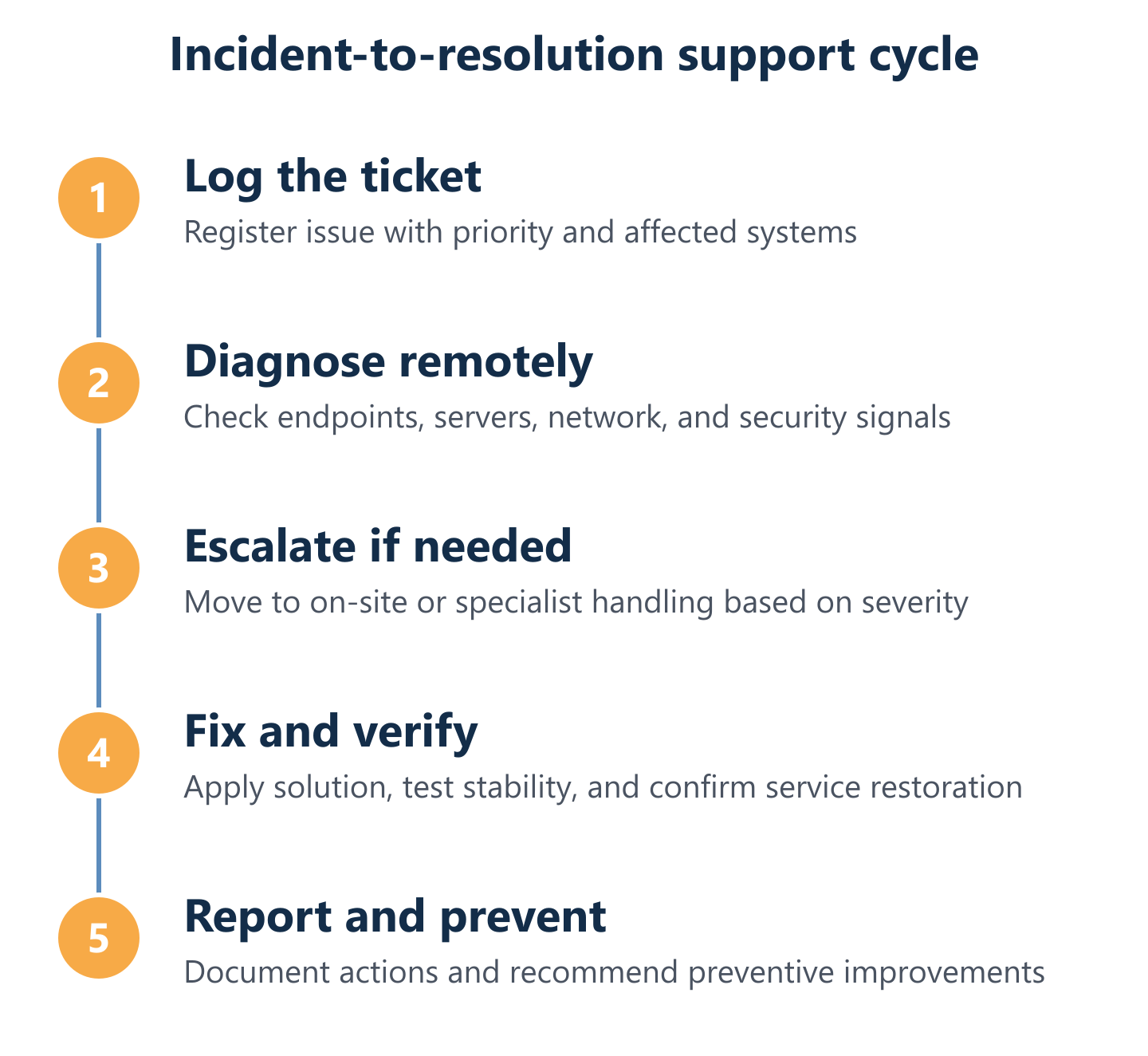
A managed IT support contract is only as good as its operational process. Incident categorisation determines priority and response: a server failure affecting all users is not treated the same as a single user unable to open a specific application. Clear escalation paths—from first-line helpdesk to senior engineer to on-site technician—ensure that no incident stalls at a level that cannot resolve it. Impulso Tecnológico documents every intervention: what the incident was, what was done to resolve it, what was found during the system check, and what is recommended to prevent recurrence. This reporting discipline is valuable not just for compliance but for planning future investments and identifying recurring problems before they become systemic. Clients in Leganés receive this documentation as a standard part of the service, not as an optional extra.
SLAs, response times, and pricing models in Leganés
Service Level Agreements define the contractual backbone of any IT support relationship. Without them, response times are aspirational rather than enforceable. For businesses in Leganés comparing providers, the key variables are: how response times are defined (clock hours vs business hours), what counts as an "urgent" incident, whether on-site response is included or billed separately, and how pricing is structured.
Impulso Tecnológico offers three service level options to match different business sizes and budgets:
- Hourly packages: A block of hours purchased in advance, suitable for businesses with occasional or unpredictable IT needs. Transparent cost per intervention, no monthly commitment.
- Monthly hour rate: A fixed number of support hours per month, rolling over or resetting depending on the agreement. Predictable monthly cost with flexibility on usage.
- Flat-rate managed IT: Unlimited remote support and defined on-site response included in a single monthly fee. Best for businesses where IT issues are frequent or where downtime risk is high. Costs remain controlled regardless of incident volume.
All models include the initial audit, asset inventory, and reporting. Security recommendations—endpoint protection, patch management, backup verification—are integrated into the service rather than treated as separate billable items. For businesses in Leganés evaluating flat-rate managed IT, the key question is not just the monthly price but what the contract explicitly includes and excludes.
Response times and SLAs: how to interpret "<4 hours" style promises
A "<4 hours" on-site response promise means nothing without a clear definition of when the clock starts. Does it begin when you report the incident, when it is registered in the ticketing system, or when it is assigned to a technician? Impulso Tecnológico defines its on-site response times from the moment a server breakdown is registered: under 4 business hours for critical server failures, under 8 business hours for other equipment. "Business hours" refers to the service window of 09:00–17:00 CET, Monday to Friday. This is important context for planning: incidents reported at 16:30 on a Friday will be addressed the following Monday morning. Understanding this distinction prevents mismatched expectations and helps businesses plan their own contingency procedures for out-of-hours situations.
Flat-rate vs contracts: pros, cons, and what to verify in writing
Flat-rate managed IT is appealing because it converts unpredictable IT costs into a fixed monthly line. The risk is that "unlimited" support can be defined very narrowly in the small print—excluding on-site visits, hardware replacement, project work, or specific software categories. Before signing, verify exactly what "unlimited" covers: does it include on-site response, or only remote support? Are security tools (antivirus, backup software) included or billed separately? Is there a minimum contract term, and what are the exit conditions? Impulso Tecnológico's flat-rate model includes unlimited remote support and defined on-site response within the same fee, with no rigid long-term permanence requirements. The goal is a contract that reflects the client's actual needs rather than a standardised package that leaves gaps.
How to evaluate value: coverage, reporting quality, and security outcomes
Price per month is the easiest metric to compare, but it is rarely the most meaningful one. A provider charging less but delivering no proactive monitoring, no documentation, and no structured escalation path will cost more in lost productivity over 12 months than a slightly higher flat-rate contract that prevents incidents systematically. When evaluating IT support providers for your Leganés business, ask for sample reports from existing clients, request a written description of the escalation process, and verify that security deliverables—endpoint protection, patch management, backup verification—are explicitly included. You may also find it useful to review how similar businesses structure their IT support arrangements; our guide on IT maintenance pricing covers the key variables in detail, and our overview of preventive IT maintenance explains what proactive work should look like in practice.
Selecting IT support in Leganés becomes a straightforward decision once you align three elements: a clearly scoped service (what is included, what is excluded), enforceable SLAs with realistic response windows, and integrated security deliverables rather than bolt-on extras. Impulso Tecnológico's model is built around exactly this structure—starting with a real audit of your environment, maintaining documented knowledge of your systems, and resolving incidents through the fastest available channel. If you are evaluating options for your business in Leganés or the wider Madrid area, the practical next step is a conversation about your current setup and where the gaps are. You can also explore how we approach IT support across Madrid and our experience with corrective IT maintenance for context on how we handle incidents when they do occur.