

Businesses in La Coruña looking for reliable IT support need a provider that covers both day-to-day incidents and proactive maintenance, with guaranteed response times and clear escalation procedures — not just a reactive helpdesk.
Keeping productivity high while managing increasingly complex IT infrastructure is a real operational challenge. Servers slow down, access credentials fail, network connectivity drops, and security patches fall behind schedule — often all at once. Without a structured support model, these issues compound into costly downtime and frustrated teams.
At Impulso Tecnológico, we address this directly. Our IT support service for La Coruña combines remote assistance for software, access, and application issues with onsite visits when physical intervention is required. We start every engagement with a thorough audit of your environment, establish proactive maintenance schedules, and back everything with fixed Service Level Agreements. The result is predictable costs, fewer unplanned outages, and a technology environment that supports your business rather than slowing it down.
What IT Support in La Coruña should include
Not every IT support contract covers the same ground. Before signing with any provider, it is worth checking whether their service addresses the full scope of your operational needs — not just break-fix incidents, but also proactive maintenance, security hygiene, and clear service boundaries.
The table below compares the core elements a quality IT support service in La Coruña should include, and what a partial or reactive-only model typically leaves out:
| Service Element | Reactive-only support | Managed IT support (Impulso Tecnológico) |
|---|---|---|
| Helpdesk for users and devices | On request only | Structured ticketing with defined response times |
| Network and infrastructure support | Emergency callouts only | Monitoring, maintenance, and onsite visits |
| Security patching and updates | Irregular or manual | Scheduled and automated with audit trail |
| Backup and disaster recovery | Not included | Managed backups with Veeam and recovery testing |
| SLA and escalation process | No formal commitment | Fixed SLAs: <8h standard, <4h critical server issues |
| Onboarding and environment audit | Rarely included | Full audit and inventory at contract start |
Impulso Tecnológico combines approachable human support with deep technical capability, delivering both remote and onsite IT support across La Coruña. The focus is on reducing downtime through proactive monitoring and maintenance, while keeping SLAs and escalation procedures fully transparent from day one.
Core coverage: helpdesk, devices, networks, and applications
A well-structured IT support service covers the full range of incidents that affect daily operations — not just server failures. This means helpdesk support for end users dealing with access issues, device problems, email configuration, and application errors, as well as network connectivity troubleshooting and support for core business platforms such as Microsoft 365.
At Impulso Tecnológico, our remote IT support handles the majority of user-facing incidents: password resets, VPN connectivity, email delivery problems, software installations, and performance issues on managed endpoints. For La Coruña businesses, this translates to faster resolution without waiting for an engineer to travel to site. Our helpdesk ticketing system logs every request, tracks resolution time, and maintains a history of recurring issues — giving both our team and your management team visibility into where IT friction is concentrated.
Managed maintenance: monitoring, patching, backups, and hygiene
Reactive support alone is not enough to keep a business running smoothly. The majority of serious IT incidents — server failures, ransomware infections, data loss events — are preceded by warning signs that continuous monitoring can detect before they escalate.
Impulso Tecnológico implements proactive maintenance schedules as a core part of every managed IT support contract. This includes automated security patching for operating systems and applications, regular backup verification using Veeam, disk health checks, and access hygiene reviews to remove stale credentials. Monitoring tools run continuously across managed endpoints and infrastructure, alerting our team to anomalies before they affect your users. For La Coruña clients, this means fewer emergency callouts, lower risk of data loss, and a cleaner, more secure IT environment — without requiring your internal team to manage these tasks manually. Cybersecurity patching alone, when handled proactively, eliminates a significant category of vulnerability exposure.
Service model clarity: remote vs onsite and what triggers visits
One of the most common sources of frustration with IT support contracts is ambiguity about what is actually included. Knowing in advance which issues will be resolved remotely, which require an onsite visit, and what the coverage hours are prevents disputes and sets realistic expectations.
Impulso Tecnológico defines these boundaries clearly at contract start. Remote support covers software faults, user access issues, application errors, and most performance concerns. Onsite visits are triggered by hardware failures, physical network cabling work, workstation deployments, infrastructure upgrades, and any situation where remote diagnosis confirms that physical intervention is necessary. Coverage runs Monday to Friday, 09:00–17:00 CET, with escalation procedures in place for critical incidents. Channels include helpdesk ticketing, telephone, and email — so your team always knows how to reach us and what to expect in return. This level of service model clarity is something many IT support providers in La Coruña do not offer upfront.

Remote vs onsite support: how we handle tickets and urgent issues
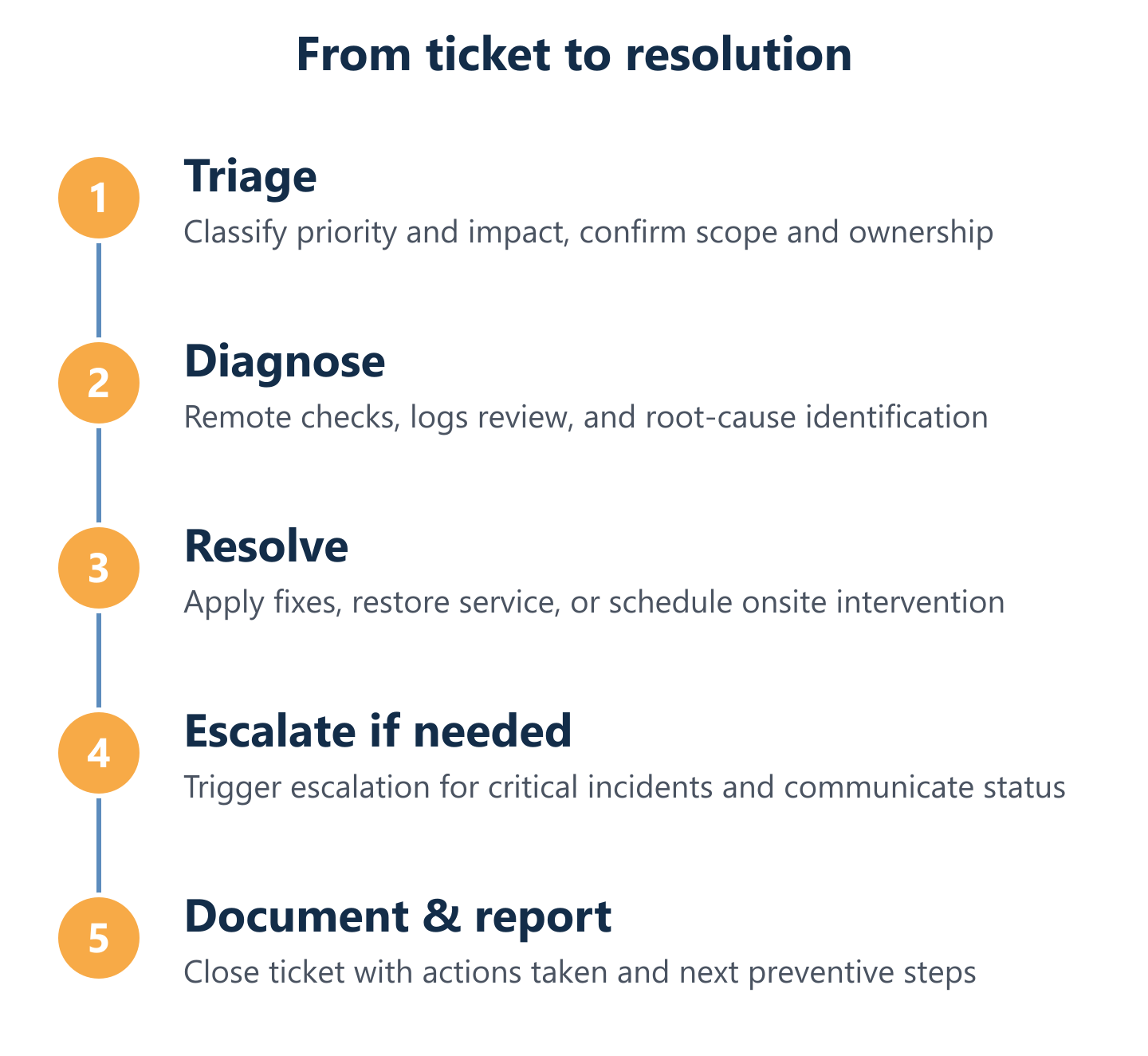
Every IT incident follows a decision path. The goal is to resolve issues as quickly as possible with the least disruption to your team — which means starting remotely and escalating to onsite only when it genuinely accelerates resolution.
- Ticket received: The user submits an incident via the helpdesk portal, email, or telephone. The ticket is logged, categorised by severity, and assigned immediately.
- Triage: A technician reviews the ticket and determines whether the issue can be diagnosed and resolved remotely or requires onsite assessment.
- Remote diagnosis: For software, access, and application issues, the technician connects remotely to the affected device or system and begins resolution within the SLA window.
- Escalation decision: If remote resolution is not possible — due to hardware failure, physical network fault, or deployment requirement — an onsite visit is scheduled with the client.
- Onsite intervention: An engineer travels to the La Coruña location, resolves the physical issue, and documents the work completed.
- Resolution and documentation: The ticket is closed with a full record of actions taken, time spent, and any follow-up recommendations.
This blended remote IT support and onsite IT support model is particularly effective for organisations with multiple locations or distributed teams, where consistent service quality across all sites matters as much as speed of response.
Ticket workflow: triage, diagnosis, resolution, and documentation
Every ticket submitted to Impulso Tecnológico's helpdesk goes through a structured workflow designed to minimise resolution time and maintain a clear audit trail. On receipt, tickets are categorised by type — user issue, device fault, network problem, application error, or security alert — and assigned a severity level that determines the response window under the applicable service level agreement.
Remote diagnosis is the default first step. The majority of user-facing incidents — email configuration errors, VPN access failures, Microsoft 365 permission issues, slow device performance — are resolved without any need for an engineer to visit site. This keeps resolution times short and avoids disruption to the wider team. Every resolved ticket is documented with the root cause, actions taken, and any preventive recommendation, building a knowledge base that helps reduce repeat incidents over time.
Urgency rules: when to escalate and how onsite gets scheduled
Not every IT incident is equal. A user unable to print is inconvenient; a server that is down or inaccessible is critical. Impulso Tecnológico applies clear urgency rules to ensure that critical issues receive a faster response and that onsite visits are scheduled without unnecessary delay when physical intervention is the right solution.
Critical server incidents — where core business systems are unavailable or at risk — carry a response target of under four hours. Standard requests are handled within eight hours. When remote diagnosis confirms that an onsite visit is required, the scheduling process is initiated immediately, with priority given to incidents affecting multiple users or business-critical infrastructure. Typical triggers for onsite intervention include hardware failures, physical network cabling faults, workstation or server deployments, printer installation, and infrastructure upgrades requiring hands-on configuration with Cisco, Aruba, or Fortinet equipment.
Operational fit: multi-location teams and remote workers in La Coruña
Businesses in La Coruña increasingly operate across multiple sites or employ staff who work remotely part of the time. This creates a support challenge: incidents can occur anywhere, but the quality of resolution should be consistent regardless of where a user is located.
Impulso Tecnológico's support model is built for this operational reality. Remote IT support covers distributed users regardless of their physical location — whether they are working from a secondary office, from home, or travelling. For La Coruña-based sites requiring onsite visits, our engineers are available within the defined coverage area. For organisations with locations beyond La Coruña, our broader service footprint across Spain and Portugal means we can coordinate consistent support across sites without requiring multiple providers. This is especially relevant for growing companies that need a single point of accountability for IT across their entire operation. You may also find it useful to review how we structure IT support in Cantabria for a comparable regional deployment model.
Response times, SLAs and pricing options for SMEs
Service level agreements are only meaningful when they are specific. Vague commitments such as "fast response" or "best effort" provide no real protection when a critical system goes down. Before committing to any IT support contract in La Coruña, verify that the provider offers written SLAs with defined response windows, clear escalation paths, and measurable reporting.
Impulso Tecnológico structures its managed IT support around the following commitments and features:
- Response time for critical server incidents: under four hours from ticket submission during coverage hours.
- Response time for standard requests: under eight hours from ticket submission during coverage hours.
- Coverage hours: Monday to Friday, 09:00–17:00 CET — clearly defined so your team knows when to expect a response.
- Escalation process: incidents that cannot be resolved remotely within the SLA window are escalated automatically to onsite intervention.
- Initial IT environment audit: every new client receives a full audit and device inventory before the service goes live.
- Proactive monitoring: continuous monitoring of managed endpoints and infrastructure to detect anomalies before they become incidents.
- Reporting: regular reports covering ticket volumes, resolution times, recurring issues, and infrastructure health KPIs.
- Pricing flexibility: fixed monthly packages for SMEs managing between 3 and 150 devices, with options tailored to budget and risk profile.
For a detailed comparison of how this approach applies in a similar urban context, see our guide to IT support in Barcelona.
SLAs that matter: response targets and escalation process
A service level agreement is the contractual backbone of any managed IT support relationship. At Impulso Tecnológico, our SLAs define two primary response tiers: under four hours for critical server incidents where core business operations are affected, and under eight hours for standard user requests and non-critical issues. These targets apply during coverage hours (Monday to Friday, 09:00–17:00 CET) and are tracked through our helpdesk ticketing system.
Escalation is triggered automatically when an incident cannot be resolved within the initial response window or when remote diagnosis confirms that onsite intervention is required. The escalation path is documented in the contract, so your team always knows who is handling the issue and what the next step is. This transparency is particularly important for IT incident response scenarios where business continuity is at stake — for example, a server outage affecting multiple departments simultaneously.
Cost structure options: predictable monthly packages for 3–150 devices
Unpredictable IT costs are one of the main reasons businesses in La Coruña look to switch providers. Emergency callout fees, variable hourly rates, and scope disputes make budgeting difficult and erode trust.
Impulso Tecnológico offers fixed monthly managed IT support packages designed for SMEs operating between 3 and 150 computers. Pricing is structured per device or per user depending on the service scope, and each package defines clearly what is included — helpdesk support, monitoring, patching, backup management, and onsite visits within agreed parameters. For organisations that prefer flexibility, a modular approach is also available, allowing you to start with core support and add services such as cybersecurity management or cloud administration as your needs grow. There are no hidden callout fees for incidents covered within the contract scope. Our approach to preventive IT maintenance is built into every package rather than sold as an add-on.
Onboarding and reporting: audit, first-week plan, and ongoing KPIs
Starting a new IT support contract without a structured onboarding process is one of the most common causes of early dissatisfaction. If the provider does not know your environment, they cannot support it effectively.
Impulso Tecnológico begins every engagement with a full audit of your IT infrastructure — servers, endpoints, network equipment, software licences, backup status, and security configuration. This produces a detailed inventory that forms the foundation for proactive maintenance scheduling and risk identification. During the first week, we establish monitoring agents, configure the helpdesk ticketing integration, and agree on escalation contacts within your organisation. From that point forward, monthly reports cover ticket volumes, average resolution times, recurring incident categories, patch compliance status, and backup health — giving your management team the data needed to make informed decisions about IT investment. For a comparable onboarding model applied in another location, see how we deliver IT support in Alcobendas.
Choosing an IT support provider in La Coruña comes down to one practical question: does their coverage, SLA structure, and onboarding process actually match how your business operates? Generic promises about fast response mean little without written commitments, a defined escalation path, and a provider who understands your infrastructure from day one. Impulso Tecnológico brings over 25 years of managed IT experience, certified partnerships with Sophos, Fortinet, Microsoft, Cisco, and Veeam, and a service model built around transparency and accountability. If you are ready to move from reactive troubleshooting to structured, proactive IT support, the next step is straightforward.