

IT support in Cadiz means keeping desktops, servers, and communications running reliably, with defined response times and proactive protection — not just fixing problems after they occur. A managed approach combines remote and onsite coverage, security hardening, and backup protection under a single, predictable service model.
Many businesses in Cadiz reach out for IT support only after something breaks — a server goes down, ransomware hits an endpoint, or a critical file disappears without a recoverable backup. By then, the cost in lost productivity and recovery time is already accumulating. The smarter approach is a managed services model that prevents those incidents through regular maintenance, security alignment, and tested backup routines. Impulso Tecnológico has been delivering this kind of structured IT support across Spain for over 25 years, working with companies that need their technology to stay available, secure, and predictable — whether or not they have an internal IT team. The result is fewer disruptions, faster resolution when issues do arise, and a clear understanding of what is covered before anything goes wrong.
What IT Support Cadiz should include (beyond break/fix)
Most IT support engagements in Spain begin as reactive arrangements: something fails, a technician is called, the problem is resolved. That model works until the same failure repeats three months later because the root cause was never addressed. Businesses in Cadiz — from logistics operators in the port area to professional services firms in the city centre — need support that is structured around availability, not just repair speed.
Good IT support combines three layers: a reliable response mechanism with measurable SLAs, a proactive maintenance routine that reduces incident frequency, and embedded security and backup practices that limit the blast radius when something does go wrong. Impulso Tecnológico designs its support packages around all three layers, offering onsite and remote IT support with tailored service level agreements and proactive checks after every resolved ticket — particularly useful for organisations that lack a dedicated internal IT department.
| Capability | Break/Fix Only | Managed IT Support |
|---|---|---|
| Response time commitment | Best effort, no guarantee | Defined SLAs (e.g., <8 h standard, <4 h urgent) |
| Maintenance approach | Reactive only | Proactive checks and preventive routines |
| Security alignment | Not included | Hardening and environment review included |
| Backup oversight | Client responsibility | Backup verification and continuity planning |
| Reporting and documentation | Rarely provided | Resolution reports and asset inventory maintained |
| Cost predictability | Variable, unpredictable | Fixed monthly or packaged pricing available |
Core coverage: desktops, servers, and communications
The foundation of any IT support contract is coverage of the three asset categories that affect daily operations most directly: end-user devices (desktops, laptops, and workstations), servers (on-premise or hybrid), and communications infrastructure (internet connectivity, email, and VoIP where applicable). Impulso Tecnológico maintains a documented inventory of every asset under contract, which serves two purposes: it ensures nothing is overlooked during a maintenance cycle, and it provides a baseline for faster diagnosis when an incident occurs. Proactive maintenance — patch management, performance monitoring, and scheduled health checks — reduces the frequency of incidents rather than simply resolving them faster. For businesses running critical line-of-business applications, keeping servers stable and communications reliable is not optional; it is the baseline expectation.
Security-by-design: hardening and environment alignment
Cybersecurity hardening is not a separate project — it is part of how a well-run support service operates. Every endpoint, server, and communication channel is a potential entry point, and without deliberate configuration controls, even patched systems remain exposed. Impulso Tecnológico applies security hardening as a standard component of its IT support work, aligning the security environment with industry criteria and each client's specific operational context. This includes endpoint protection via Sophos or Fortinet technologies, firewall configuration review, access control alignment, and GDPR-relevant data handling practices. When a support ticket is resolved, the technician also checks whether the incident reveals a broader configuration gap — turning individual fixes into systematic improvements rather than isolated repairs. This approach is what separates a managed services provider from a standard helpdesk.
Backup protection and continuity planning
A backup that has never been tested is not a backup — it is an assumption. Backup and disaster recovery planning must be verified regularly, and the recovery objectives (how much data can be lost, how quickly systems must be restored) need to be defined before an incident occurs, not during one. Impulso Tecnológico incorporates backup oversight into its support contracts, using Veeam-based solutions for server and workload protection, and aligning recovery point and time objectives with each client's business continuity requirements. For Cadiz businesses with limited IT staff, this means backup health is monitored as part of the ongoing support cycle — not left to chance. When a failure does occur, a tested recovery plan reduces downtime from days to hours. You can find similar continuity practices described in our approach to preventive IT maintenance for businesses.

How to compare providers: SLAs, scope, and support model
Choosing an IT support provider in Cadiz is not primarily a price decision — it is a risk management decision. The right question is not "how much does it cost per month?" but "what happens when a server goes down on a Tuesday morning and half the office cannot work?" The answer to that question is determined by the provider's SLAs, escalation paths, and whether their scope actually covers what matters to your business.
Impulso Tecnológico structures its evaluation process around a clear sequence that removes ambiguity before the contract is signed:
- Initial audit: Assess the current state of endpoints, servers, antivirus, backups, and communications before proposing anything.
- Scope definition: Agree precisely which assets and services are covered — no vague "general IT support" language.
- SLA selection: Choose response time targets that match your operational risk (standard requests vs. urgent server or business-impact issues).
- Pricing model alignment: Select between fixed-price all-inclusive, hourly packages, or full IT outsourcing based on volume and predictability needs.
- Escalation mapping: Confirm how incidents are escalated, who the named contacts are, and what triggers onsite intervention.
- Reporting cadence: Establish how resolution reports, inventory updates, and proactive review findings are communicated.
- Review cycle: Set a regular service review to assess ticket trends, recurring issues, and whether the support model still fits as the business grows.
This structured approach is consistent with how Impulso Tecnológico onboards clients across Spain, including engagements similar to our IT support work in Almeria and other Andalusian locations.
Service level agreements (SLAs) and escalation expectations
An SLA without enforcement is a marketing statement. When evaluating an IT helpdesk in Cadiz, ask the provider to show you the specific response time targets written into the contract — not a general commitment to "fast response." Impulso Tecnológico defines SLAs with measurable targets: under 8 working hours for standard requests, and under 4 working hours for server failures or incidents affecting the entire business operation. These targets apply to the initial response and to escalation triggers for onsite intervention. Equally important is the escalation path: who handles a ticket if the first technician cannot resolve it remotely? Is there a named escalation contact? For businesses with no internal IT team, these details determine whether a crisis is managed or merely endured. Support hours run Monday to Friday, 09:00–17:00 CET, so expectations are transparent from the outset.
Pricing and engagement models: fixed, hourly, or outsourced
Three pricing structures dominate the managed IT support market in Spain, and each suits a different operational profile. A fixed-price all-inclusive model provides unlimited remote support hours within the agreed scope, making it ideal for businesses that want cost certainty and high support volume. An hourly package suits organisations with lower, more predictable ticket volumes that still want a formal relationship with defined response times. Full IT outsourcing — where Impulso Tecnológico acts as the entire IT department — is appropriate for companies that want to eliminate internal IT overhead entirely. Regardless of the model chosen, the all-inclusive option from Impulso Tecnológico includes a maintained asset inventory, proactive review after each support request, and detailed resolution reporting. These are not premium add-ons; they are structural components that prevent repeat incidents and reduce the total cost of support over time.
Proactive processes: inventory, reviews, and resolution reports
The difference between a support provider that reduces your IT problems over time and one that simply keeps resolving the same issues lies in three operational habits: maintaining an accurate asset inventory, conducting a proactive review after every resolved ticket, and producing structured resolution reports. An up-to-date inventory means the technician knows exactly what is in scope before touching anything — no surprises about unlicensed software or unsupported hardware. A post-resolution review checks whether the incident reveals a wider vulnerability or configuration gap that should be addressed proactively. Resolution reports create an auditable record of what was done, why, and what was recommended — useful for compliance purposes and for identifying recurring failure patterns. Impulso Tecnológico includes all three in its managed support contracts, treating them as quality controls rather than optional documentation.
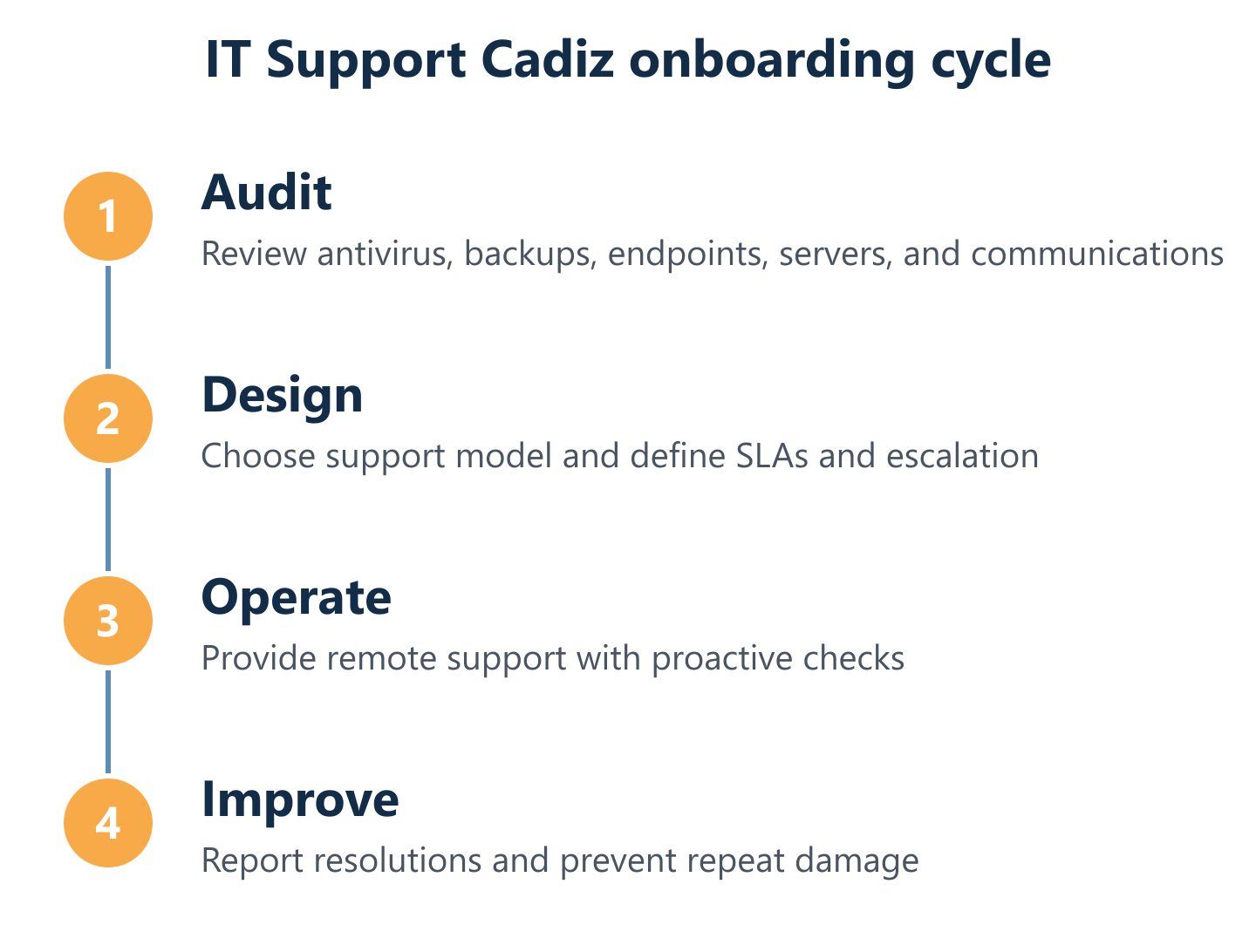
A practical onboarding cycle for IT Support Cadiz
Understanding what the first 30–60 days of an IT support engagement look like helps businesses set realistic expectations and avoid the common frustration of paying for a service before it is properly configured. A well-structured onboarding cycle moves through distinct phases: discovery, baseline alignment, and transition to steady-state support.
Impulso Tecnológico follows a consistent onboarding sequence for new clients in Cadiz and across Spain:
- Discovery meeting: Understand the business context, critical systems, existing pain points, and any compliance requirements (e.g., GDPR, sector-specific regulations).
- Technical audit: Assess the current state of endpoints, servers, antivirus coverage, backup configurations, and communications infrastructure.
- Gap identification: Document security, backup, and maintenance gaps that need to be addressed before steady-state support begins.
- Baseline remediation: Resolve critical gaps — misconfigured firewalls, missing endpoint protection, untested backups — as a precondition for reliable ongoing support.
- SLA and scope agreement: Finalise which assets are covered, response time targets, escalation paths, and the pricing model.
- Monitoring and tooling deployment: Install remote monitoring and management tools to enable proactive visibility across all covered systems.
- Handover and communication: Introduce the support team, confirm ticket submission channels, and set expectations for reporting cadence.
- First review: After 30 days, review ticket trends, any recurring issues, and whether the agreed SLAs are being met consistently.
For companies that already have an internal IT team, Impulso Tecnológico can act as an external extension — handling overflow, specialist tasks, or onsite interventions that the internal team cannot cover. This hybrid model is particularly common among mid-sized businesses in Andalusia that have one or two IT generalists but need specialist depth for security, infrastructure, or cloud projects. Similar onboarding approaches are used in our IT support engagements in La Coruña and IT support in Ciudad Real.
Step 1: Initial audit and system baseline
The initial audit is not a formality — it is the document that determines whether the support contract will actually work. Without knowing the current state of antivirus coverage, backup health, endpoint configurations, server patch levels, and communications infrastructure, a provider cannot make meaningful SLA commitments or price the engagement accurately. Impulso Tecnológico conducts a structured audit covering all assets that will fall under the support contract, producing a baseline inventory that becomes the reference point for all future maintenance and incident work. This audit also identifies immediate risks — systems running without active backup, endpoints with outdated endpoint protection, or servers approaching end-of-support lifecycle — that need to be addressed before steady-state support begins. Starting from a known, documented baseline is what makes proactive support possible.
Step 2: Define the support model and SLAs
Once the audit is complete and critical gaps have been remediated, the next step is agreeing the support model and formalising the SLAs. This is the stage where vague commitments become contractual obligations. The support model — fixed-price all-inclusive, hourly package, or full outsourcing — is selected based on the volume and criticality of expected support demand. SLAs are then calibrated to the business's operational risk: a company running time-sensitive logistics operations needs faster escalation paths than a professional services firm with more tolerance for minor delays. Impulso Tecnológico documents response time targets, escalation triggers, onsite intervention criteria, and reporting obligations in the service agreement — so both parties know exactly what to expect before the first ticket is raised. Security and backup alignment are confirmed at this stage, not retrofitted later.
Step 3: Ongoing support, proactive review, and reporting
Steady-state support is where the value of a managed services model becomes measurable. Every resolved ticket triggers a proactive review: did this incident reveal a configuration gap, a hardware risk, or a security exposure that should be addressed before it causes a second incident? This review step is what separates a managed services provider from a standard IT helpdesk. Impulso Tecnológico produces a detailed resolution report for each ticket, documenting what was found, what was done, and what was recommended — creating an auditable record that is useful for both operational and compliance purposes. Monthly or quarterly service reviews assess ticket trends, recurring failure patterns, and whether the current support model still fits the business's evolving needs. Remote IT support handles the majority of requests within SLA; onsite intervention is deployed when a general fault is identified or when local action is required.
Selecting the right IT support model for your Cadiz operations comes down to matching the service structure to your actual risk exposure. If your business cannot afford extended downtime, the SLAs, security hardening, and backup protection need to be in place from day one — not added later when something goes wrong. Impulso Tecnológico offers a clear path from initial audit to ongoing managed support, with transparent pricing, defined response times, and proactive processes that reduce incident frequency over time. The first step is understanding your current baseline. Contact Impulso Tecnológico to arrange an initial assessment and find the support model that fits your organisation.