

IT support in Asturias covers day-to-day helpdesk assistance, proactive system maintenance, network management, and security monitoring for local businesses. A qualified provider handles incidents quickly, maintains infrastructure, and prevents downtime before it disrupts operations.
Many businesses in Asturias operate with lean internal teams that simply cannot absorb the workload of managing servers, endpoints, security patches, and user requests simultaneously. When something breaks, productivity stalls—and without a structured support model, the same problems recur. The solution is a managed IT support service that combines reactive helpdesk response with proactive monitoring, so issues are caught before they escalate. Impulso Tecnológico delivers exactly this: a structured, audit-led approach that maps your real environment first, then applies a tailored maintenance and security plan. The result is measurable—fewer incidents, faster resolution, and predictable monthly costs that replace the unpredictability of ad-hoc IT firefighting.
What IT Support in Asturias typically includes
Before comparing providers, it pays to define exactly what you are buying. IT support is not a single product—it spans user helpdesk, incident management, preventive maintenance, network oversight, and security hygiene. Businesses that skip this scoping step often discover, mid-contract, that critical services such as backup verification or endpoint protection sit outside the agreed scope.
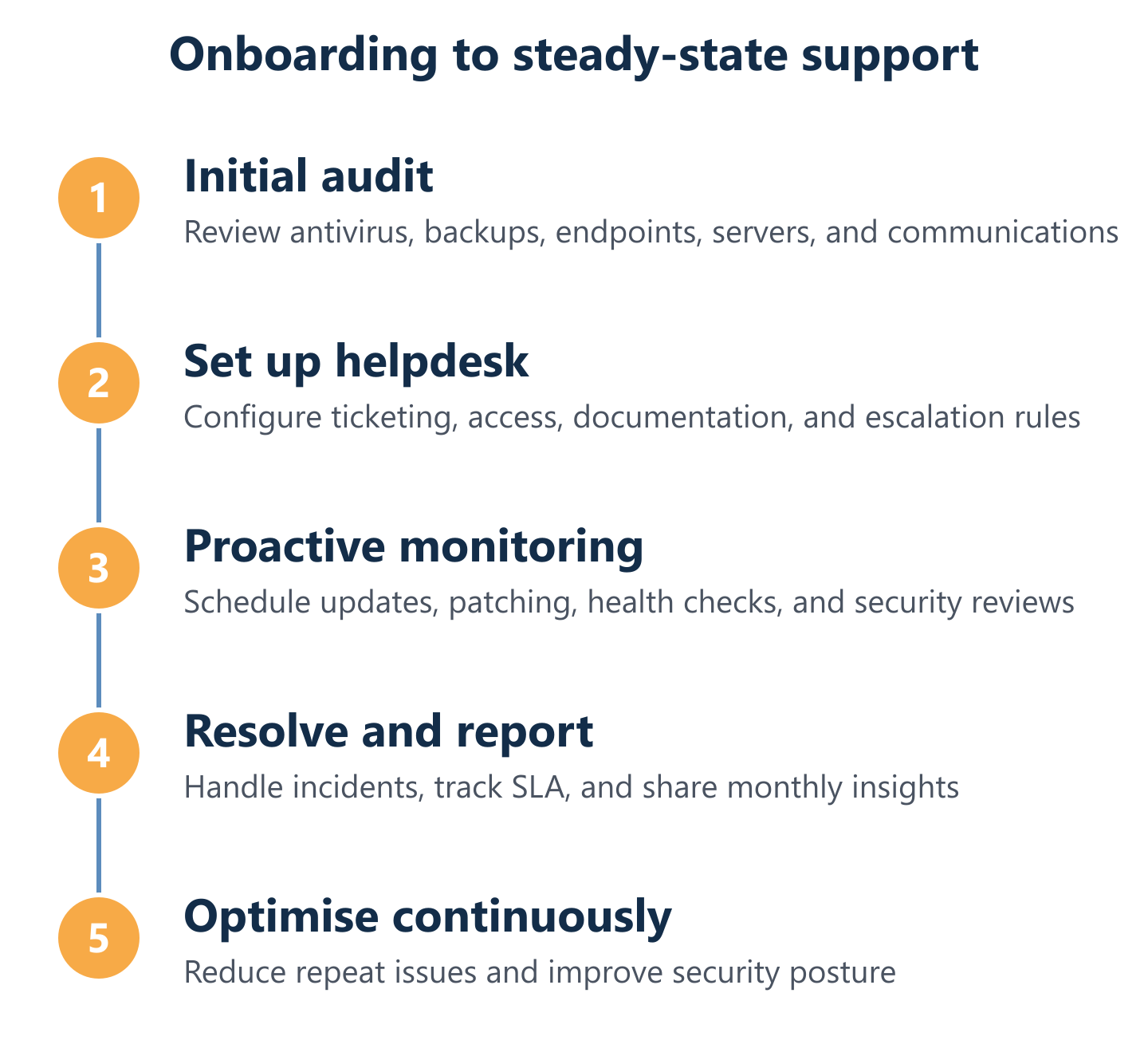
At Impulso Tecnológico, every engagement begins with a structured audit covering antivirus protection, backup systems, desktop and server configurations, and communications infrastructure. This baseline makes the service scope measurable rather than assumed, and it allows the team to build a maintenance and security plan aligned to your actual environment—not a generic template.
| Support Area | Reactive-Only Provider | Managed IT Support (Impulso Tecnológico) |
|---|---|---|
| Helpdesk & incident tickets | On request only | Structured triage, priority queues, follow-up |
| Preventive maintenance | Rarely included | Scheduled patching, health checks, updates |
| Network & connectivity | Break-fix only | Proactive monitoring, configuration management |
| Security (endpoint + backup) | Separate contract | Integrated multi-layer protection |
| Initial environment audit | Not standard | Mandatory onboarding step |
| Reporting & SLA tracking | Rarely provided | Regular reports, SLA compliance data |
Core support coverage: users, devices, and business apps
The most visible layer of any IT support service is the helpdesk: the channel through which staff log problems, receive triage, and get resolution. A well-run IT helpdesk classifies each ticket by priority, assigns ownership, and tracks it to closure—with follow-up to confirm the fix held. For businesses running Microsoft 365, line-of-business applications, or cloud-hosted platforms, this also means supporting user accounts, permissions, application errors, and device configuration. Impulso Tecnológico manages this full scope—from a user who cannot access their email to a workstation that needs reconfiguring after a hardware swap—ensuring that day-to-day productivity is never blocked by unresolved IT queues. This structured approach to incident management is what separates a professional managed service from informal IT assistance.
Infrastructure and network support: Wi-Fi, switches, and connectivity basics
Network reliability underpins every business operation, yet it is frequently the area where proactive maintenance is most neglected. Firmware updates for switches and access points, VLAN configuration reviews, and Wi-Fi coverage assessments are not glamorous tasks—but skipping them is a common cause of intermittent connectivity issues that erode staff productivity over time. Impulso Tecnológico works with certified technologies from Cisco, Aruba, and Fortinet to manage wired and wireless infrastructure, applying scheduled patching and hardware health checks as part of the ongoing maintenance cycle. For businesses in Asturias that rely on stable connectivity for cloud applications, VoIP, or remote access, this layer of infrastructure support is not optional—it is the foundation on which everything else depends. On-site visits cover physical cabling and hardware installation when remote resolution is not sufficient.
Security and continuity: backups, recovery checks, and vulnerability management
Security support is no longer a separate discipline from day-to-day IT maintenance—it must be embedded in every layer of the service. Endpoint protection, secure remote access practices, and regular backup verification should be standard deliverables, not add-ons. Impulso Tecnológico applies a multi-layer security mindset across all managed engagements, using certified tools from Sophos, Fortinet, and Veeam to cover endpoint protection, network-level filtering, and backup and disaster recovery. Critically, backup health is verified regularly—not just assumed to be working. Vulnerability management includes systematic application of security patches and firmware updates, reducing the attack surface before threats can exploit known weaknesses. For SMEs in Asturias handling sensitive business or client data, this integrated approach to business IT security support ensures that continuity planning is built into the service from day one, rather than addressed only after an incident.

Service levels, response times, and escalation you can trust
An IT support contract without defined SLAs is a goodwill agreement, not a service commitment. Before signing with any provider, demand written response time targets, clear priority classifications, and a documented escalation path for critical incidents.
Impulso Tecnológico structures its IT support SLA around two core response targets:
- Under 8 hours for general support requests—covering user issues, software problems, and standard maintenance tasks.
- Under 4 hours for urgent server or infrastructure incidents—where business operations are directly at risk.
- Unlimited remote and on-site support hours within the Fixed Price All-Inclusive package, eliminating the risk of unexpected invoices when incident volumes spike.
- Hourly reactive packages for businesses that need occasional support without a full managed contract—providing flexibility without sacrificing structure.
- Proactive system reviews reduce repeat incidents by identifying root causes, not just applying temporary fixes—so the same problem does not consume SLA hours month after month.
- Regular reporting keeps business owners informed of SLA compliance, incident trends, and any open risks—turning IT support from a black box into a transparent, measurable service.
This model is particularly relevant for SMEs in Asturias that need managed services for SMEs with cost predictability and clear accountability, without the overhead of managing an internal IT department.
SLA design: what "under 8 hours" and "under 4 hours" should mean in practice
Response time targets only have value when they are tied to a clear definition of when the clock starts. A well-designed IT support SLA specifies: the moment a ticket is logged (not when it is first read), the priority classification that triggers each response target, and whether the target covers first response or full resolution. For general requests, an under-8-hour response window covers the majority of user-facing issues without disrupting the working day. For urgent server incidents—where a failed server can halt an entire office—a sub-4-hour response is the minimum acceptable standard. Impulso Tecnológico applies these targets across its Fixed Price All-Inclusive package, with priority classification handled at ticket creation so that critical incidents are never queued behind routine requests. Businesses comparing providers should ask for historical SLA compliance data, not just contractual promises.
Escalation and ownership: single point of contact and structured handovers
One of the most common frustrations with IT support is the absence of clear ownership: tickets bounce between technicians, nobody takes responsibility for a complex incident, and the business owner is left chasing updates. Impulso Tecnológico addresses this through a single point of contact model—one named coordinator who owns the relationship, tracks open incidents, and ensures that escalations to senior engineers or specialist teams are handled with a structured handover rather than an informal verbal note. When an incident escalates—because it affects a critical server, a security event is detected, or a hardware failure requires on-site intervention—the escalation path is predefined, not improvised. This structure is especially important for businesses in Asturias that cannot afford ambiguity during a critical outage, where every minute of delay has a direct operational cost.
Reporting and transparency: what you receive and how often
Regular reporting transforms IT support from a cost centre into a managed business function. A monthly report should include: total tickets logged and resolved, average response and resolution times versus SLA targets, recurring issues identified and root-cause actions taken, and any open risks or deferred maintenance items. Impulso Tecnológico provides this visibility as a standard part of its managed service—so business owners in Asturias are never left wondering whether their IT investment is delivering value. Reporting also serves a strategic purpose: by tracking incident trends over time, the team can identify systemic weaknesses—an ageing server, a misconfigured application, or a user group generating disproportionate ticket volume—and address them proactively before they generate downtime. Transparency at this level is what distinguishes a genuine managed IT partner from a reactive break-fix supplier.
Choosing the right IT Support model for your business in Asturias
The right IT support model depends on your business size, risk tolerance, internal technical capability, and the criticality of your IT systems. There is no single correct answer—but there are clear signals that point towards one model over another.
- You have zero internal IT staff: a fully managed service is the most efficient option—Impulso Tecnológico acts as your entire IT department, aligning technology strategy with business objectives.
- You have one internal IT person managing day-to-day tasks: a hybrid managed service supplements their capacity with specialist skills, on-site resource, and security tooling they cannot handle alone.
- You need occasional support for specific projects or incidents: an hourly reactive package provides structured assistance without a monthly commitment.
- Your systems include servers, firewalls, or cloud infrastructure: proactive monitoring is non-negotiable—reactive-only support will always arrive after the damage is done.
- You operate across multiple sites or have remote workers: a hybrid support model combining remote IT support with scheduled on-site visits delivers both speed and physical coverage.
- You are moving to or expanding Microsoft 365 or Azure: managed services that include cloud governance and identity management prevent configuration drift and security gaps.
Impulso Tecnológico's onboarding audit removes guesswork from this decision—by mapping your environment first, the recommended model is grounded in your actual infrastructure, not a sales assumption. Similar structured approaches have proven effective across other regions where we operate, including our IT support services in Cantabria and IT support in La Coruña.
Remote vs on-site: decision criteria by risk, complexity, and site needs
Remote IT support resolves the majority of business IT issues faster than any on-site visit could—because there is no travel time, and a technician can connect to a device within minutes of a ticket being logged. For software errors, account issues, cloud configuration, and most user-facing problems, remote support is both faster and more cost-effective. On-site support becomes necessary when the issue is physical: hardware replacement, network cabling, firewall installation, or any infrastructure task that cannot be completed remotely. Impulso Tecnológico uses a remote-first model, escalating to on-site visits only when the complexity or physical nature of the task requires it. This approach maximises response speed while ensuring that no incident is left unresolved simply because it requires a physical presence. For businesses in Asturias with server rooms or multi-floor offices, scheduled on-site visits also allow for hardware health checks and infrastructure reviews that remote monitoring cannot fully replace.
Engagement options: hourly reactive support vs fixed monthly packages vs fully managed services
Three engagement models cover the full spectrum of business IT support needs. Hourly reactive support suits businesses with infrequent IT issues that do not justify a monthly contract—it provides structured assistance on demand, with clear hourly billing and no long-term commitment. Fixed monthly packages, such as Impulso Tecnológico's Fixed Price All-Inclusive offering for businesses with between 3 and 150 computers, deliver unlimited remote and on-site support hours at a predictable monthly cost—eliminating the financial unpredictability of reactive billing during high-incident months. Fully managed services go further, embedding IT strategy alignment, proactive monitoring, security management, and regular optimisation reviews into a single coordinated service. In all three models, Impulso Tecnológico coordinates through a single point of contact, ensuring that no incident falls between the gaps of different teams or contracts. Businesses considering their options can also review how we structure preventive IT maintenance for companies as a foundation for any engagement model.
Provider checklist: SLAs, onboarding steps, monitoring, security stack, and communication
Evaluating an IT support provider requires more than comparing prices. Use this checklist before committing to any contract:
- SLAs in writing: are response time targets documented, with priority classifications and penalty or escalation clauses?
- Onboarding process: does the provider conduct an initial audit of your environment, or do they start support without a baseline?
- Proactive monitoring: are systems monitored continuously, or does the provider only respond when you raise a ticket?
- Security stack: are certified tools (such as Sophos, Fortinet, or Veeam) included, or is security an optional extra?
- Vendor certifications: does the provider hold active partner or certification status with the technologies they recommend?
- Communication model: is there a single point of contact, or will you deal with a rotating helpdesk queue?
- Reporting cadence: will you receive regular written reports on SLA compliance and incident trends?
Impulso Tecnológico meets each of these criteria, backed by more than 25 years of IT consulting experience and active partnerships with Sophos, Fortinet, Veeam, Cisco, Aruba, and Microsoft, among others.
Choosing an IT support provider in Asturias is a decision that affects your daily operations, your security posture, and your ability to scale without technology becoming a bottleneck. The right partner will not ask you to trust their word—they will show you the scope of their service, the SLAs they commit to, and the onboarding steps that ensure a smooth transition from day one. Impulso Tecnológico's approach is built on exactly this transparency: a structured audit, defined response targets, and a support model tailored to your actual environment. If you are ready to move from reactive IT firefighting to predictable, managed support, the next step is a conversation about your specific needs in Asturias. You may also find it useful to review how we deliver IT support in Almeria as a comparable regional reference.