

IT Support Alava covers the full range of services businesses need to keep their technology running: helpdesk and incident resolution, preventive maintenance, system monitoring, and managed security basics — delivered remotely or on-site depending on the situation and urgency.
Most companies in Álava don't struggle with technology because they lack equipment. They struggle because their IT support is reactive, slow, or fragmented across multiple vendors with no clear accountability. When a server goes down on a Monday morning or a user can't access a critical application before a client meeting, the cost isn't just technical — it's operational and reputational.
A structured IT support model solves this by shifting from fire-fighting to prevention. Monitoring tools flag issues before they escalate. Patching schedules reduce vulnerability windows. Defined SLAs mean your team knows exactly when to expect a response and who is handling it. At Impulso Tecnológico, we combine proactive managed services with helpdesk capabilities to deliver predictable, measurable support — for businesses across Spain and beyond, including organisations operating in or from Álava.
IT Support Alava: what it includes for companies
Many businesses request IT support without a clear picture of what the service should actually cover. The term is broad — and providers vary significantly in scope, depth, and delivery model. For companies in Álava, understanding what you are buying before signing a contract is the difference between a service that protects your operations and one that only reacts when things break.
At its core, IT support for business covers four interconnected areas: helpdesk and incident handling, preventive maintenance and patching, infrastructure monitoring, and managed security basics. Some providers offer only one or two of these; a managed services model integrates all of them under a single contract with defined accountability.
Impulso Tecnológico approaches IT support as a centralised managed service — combining proactive monitoring with endpoint and network management, so clients deal with one partner rather than coordinating between multiple vendors. This reduces complexity, improves response coordination, and makes outcomes measurable through structured reporting.
| Support Area | Reactive-Only Model | Managed Services Model (MSP) |
|---|---|---|
| Helpdesk & Incident Resolution | On request only, variable response | Defined SLA, structured triage and escalation |
| Preventive Maintenance | Rarely included | Scheduled patching, updates, and health checks |
| System Monitoring | Not included | Continuous monitoring with alerts and proactive action |
| Security Basics | Optional add-on, inconsistent | Integrated: endpoint protection, backup, access control |
| Cost Predictability | Variable, per-incident billing | Fixed monthly price per device |
| Vendor Coordination | Client manages multiple suppliers | Single point of contact for all IT matters |
What "IT support" covers: helpdesk, maintenance, and managed services
Helpdesk and incident management form the visible layer of IT support — the point where users report problems and expect resolution. In a well-structured model, this means a defined intake channel (phone, email, or ticketing portal), a triage process that categorises issues by severity, and a clear workflow from first contact through diagnosis to closure. Beyond the helpdesk, IT support includes scheduled maintenance tasks: applying operating system and application patches, reviewing system health, and managing backups. Managed services extend this further by adding continuous monitoring and proactive intervention — so many issues are identified and resolved before users are even aware of them. Impulso Tecnológico resolves over 4,000 IT tickets annually across its client base, which reflects the volume and variety of incidents a structured support model handles day to day.
Remote vs on-site support in Álava: when each is best
Remote support resolves the majority of business IT incidents — software errors, connectivity issues, user access problems, and configuration changes can all be handled without a technician visiting the premises. This makes remote assistance the fastest and most cost-efficient channel for most day-to-day requests. On-site support becomes necessary when the issue is physical: hardware failure, network cabling, device replacement, or any situation where hands-on intervention is required. For businesses in Vitoria-Gasteiz and across Álava, having a provider capable of both modalities matters — particularly for incidents that start as software problems and escalate to hardware. Impulso Tecnológico delivers both remote and on-site IT support across Spain, with its computer support service offering unlimited access to both channels under a fixed monthly price per device, so businesses are never left choosing between speed and thoroughness.
Typical deliverables: monitoring, updates, backups, and user assistance
A managed IT support contract should produce tangible, recurring deliverables — not just reactive responses. The standard set includes: continuous system monitoring (servers, endpoints, network devices), scheduled patch management and software updates, backup verification and recovery testing, and user-level assistance for day-to-day technical queries. Monitoring is particularly critical: without visibility into system health, problems accumulate silently until they cause outages. Patching reduces the attack surface for cyber threats and keeps applications stable. Backup verification — often overlooked — ensures that when a recovery is needed, the data is actually there and restorable. Impulso Tecnológico integrates these deliverables using technology from partners including Veeam for backup, Sophos and Fortinet for endpoint and network security, and Microsoft for cloud and identity management, giving clients an enterprise-grade foundation regardless of company size.

How helpdesk and SLAs work: resolution, priorities, and communication
A service level agreement (SLA) is not just a contractual formality — it is the operational backbone of any IT support relationship. Without defined SLAs, response times are unpredictable, priorities are inconsistent, and clients have no basis to measure whether they are getting what they paid for. For businesses in Álava relying on IT support services, understanding how SLAs translate into daily operations is essential before committing to a provider.
Impulso Tecnológico structures its managed support around clear service delivery principles: incidents are categorised by severity, response and resolution targets are set accordingly, and clients receive transparent communication throughout. The model is designed to remove ambiguity — so when an issue occurs, your team knows exactly what happens next.
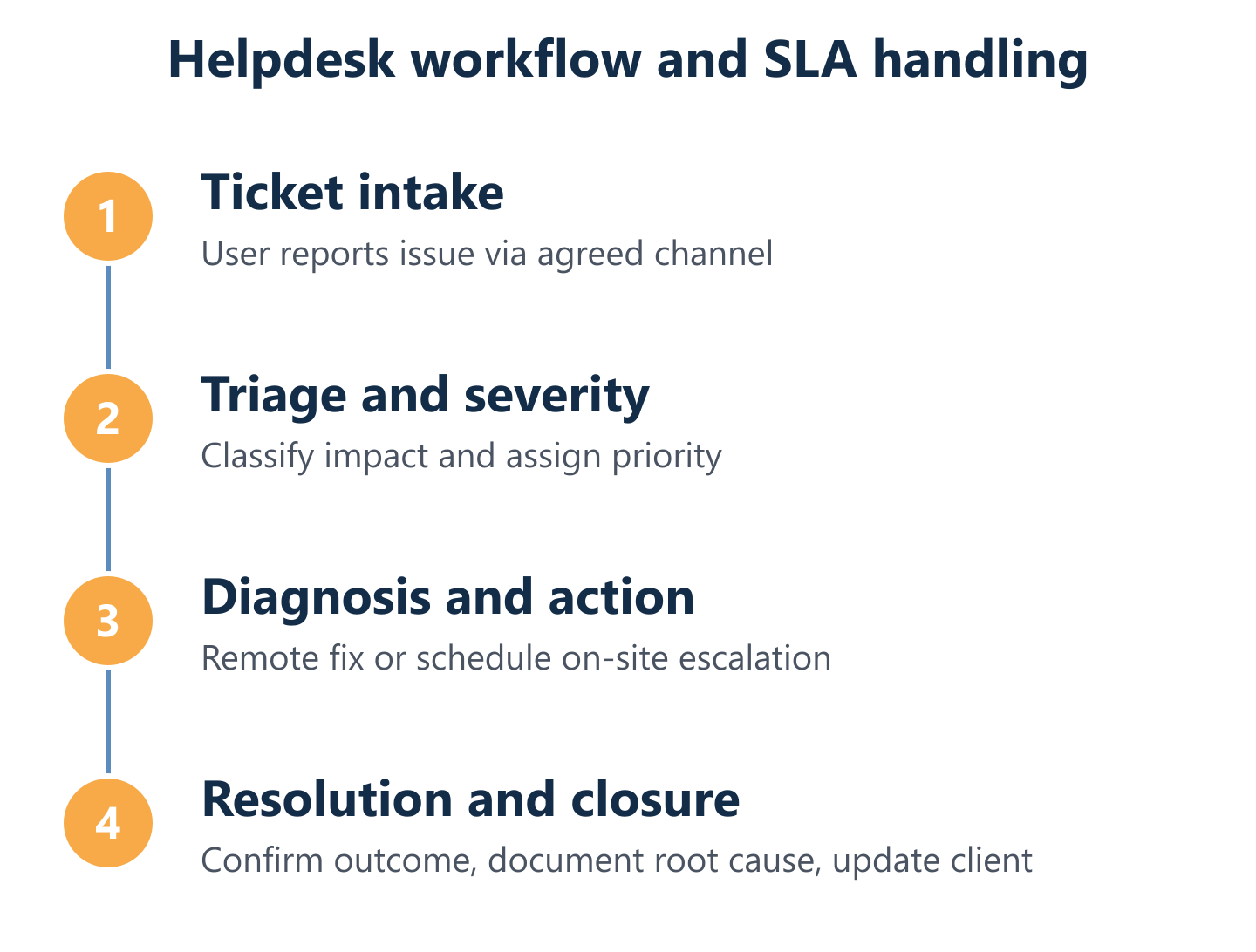
- Incident intake: The user reports an issue via the agreed channel (ticket portal, email, or phone); the system logs it with a timestamp and assigns a reference number.
- Triage and severity classification: The support team assesses impact and urgency, assigning a priority level that determines response and resolution targets.
- Diagnosis and action: The assigned technician investigates, applies a fix remotely or escalates to on-site intervention if required.
- Client update: The user receives a status update at defined intervals — no silence, no guessing.
- Resolution and closure: The ticket is closed with documented root cause and resolution steps, creating an auditable record for future reference.
- Review and improvement: Recurring incidents trigger a root-cause review, feeding into preventive maintenance schedules to reduce repeat occurrences.
Helpdesk workflow: intake, triage, diagnosis, and closure
The helpdesk workflow defines how a user's problem becomes a resolved ticket — and the quality of that workflow directly affects how quickly business operations return to normal. Effective intake means every issue is logged immediately, with enough context for the triage team to act without back-and-forth delays. Triage assigns the right technician based on skill set and availability, not just whoever is free. Diagnosis follows a structured process: remote tools allow technicians to access endpoints securely, review logs, and replicate the issue before applying a fix. Where remote resolution is not possible, an on-site visit is scheduled with the client informed of the timeline. Closure includes documentation — not just marking the ticket "done", but recording what was found, what was done, and whether any follow-up action is needed. This documentation builds institutional knowledge that improves future response times and reduces repeat incidents.
SLA and prioritisation: how severity affects response and resolution
Not all IT incidents carry the same business impact, and SLA frameworks reflect this through severity levels. A typical structure distinguishes between critical incidents (full system outage, data loss risk, security breach — requiring immediate response and rapid resolution), high-priority issues (significant service degradation affecting multiple users), medium-priority problems (single-user impact with a workaround available), and low-priority requests (minor issues, queries, or configuration changes). Each level carries defined response and resolution targets. The value of this structure is that it aligns IT resources with business impact: a server failure at a logistics company is treated differently from a printer configuration issue. Impulso Tecnológico applies SLA-based prioritisation across its managed service contracts, ensuring that business-critical systems receive the fastest attention while routine requests are handled efficiently without disrupting higher-priority work.
Client communication: reporting cadence and incident transparency
One of the most common complaints about IT support providers is not slow resolution — it is silence. Clients often don't know whether their ticket is being worked on, who is handling it, or when to expect an update. Transparent communication resolves this. A well-run IT support model includes: real-time status updates during active incidents, regular reporting on ticket volumes, resolution times, and recurring issues, and post-incident notes that explain root cause and preventive actions taken. Monthly or quarterly service reviews give management teams visibility into IT health trends and allow informed decisions about infrastructure investment. Impulso Tecnológico builds this communication cadence into its managed service model — clients receive structured reporting rather than ad-hoc updates, and the relationship is treated as a long-term partnership rather than a transactional arrangement. One client testimonial highlights the commitment to respond quickly and efficiently to both small and corporate-level issues, within agreed timeframes.
Choosing the right IT Support Alava provider: criteria and trade-offs
Selecting an IT support provider for your business in Álava is a commercial decision with long-term operational consequences. The wrong choice — whether a provider that is too reactive, too generic, or too rigid in its contracts — can leave your team exposed to downtime, security gaps, and unpredictable costs. The right provider acts as an extension of your business, not just a break-fix service.
Impulso Tecnológico offers a managed model specifically designed to reduce vendor complexity: a single partner covering helpdesk, maintenance, monitoring, and security basics, with a fixed monthly price per device for computer support that gives businesses access to unlimited remote and on-site technical assistance. This predictability is particularly valuable for SMEs and mid-sized organisations that need enterprise-grade IT support without the overhead of an in-house IT department.
When evaluating providers, consider these criteria:
- Scope clarity: Does the contract specify exactly what is included — helpdesk hours, device coverage, on-site visits, security tools?
- SLA definition: Are response and resolution targets written into the agreement, with consequences for non-compliance?
- Remote and on-site balance: Can the provider deliver both modalities, and is on-site support available in Vitoria-Gasteiz and across Álava?
- Technology stack: Does the provider work with enterprise-grade tools (e.g., Sophos, Fortinet, Veeam, Microsoft) or rely on consumer-grade alternatives?
- Security integration: Is cybersecurity built into the support model, or is it a separate, optional add-on?
- Scalability: Can the service grow with your organisation — adding devices, users, or locations without renegotiating the entire contract?
- Communication and reporting: Will you receive structured reports, or only hear from the provider when something breaks?
- Commercial flexibility: Are contracts rigid or adaptable to your actual needs and budget cycles?
Pros and cons of reactive vs managed IT support
Reactive IT support — also called break-fix — means you call a technician when something fails and pay per incident or hour. The apparent advantage is low upfront cost; the real disadvantage is unpredictability. A single server failure or ransomware incident can cost far more than months of managed service fees. Managed IT support inverts this model: a fixed monthly cost covers proactive monitoring, scheduled maintenance, and helpdesk access, so issues are caught early and costs are stable. For businesses with more than ten devices or any dependency on IT for revenue-generating operations, the managed model almost always delivers better value. The trade-off is a contractual commitment and the need to onboard a provider properly — but a well-structured MSP like Impulso Tecnológico handles this through an initial audit that establishes a baseline and identifies immediate risks before the service begins. You can also explore how this applies to computer maintenance best practices for a deeper look at preventive approaches.
Evaluation checklist: scope, SLAs, tools, and escalation paths
Before signing with any IT support provider in Álava, run through this practical checklist. First, confirm the exact scope: which devices are covered, which services are included, and what falls outside the contract. Second, review the SLA document — not just the headline response time, but the full severity matrix and resolution targets. Third, ask about the technology stack: which monitoring, endpoint protection, and backup tools are used, and are they enterprise-grade? Fourth, understand the escalation path: what happens when a first-line technician cannot resolve an issue, and how quickly does it reach a specialist? Fifth, assess security integration — is GDPR compliance, endpoint protection, and backup management part of the service or an extra cost? Impulso Tecnológico works with Sophos, Fortinet, Veeam, Cisco, and Aruba, ensuring that security and resilience are built into the support model from day one.
Best-fit scenarios: SMEs, office teams, and multi-location operations
IT support needs vary significantly by organisation type. An SME with fifteen employees and a single office in Vitoria-Gasteiz needs a provider that can handle all IT matters without requiring an internal IT coordinator. A mid-sized company with multiple departments needs structured helpdesk triage and reporting to manage volume. A business with offices in Álava and other Spanish or European locations needs a provider with remote support capability and the ability to coordinate on-site visits across geographies. Impulso Tecnológico covers all three scenarios: its managed services model scales by device count, its remote support covers Spain and internationally, and its on-site capability is available across Spain. For businesses considering how IT support works in other locations, our coverage extends to cities including La Coruña and Barcelona, demonstrating the consistency of the service model regardless of geography.
Choosing an IT support provider in Álava comes down to one question: does this service prevent problems or just respond to them? If your current model is reactive, you are absorbing hidden costs in downtime, lost productivity, and security exposure. A managed IT support model — with defined SLAs, proactive monitoring, and integrated security — changes that equation. Impulso Tecnológico offers businesses in Álava and across Spain a structured, scalable approach to IT support: predictable costs, clear accountability, and a single partner for the full technology stack. The next step is a conversation about your specific environment and needs.