

IT services outsourcing means contracting an external provider to deliver defined IT functions—such as support, security, cloud management, or infrastructure—under agreed service levels, so your organisation gains specialist capability without the cost and complexity of building it internally.
Most businesses reach a point where their internal IT team cannot cover every discipline at once. Hiring takes months, retaining specialists is expensive, and gaps in coverage—particularly in cybersecurity and cloud governance—create real operational risk. IT services outsourcing solves this by giving you access to a structured team, defined processes, and measurable outcomes from day one. Rather than managing multiple vendors or relying on reactive fixes, a well-structured outsourcing arrangement consolidates delivery under one accountable provider. The result is a more stable, secure, and cost-predictable IT environment—one that can scale as your business grows without requiring you to rebuild your internal team from scratch.
What IT Services Outsourcing Means (and what it includes)
The term "IT services outsourcing" is used loosely in the market, which causes real confusion when comparing providers. At its core, it describes a formal arrangement in which a business delegates responsibility for one or more IT functions to an external organisation, with defined scope, agreed service levels, and clear accountability for outcomes. That definition, however, covers a wide spectrum—from a single outsourced helpdesk to a fully externalised IT department.
Understanding the distinctions between delivery models is essential before you approach any provider. Impulso Tecnológico, for instance, structures outsourcing around measurable delivery and proactive support, combining on-site and remote coverage (9:00–17:00 CET, Monday to Friday) and aligning security and continuity capabilities to each client's specific environment—rather than applying a generic package.
| Model | Scope | Accountability | Typical Use Case | Cost Structure |
|---|---|---|---|---|
| Managed IT Services | Broad: monitoring, support, security, cloud | Provider owns outcomes and SLAs | Full or partial IT department replacement | Fixed monthly fee |
| IT Services Outsourcing | Defined functions (e.g., helpdesk, infrastructure) | Shared, governed by contract | Supplementing internal IT with specialist capacity | Fixed or time-and-materials |
| Staff Augmentation | Individual roles or profiles | Client retains management control | Covering vacancies, leave, or project spikes | Day/week/month rate |
| Infrastructure Outsourcing | Networks, servers, data centres | Provider manages physical/virtual layer | Reducing capital expenditure on hardware | Usage-based or fixed |
Core definition: scope, accountability, and service governance
IT services outsourcing is a delivery arrangement in which an external provider assumes responsibility for specified IT functions, with outcomes and performance standards defined in a contract or service level agreement (SLA). What separates a well-structured outsourcing engagement from a simple vendor relationship is governance: the mechanisms by which scope is agreed, performance is measured, and issues are escalated. A credible provider will define response times, ticket resolution targets, reporting cadences, and escalation paths before work begins. Without this governance layer, outsourcing becomes reactive and unpredictable—which defeats its primary purpose of reducing operational risk and cost.
Managed IT vs IT outsourcing vs staff augmentation
These three models differ primarily in who holds accountability for outcomes. With managed IT services, the provider takes end-to-end responsibility for a defined environment—monitoring, maintaining, and securing it against agreed standards. With IT services outsourcing in the broader sense, the client and provider share responsibility: the provider delivers specific functions, but the client retains strategic oversight. With staff augmentation, the client manages the individual directly; the provider simply supplies the resource. Choosing the wrong model is a common and costly mistake. An organisation that needs consistent monitoring and incident response should not rely on staff augmentation alone; conversely, a business that needs a specialist for a six-week project does not need a full managed services contract.
What is usually included: support, monitoring, and service desk
A standard IT services outsourcing engagement typically covers service desk operations (incident logging, triage, and resolution), remote and on-site technical support, system monitoring, patch management, and basic security controls such as endpoint protection and backup verification. More comprehensive arrangements extend to proactive maintenance, vulnerability assessments, cloud environment management, and governance reporting. The key question is not just what is listed in the contract, but what is actively managed and measured. Impulso Tecnológico, for example, resolves over 4,000 IT tickets annually across its client base, with support available in both Spanish and English—a practical indicator of operational capacity rather than a marketing claim. Always ask for evidence of ticket volumes and resolution metrics before committing.

Common IT Services You Can Outsource
Not every IT function carries the same outsourcing value. Some services—particularly those requiring deep specialisation, continuous availability, or rapid scaling—deliver a stronger return when handled externally. Impulso Tecnológico supports SMEs and larger organisations across Spain and Portugal with technician and systems support, security-aligned delivery, and cloud-focused services built around Microsoft 365 and Azure, using technologies such as Sophos, Fortinet, and Veeam.
The following categories represent the services most commonly and effectively outsourced:
- Service desk and technical support — First and second-line incident handling, request fulfilment, and escalation management, available remotely and on-site.
- Cybersecurity services — Endpoint protection, firewall management, vulnerability assessments, and breach response readiness using tools such as Sophos and Fortinet.
- Cloud management — Microsoft 365 and Azure environment support, licence governance, identity management, and backup configuration with Veeam.
- Network and infrastructure management — Design, installation, and ongoing maintenance of wired and wireless networks using Cisco and Aruba solutions.
- Systems administration — Server management, patch cycles, performance monitoring, and disaster recovery planning.
- Staff augmentation for IT roles — Covering junior and senior systems technicians, network engineers, and server administrators on a flexible basis (by day, week, month, or indefinitely).
- Automation and workflow integration — Connecting business platforms and improving operational efficiency using tools such as Odoo, n8n, or Make.com.
Service desk and technical support (including systems and network roles)
An outsourced helpdesk is one of the highest-impact, fastest-to-deploy outsourcing decisions a business can make. It removes the burden of first-line incident management from internal staff, standardises ticket workflows, and provides measurable response data from the outset. A well-run outsourced service desk handles incident logging, classification, remote resolution, and escalation to second or third-line support—all within defined SLA windows. Beyond reactive support, it also covers request fulfilment: user provisioning, access management, and equipment configuration. For organisations operating across multiple locations, as many of Impulso Tecnológico's clients do across Spain and Portugal, having a centralised service desk with both remote and on-site capability is particularly valuable for maintaining consistent service quality without duplicating local IT staff.
Security services: assessments, monitoring, and breach response readiness
Cybersecurity incident response support is one of the most compelling reasons to outsource IT services, yet it is also the area where provider quality varies most sharply. A credible security-capable provider should offer baseline cyber hygiene (patching, endpoint protection, access controls), continuous monitoring for threats and anomalies, and a documented process for responding to incidents or breaches. Before signing, ask specifically how the provider handles a confirmed breach: who is notified, within what timeframe, and what containment steps are taken. Impulso Tecnológico delivers security services using Sophos and Fortinet technologies, covering firewall management, endpoint protection, and backup integrity with Veeam—ensuring that recovery options exist before an incident occurs, not after. GDPR compliance support is also part of this scope for clients operating in the EU.
Cloud, infrastructure, and applications: Microsoft 365/Azure, networks, and managed operations
Cloud support for Microsoft 365 and Azure is now a standard component of most managed outsourcing engagements. This includes licence management, conditional access policies, mailbox configuration, Teams governance, SharePoint administration, and Azure virtual machine oversight. Beyond the Microsoft stack, infrastructure outsourcing covers network design and maintenance—particularly relevant for organisations expanding to new premises or consolidating sites. Impulso Tecnológico works with Cisco and Aruba for network deployments and supports structured cabling, wireless coverage, and related physical infrastructure. For application-layer needs, the IT outsourcing delivery model can extend to integration work and automation, connecting business tools through platforms such as Odoo or n8n to reduce manual processes and improve data flow between systems.
How to Choose the Right Provider (a practical checklist)
Selecting an IT outsourcing provider is a governance decision as much as a commercial one. The wrong choice creates dependency without accountability—you hand over control of critical systems to a provider who cannot demonstrate how they manage, monitor, or secure them. A structured evaluation process reduces that risk significantly.
Impulso Tecnológico's approach is built around flexibility and responsiveness: engagements are tailored to each client's real operational needs, with proactive support designed to prevent incidents rather than simply respond to them. That philosophy—prevention over reaction—should be a baseline expectation from any provider you evaluate. For further context on what to look for when comparing options, our article on the benefits of IT outsourcing covers the commercial and operational case in more detail.
Use the following criteria as a minimum evaluation checklist:
- Defined scope document: Can the provider produce a clear written scope before contract signature, specifying what is and is not included?
- SLA evidence: Do they publish response and resolution time targets, and can they share historical performance data?
- Security controls: What endpoint protection, monitoring, and backup technologies do they use, and are these certified or partner-validated?
- Breach response process: Is there a documented incident response procedure, including client notification timelines?
- Delivery geography: Can they provide on-site support at your locations, or is delivery remote-only?
- Flexibility of engagement: Can you scale up or down without penalty clauses, and are short-term or project-based engagements available?
- References and ticket metrics: Will they share anonymised ticket volumes, resolution rates, or client satisfaction indicators?
- Technology partnerships: Are they certified by the vendors whose products they manage (e.g., Microsoft, Sophos, Fortinet, Cisco)?
- Language and communication: If your team operates in multiple languages, can the provider match that requirement?
Delivery model selection: dedicated team vs staff augmentation vs managed services
The right delivery model depends on where accountability needs to sit. If your organisation has a functioning IT manager but lacks execution capacity, staff augmentation—covering roles such as systems technicians, network engineers, or server administrators—gives you resource without transferring strategic control. Impulso Tecnológico offers this model by day, week, month, or on an indefinite basis, including cover for holiday and leave periods. If you need a provider to take full ownership of IT operations, managed services is the appropriate model, with the provider responsible for monitoring, maintenance, and incident resolution under defined SLAs. A dedicated team model sits between the two: a fixed group of specialists assigned to your account, operating with deeper context than a shared service pool but without full managed accountability.
Security, compliance, and continuity criteria to ask before signing
Security due diligence is non-negotiable before committing to any IT outsourcing arrangement. Start by asking for the provider's approach to IT service management governance: how frequently are security reviews conducted, and what does a typical governance cadence look like? Request evidence of the technologies deployed—not just brand names, but confirmation of active licences, configuration standards, and patch frequency. For GDPR-regulated organisations, verify that the provider can act as a data processor under Article 28 and that they have a documented data breach notification process. Continuity planning should also be assessed: does the provider maintain tested backup and disaster recovery procedures, and can they demonstrate recovery time objectives for a scenario relevant to your environment? Vague answers to these questions are a reliable disqualification signal.
Commercial and operational checks: scope, SLAs, reporting, and onboarding
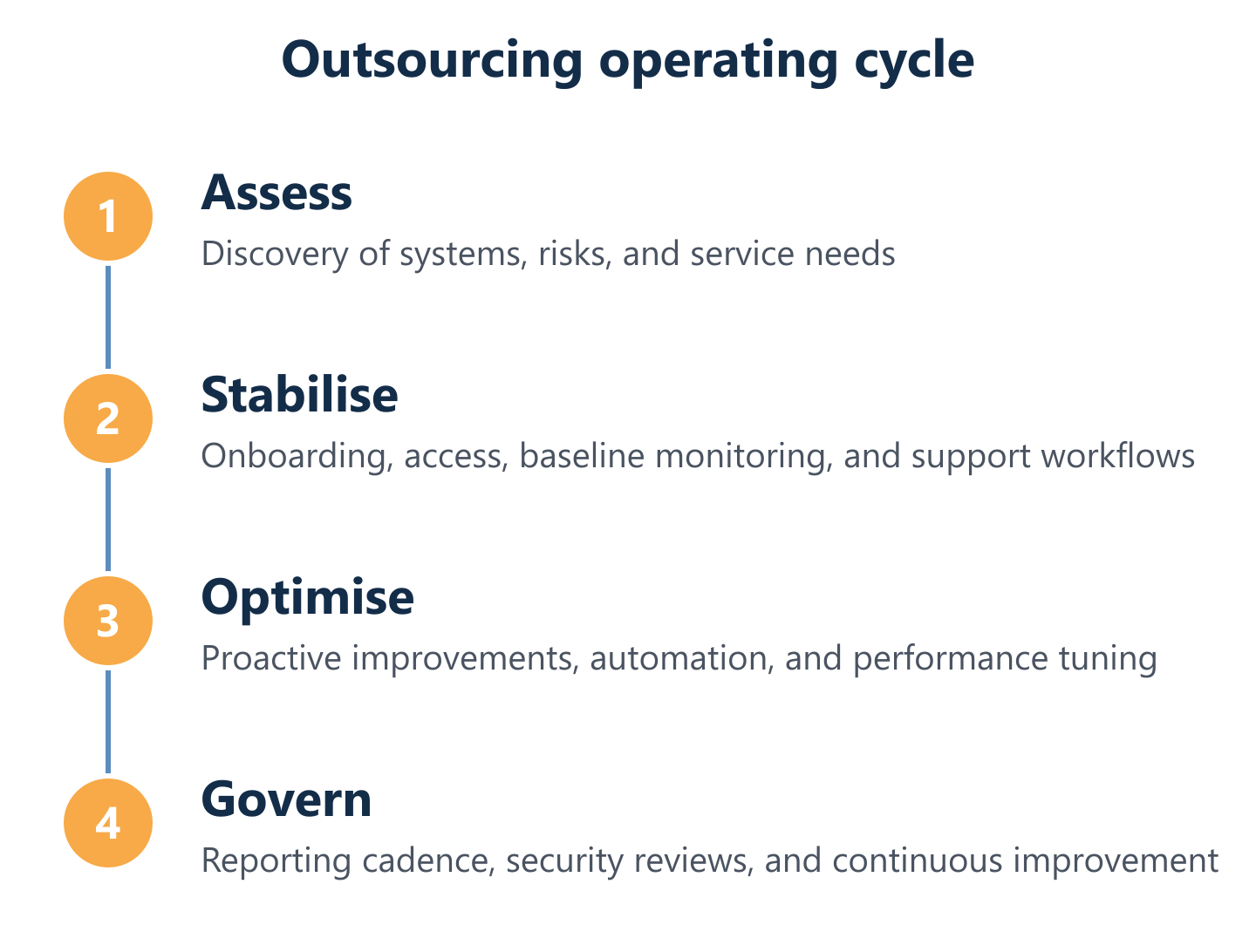
Commercial clarity prevents the most common outsourcing disputes. Before signing, confirm that the contract specifies: the exact services included and excluded; response time and resolution SLAs by incident priority; reporting frequency and format (weekly summaries, monthly reviews, or both); how costs scale if your user count or infrastructure grows; and what the exit process looks like if the arrangement needs to change. Onboarding quality is also a leading indicator of operational quality: a provider who cannot produce a structured onboarding plan—covering asset discovery, access provisioning, documentation handover, and a stabilisation period—is unlikely to deliver consistent service thereafter. For organisations based in Madrid or with Spain-wide operations, our dedicated guide to IT outsourcing in Madrid covers local delivery considerations in more detail.
Moving from "we need IT help" to a structured, secure operating model requires more than finding a provider—it requires defining what good looks like before you start. The organisations that get the most from IT services outsourcing are those that enter the engagement with clear scope, measurable expectations, and a provider who treats their infrastructure as seriously as their own. Impulso Tecnológico has supported businesses across Spain, Portugal, and beyond for more than 25 years, building outsourcing arrangements that are flexible enough to adapt and structured enough to deliver. If you are evaluating your options, our overview of IT outsourcing for businesses is a useful next step before making any commitment.