

Hiring an IT company gives businesses immediate access to specialist expertise, structured support under defined SLAs, and proactive security management — without the cost and complexity of maintaining a full internal IT department. Companies that make this move typically see fewer operational disruptions, lower overhead, and faster resolution of technical issues.
Most organisations reach a tipping point where IT demands outpace what a generalist team can handle. Servers need monitoring around the clock, security threats evolve faster than internal staff can track, and every unplanned outage costs time and money. The reactive approach — waiting for something to break before acting — is both expensive and risky. Hiring a dedicated IT company shifts that model entirely: you gain structured processes, preventive maintenance, and access to a broad range of technical profiles, from network engineers to security specialists, on demand. The result is a more stable, secure, and cost-predictable technology environment that lets your team concentrate on the work that actually drives your business forward.
Advantages Of Hiring An IT Company: Outcomes, not just support
The most common misconception about hiring an IT company is that you are simply buying a helpdesk. The actual value sits elsewhere: in the operational stability that comes from proactive management, the strategic clarity that comes from working with specialists who have seen the same problems dozens of times before, and the business continuity that comes from having defined processes rather than ad hoc fixes.
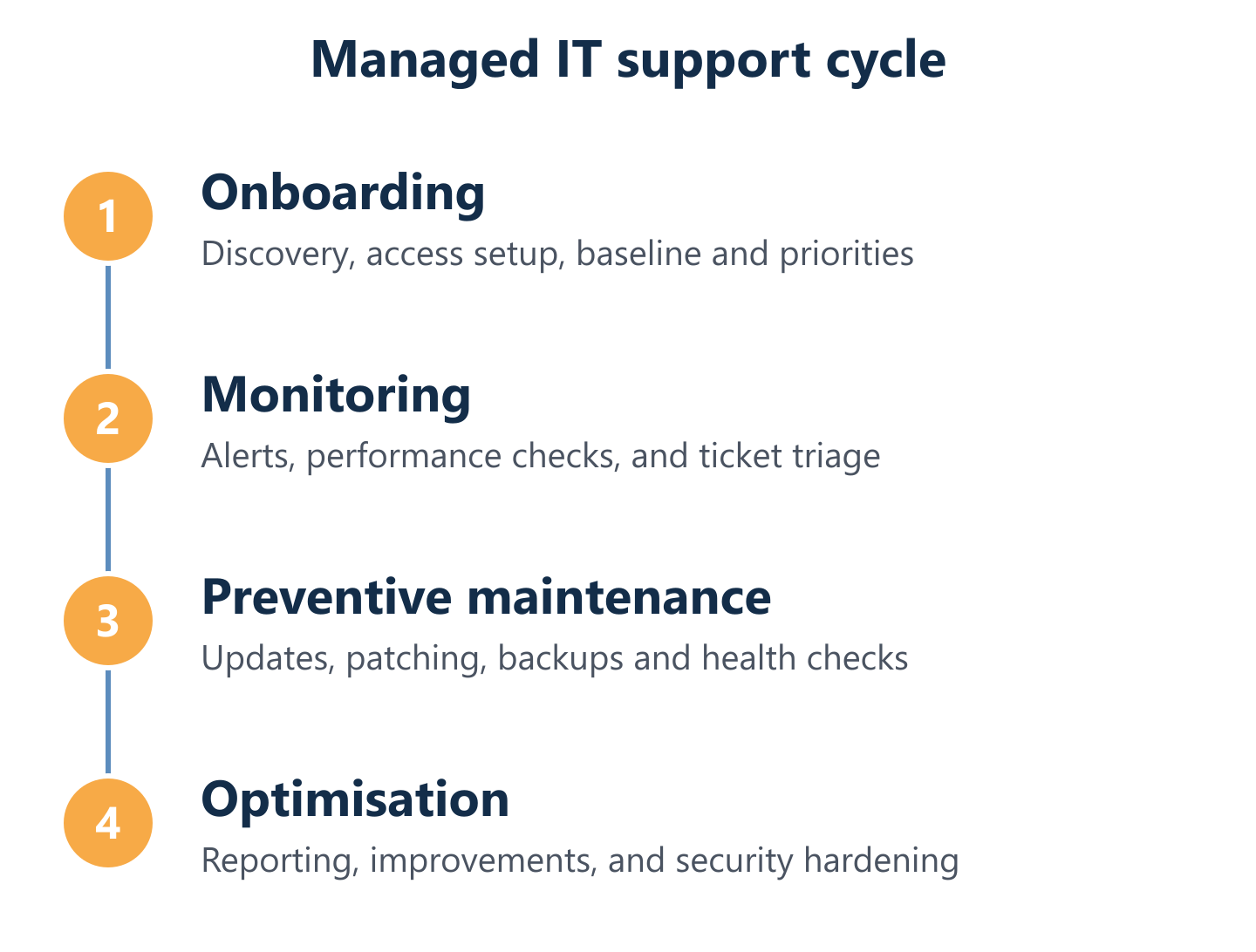
At Impulso Tecnológico, we work with SMEs and larger organisations across Spain — with on-site coverage and remote support extending to international clients — and the pattern is consistent. Businesses that switch from reactive break-fix to a managed services model stop losing hours to unplanned downtime and start making technology decisions with confidence. Our managed services include continuous monitoring, preventive maintenance, regular updates, and both remote and on-site technical assistance, all under guaranteed SLAs. That shift from reactive to proactive is where the real return on investment appears.
| Outcome area | Reactive IT (break-fix) | Managed IT company (proactive) |
|---|---|---|
| Downtime response | After failure occurs | Issues flagged and resolved before impact |
| Cost predictability | Variable, often high at worst moments | Fixed monthly fee with defined scope |
| Security posture | Patched reactively | Continuously monitored and updated |
| Specialist access | One or two generalists | Multi-profile team (network, security, cloud) |
| Strategic alignment | Minimal — IT follows problems | IT roadmap aligned with business goals |
Business focus: fewer distractions from day-to-day IT issues
Every hour a finance manager spends troubleshooting a VPN connection or a sales director waits for a server to come back online is an hour not spent on revenue-generating work. When IT is managed by a dedicated company with structured processes, those distractions disappear from your team's daily experience. Incidents are logged, prioritised, and resolved through defined workflows — not escalated informally through WhatsApp messages to whoever happens to know the most about computers. The operational benefit is immediate: your people stay focused on core business functions, and IT issues are handled by the people best equipped to resolve them efficiently.
Operational efficiency: planned technology management and smoother delivery
Technology managed without a plan accumulates technical debt rapidly. Outdated software, unpatched vulnerabilities, and mismatched hardware configurations create friction that slows every process that depends on them. A professional IT company introduces structured planning: scheduled maintenance windows, version control, capacity monitoring, and documented change management. The practical effect is that systems run more reliably, projects deploy faster, and staff spend less time working around IT limitations. Impulso Tecnológico's approach to preventive IT maintenance is built on this principle — catching problems before they become outages, rather than scrambling to recover after the fact.
Access to specialist expertise and wider knowledge breadth
No single in-house hire covers the full spectrum of modern IT: network architecture, endpoint security, cloud migration, backup strategy, and compliance requirements each demand different expertise. An IT company brings a team of specialists — not a generalist wearing too many hats. At Impulso Tecnológico, we hold certifications and partnerships with Sophos, Fortinet, Veeam, Microsoft, Cisco, Aruba, and others, meaning clients access field-tested knowledge across security, infrastructure, and cloud without needing to recruit for each discipline individually. This breadth of knowledge is one of the clearest IT outsourcing benefits: you pay for outcomes, not for headcount.

Cost-effective delivery and scalability: in-house vs IT company
The salary of a mid-level IT professional in Spain is only the starting point. Add recruitment costs, employer social security contributions, hardware, training, holiday cover, and the inevitable idle time during quieter periods, and the true cost of an internal hire is substantially higher than the gross salary figure. An IT company converts that unpredictable expenditure into a structured, foreseeable monthly cost — with defined service levels and the ability to scale up or down without redundancy processes.
Impulso Tecnológico's computer outsourcing service in Madrid illustrates this practically. Clients can access field-ready technician profiles — junior and senior systems technicians, systems administrators, server administrators, network technicians — without the burden of internal hiring. Engagements can be structured by day, week, month, or on an ongoing basis, and the service can cover holiday leave or peak demand periods without any minimum time commitment (subject to client agreement if the technician is to be formally incorporated). Our managed services track record includes resolving thousands of IT tickets annually, with client satisfaction consistently rated highly across both SME and corporate accounts.
- Identify your actual IT demand: Map recurring tasks (monitoring, updates, support) against occasional needs (projects, migrations) to understand where fixed versus flexible coverage is most cost-efficient.
- Calculate total in-house cost: Include salary, employer contributions, recruitment, training, equipment, and cover for absence — not just the headline wage.
- Define required service levels: Determine response time expectations, escalation paths, and reporting needs before comparing provider proposals.
- Match engagement model to demand: Choose between fully managed services, partial outsourcing, or technician subcontracting depending on whether your need is ongoing or project-based.
- Evaluate scalability clauses: Confirm that the provider can scale coverage up or down without long-term lock-in, particularly for seasonal or growth-driven fluctuations.
Total cost of ownership: salary, overhead, and downtime trade-offs
Downtime is the hidden cost that most in-house vs outsourcing comparisons underestimate. When a server fails at a critical moment and the only available technician lacks the specific expertise to resolve it quickly, the cost is not just the repair — it is every hour of lost productivity across the affected team. A managed IT company with SLA-backed response times eliminates that uncertainty. You know in advance what the response window is, what the escalation path looks like, and what compensation applies if targets are missed. That contractual clarity converts an open-ended financial risk into a manageable, budgeted line item. For a detailed view of what structured IT maintenance costs, our IT maintenance price guide provides a practical reference.
Scalable coverage: flexible outsourcing options by days, weeks, months, or ongoing
Growth phases, seasonal peaks, and project-driven demand spikes all create IT support requirements that a fixed internal team cannot absorb efficiently. Outsourcing to an IT company solves this with genuine flexibility: coverage can be increased for a specific project, reduced during quieter periods, or adjusted to cover staff absence — all without triggering employment law obligations. Impulso Tecnológico offers engagement options ranging from single-day technician cover to indefinite outsourcing arrangements, with no enforced minimum duration. This IT support scalability means businesses are never paying for capacity they do not need, and never short of expertise when demand rises. It is a structural advantage that in-house teams simply cannot replicate at comparable cost.
Pros and cons: what you gain (and what you must verify) before choosing
Hiring an IT company delivers clear gains: cost predictability, specialist depth, scalability, and defined service levels. However, there are factors to verify before signing. Response time commitments must be explicit in the contract — vague language such as "as soon as possible" is not an SLA. Check whether on-site coverage is included or charged separately, and confirm the provider's geographic reach if your operations span multiple locations. Understand the reporting structure: how are tickets logged, how are incidents communicated, and how is performance measured month to month? Providers who operate transparently — without small print that limits liability in practice — are distinguishable by the clarity of their service documentation. Managed services SLA terms deserve careful scrutiny before any agreement is signed.
Security, resilience, and continuity: managed capability you can trust
Cybersecurity for SMEs is no longer an optional layer — it is a baseline operational requirement. Ransomware, phishing, and supply chain attacks affect organisations of every size, and the cost of a successful breach extends well beyond the immediate incident: regulatory exposure, reputational damage, and operational recovery can take weeks. Managing this risk in-house requires continuous investment in tools, training, and monitoring that most organisations cannot sustain at the required level.
Impulso Tecnológico approaches security as a managed capability rather than a one-time project. Our security stack is built on established technologies — Sophos for endpoint protection, Fortinet for firewall and network security, and Veeam for backup and disaster recovery — covering the full chain from perimeter defence to data restoration. This is complemented by proactive monitoring, preventive maintenance, and clear, jargon-free communication with clients about their security posture. The framework we apply covers:
- Vulnerability assessment: Identifying exposure points across endpoints, network, and cloud environments before they are exploited.
- Endpoint protection: Deploying and managing Sophos-based controls across all devices, with centralised visibility and automated threat response.
- Firewall and network segmentation: Fortinet-based perimeter controls with policy management aligned to business access requirements.
- Backup and disaster recovery: Veeam-powered backup strategies with defined recovery time and recovery point objectives, tested regularly.
- GDPR-aligned practices: Data handling, access controls, and incident response processes structured to meet regulatory obligations.
- User enablement: Guidance and awareness support to reduce human-factor risk across the organisation.
- Continuous monitoring: Ongoing system monitoring to detect anomalies and respond before they escalate into incidents.
Cybersecurity foundations: assessment, endpoint protection, and firewall controls
Effective cybersecurity starts with knowing what you are protecting and where the gaps are. A structured assessment maps every endpoint, network entry point, and cloud connection against known threat vectors — producing a prioritised list of remediation actions rather than a generic report. From that baseline, endpoint protection tools such as Sophos provide automated threat detection and response across all devices, while Fortinet firewall controls manage traffic at the network perimeter. Together, these layers reduce the attack surface significantly. The key differentiator between a managed security approach and a self-managed one is continuous oversight: threats evolve daily, and static configurations become obsolete quickly without active management and regular policy reviews.
Disaster recovery and backup: protecting data and reducing downtime impact
Endpoint protection stops many threats, but no security layer is impenetrable. Disaster recovery and backup strategies exist precisely for the scenarios where prevention fails — whether through ransomware, hardware failure, accidental deletion, or a physical incident at a server location. A robust backup strategy defines recovery time objectives (how quickly systems must be restored) and recovery point objectives (how much data loss is acceptable), then builds the technical architecture to meet them. Impulso Tecnológico implements Veeam-based backup solutions that cover on-premises and cloud environments, with regular restoration tests to confirm that backups actually work when needed. For organisations assessing their options, our guide to affordable online backup services outlines the key considerations in plain terms.
Compliance alignment and secure operations (including GDPR-aware practices)
GDPR compliance is not a one-time audit — it is an ongoing operational requirement that touches data storage, access controls, breach notification procedures, and vendor agreements. An IT company that understands regulatory obligations can embed compliant practices into the technical architecture from the outset, rather than retrofitting them after a regulator inquiry. This includes defining who has access to what data and under what conditions, ensuring that backup and recovery processes handle personal data appropriately, and maintaining documentation that demonstrates accountability. For businesses operating across multiple locations or with remote teams, consistent enforcement of these controls across both on-site and remote environments is where many self-managed setups fall short — and where managed IT support delivers clear, measurable value.
The advantages of hiring an IT company are clearest when you move beyond the headline cost comparison and look at what structured, proactive support actually delivers: fewer disruptions, stronger security, predictable expenditure, and a team that scales with your needs. If your current IT setup is reactive, fragmented, or consuming management attention it should not, the practical next step is to shortlist providers with demonstrable experience, clear SLA commitments, and a service model that matches your operational profile. Request a tailored proposal based on your specific priorities — infrastructure, security, cloud, or a combination — and evaluate providers on transparency and technical depth, not just price. The right IT partner does not just fix problems; it prevents them.