

IT outsourcing for businesses means delegating defined IT functions — such as help desk, network management or cybersecurity — to a specialist provider under agreed responsibilities and service levels. It reduces internal overhead, fills skills gaps and keeps operations running without the cost of building a full in-house team.
Most organisations reach a tipping point where internal IT resource cannot keep pace with demand: systems go unpatched, incidents take too long to resolve, and the team is stretched across support, projects and strategy simultaneously. The result is operational risk disguised as a staffing problem. IT outsourcing addresses this by transferring specific, well-defined functions to a provider who brings both the technical depth and the processes to manage them reliably. The outcome is not just cost reduction — it is predictability. You know what is covered, who is responsible and what response time to expect. Impulso Tecnológico has been operating as an external IT department for organisations across Spain, Portugal and internationally for over 25 years, helping businesses move from reactive firefighting to a structured, proactive model of IT management.
What IT outsourcing is (and what it is not) for businesses
IT outsourcing is the structured transfer of specific technology functions to an external provider under defined responsibilities, service levels and governance. It is not a wholesale handover of control. The business retains ownership of its data, its strategy and its decisions — what changes is who executes and maintains the underlying systems and support processes.
The confusion often arises because organisations conflate outsourcing with loss of visibility. A well-designed engagement does the opposite: it introduces clarity. Responsibilities are documented, escalation paths are agreed, and performance is measured against benchmarks. Impulso Tecnológico approaches every engagement as an external IT department — advising, implementing and managing day-to-day technology needs while the client retains full strategic ownership. The model is tailored to each organisation's actual requirements rather than imposed as a standard package.
| Aspect | What outsourcing IS | What outsourcing is NOT |
|---|---|---|
| Control | Defined responsibilities shared via RACI and SLA | Surrendering decision-making authority |
| Scope | Specific functions (help desk, network, security) | Handing over the entire IT strategy |
| Visibility | Regular reporting, ticketing and KPI dashboards | A black box with no oversight |
| Flexibility | Scalable coverage adjusted to business needs | A rigid, long-term contract with no exit |
| Risk | Shared and mitigated through documented protocols | Fully transferred to the provider |
Core definition: managed IT services vs staff augmentation
Managed IT services and staff augmentation are both forms of IT outsourcing, but they operate on fundamentally different principles. Managed services transfer responsibility for an outcome — the provider owns the process, the tooling and the resolution. Staff augmentation adds individuals to your existing team under your direction; the management burden stays with you.
For most small and mid-sized businesses, managed IT services deliver more value because they include the processes, not just the people. When Impulso Tecnológico acts as an external IT department, it brings systems administrators, network technicians and senior engineers under a single engagement — along with the monitoring, escalation and documentation that make the service self-sustaining. Outsourcing delegates defined IT activities under agreed responsibilities, not your business ownership.
Scope boundaries: what you keep in-house and why
Not everything belongs in an outsourcing scope. IT strategy, vendor contract ownership, data governance decisions and business-critical application roadmaps typically remain with the internal team or leadership. These are areas where business context, regulatory accountability and strategic direction cannot be fully delegated.
What outsourcing handles well are the operational and technical layers: day-to-day support, infrastructure maintenance, patch management, network monitoring and security operations. A good model defines these boundaries explicitly — through documentation, a RACI matrix and agreed service levels — so that neither party operates in ambiguity. Retaining governance does not mean retaining execution; it means staying in control of what matters most while the provider handles what they do best. This boundary clarity is what separates a productive outsourcing relationship from a problematic one.
Governance essentials: RACI, escalation and service ownership
Governance is the operational backbone of any outsourcing engagement. Without it, responsibilities blur, incidents escalate to the wrong people and service quality degrades over time. Three tools prevent this: a RACI matrix (Responsible, Accountable, Consulted, Informed) that maps every IT function to an owner; a defined escalation path that specifies who handles what severity level and within what timeframe; and a service ownership model that assigns accountability for each domain (network, endpoints, security, cloud).
An IT service level agreement (SLA) formalises these commitments — response times, resolution targets, reporting cadence and review cycles. Impulso Tecnológico builds these governance elements into every engagement from the outset, ensuring that coverage and escalation paths match the client's actual operational reality rather than a generic template. Avoid one-size-fits-all: scope, coverage and escalation paths must match your operational reality.

Best-fit outsourcing models: onshore, nearshore, offshore
Choosing the right delivery model is not primarily a cost decision — it is a risk and coordination decision. The model you select determines how quickly issues get resolved, how well the provider understands your regulatory environment and how much management overhead you carry internally. Three models dominate the market, each with a distinct risk and benefit profile.
- Onshore: provider and client operate in the same country. Highest alignment on compliance, language and business culture; fastest escalation for on-site needs; typically the highest cost per resource.
- Nearshore: provider operates in a neighbouring or culturally close country. Balances cost efficiency with time-zone overlap and communication quality; well-suited to organisations that need regular collaboration without the premium of fully local delivery.
- Offshore: provider operates in a geographically distant country. Lowest cost per resource but requires stronger documentation, governance frameworks and security controls to compensate for time-zone gaps and reduced cultural proximity.
- Hybrid: combines models — for example, onshore account management with nearshore or offshore technical execution. Increasingly common for organisations that need local governance but want cost flexibility at the delivery layer.
- Remote-first: provider delivers all services remotely regardless of geography. Effective for well-documented environments where on-site presence is rarely required; depends heavily on tooling, monitoring and self-service capabilities.
Impulso Tecnológico supports clients across Spain and Portugal with on-site capability, and provides remote assistance to organisations in Europe, Asia and the Americas — making it possible to align coverage, language and escalation with the client's actual timeline and operational requirements.
Onshore: strengths for governance, compliance and rapid collaboration
Onshore outsourcing is the natural choice when regulatory compliance, data residency or frequent in-person collaboration are non-negotiable. Sectors such as healthcare, financial services and public administration often require that data stays within national borders and that the provider operates under the same legal framework — conditions that only onshore delivery can guarantee without contractual complexity.
Beyond compliance, onshore providers offer faster on-site response, shared business culture and easier stakeholder alignment. When a network outage requires a physical intervention within hours, or when a project kickoff demands a face-to-face workshop, proximity matters. The cost premium is real, but for organisations where downtime has a direct revenue impact or where audit requirements are strict, onshore delivery reduces total risk cost. Onshore suits strict compliance, frequent workshops and tight stakeholder collaboration.
Nearshore: the middle ground for continuity and cost predictability
Nearshore outsourcing occupies a practical middle ground that many mid-sized businesses find compelling: time-zone overlap (typically within one to three hours), shared or compatible regulatory context, and a cost structure that is more efficient than onshore without the coordination overhead of offshore. For organisations in Western Europe, nearshore providers in Southern or Eastern Europe offer strong technical profiles, EU data protection alignment and working hours that match business operations.
Continuity is a particular strength of the nearshore model. Because communication happens in overlapping hours and cultural references are closer, handoffs between client and provider teams are smoother. IT managed services delivered nearshore can sustain consistent ticket resolution times and proactive monitoring without the scheduling friction that offshore models introduce. Nearshore can balance cultural alignment with cost efficiency and smoother communication.
Offshore: when it works best and how to mitigate coordination risk
Offshore delivery works best for well-defined, process-heavy functions that do not require real-time collaboration: batch monitoring, tier-1 ticket triage, software testing or infrastructure provisioning from documented runbooks. When the work is repeatable and the instructions are precise, time-zone distance becomes manageable.
The risks are real, however. Security controls must be stronger because data crosses more jurisdictions. Documentation must be exhaustive because verbal context cannot fill gaps across a twelve-hour time difference. Governance overhead increases — more formal reporting cycles, more structured escalation paths and more rigorous vendor audits. Organisations that underinvest in these controls often find that offshore savings are eroded by rework, miscommunication and incident response delays. Offshore may reduce costs but requires stronger governance, documentation and security controls to deliver reliable outcomes.
How to choose and measure IT outsourcing success
Selecting a provider and defining success criteria are two sides of the same decision. Organisations that evaluate vendors on price alone consistently underperform those that evaluate on governance capability, security posture and measurable service commitments. The following criteria form the foundation of a sound evaluation:
- SLA specificity: response and resolution times must be defined per incident severity, not as averages. Vague SLAs protect the provider, not the client.
- Security architecture: ask for the provider's endpoint protection, patch management, remote access controls and backup strategy. Cybersecurity outsourcing is only credible when the provider's own environment is auditable.
- Business continuity planning: the provider should have documented disaster recovery procedures and be able to demonstrate how your systems would be restored after a failure.
- Flexibility of coverage: can the engagement scale up or down? Impulso Tecnológico offers outsourcing by days, weeks or months, indefinite arrangements and cover during holiday periods — a practical differentiator for businesses with variable demand.
- Vendor dependency safeguards: check that documentation, access credentials and operational knowledge are held by the client, not locked in the provider's systems.
- Partner ecosystem: providers certified by Sophos, Fortinet, Veeam, Microsoft, Cisco and similar vendors bring validated technical competence, not just generalist support.
- Communication and reporting: regular review meetings, ticket dashboards and escalation contacts should be contractually defined, not ad hoc.
What to outsource first: quick-win process shortlist and prioritisation logic
Prioritisation should follow two criteria: impact on daily operations if the function fails, and the gap between current internal capability and what is actually required. Processes that score high on both are the best starting points.
Help desk outsourcing typically delivers the fastest visible return — users get consistent, measured support, and internal staff are freed from reactive ticket handling. Network management outsourcing follows closely: proactive monitoring prevents outages that are expensive and disruptive to resolve reactively. IT asset and account management — tracking hardware lifecycles, software licences and user provisioning — is often neglected internally and benefits immediately from a structured external process. For organisations with compliance obligations, cybersecurity outsourcing (patch management, firewall oversight, endpoint protection) is a priority because the cost of a breach far exceeds the cost of prevention. Start with processes that deliver quick wins and build from there.
Vendor evaluation checklist: SLAs, security, continuity and governance
A structured evaluation prevents the common mistake of selecting a provider based on price and discovering governance gaps after go-live. Use the following checklist before signing any IT outsourcing agreement:
Confirm that SLAs define response and resolution times by incident severity. Verify the provider's security stack — endpoint protection, firewall management, patch cadence and backup tooling. Ask for evidence of business continuity planning, including recovery time objectives for critical systems. Review the RACI model the provider uses: are responsibilities documented and agreed before work begins? Check that all operational documentation and access credentials remain with your organisation. Assess the provider's escalation path — who handles P1 incidents, and how? Validate partner certifications relevant to your environment (Microsoft, Fortinet, Veeam, Cisco). Finally, confirm flexibility: can the scope be adjusted as your business changes without renegotiating the entire contract?
KPIs and ROI: translating service quality into business outcomes
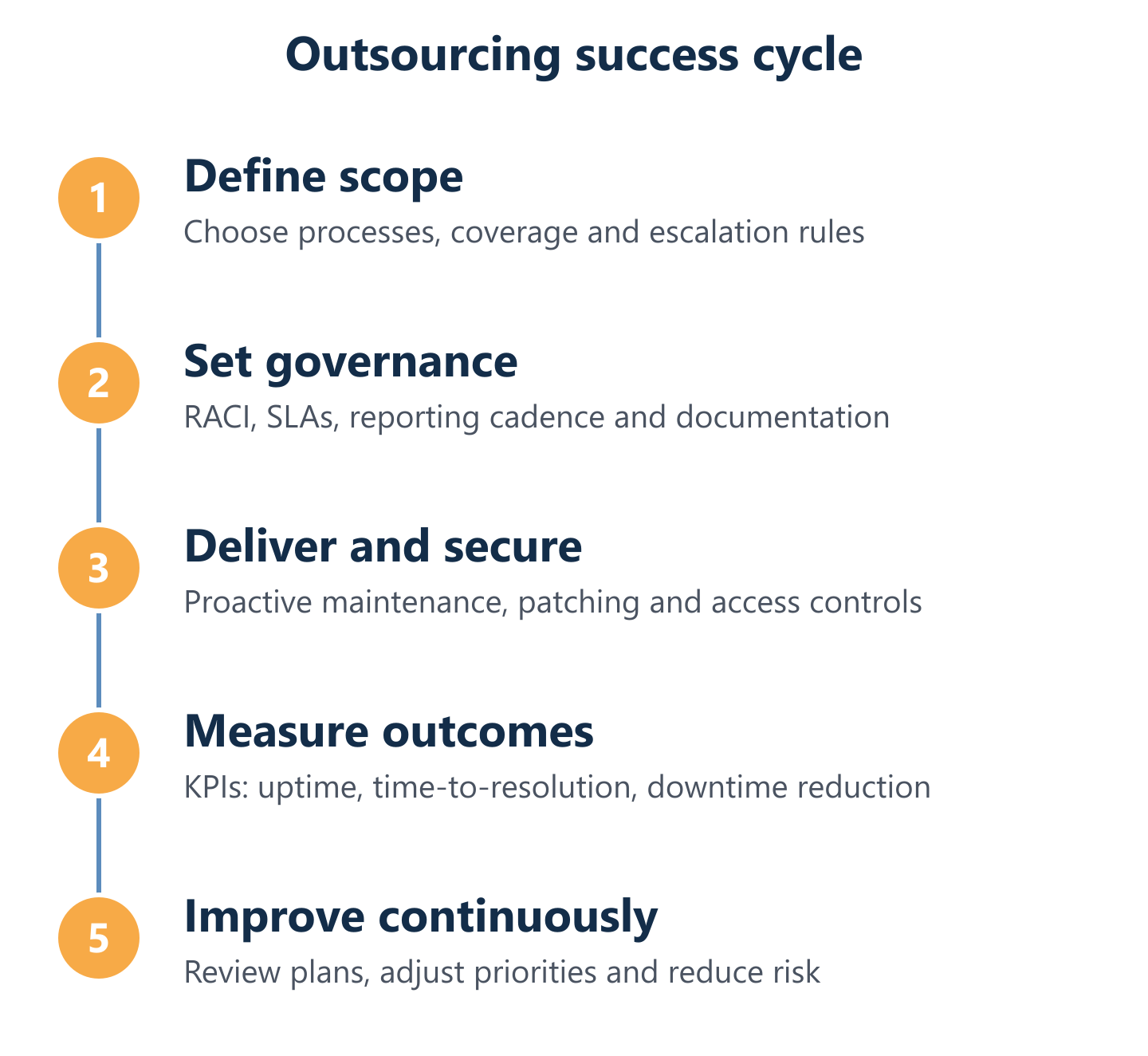
Service quality only becomes ROI when it is connected to business outcomes. The metrics that matter most are those that reflect operational continuity and cost predictability — not just provider activity. Track mean time to resolution (MTTR) per incident severity; a reduction here directly reduces lost productivity. Monitor system uptime against agreed targets: unplanned downtime has a quantifiable cost per hour that makes the value of proactive IT managed services concrete. Measure ticket volume trends over time — a well-managed environment should show declining reactive tickets as preventive maintenance takes effect. For cybersecurity outsourcing, track patch compliance rates and the time between vulnerability disclosure and remediation. Impulso Tecnológico resolves 4,000 IT tickets annually across its client base, providing a volume benchmark that reflects the operational scale of a mature managed services engagement. Prove ROI with KPIs: uptime, time-to-resolution, downtime reduction and responsiveness.
IT outsourcing delivers its full value only when scope, governance and measurement are aligned from the outset. Organisations that define responsibilities clearly, choose a delivery model suited to their risk profile and track outcomes against agreed KPIs consistently report better results — not because outsourcing is inherently transformative, but because the discipline of structuring it properly forces clarity that was previously absent. If your business is evaluating whether to externalise IT functions, the decision framework in this guide gives you a practical starting point. For a tailored assessment of which services to outsource first and how to structure the engagement, Impulso Tecnológico can help you move from analysis to a working plan. You may also find it useful to explore our detailed guidance on the benefits of IT outsourcing and our overview of IT services outsourcing for further context.