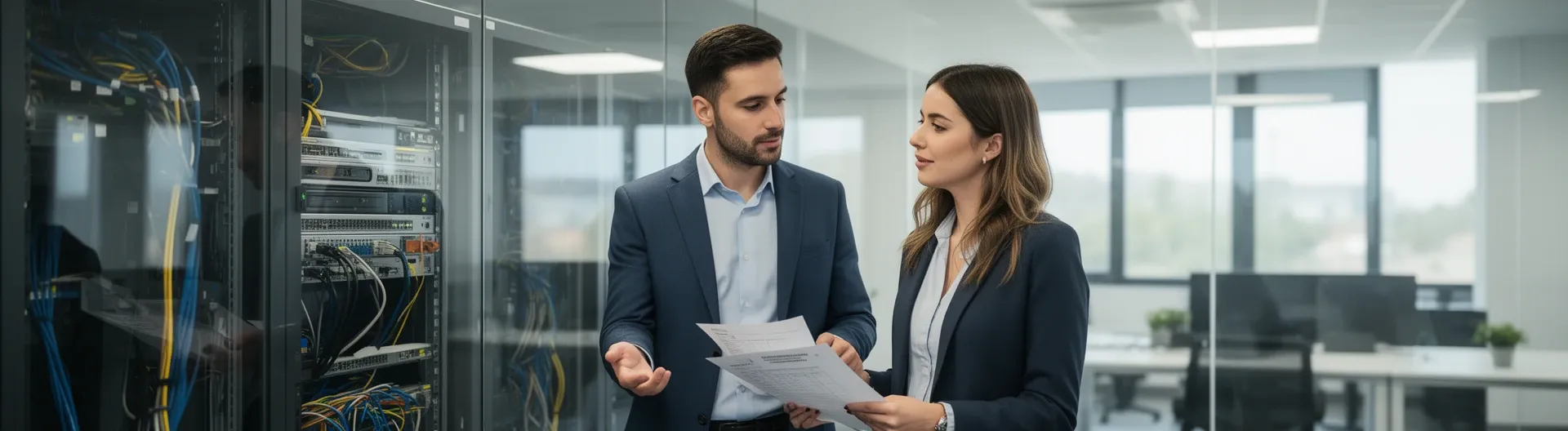

IT maintenance in Tres Cantos covers the ongoing preventive and corrective care of your business's servers, networks, endpoints, and communications — with defined response times, documented outcomes, and clear accountability. A structured maintenance contract reduces unplanned downtime and keeps critical systems secure and operational.
Many businesses in the Community of Madrid discover their IT maintenance gaps only after an incident: a failed backup, an unpatched vulnerability, or a server outage that could have been caught weeks earlier. The problem is rarely a lack of technology — it is a lack of structured, proactive oversight. A properly scoped IT maintenance service addresses this by combining scheduled preventive tasks (monitoring, patching, antivirus health checks, backup readiness verification) with a reliable corrective response when something does go wrong. The result is a predictable IT environment where your team can focus on business operations rather than firefighting. Impulso Tecnológico has been working in the IT sector in Tres Cantos since 2000, building a managed-services model that starts with a full audit of your environment and delivers ongoing support from a single, accountable partner.
What "IT Maintenance Tres Cantos" means (scope you can verify)
The phrase "IT maintenance" is used loosely by many providers, but for a business in Tres Cantos it should translate into a concrete, auditable set of activities. At its core, IT maintenance encompasses two complementary disciplines: preventive maintenance — scheduled tasks designed to keep systems healthy and reduce the probability of failure — and corrective maintenance — structured incident response when something breaks or degrades. Both must be documented, measured, and reported to be commercially meaningful.
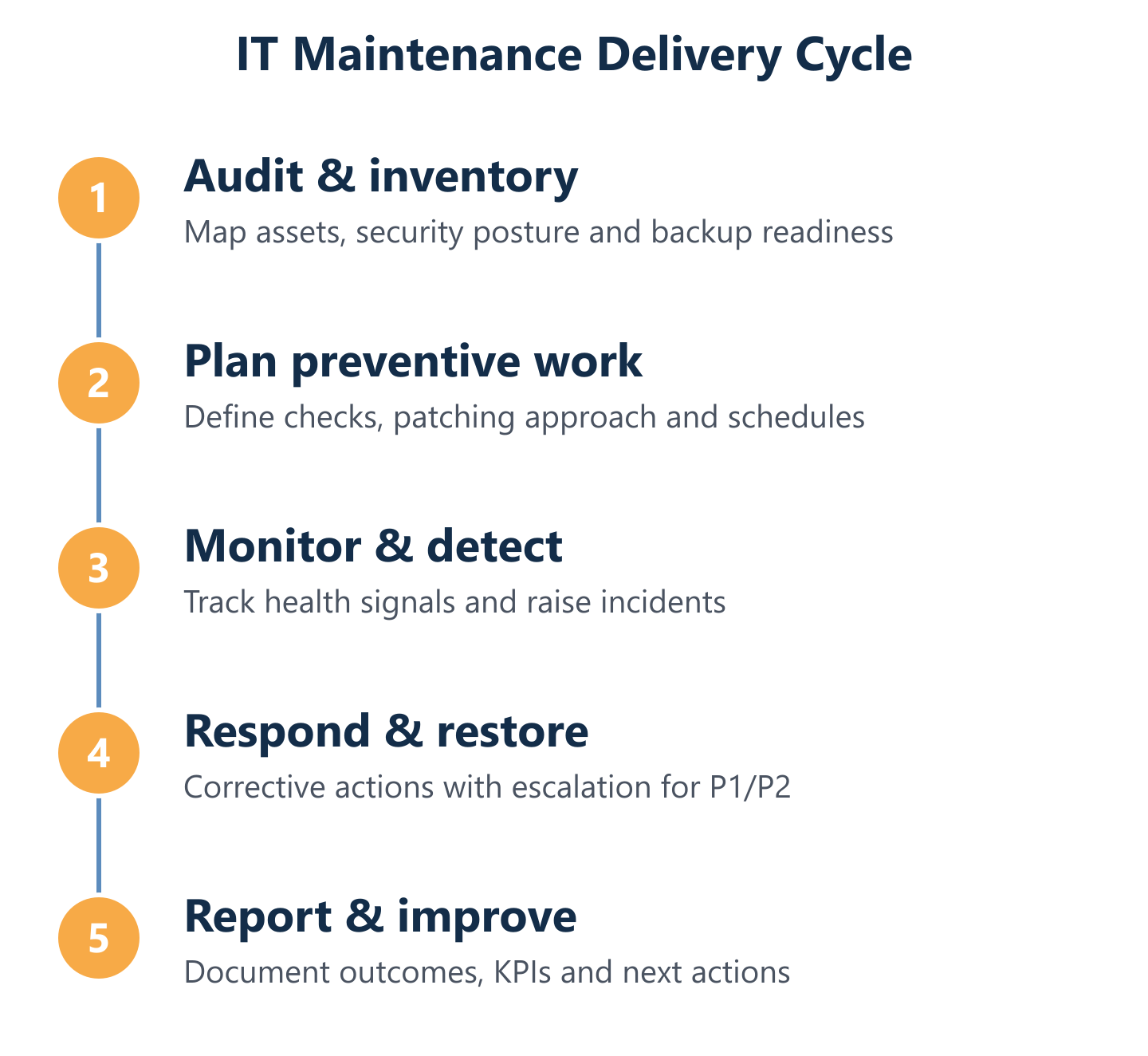
Impulso Tecnológico approaches every new engagement in Tres Cantos with an initial audit and inventory of the client's IT assets. This is not a formality: it establishes a verified baseline of what exists, its current health, and where the risks lie — particularly around antivirus status, backup readiness, and the condition of servers and communications infrastructure. Only after this audit does the maintenance scope get defined, ensuring clients know exactly what is covered and why.
| Maintenance dimension | Preventive | Corrective |
|---|---|---|
| Primary goal | Reduce failure probability | Restore normal operation |
| Trigger | Schedule / monitoring alert | Incident / user report |
| Typical activities | Patching, health checks, backup verification, antivirus updates | Troubleshooting, repair, restoration, root-cause analysis |
| Output | Maintenance report, action log | Incident record, resolution note, known-error documentation |
| SLA metric | Task completion rate, cadence adherence | Response time, resolution time |
Core coverage: servers, networks, endpoints and communications
A credible IT maintenance contract in Tres Cantos should explicitly name the asset categories it covers. The four pillars are servers (physical and virtual), network infrastructure (switches, routers, firewalls, wireless access points), endpoints (workstations, laptops, and mobile devices enrolled in management), and communications systems (VoIP, connectivity, and any unified-communications platforms in use). Applications critical to business operations — ERP, email, collaboration tools — should also be scoped, even if maintenance responsibility is shared with a software vendor. Impulso Tecnológico's maintenance offering covers environments ranging from a single workstation to estates of 200 or more devices, with technology partners including Cisco and Aruba for network infrastructure, and Microsoft for cloud-connected endpoints and services. Knowing which assets are in scope — and which are explicitly excluded — is the first question to resolve before any contract is signed.
Preventive vs corrective: what changes in day-to-day operations
Preventive IT maintenance is what separates a managed service from a break-fix arrangement. In practice, it means scheduled monitoring of system health, planned patch deployment cycles, regular antivirus health monitoring to confirm definitions are current and scans are completing successfully, and backup readiness checks to verify that recovery points exist and are restorable — not just that a backup job ran. When these tasks are performed consistently, the volume of corrective incidents drops measurably. Corrective maintenance, by contrast, is the structured response when a failure does occur: diagnosis, repair or workaround, restoration of service, and documentation of what happened and why. Both modes are necessary; the ratio between them is a useful indicator of how mature a maintenance programme is. A provider that handles mostly corrective work is, by definition, running a reactive operation.
Deliverables that matter: reports, documentation and action logs
Maintenance without documentation is maintenance you cannot verify or improve. Every corrective intervention should produce an incident record that captures the symptom, the diagnosis, the action taken, and the resolution time. Preventive cycles should generate a maintenance report that confirms which tasks were completed, which systems passed or failed health checks, and what follow-up actions are recommended. Over time, this documentation feeds a knowledge base that accelerates future resolutions and supports problem management — identifying recurring issues that warrant a permanent fix rather than repeated workarounds. For businesses in Tres Cantos subject to GDPR or sector-specific compliance requirements, this audit trail also serves as evidence that IT systems are actively managed and that data-handling infrastructure is maintained to an appropriate standard. Ask any prospective provider to show you a sample report before committing to a contract.

Service levels, SLAs and escalation: what to ask before signing
Service Level Agreements are only useful if they are specific, measurable, and tied to consequences. Before signing any IT maintenance contract in Tres Cantos, work through the following sequence to ensure the SLA framework is commercially sound:
- Confirm working-hours coverage: Establish the exact hours during which response commitments apply. Impulso Tecnológico operates Monday to Friday, 09:00–17:00 CET — a standard business-hours model that suits most SMEs in the Community of Madrid.
- Verify response-time commitments by priority: Impulso Tecnológico defines a 4-working-hour response target for server or general infrastructure issues, and 8 working hours for other assistance requests. These are the numbers that govern day-to-day expectations.
- Understand what "unlimited intervention" means: Under Impulso Tecnológico's maintenance model, clients receive unlimited intervention hours and unlimited on-site, remote, and telephone assistance — removing the uncertainty of per-incident billing.
- Clarify escalation governance: Know in advance how a critical failure (P1) is handled differently from a standard incident (P2), and which technical specialists are reachable at each tier.
- Check reporting cadence: SLAs must be reported against, not just promised. Agree on the frequency and format of KPI reports before the contract starts.
- Confirm punctual incident handling: For incidents outside the standard scope, Impulso Tecnológico offers scheduled punctual interventions of up to 4 hours at an additional cost — a transparent mechanism that avoids hidden charges.
Response and resolution expectations (working hours and priority tiers)
Response time is the interval between a ticket being raised and a qualified technician beginning to work on it. Resolution time is how long it takes to restore normal service. Both metrics must be defined per priority tier. For IT maintenance in Tres Cantos, a practical baseline is: critical infrastructure failures (servers down, network outage, security breach) should trigger a response within 4 working hours; standard issues affecting individual users or non-critical systems within 8 working hours. These are the targets Impulso Tecnológico applies in its Tres Cantos maintenance engagements. Resolution times vary by complexity and are harder to guarantee absolutely, but a provider should be able to share historical resolution data from comparable environments. If a prospective provider cannot give you specific numbers — only vague assurances of "fast response" — treat that as a red flag. For a broader view of how IT maintenance pricing relates to these service commitments, our guide on IT maintenance pricing covers the commercial structures in detail.
Escalation paths: from first-line support to specialised technical teams
Escalation governance determines whether a critical incident gets resolved quickly or stalls at first-line support. A well-structured model distinguishes at minimum two priority levels: P1 incidents (complete service loss, security breach, or business-critical system failure) and P2 incidents (significant degradation affecting multiple users or a key system). P1 events should trigger immediate escalation to senior or specialist engineers, bypassing standard queuing. P2 events follow a defined path with clear handoff criteria. Beyond technical escalation, vendor coordination matters: when a failure involves a third-party platform — Microsoft Azure, a Fortinet firewall, a Veeam backup appliance — the maintenance provider must be able to engage that vendor's support channel on the client's behalf, with the technical authority to do so. Impulso Tecnológico's partner certifications with Sophos, Fortinet, Veeam, Cisco, and Microsoft enable exactly this kind of coordinated escalation without the client needing to manage multiple vendor relationships.
ITSM alignment: incidents, problems, changes and knowledge management
ITSM — IT Service Management — provides the operational framework that separates professional IT maintenance from ad-hoc support. Three processes are directly relevant to maintenance contracts. Incident management covers the detection, classification, and resolution of service disruptions, with every event logged and tracked to closure. Problem management goes a layer deeper: when the same incident recurs, problem management initiates a root-cause investigation to eliminate the underlying fault, not just its symptoms. Change management governs how modifications to the IT environment — patches, configuration updates, hardware replacements — are planned, approved, and rolled back if necessary, reducing the risk of maintenance activities themselves causing outages. Knowledge management ties these together: documented resolutions, known errors, and workarounds that reduce mean time to resolution over time. Businesses in Tres Cantos evaluating providers should ask specifically which of these processes are in place and how they are reported — not just whether the provider has heard of ITIL. For context on how corrective processes fit into a broader maintenance strategy, our article on corrective IT maintenance provides a detailed breakdown.
How to choose the right provider in Tres Cantos (and avoid common traps)
Choosing an IT maintenance provider in Tres Cantos is a commercial decision with operational consequences that last years. The following criteria separate providers who can genuinely deliver from those who sell on price alone:
- Audit-led onboarding: Any credible provider should begin with a structured inventory and health assessment of your environment — not a generic contract template. Impulso Tecnológico's onboarding process starts with exactly this, covering antivirus status, backup readiness, server health, and network configuration.
- Defined asset scope: The contract must list which asset categories are covered (servers, endpoints, network, communications) and which are excluded. Ambiguity here leads to disputes during incidents.
- Measurable SLAs: Response times must be specified per priority tier and tied to working-hours coverage. Vague commitments to "quick response" are not SLAs.
- Security integration: Maintenance should include antivirus health monitoring, backup readiness checks, and access-control reviews — not treat security as a separate, billable add-on.
- Partner-certified technical coverage: Providers with certified partnerships (Sophos, Fortinet, Veeam, Microsoft, Cisco) can escalate to vendor support channels directly, reducing resolution times for complex failures.
- Transparent reporting: Monthly or quarterly reports should confirm what was done, what was found, and what is recommended — giving you visibility without needing to ask.
- Contract flexibility: Avoid providers that lock you into rigid, multi-year terms with no adjustment mechanism. Impulso Tecnológico's contracts are designed to adapt to the client's real needs and scale as the IT estate grows or changes.
- Local presence with remote capability: On-site support in Tres Cantos matters for hardware interventions; remote support matters for speed. The best model combines both, with clear rules on when each applies.
Commercial comparison: flat-rate vs per-visit vs per-hour models
Three commercial structures dominate IT maintenance contracts, and each suits a different usage profile. A flat-rate total model — such as Impulso Tecnológico's offering from 15 € + VAT per device per month — provides complete cost predictability: unlimited interventions are included, and there are no surprise invoices after a difficult month. This suits businesses that value budget certainty above all else. A flat-rate plus per-visit model combines a lower monthly base with a charge for each on-site attendance; it works well for environments with infrequent physical interventions but risks becoming expensive during hardware-intensive periods. A flat-rate plus per-hour model offers the lowest base cost but the least predictability, as billable hours accumulate during complex incidents. For most SMEs in Tres Cantos, the flat-rate total model is the most commercially rational choice: it aligns the provider's incentive with prevention (fewer incidents means lower delivery cost) rather than with volume of billable activity. Our detailed guide on IT maintenance pricing explores how to calculate the right budget for your environment.
Security during maintenance: antivirus, backups, access control and hardening checks
Maintenance windows are a common attack vector: systems are temporarily reconfigured, credentials are used, and changes are made — all of which create exposure if not managed carefully. Security must be embedded in the maintenance process itself, not bolted on afterwards. At a minimum, every maintenance cycle should include antivirus health monitoring (confirming that endpoint protection is active, definitions are current, and no threats are quarantined or unresolved), backup readiness checks (verifying that recent recovery points exist and that a restoration test has been performed), and access-control reviews (ensuring that maintenance accounts follow least-privilege principles and that no unnecessary remote-access paths remain open after an intervention). Impulso Tecnológico works with Sophos and Fortinet for endpoint and network security, and Veeam for backup and disaster recovery — technology partnerships that extend into the maintenance workflow, not just the initial deployment. GDPR compliance also depends on demonstrating that systems holding personal data are actively and verifiably maintained.
Delivery model: remote hands, on-site support and vendor coordination
The delivery model defines how maintenance work actually reaches your environment. Remote hands support covers the majority of software-layer tasks — monitoring, patch deployment, configuration changes, incident diagnosis — and can be executed quickly without travel time. On-site IT support is necessary for hardware replacements, physical network work, and any intervention that requires hands on equipment: a failed drive, a misconfigured switch, a new workstation deployment. A mature provider combines both, with clear criteria for when remote resolution is attempted first and when an engineer is dispatched. Impulso Tecnológico provides on-site, remote, and telephone assistance under its maintenance model, serving clients in Tres Cantos and the wider Community of Madrid. For hybrid and cloud environments — Microsoft 365, Azure, or infrastructure with a data centre component — maintenance responsibilities extend beyond the physical office, requiring the provider to manage cloud-layer health alongside on-premises assets. Vendor coordination (managing incidents with Microsoft, Cisco, or Fortinet support on the client's behalf) is the third dimension of a complete delivery model. For businesses across the Madrid region, our coverage of IT support in Madrid provides additional context on how regional delivery is structured.
IT maintenance in Tres Cantos is not a commodity purchase — it is an operational decision that affects your team's productivity, your data's security, and your ability to recover when something goes wrong. The right provider starts with a structured audit, defines a clear scope, commits to measurable SLAs, and embeds security into every maintenance cycle. Impulso Tecnológico has been delivering exactly this model in Tres Cantos since 2000, with a team and partner ecosystem built to keep your systems secure, predictable, and easy to manage month after month. If you want to understand what a maintenance contract should look like for your specific environment, the next step is a conversation.