

IT maintenance in Spain covers the ongoing management, protection, and support of your business IT assets — servers, endpoints, networks, email, and backups — through a combination of preventive care, fast fault resolution, and continuous monitoring, delivered under defined service levels.
Most businesses in Spain don't fail because of a single catastrophic event. They lose productivity gradually: a server that hasn't been patched, a backup that hasn't been verified, a network switch that's been running at capacity for months without anyone noticing. By the time something breaks visibly, the underlying problem has been building for weeks. A structured IT maintenance service addresses this by shifting from reactive ticket-handling to a proactive, operational model — one where systems are audited, inventoried, and monitored before problems escalate. The result is measurable: less downtime, a stronger security posture, and a more stable environment for the people who depend on it every working day.
What "IT Maintenance Spain" means (scope and asset coverage)
Search for "IT maintenance Spain" and you will find results ranging from industrial facilities management to generic helpdesk contracts. Neither is what most businesses are actually looking for. IT maintenance, properly defined, is the structured, ongoing management of your organisation's technology assets — the hardware, software, connectivity, and security layers that keep your operations running. It is not a one-off fix, and it is not a call centre you ring when something breaks.
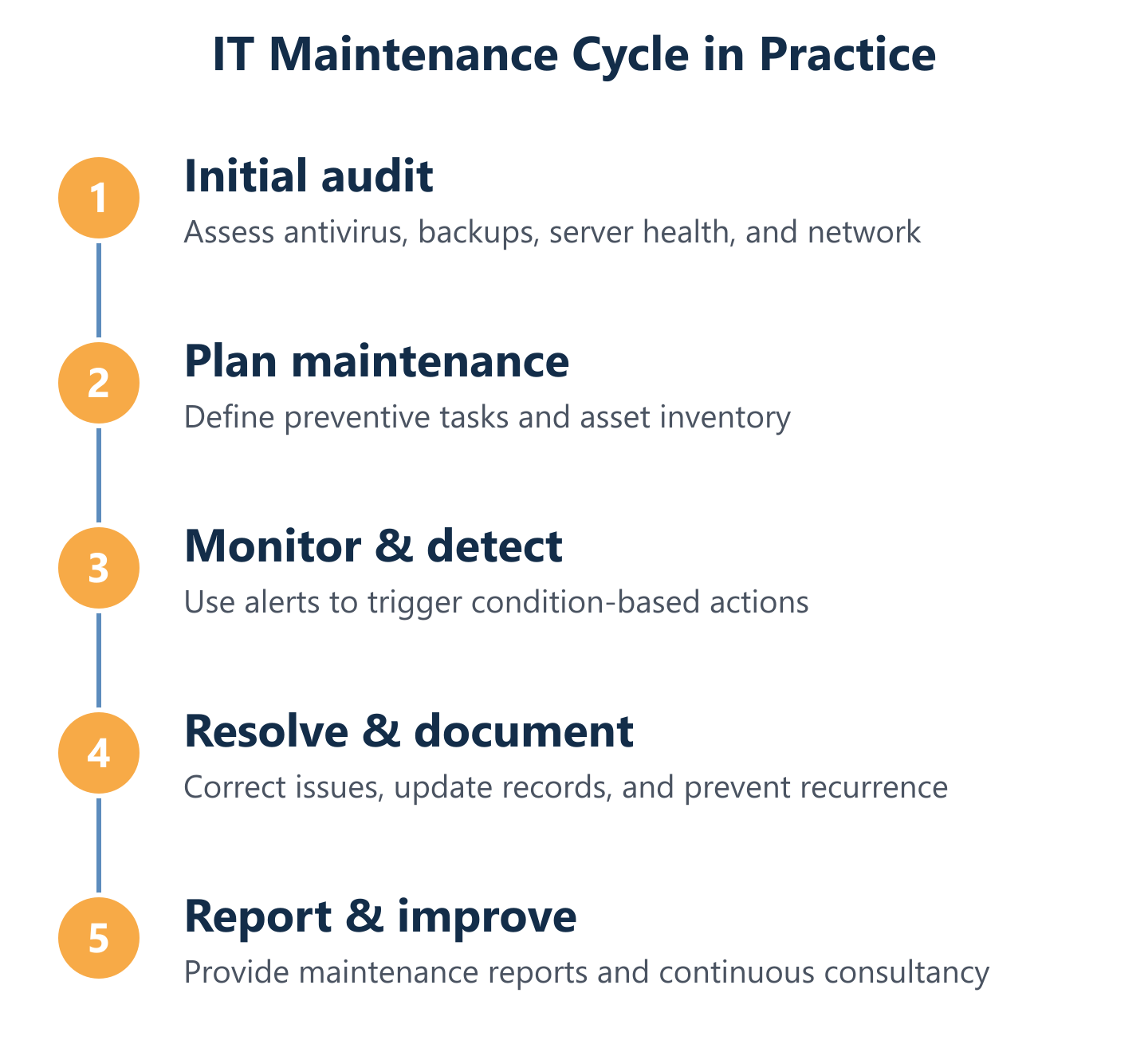
At Impulso Tecnológico, every engagement starts with a complete, real-world audit: antivirus status, backup integrity, server condition, network infrastructure, and a full inventory of the devices to be maintained. That baseline matters because maintenance without an accurate picture of the environment is guesswork. Whether we act as an external IT department for organisations without in-house capability, or as a specialist layer that supplements an existing team, the starting point is always the same — understand what you have before committing to how you will protect it.
| Scope dimension | IT maintenance service | Facilities/industrial maintenance | Basic helpdesk contract |
|---|---|---|---|
| Primary assets | Servers, endpoints, networks, email, backups, applications | HVAC, electrical, mechanical, civil infrastructure | User devices (reactive only) |
| Maintenance approach | Preventive + corrective + condition-based monitoring | Scheduled inspections + legal compliance checks | Corrective only (ticket-driven) |
| Governance output | Audit-ready reports, change logs, GDPR-aligned records | Regulatory inspection certificates | Ticket closure records |
| Security integration | Endpoint protection, firewall, backup verification | Physical access control, fire safety | Typically none |
| SLA structure | Defined response times per asset class | Legal response obligations per installation type | Best-effort or basic SLA |
IT maintenance vs facilities/industrial technical maintenance
The confusion between IT maintenance and facilities or industrial technical maintenance is common, particularly in Spain where the term "mantenimiento técnico" spans both worlds. Facilities maintenance covers physical plant: HVAC systems, electrical installations, elevators, fire safety, and mechanical equipment — all governed by specific Spanish technical regulations and inspection cycles. IT maintenance, by contrast, covers the digital and network layer: endpoints, servers, firewalls, email platforms, backup systems, and the applications your staff use daily. The skills, tools, certifications, and compliance frameworks are entirely different. Conflating the two leads to gaps — most notably, organisations that have rigorous physical maintenance programmes but no structured approach to patching, backup verification, or endpoint security. A qualified IT maintenance provider in Spain operates within the EU/GDPR regulatory framework, not the industrial inspection regime.
Typical IT assets covered in Spain (endpoints, servers, network, email)
A well-scoped IT maintenance service for a Spanish SME typically covers four asset layers. First, endpoints: workstations, laptops, and mobile devices used by staff — the most numerous assets and the most common entry point for security incidents. Second, servers: on-premises or hybrid infrastructure running business-critical applications, databases, and file storage. Third, network infrastructure: switches, routers, wireless access points, and firewalls that underpin connectivity — including technologies from Cisco, Aruba, and Fortinet. Fourth, communication and productivity platforms: email systems, Microsoft 365 environments, and cloud services that require licence management, configuration governance, and backup coverage. Maintenance across all four layers should include preventive checks, corrective resolution, and monitoring-led intervention — not only ticket handling when a user reports a problem. Scope definition at contract stage is what separates a genuine maintenance service from a reactive support arrangement.
Service outcomes: uptime, security posture, and reduced disruption
The measurable outcomes of a structured IT maintenance service are straightforward: higher uptime, a stronger security posture, and fewer disruptions to daily operations. But these outcomes only materialise when maintenance is delivered as an operational service — not as a series of isolated fixes. That means detailed reports after every intervention, a permanent consultancy layer for technical questions, and a governance structure that tracks changes, incidents, and system health over time. Impulso Tecnológico resolves thousands of IT tickets annually across its client base, and the pattern is consistent: organisations that operate under a proactive maintenance model experience significantly fewer critical incidents than those relying on reactive support alone. Continuity targets should be agreed at the outset, with reporting cycles that give management visibility into system health, security status, and maintenance activity — not just a list of closed tickets.

Maintenance models and service coverage expectations
Choosing a maintenance model is not a theoretical exercise — it directly determines how quickly your business recovers from a fault, how often problems are caught before they escalate, and what your monthly costs look like. Three models dominate managed IT maintenance in Spain, and most serious providers combine all three rather than offering one in isolation.
- Preventive maintenance: Scheduled tasks — patching, firmware updates, disk health checks, backup verification, antivirus definition updates — performed on a regular cycle to reduce the probability of failure.
- Corrective maintenance: Fast resolution of faults once they occur, with defined response times distinguishing between critical assets (servers) and standard endpoints.
- Condition-based maintenance: Monitoring-driven intervention triggered by signals — backup job failures, disk utilisation thresholds, unusual network traffic, vulnerability scan results — before a fault becomes an outage.
- Unlimited remote support: A remote maintenance system that allows technicians to access and resolve issues without waiting for an on-site visit, reducing mean time to resolution for the majority of incidents.
- On-site intervention with defined response targets: For issues that cannot be resolved remotely, response times should be contractually defined — Impulso Tecnológico commits to less than four business hours for server breakdowns and less than eight business hours for other devices.
- Post-intervention system review: After every assistance, a check of the wider environment to identify related risks and prevent repeat incidents — a step that most reactive helpdesk contracts omit entirely.
Service coverage should also specify commercial flexibility: hourly packages, monthly hour rates, or flat-rate models with unlimited remote and on-site assistance are all legitimate structures, and the right choice depends on the size and complexity of the environment.
Preventive, corrective, and condition-based maintenance for IT assets
Preventive maintenance is the foundation of any serious IT maintenance programme. Regular patching cycles, scheduled backup tests, firmware updates on network devices, and periodic hardware health checks all reduce the frequency and severity of incidents. The evidence is consistent across the industry: organisations with documented preventive maintenance schedules experience fewer unplanned outages than those without. Corrective maintenance — resolving faults after they occur — will always be necessary, but its cost and disruption are proportional to how well preventive work has been done. For a managed IT maintenance provider in Spain, this means building preventive tasks into the service contract, not treating them as optional extras. Condition-based maintenance adds a third layer: using monitoring data, vulnerability assessments, and backup health signals to trigger intervention before a threshold is breached. Together, these three approaches form a complete maintenance model for SMEs and larger organisations alike. For a deeper look at the corrective side, see our guide to corrective IT maintenance.
Remote maintenance and on-site response times: what to ask for
Response time commitments are where many IT maintenance contracts in Spain fall short. A contract that promises "fast response" without specifying what that means in hours — and for which asset classes — is not a service level agreement; it is a marketing statement. When evaluating a managed IT maintenance provider, ask for explicit commitments: what is the response time for a server failure versus a user endpoint issue? Is remote support available immediately, or is it queued? Condition-based maintenance sharpens this further: if your monitoring system detects a backup failure or a disk approaching capacity, the provider should be able to act on that signal proactively — not wait for a user to raise a ticket. Impulso Tecnológico uses a dedicated remote maintenance system for immediate access, with on-site response times defined by asset criticality. That distinction — server versus endpoint, remote versus on-site — should be explicit in any contract you sign with an IT maintenance provider in Spain.
Pros and cons: in-house team vs managed IT maintenance in Spain
Building an in-house IT team gives you direct control and proximity to the business, but it carries fixed costs — salaries, training, tooling, cover for holidays and sick leave — that are difficult to scale. For organisations with fewer than 150 users, the economics rarely favour a fully in-house model. A managed IT maintenance provider in Spain offers a defined scope, predictable monthly costs, and access to a broader skills base than a single internal technician can provide. The trade-off is that you depend on the provider's responsiveness and documentation discipline. Coverage expectations must therefore be written into the contract: response times, escalation paths, reporting frequency, and what happens when the primary contact is unavailable. A hybrid model — where an internal IT coordinator works alongside an external provider — is increasingly common among mid-sized Spanish businesses, and it is a structure that Impulso Tecnológico supports directly. For businesses evaluating local options, our IT support in Madrid and IT support in Barcelona pages outline how we structure these engagements by location.
Compliance, tooling, and how to choose the right provider in Spain
Compliance is not a separate concern from IT maintenance — it is embedded in how maintenance is documented, reported, and governed. For Spanish businesses operating under EU law, GDPR has direct implications for how IT maintenance records are kept: who accessed which system, when changes were made, and what data was touched during an intervention. A provider that cannot produce audit-ready documentation is a liability, not an asset.
On the tooling side, the choice between ITSM-style workflows and dedicated maintenance management platforms depends on the complexity of the environment and the reporting requirements of the business. What matters more than the platform is whether the provider's processes are structured enough to generate reliable data — and whether that data is shared with the client in a usable format.
Impulso Tecnológico approaches this through a security-by-design model: endpoint protection, backup configuration, network administration, and access control are built into the maintenance service from day one, not added reactively. Working with certified partners including Sophos, Fortinet, and Veeam, the service is designed to support both operational continuity and compliance obligations. When evaluating any provider, the following signals indicate a mature maintenance operation:
- A formal initial audit and asset inventory before service commencement.
- Documented response time commitments, differentiated by asset class.
- GDPR-aware maintenance records with non-editable intervention histories.
- Endpoint protection, backup verification, and network security included — not sold as add-ons.
- Named technology partners with verifiable certifications (e.g., Sophos, Fortinet, Veeam, Microsoft).
- Reporting delivered after every intervention, plus periodic system health summaries.
- Flexible commercial models (hourly, monthly, flat-rate) that match your actual usage pattern.
- Clear escalation paths and a named contact for ongoing consultancy.
Compliance and governance for IT operations (GDPR-aware maintenance records)
GDPR compliance in Spain is enforced by the AEPD (Agencia Española de Protección de Datos), and the obligations extend well beyond data processing agreements. When a technician accesses a server, modifies a user account, or changes a network configuration, that action may touch personal data — and under GDPR, the organisation must be able to demonstrate what happened, when, and by whom. Maintenance records that are editable after the fact, incomplete, or simply absent create audit exposure. A governance-aware IT maintenance provider will maintain non-editable logs of interventions, document configuration changes, and produce reports that can be presented to an auditor or a data protection officer without additional preparation. This is not a niche requirement for large enterprises — it applies to any Spanish SME that processes personal data, which in practice means almost every business. When reviewing a provider's proposal, ask specifically how maintenance actions are logged and how long records are retained.
Tooling and automation: ITSM workflows vs maintenance management platforms
The distinction between ITSM (IT Service Management) tools and CMMS/GMAO (Computerised Maintenance Management System) platforms matters when scoping a managed IT maintenance service. ITSM tools — such as those built around ITIL frameworks — are designed for service desk workflows: incident management, change requests, problem tracking, and SLA monitoring. They are well-suited to IT environments where the primary unit of work is a ticket or a change record. CMMS/GMAO platforms, by contrast, originate in industrial and facilities maintenance and are optimised for asset lifecycle management, scheduled inspection cycles, and spare parts inventory. For most IT maintenance engagements in Spain, an ITSM-style workflow is the appropriate foundation — but the provider should also support automation where it adds value. Impulso Tecnológico works with platforms including Odoo, n8n, and Make.com to automate repetitive maintenance workflows, integrate monitoring alerts with ticketing systems, and generate reporting without manual data entry. The key question for any client is not which platform the provider uses, but whether their tooling produces reliable, shareable data.
Provider selection checklist: scope, SLAs, security-by-design, and integrations
Selecting a managed IT maintenance provider in Spain requires more than comparing hourly rates. The following checklist covers the dimensions that most procurement processes miss. On scope: does the contract define every asset class, or does it leave endpoints, network devices, or cloud platforms in a grey area? On SLAs: are response times differentiated by asset criticality, and are they contractually binding rather than indicative? On security: is endpoint protection, backup verification, and firewall management included by default, or priced separately? On integrations: can the provider's monitoring and ticketing systems exchange data with your ERP, your backup platform, or your cloud environment? On reporting: will you receive structured reports after interventions, and periodic summaries of system health? On commercial flexibility: can the model be adjusted as your environment grows or changes? For businesses in specific locations, our pages on preventive IT maintenance and IT maintenance pricing provide additional detail on how these elements are structured in practice.
Fewer outages and a more stable IT environment are achievable outcomes — but only when the maintenance scope is matched to your actual assets, risk profile, and operational requirements. The first step is not signing a contract; it is commissioning a thorough audit of your current environment so that the service is built on accurate data rather than assumptions. If your current provider cannot tell you the patch status of every server in your estate, the last verified backup date, or the firmware version running on your core switch, that is the gap a structured IT maintenance service in Spain should close.