

IT maintenance Madrid covers the full cycle of keeping business technology operational: scheduled preventive checks, rapid corrective support, ongoing security configuration, and backup management — delivered under defined response targets by a single accountable provider.
Most Madrid SMEs experience IT problems reactively: a server goes down, productivity halts, and the cost of recovery is unpredictable. The root cause is almost always the absence of a structured maintenance plan — no regular patch cycles, no monitored backups, no documented escalation path. The result is not just downtime; it is accumulated technical debt that makes every future incident worse.
A properly scoped IT maintenance service changes this dynamic. Instead of responding to failures, the provider prevents them through scheduled audits, proactive updates, and continuous security monitoring. When incidents do occur, defined response targets and a clear escalation process minimise their impact. At Impulso Tecnológico, we have structured this model over more than 25 years of managed IT support, serving SMEs across Madrid and beyond — and the measurable outcome for clients is fewer surprises, lower operational risk, and IT costs that are genuinely predictable month to month.
What IT Maintenance Madrid should include for businesses
Searching for IT maintenance in Madrid returns dozens of providers, but few of them define what is actually included. The difference between a reactive break-fix contract and a genuinely managed IT maintenance service is structural: one waits for failures, the other is engineered to prevent them.
A complete maintenance plan for a Madrid SME should cover four pillars simultaneously: preventive maintenance (scheduled checks, updates, lifecycle management), corrective support (incident resolution with defined response times), security (ongoing protection configuration, not one-off installation), and business continuity (backup management and recovery readiness). Providers that separate these into optional add-ons shift operational risk back onto the client.
At Impulso Tecnológico, every engagement begins with a real audit of the client's environment — antivirus status, backup copies, servers, and communications — followed by a full device inventory. This baseline determines the appropriate service level agreement and ensures the maintenance plan is sized to actual risk, not a generic template.
| Maintenance Component | Break-Fix Model | Managed IT Maintenance |
|---|---|---|
| Preventive checks | Not included | Scheduled (monthly/quarterly) |
| OS and security updates | On request only | Proactive, managed centrally |
| Incident response time | Best effort, no SLA | Defined targets per incident type |
| Backup management | Client responsibility | Configured, monitored, tested |
| Security configuration | One-off setup | Ongoing, adapted to threats |
| Reporting and documentation | Rarely provided | Detailed reports per intervention |
| Cost predictability | Variable, unpredictable | Fixed monthly contract |
Maintenance scope: preventive + corrective + security + continuity
Preventive IT maintenance is the discipline of reducing failure probability before it becomes a business problem. In practice, this means scheduled operating system updates, security patch cycles, hardware health checks, and lifecycle assessments that flag devices approaching end-of-life before they fail in production. For Madrid SMEs running environments of 10 to 150 devices, skipping preventive cycles is the single most common reason for avoidable downtime.
Corrective maintenance handles incidents when they occur — but its quality depends entirely on what was documented during preventive cycles. Without an accurate inventory and configuration baseline, corrective support is slower and more expensive. Continuity planning closes the loop: if a system cannot be restored quickly, preventive and corrective work alone cannot protect the business. All four pillars must function together.
Service coverage: remote support, on-site interventions, and escalation paths
Not every incident requires a technician on site, but every incident requires a defined path to resolution. Effective IT support outsourcing in Madrid combines remote maintenance — which resolves the majority of software, configuration, and connectivity issues within minutes — with structured on-site capability for hardware failures, physical infrastructure problems, or situations where remote access is not viable.
The escalation path matters as much as the response time. A provider should be able to triage an incident remotely, determine whether on-site intervention is required, and dispatch accordingly — without the client needing to manage that decision. At Impulso Tecnológico, unlimited remote support is the first line of response, with on-site targets activated when the incident type demands physical presence. This hybrid model keeps resolution times low while controlling costs.
What "managed IT maintenance" should deliver: documentation and reporting
Documentation is the evidence that maintenance is actually happening. A managed IT maintenance contract without reporting is indistinguishable from a verbal promise. Every intervention — whether preventive or corrective — should produce a written record: what was checked, what was found, what was resolved, and what was deferred with a rationale.
This documentation serves three practical purposes. First, it creates an audit trail that supports GDPR compliance and internal governance. Second, it enables the provider to identify recurring patterns — the same device failing repeatedly, a network segment generating disproportionate incidents — and address root causes rather than symptoms. Third, it gives decision-makers visibility into IT health without requiring technical expertise. Impulso Tecnológico delivers detailed reports after each intervention, giving clients a clear picture of their infrastructure status and the value of the maintenance investment.

Support model: remote vs on-site, escalation, and downtime minimisation
The support model is where the quality of IT maintenance becomes tangible. Theoretical coverage means nothing if incidents queue for hours without a response or if technicians arrive on site without context. A well-designed support model defines exactly how each type of incident is handled from the moment it is reported to the moment it is closed.
At Impulso Tecnológico, the delivery model for managed IT maintenance in Madrid is structured around measurable commitments: unlimited remote support as the primary channel, with on-site response targets for server breakdowns and other hardware incidents. Critically, every on-site intervention also includes a review of the surrounding environment — not just the reported fault — to prevent secondary failures that would otherwise surface days later as separate incidents. This approach directly reduces the hidden costs of IT maintenance: the repeat visits, the cascading failures, and the productivity losses that never appear on a support ticket but accumulate across the year.
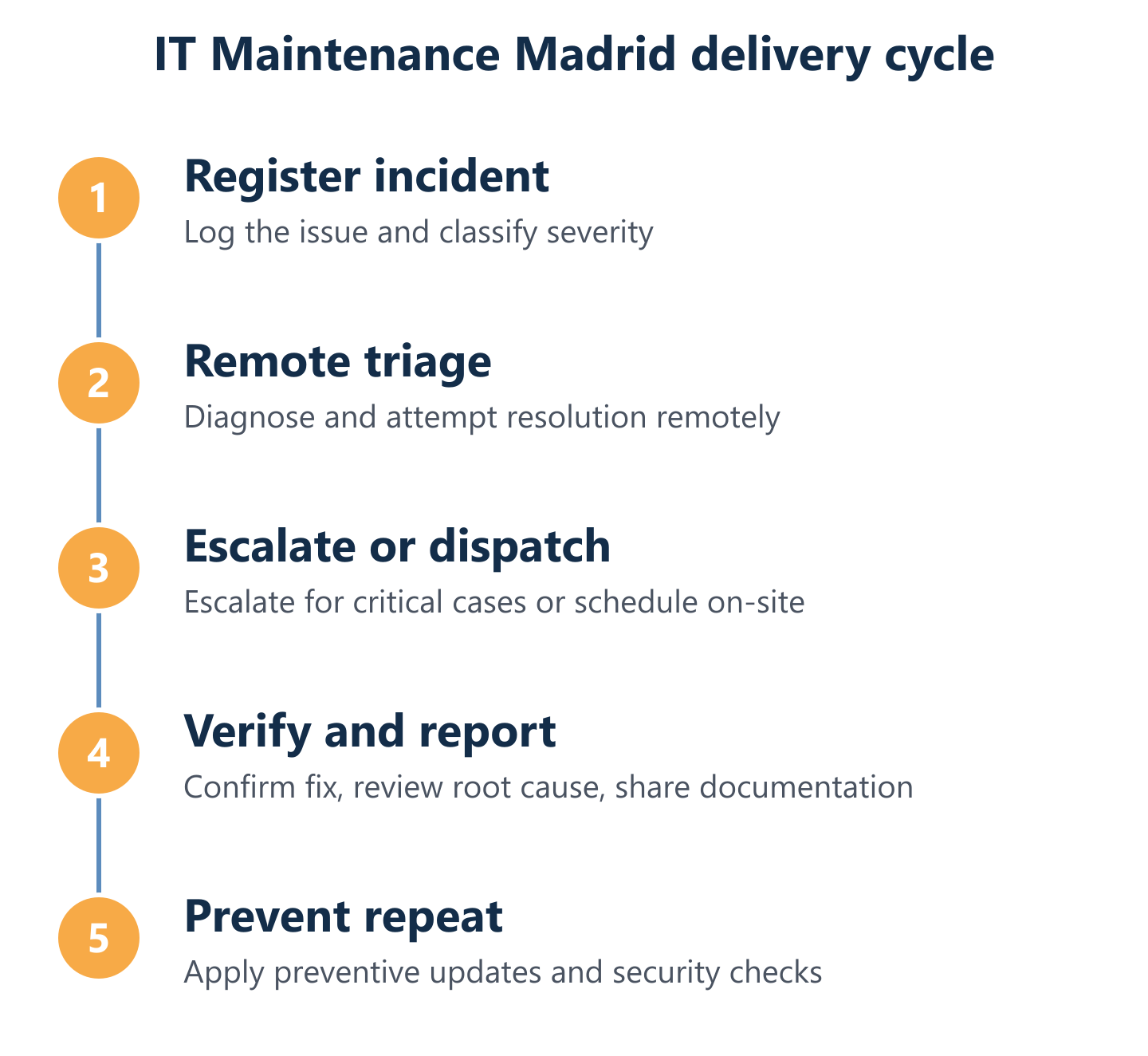
- Incident registration: The client reports an issue via the remote maintenance system; the ticket is logged with priority classification.
- Remote triage: A technician connects remotely to diagnose the fault, resolving the majority of issues without on-site presence.
- Escalation decision: If remote resolution is not viable, on-site dispatch is triggered with defined response targets (under 4 business hours for server breakdowns; under 8 business hours for other devices).
- Resolution and environment review: The technician resolves the reported fault and reviews adjacent systems to identify latent risks.
- Documentation and follow-up: A detailed report is delivered covering the solution, findings, and any recommended actions to prevent recurrence.
Remote support workflow: triage, diagnosis, resolution, and follow-up
Remote IT maintenance resolves the vast majority of business IT incidents faster than any on-site visit could. The reason is straightforward: a technician with remote access to a device can diagnose and fix software faults, configuration errors, connectivity issues, and user-level problems within minutes of the ticket being raised — without travel time or scheduling delays.
The critical factor is the quality of the remote maintenance system. Impulso Tecnológico uses a centralised remote support platform that provides full visibility into client environments, enabling technicians to act immediately on registered incidents. Unlimited remote support means clients are not rationing tickets or deferring minor issues that, left unresolved, become major ones. Follow-up after resolution confirms the fix held and captures any related observations for the maintenance record.
On-site delivery: when it is needed and how response targets work
On-site IT support becomes necessary when the fault is physical — a failed hard drive, a network switch requiring replacement, a server that will not boot — or when the environment itself prevents remote access. The quality of on-site support depends on two things: how quickly a technician can arrive, and how well-prepared they are when they do.
Impulso Tecnológico targets on-site response within 4 business hours for server breakdowns and within 8 business hours for other computer incidents across Madrid. These targets are not aspirational; they are built into the service level agreement. For clients requiring a more intensive on-site presence, Impulso Tecnológico can also provide a dedicated IT technician at the client's premises on a part-time or full-time basis, with different technical profiles available depending on the environment's complexity.
Escalation and incident review: reducing repeat downtime and hidden costs
Repeat incidents are the most expensive form of IT maintenance failure. When the same server restarts unexpectedly three times in a month, or the same user loses connectivity every Tuesday morning, the cost is not just the technician's time — it is the accumulated productivity loss, the management attention diverted, and the erosion of confidence in the IT environment.
Effective escalation means that when an incident exceeds the remote support tier, it moves to on-site with full context already transferred. Impulso Tecnológico's intervention model includes a review of the broader system during every on-site visit, specifically to surface latent issues before they trigger separate incidents. This proactive review, combined with detailed post-intervention reporting, is what converts reactive support into a genuine preventive IT maintenance discipline — and what keeps annual IT maintenance costs predictable rather than volatile.
Cybersecurity, backups, and compliance as ongoing maintenance activities
Cybersecurity is not a product you install once and forget. Threat landscapes shift monthly, vulnerabilities are disclosed continuously, and user behaviour introduces risk regardless of how good the perimeter defences are. Treating security as a maintenance activity — something that is configured, monitored, updated, and reviewed on a regular cycle — is the only approach that keeps Madrid businesses genuinely protected.
The same logic applies to backups and compliance. A backup that has not been tested is not a backup; it is an assumption. A GDPR-aligned data protection posture that was documented two years ago and never reviewed is a liability, not a safeguard. Impulso Tecnológico integrates all three disciplines into the ongoing maintenance cycle:
- Security configuration: Operating system security software is configured and maintained; endpoint protection (using technologies including Sophos and Fortinet) is deployed and kept current.
- Patch management: Security patches and OS updates are applied on a managed schedule, not left to individual users.
- Backup management: Backup copies are configured, monitored for successful completion, and tested for recoverability — managed by Impulso Tecnológico as part of the maintenance contract.
- Access and network administration: Internet access settings, email configuration, and user access controls are reviewed and adapted as the client's environment evolves.
- Compliance documentation: Maintenance records and configuration evidence support GDPR obligations and internal audit requirements.
- Permanent consultancy: Clients have access to technical guidance beyond incident resolution — clarifying questions, evaluating new tools, and planning changes safely.
Cybersecurity within maintenance: continuous protection and training
Firewall management, anti-malware deployment, and patch cycles are the technical foundation of cybersecurity maintenance — but they are not sufficient on their own. The majority of successful cyberattacks against SMEs exploit human behaviour: phishing clicks, weak passwords, unpatched devices used outside the corporate network. A maintenance-integrated security approach addresses both layers.
Impulso Tecnológico configures and maintains endpoint protection and firewall solutions as part of the managed service, applying updates and policy adaptations based on current threat intelligence and market standards. This is not a one-time setup; it is a recurring maintenance task. For clients operating in regulated sectors or handling sensitive data, security configuration is also aligned to compliance requirements, creating a documented evidence trail that supports both internal governance and external audit obligations.
Backups and data recovery: operational readiness, not just "having backups"
The question is not whether a business has backups — most do, in some form. The question is whether those backups can actually restore operations within an acceptable timeframe when a server fails, ransomware encrypts the file share, or a critical database is accidentally deleted. Backup and disaster recovery planning, managed as part of IT maintenance, answers that question before the incident occurs.
Impulso Tecnológico manages backup copies as a core maintenance activity: configuration, monitoring of completion status, and periodic recovery testing using Veeam and compatible technologies. The goal is operational readiness — knowing exactly what can be restored, how quickly, and to what point in time. This clarity is what converts backup and disaster recovery from a theoretical safeguard into a genuine business continuity capability for Madrid SMEs.
Compliance and governance for Madrid companies: documentation and verification
GDPR compliance for Madrid companies is not a one-time project; it is an ongoing operational requirement. Data processing activities change, new tools are introduced, staff turn over, and the regulatory environment evolves. Maintenance-integrated compliance means that configuration changes are documented, access controls are reviewed periodically, and the evidence needed for a data protection audit is generated as a natural by-product of the maintenance cycle — not assembled in a panic when an inspection is announced.
Impulso Tecnológico's maintenance model includes the documentation and verification activities that support this posture: intervention reports, configuration records, access setting reviews, and standards-aligned security practices. For clients in regulated sectors — healthcare, education, financial services — this governance layer is not optional; it is a core deliverable of the managed IT maintenance service. You can explore how this approach applies across different business environments in our guide to computer maintenance for companies.
Defining your IT maintenance requirements before approaching a provider is the most effective way to evaluate proposals on equal terms. Start with the basics: how many devices and users need coverage, what your critical systems are, what response times your operations can tolerate, and whether you have internal IT capacity or need full outsourcing. With those parameters clear, a structured managed IT maintenance proposal — with defined SLAs, documented scope, and measurable reporting — becomes straightforward to compare and validate.
Impulso Tecnológico offers an initial audit of your environment as the starting point for any engagement. This gives you an accurate picture of your current IT health and a realistic basis for a maintenance plan that fits your actual risk profile, not a generic template. For businesses across Madrid looking to reduce incidents and bring predictability to IT costs, that audit is where the process begins. Our teams also provide the same structured approach to clients in other Spanish cities — see how we deliver managed IT support in Barcelona and IT maintenance in La Coruña for further reference.