
IT maintenance in Barcelona covers the proactive monitoring, preventive checks and corrective support needed to keep business computers, servers and networks running reliably. A structured maintenance contract reduces unplanned downtime, controls IT costs and ensures security is maintained continuously — not just when something breaks.
For most businesses operating in Barcelona, IT failures translate directly into lost productivity and operational risk. Whether it is a server outage, a failed backup or a security misconfiguration, the cost of reactive-only IT support is consistently higher than a structured, preventive approach. The real question is not whether to invest in IT maintenance, but how to structure it so it actually delivers continuity.
At Impulso Tecnológico, we design IT maintenance engagements around a clear starting point: an initial audit that establishes the real status of your systems before any contract begins. From that baseline, we build a maintenance model combining proactive monitoring, scheduled preventive checks and rapid corrective response — all underpinned by defined SLAs and detailed reporting. The result is IT that supports your business operations rather than interrupting them.
What IT Maintenance Barcelona includes (preventive + corrective)
IT maintenance is not a single activity — it is a structured combination of scheduled prevention and rapid incident response. Preventive maintenance reduces the probability of failure by keeping systems patched, monitored and correctly configured. Corrective maintenance restores service when something does go wrong, with a defined workflow that minimises impact on the business. Security hardening sits across both: it is applied proactively during preventive cycles and reviewed after every corrective intervention.
For businesses in Barcelona, the practical scope of a well-structured maintenance contract covers endpoints (desktops and laptops), servers, network infrastructure, email and internet access controls, backup systems and security software. Impulso Tecnológico structures this scope explicitly in every engagement, so there are no ambiguities about what is and is not included when an incident occurs.
| Maintenance Type | Primary Goal | Typical Activities | When It Runs |
|---|---|---|---|
| Preventive | Reduce failure probability | Patch management, antivirus updates, backup verification, system health checks, performance tuning | Scheduled — monthly, quarterly or as defined in the SLA |
| Corrective | Restore service after failure | Incident diagnosis, hardware/software repair, configuration fixes, post-incident review | On demand — triggered by incident or user request |
| Security hardening | Reduce attack surface continuously | Firewall rules review, access permissions audit, email/web filtering, vulnerability scanning | Ongoing — applied during both preventive and corrective cycles |
| Monitoring | Detect issues before users notice | Server and network monitoring, alert management, capacity tracking | Continuous — automated with human review |
Preventive IT maintenance: what gets checked and why it matters
Preventive IT maintenance is the discipline of checking, updating and fine-tuning systems before they fail. In practice, this means scheduled verification of antivirus definitions and endpoint protection status, patch deployment across operating systems and applications, backup integrity tests, disk health checks and network configuration reviews. Each check is documented so that trends — a server approaching capacity, a device consistently generating errors — are visible before they become incidents.
For SMEs in Barcelona, preventive maintenance is particularly valuable because it replaces unpredictable emergency costs with a controlled, monthly cadence. Impulso Tecnológico includes a proactive system review with every support request, not just during scheduled cycles, which means the preventive mindset is applied continuously rather than only on a fixed calendar. This approach aligns directly with our preventive IT maintenance methodology for businesses.
Corrective IT maintenance: incident handling and restoration workflow
When a system fails, the speed and quality of the corrective response determines how much the business actually loses. Corrective IT maintenance covers the full workflow: initial triage to classify severity, remote diagnosis to identify root cause, resolution (whether that is a configuration fix, software repair or hardware replacement), and a post-resolution review to prevent recurrence.
At Impulso Tecnológico, our corrective support SLAs define response times of under 8 working hours for standard requests and under 4 working hours for urgent issues affecting the whole business or involving servers. Every corrective intervention includes a detailed resolution report, which feeds back into the preventive maintenance cycle. This closed loop — from incident to resolution to prevention — is what separates structured corrective IT maintenance from simple break-fix support.
Scope coverage: endpoints, servers, networks, email and internet access
A maintenance contract is only as useful as its scope definition. Impulso Tecnológico covers the full stack of business IT assets: desktops and laptops (operating system security configuration, application management, endpoint protection), servers (monitoring, patch management, performance and availability), network infrastructure (routing, switching, Wi-Fi — with Cisco and Aruba technologies where applicable), and communication controls (email filtering, internet access policies and permissions). Security software installation and configuration — including Sophos and Fortinet solutions — is included within the maintenance scope, not treated as a separate billable item.
Patch and vulnerability management is applied across all covered assets, and backup systems are configured and verified as part of the standard engagement. Access permissions for both local and remote users are reviewed and maintained, ensuring that security posture does not degrade between scheduled preventive cycles.
Onboarding in 30 days: audit, diagnosis and action plan
Starting a maintenance contract without first understanding the real state of the environment is one of the most common mistakes businesses make when switching IT providers. Assumptions about backup status, antivirus coverage or server health are frequently wrong — and those gaps become the provider's first corrective incidents rather than planned improvements.
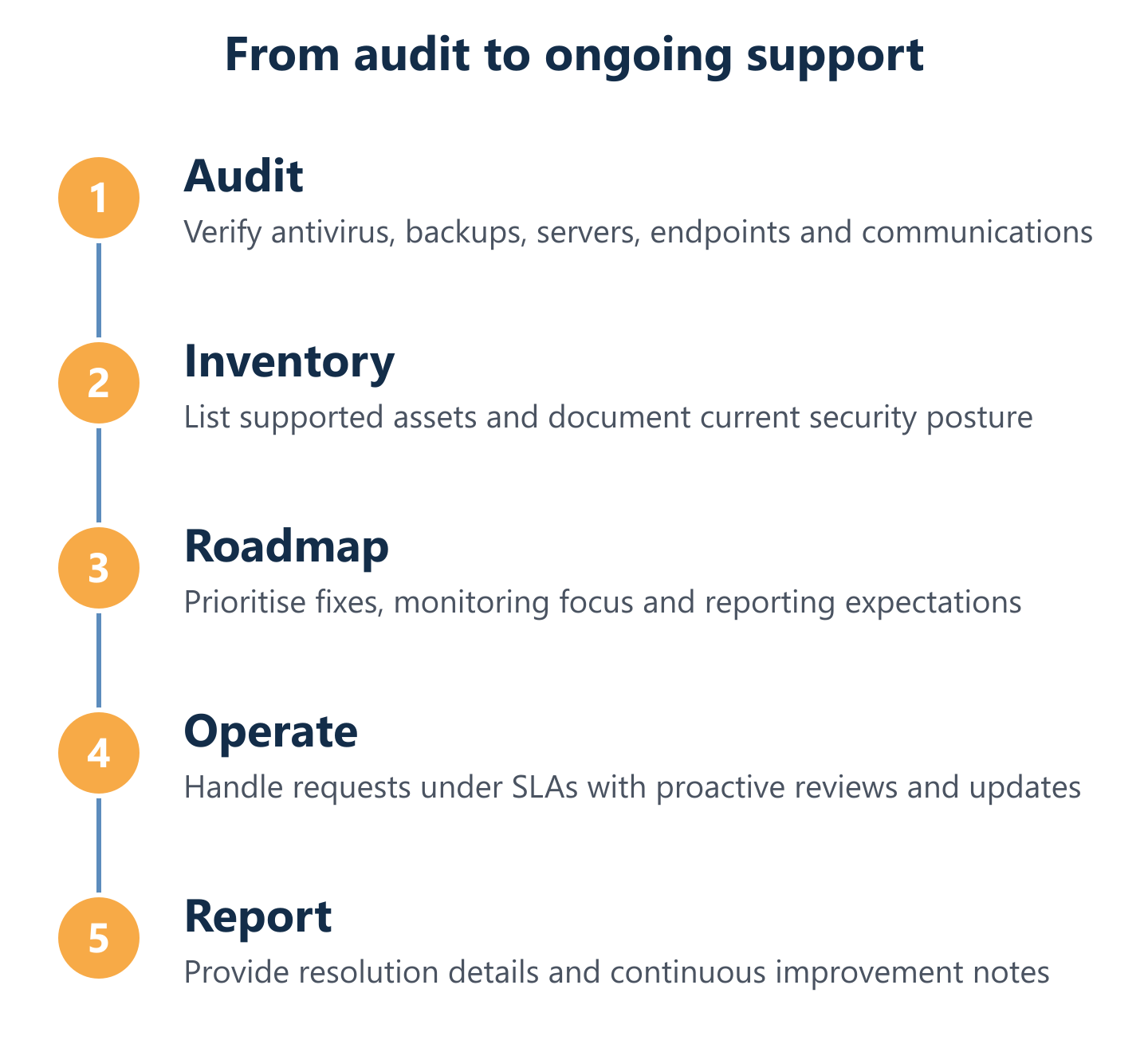
Impulso Tecnológico begins every IT maintenance engagement in Barcelona with an initial audit at no additional cost. This audit establishes a verified baseline across all systems to be supported, documents the current security posture and identifies the highest-priority risks. From that evidence, we build a structured action plan with clear priorities, agreed timelines and defined SLAs for ongoing support. The onboarding process follows a structured sequence:
- Initial contact and scoping: Define the assets to be covered, the business context and any known pain points before the audit begins.
- On-site or remote audit: Verify the status of antivirus, backups, desktops, servers, network and communications — documented systematically, not from memory.
- Inventory creation: Produce a complete asset register of all supported devices and systems, with current configuration and health status recorded.
- Risk and gap analysis: Identify security gaps, missing patches, backup failures and configuration risks, ranked by business impact.
- Action plan and roadmap: Agree what gets fixed immediately, what enters the preventive maintenance cycle and what requires a separate project.
- Operational handover: Set up communication channels, escalation paths and reporting cadence before the first support request is logged.
Day-one to audit completion: data collection and system status verification
The audit phase is not a sales exercise — it is a technical data-collection process that determines whether the maintenance contract will actually work. During the audit, Impulso Tecnológico verifies the status of every asset in scope: antivirus installation and definition currency, backup configuration and last successful completion, operating system patch levels, server hardware health indicators, network topology and active security policies, and email and internet access controls.
For businesses in Barcelona that have never had a structured IT maintenance contract, this audit frequently surfaces issues that were unknown to the internal team: backups that have been silently failing for months, endpoints running outdated operating system versions, or firewall rules that have not been reviewed since installation. Identifying these issues before the contract starts means they are addressed as planned improvements rather than emergency incidents — which protects both the business and the quality of the ongoing service.
Deliverables: inventory, risk notes, backup/security checks and next-step roadmap
The audit produces a set of concrete deliverables that become the operational foundation of the maintenance engagement. The asset inventory lists every supported device and system with its current configuration, software versions and health status — this is the reference document used for all future support requests and preventive checks. Risk notes document identified gaps in plain language, with a severity classification so the business can understand what needs immediate attention versus what can be scheduled.
Backup and security checks are reported explicitly: is backup running, when did it last complete successfully, where are copies stored, and does the current antivirus and firewall configuration meet the minimum standards for the environment? The next-step roadmap translates all of this into a prioritised action list, with agreed timelines and ownership. This document is reviewed at regular intervals as part of the ongoing maintenance reporting cycle, ensuring that the roadmap stays current as the environment evolves.
Operational handover: how requests, escalation and communication channels are set up
Before the first support request is logged, the operational structure of the engagement needs to be clearly defined. Impulso Tecnológico establishes the communication channels and escalation paths during the onboarding phase, not after the first incident. This includes defining how users submit requests (ticketing system, email or telephone), who the primary contact is on the client side, and what the escalation path looks like for urgent issues affecting the whole business.
Reporting cadence is agreed at this stage: clients receive detailed resolution reports for every corrective intervention, and periodic summaries of preventive maintenance activity. For businesses that want a dedicated point of contact, our IT Manager service provides a named individual who understands the environment and can provide ongoing advice — not just reactive ticket handling. This structure ensures that technical questions and emerging issues are handled in context, which is a material difference from anonymous helpdesk support. For a broader view of how we structure IT technical support for businesses, our dedicated resource covers the full service model.
SLAs, reporting and security: choosing a provider in Barcelona
Choosing an IT maintenance provider in Barcelona is a procurement decision with operational consequences that last years. The criteria that matter most are not the ones most prominently advertised — they are the ones that determine what actually happens when something goes wrong at 9 a.m. on a Monday.
Impulso Tecnológico differentiates on contractual clarity and security depth: defined SLAs with specific response times, written documentation of what is included, and a security scope that covers the full attack surface rather than just endpoint antivirus. Our maintenance contracts are structured around fixed monthly pricing per device with unlimited remote and on-site support for covered assets, so there are no unexpected costs when incident volume is higher than average.
When evaluating providers, these are the criteria that reduce uncertainty and protect the business:
- Written SLAs with specific response times: Ask for the exact response time commitment for standard requests and for urgent, business-wide incidents — and verify that these are contractually binding, not aspirational.
- Scope definition in writing: Confirm exactly which assets, systems and activities are included. Ambiguity in scope becomes a billing dispute when an incident occurs.
- Initial audit included: A provider that starts without an audit is maintaining assumptions, not systems. The audit is the baseline for everything that follows.
- Security coverage depth: Check whether firewall management, patch deployment, email filtering and backup verification are included — or whether each requires a separate engagement.
- Remote and on-site support availability: Confirm that the provider can attend on-site in Barcelona when remote resolution is not sufficient, and that this is included in the contract rather than billed separately.
- Reporting and transparency: Ask what documentation you receive after each corrective intervention and how preventive maintenance activity is reported.
- Technology partnerships: Providers with certified partnerships with vendors such as Sophos, Fortinet, Veeam, Microsoft, Cisco and Aruba can implement and support these environments correctly — not just install them.
For a detailed breakdown of how maintenance contract pricing is structured, our guide on IT maintenance pricing covers the key variables and what to expect at each service tier.
SLAs and written warranty: what to ask before signing
Service Level Agreements are the contractual mechanism that converts a provider's verbal commitments into enforceable obligations. Before signing any IT maintenance contract in Barcelona, request the SLA document and verify three specific elements: the response time for standard requests, the response time for urgent issues with business-wide impact, and the escalation process when SLAs are not met.
At Impulso Tecnológico, our SLAs define response under 8 working hours for most requests and under 4 working hours for urgent incidents affecting the whole business or involving servers. These are written commitments, not estimates. A written warranty that documents what the service includes — and what remedies apply if it is not delivered — is a basic requirement for any professional IT maintenance engagement. If a provider cannot or will not provide this in writing, that is a material risk indicator before the contract begins.
Backups, disaster recovery posture and continuity controls
Backup failure is one of the most common and most damaging gaps in SME IT environments — and it is almost always silent until a recovery is actually needed. A professional IT maintenance contract should include backup configuration, scheduled integrity testing and documented recovery procedures as standard, not as optional add-ons.
Impulso Tecnológico includes backup systems within the maintenance scope, using Veeam for server and workload protection where appropriate. Disaster recovery posture is reviewed during the initial audit and maintained as part of the preventive cycle: backup jobs are verified, retention policies are checked and recovery time objectives are documented. Business continuity controls — including secure remote access for staff and failover procedures for critical systems — are implemented as part of the multi-layer security strategy we apply to every environment. This means that when a failure does occur, recovery is a planned process rather than an improvised one.
Remote vs on-site support: how to balance speed, coverage and cost
The majority of IT incidents — software faults, configuration errors, user access issues, application problems — can be resolved remotely in less time than an on-site visit would take to arrange. Remote support is faster for these cases and is included without additional cost in Impulso Tecnológico's all-inclusive maintenance plans. However, hardware failures, network cabling issues, physical security installations and complex server interventions require on-site presence, and a maintenance contract that only offers remote support leaves a real gap for Barcelona businesses.
Impulso Tecnológico provides both remote and on-site support in Barcelona, with on-site visits included in the contract for covered assets rather than billed as separate call-out fees. The balance between remote and on-site is determined by the nature of the incident, not by cost optimisation on the provider's side. For businesses comparing IT support options in Barcelona, this distinction — whether on-site is included or extra — is one of the most important practical differences between providers.
When IT maintenance is proactive, security-focused and backed by contractual clarity, it stops being a cost centre and becomes a dependable operational foundation. The difference between a business that loses half a day to an avoidable incident and one that resolves it in under four hours is almost always the quality of the maintenance structure behind it. If your current IT support relies on reactive calls and verbal commitments, it is worth reviewing what a structured maintenance engagement in Barcelona would actually cost — and what it would protect.