
IT maintenance in Arganda del Rey means scheduled, proactive care of your computers, servers, network and security systems — not waiting for something to break. A structured maintenance agreement covers routine health checks, patch management, backup verification and defined response times, so your team stays productive and your data stays protected.
Many businesses in Arganda del Rey and the wider Madrid Corredor del Henares area still operate on a break/fix basis: they call a technician when something stops working. That model has a hidden cost. Every hour of unplanned downtime affects productivity, and recurring incidents — a server that crashes repeatedly, endpoints running outdated software, backups that have never been tested — signal a maintenance gap rather than bad luck. Impulso Tecnológico has spent more than 25 years helping Spanish and international companies close that gap. Our IT maintenance service starts with a complete audit of your environment, establishes a clear scope of devices and systems, and then runs as a predictable monthly service with measurable outcomes. The result: fewer interruptions, faster recovery when incidents do occur, and a security posture that meets current standards.
What IT Maintenance means for Arganda del Rey businesses
For a company operating in Arganda del Rey — whether in logistics, manufacturing, professional services or any other sector — IT maintenance is not a single event. It is a continuous cycle of monitoring, updating, verifying and documenting that keeps systems available when employees need them. The distinction that matters most commercially is between a reactive model (you call when something breaks) and a proactive managed model (your provider monitors, patches and checks before problems escalate).
Impulso Tecnológico positions IT maintenance as either a full external IT department or a structured complement to an existing internal team. Either way, the engagement starts with a real audit of the environment — antivirus status, backup integrity, server health, network configuration — and then moves into a defined service cycle with agreed SLAs, unlimited remote support through our maintenance platform, and scheduled on-site visits.
| Criterion | Break/Fix (Reactive) | Managed IT Maintenance (Proactive) |
|---|---|---|
| Cost model | Variable; unpredictable invoices | Fixed monthly fee; controlled budget |
| Response trigger | User reports a failure | Monitoring alert or scheduled check |
| Patch management | Ad hoc or absent | Scheduled, documented, verified |
| Backup status | Rarely tested | Verified on a defined cadence |
| Reporting | None or invoice only | Monthly report: incidents, patches, risks |
| Security posture | Reactive to breaches | Continuous endpoint and network protection |
Break/fix vs managed IT maintenance: what changes
Break/fix solves the incident in front of you. Managed IT maintenance solves the conditions that caused it — and prevents the next three. When a server fails under a break/fix arrangement, the technician arrives, repairs the fault and leaves. Under a maintenance contract, that same server has been monitored for weeks: disk health trends, event log warnings and memory pressure are all reviewed before they become outages. Patch management is scheduled rather than skipped. Antivirus definitions are current. The difference in outcome is measurable: repeat incidents drop, and when something does fail, the recovery path is already documented. For businesses in Arganda del Rey that cannot afford prolonged downtime, this shift from reactive to proactive IT managed services is the single most impactful operational change available.
Service scope: devices, servers, network, security and backups
A maintenance agreement defines exactly what is covered, removing ambiguity when an incident occurs. At Impulso Tecnológico, scope typically includes workstations and laptops, physical and virtual servers, network infrastructure (switches, routers, wireless access points), security appliances, and backup systems. Each device category carries its own check frequency and response time. Servers, for example, attract a faster on-site response commitment than standard endpoints because their failure affects multiple users simultaneously. Security and backup coverage is not optional: antivirus and EDR configuration, firewall rules and backup integrity checks are built into the maintenance cycle, not treated as add-ons. This defined scope means clients always know what is being maintained, at what frequency, and to what standard — before they sign anything.
Service levels (SLA) and escalation expectations
SLAs translate maintenance commitments into measurable numbers. Impulso Tecnológico structures response times by incident severity: server-level issues receive an on-site response within four business hours of the fault being registered; other endpoint issues are attended within eight business hours. Remote support is available without a call limit during contracted hours, which means minor issues — a user locked out, a configuration error, a software conflict — are resolved the same day without consuming a separate support budget. Escalation paths are agreed at onboarding: who to contact, how to log an incident, and what happens if the first-line response does not resolve the issue. This structure gives IT managers and business owners a clear framework for planning, not a vague promise of "fast response".

Preventive maintenance checklist and security upkeep
Preventive IT maintenance is not a single task — it is a repeating sequence of checks that, taken together, keep infrastructure stable and secure. Every engagement at Impulso Tecnológico begins with a complete environment audit before any ongoing work starts. This establishes a baseline: what is installed, what version, what state. From that baseline, a maintenance schedule is built using tools and partners including Microsoft, Fortinet, Sophos and Veeam, depending on the client's existing stack.
- Initial audit: Document all devices, operating system versions, antivirus status, backup configuration and network topology.
- Endpoint health checks: Review storage capacity, CPU and memory baselines, event logs and hardware diagnostics on a defined cadence.
- Patch management cycle: Apply OS and application updates on a tested, scheduled basis — not ad hoc — to reduce vulnerability windows.
- Security configuration review: Verify antivirus/EDR policies, firewall rules, access controls and email security settings.
- Backup verification: Confirm that backup jobs completed successfully and test restore procedures to validate recoverability.
- Network and communications check: Review switch, router and wireless performance; identify bottlenecks or misconfigurations before they cause outages.
- Reporting: Deliver a structured report covering what was checked, what was found and what action was taken or recommended.
Preventive checklist for PCs, servers and network gear
Endpoint and server health checks are the foundation of computer maintenance for companies. For workstations, the checklist covers available storage, RAM usage trends, pending OS updates, antivirus definition currency and hardware error logs. For servers — whether physical or virtual — the scope expands to include RAID or storage pool health, event viewer warnings, backup job status, service availability and capacity headroom. Network gear (managed switches, routers, firewalls and wireless controllers) is reviewed for firmware currency, unusual traffic patterns and configuration drift. These checks are not performed once at onboarding; they repeat on a defined schedule — monthly at minimum for most environments — so that degradation trends are caught early rather than discovered during a failure. Impulso Tecnológico records findings against the original audit baseline, making it straightforward to spot when a device is approaching end-of-life or when a configuration has changed unexpectedly.
Monitoring, patching and vulnerability risk reduction
Patch management is one of the most consistently neglected areas in SME IT environments, and one of the most exploited by attackers. Unpatched operating systems and applications account for a significant proportion of successful ransomware and data breach incidents. Within an IT maintenance contract, patch management is scheduled, tested and documented: OS updates are applied during agreed maintenance windows to avoid disrupting business hours; application updates are reviewed before deployment; and antivirus or EDR policies (using platforms such as Sophos or Fortinet, depending on the environment) are kept current and verified against the manufacturer's recommended configuration. IT monitoring and reporting tools flag when a device falls out of compliance — for example, a laptop that missed a patch cycle because it was offline — so nothing is left unprotected by default. This continuous cycle is what separates genuine preventive IT maintenance from a one-off repair visit.
Backup verification and disaster recovery readiness
A backup that has never been tested is not a backup — it is an assumption. Backup and disaster recovery readiness is a core pillar of any serious IT maintenance programme, yet it is routinely absent from break/fix or repair-focused arrangements. Within Impulso Tecnológico's maintenance scope, backup verification means confirming that jobs completed without error, that retention rules are correctly configured, and — critically — that restore tests are performed on a defined schedule to validate that data can actually be recovered. We work with Veeam for server and virtualisation environments, and with Microsoft 365 backup solutions for cloud data. Recovery time and recovery point objectives (RTO/RPO) are agreed at the plan design stage, so clients know in advance how quickly they can be back online after an incident. This planning removes the worst-case scenario: discovering that backups were silently failing only after a ransomware attack or hardware loss.
Maintenance plans, reporting and how to start
Choosing the right maintenance structure depends on three variables: the number and type of devices in scope, the response times the business genuinely needs, and whether an internal IT resource already exists. Impulso Tecnológico offers flexible plan structures — from hourly packages for lighter needs to flat-rate plans with unlimited remote and on-site support — so clients pay for what they actually require rather than an oversized retainer.
- Defined scope from day one: Every plan starts with the device and systems inventory from the initial audit, so nothing is ambiguous about what is covered.
- Unlimited remote support: Contracted clients access remote assistance through our maintenance platform without counting hours for routine queries and minor incidents.
- On-site response within agreed SLA windows: Server issues within four business hours; other endpoints within eight business hours — committed in writing.
- Monthly reporting: Each reporting cycle covers incidents resolved, patches applied, backup status and any risks identified — giving IT managers and business owners a clear picture of their environment.
- No surprises on cost: Flat-rate and monthly-hour structures mean the invoice is predictable; scope changes are agreed in advance, not invoiced retrospectively.
- Scalable as the business grows: Plans are adjusted when device counts change, new sites are added or the required service level increases.
Impulso Tecnológico's client satisfaction record reflects this structured approach: consistent, measurable service delivery rather than ad hoc interventions. For businesses in Arganda del Rey looking to move from reactive IT to a managed maintenance model, the starting point is a conversation about device count, current pain points and required response times.
Plan tiers: frequency, scope and decision criteria
Impulso Tecnológico structures maintenance plans around three primary models. An hourly package suits organisations with a small device count or an existing internal IT team that needs specialist support for specific tasks — patch cycles, server reviews or security audits. A monthly hour-rate plan provides a fixed block of remote and on-site hours each month, with rollover rules agreed in the contract; this works well for growing SMEs with predictable but moderate support demand. A flat-rate plan covers unlimited remote support and scheduled on-site visits within the SLA windows, making it the right choice for businesses where downtime has a direct revenue impact and cost predictability is a priority. The decision between tiers comes down to device count, criticality of systems and the client's tolerance for variability in monthly IT spend. Impulso Tecnológico's initial audit provides the data needed to recommend the appropriate tier objectively.
Remote support plus on-site response in Arganda del Rey
Arganda del Rey's location — within the Madrid Corredor del Henares industrial and logistics corridor — means that on-site response is practical and fast. Impulso Tecnológico combines remote monitoring and support as the first line of resolution (most software, configuration and connectivity issues are resolved remotely without any delay waiting for a technician) with committed on-site attendance for hardware faults, complex network issues or situations where physical access is required. Under a maintenance contract, remote support is not billed per incident; it is part of the service. This matters because it removes the hesitation employees sometimes feel about logging a ticket for a "small" problem — and small problems, left unresolved, frequently become large ones. For clients with multiple sites or remote workers, Impulso Tecnológico's IT managed services extend the same support model beyond the Arganda del Rey office, including remote assistance across Spain, Portugal and internationally.
Reporting cadence and onboarding to go live
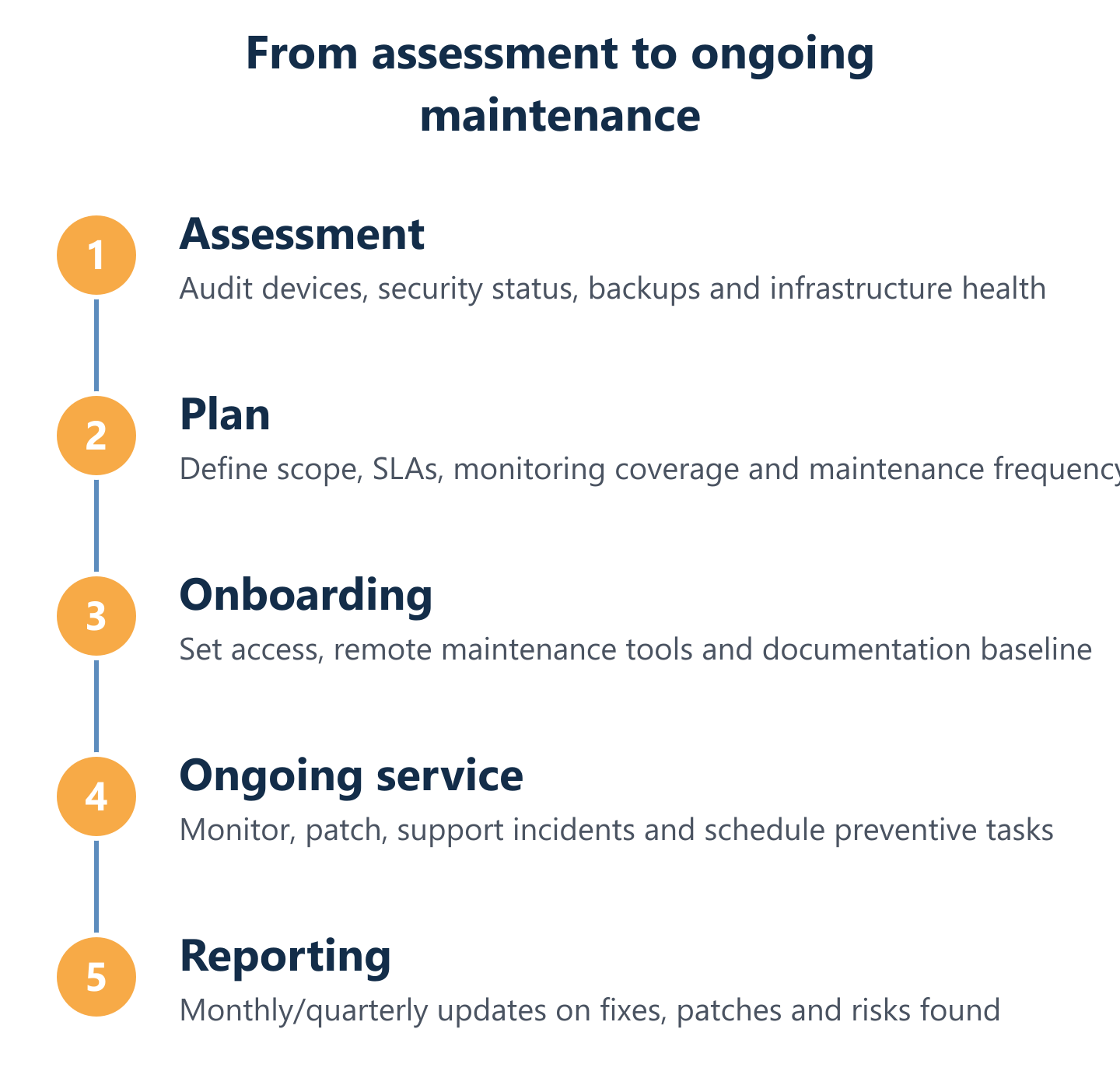
Onboarding to a managed IT maintenance contract follows a clear sequence that gets clients to a fully operational service quickly. First, Impulso Tecnológico conducts the initial audit: device inventory, antivirus and backup status, server and network health, and access credentials. This typically takes one structured session on-site plus remote review time. Second, the maintenance plan is defined: scope, SLA tiers, reporting frequency and escalation contacts are documented and agreed. Third, remote monitoring and management tools are deployed across in-scope devices. Fourth, the first maintenance cycle begins — patches, health checks and backup verification — with findings recorded against the audit baseline. Reporting is delivered monthly: a structured document covering what was checked, what was resolved, what patches were applied and what risks or recommendations were identified. This cadence gives clients continuous visibility without requiring them to ask. For a reference on how this approach applies across different locations, see our articles on preventive IT maintenance for businesses and IT maintenance and security for companies.
Fewer interruptions and stronger security do not happen by accident — they are the result of a maintenance structure that is correctly scoped, consistently executed and transparently reported. If your business in Arganda del Rey is currently operating without a defined maintenance agreement, or if your existing arrangement lacks monitoring, patch management or verified backups, the practical next step is to assess your current device count and response-time requirements. Impulso Tecnológico can then recommend the plan tier that fits your environment and budget, with no obligation and no generic proposal. Contact us to arrange an initial audit and get a clear picture of where your IT infrastructure stands today. You can also explore how we deliver the same structured approach in other locations, including our IT maintenance service in Tres Cantos and IT support in Las Rozas de Madrid.