

An IT audit checklist is a structured set of controls, checks, and evidence requirements used to verify that an organisation's IT environment is secure, compliant, and operating as intended. It covers system security, access controls, backup recoverability, incident response procedures, documentation standards, and performance monitoring—providing a repeatable framework for identifying gaps and driving improvement.
Without a well-structured checklist, IT audits tend to produce inconsistent results: some areas are examined in depth while others are overlooked entirely, and findings lack the evidence needed to justify remediation investment. The root cause is usually the same—audit scope is defined too loosely, check criteria are vague, and ownership of findings is never assigned.
A practical IT audit checklist solves this by translating broad control objectives into specific, testable items with defined evidence requirements and clear pass/fail criteria. At Impulso Tecnológico, with over 25 years of experience as an IT consultancy and Managed Services Provider operating across Spain, Portugal, and internationally, we approach checklist items as operational realities rather than theoretical boxes to tick. The result is an audit that produces actionable findings, measurable risk reduction, and a remediation plan that leadership can actually execute.
What an IT Audit Checklist Covers (and what "good" looks like)
A checklist that simply lists control categories without defining what evidence constitutes a pass is not an audit tool—it is a reading list. Good IT audit checklists share four characteristics: they define scope explicitly (which systems, users, locations, and vendors are in scope), they state the control intent for each item, they specify the evidence required to verify the control, and they assign a severity level to each gap found.
At Impulso Tecnológico, we translate audit items into operational checks that reflect how services are actually delivered. Verifying that monitoring is active, that preventive maintenance schedules are followed, that backups are automatic and recoverable, and that access controls are correctly configured are not abstract requirements—they are daily service responsibilities we manage for clients across multiple sectors including industry, logistics, education, and healthcare.
| Checklist quality criterion | Weak example | Strong example |
|---|---|---|
| Scope definition | "Review IT systems" | "All servers, endpoints, and network devices in HQ and remote sites listed in asset register v2.4" |
| Control intent | "Check backups" | "Verify that automated backups run daily, are stored off-site, and have been successfully restored within the last 90 days" |
| Evidence requirement | "Confirm with IT team" | "Backup job logs from the last 30 days + documented restore test report" |
| Severity assignment | Not assigned | Critical / High / Medium / Low based on business impact and likelihood |
| Ownership | Not assigned | Named remediation owner and target resolution date per finding |
Core outcomes: assurance, risk reduction, and operational improvement
An IT audit produces three distinct types of value. First, assurance: stakeholders—including board members, insurers, and regulators—receive documented evidence that controls are operating as designed. Second, risk reduction: gaps identified during the audit become the basis for a prioritised remediation plan, reducing the probability and impact of incidents. Third, operational improvement: audit findings often surface inefficiencies in change management, access provisioning, or incident response procedures that, once addressed, reduce ticket volumes and support costs.
Defining these outcomes before the audit begins determines what the checklist needs to cover. An assurance-focused audit requires stronger documentation and traceability. A risk-reduction audit requires controls and risk assessment criteria aligned to threat scenarios. An operational audit requires performance data and service-level evidence. Most mature IT audits pursue all three simultaneously.
Quality criteria: clarity, coverage, evidence requirements, and traceability
Every item on an IT audit checklist should pass a four-point quality test before the audit begins. Clarity: can an auditor who did not write the check interpret it consistently? Coverage: does the checklist address all in-scope control domains without leaving material gaps? Evidence requirements: is it explicit what documentation, log, or configuration record constitutes a satisfactory answer? Traceability: can each finding be traced back to a specific checklist item, a control objective, and a risk?
When these criteria are met, IT audit evidence collected during fieldwork maps directly to findings, and findings map directly to remediation actions. This traceability is what allows management to prioritise investment and track closure. Without it, audit reports become lengthy narratives that are difficult to act on and even harder to use in subsequent audit cycles as a baseline.
Common pitfalls: vague checks, missing evidence, and unclear ownership
Three failure patterns appear repeatedly in IT audits that do not produce actionable results. The first is vague check criteria: items such as "confirm security policies are in place" without specifying which policies, which version, and which systems they apply to. The second is missing evidence: the audit team accepts verbal confirmation instead of requesting logs, configuration exports, or signed policy acknowledgements—leaving findings unsubstantiated and contestable. The third is unclear ownership: findings are reported at a team or department level rather than assigned to a named individual with a resolution deadline.
Outputs from a well-run audit should include a findings register with severity, a named remediation owner per item, a target date, and a verification method for closure. Impulso Tecnológico's managed services model supports this by maintaining documented records of maintenance tasks, monitoring alerts, and support tickets—providing ready-made IT audit evidence for clients who need to demonstrate operational controls.

The IT Audit Checklist: Five Core Areas
A comprehensive IT audit checklist is organised around five control domains. Each domain contains specific subchecks with defined evidence requirements. The structure below reflects the areas most commonly examined in both internal and third-party IT audits, and aligns with the control frameworks used by organisations operating under GDPR, ISO 27001, and sector-specific compliance requirements.
Impulso Tecnológico supports organisations across Spain and Portugal with managed services and security tooling—including monitoring, structured preventive maintenance, and backup services built on Veeam, Sophos, and Fortinet—so checklist items in each of these five domains can be validated using the same toolsets operated day to day. This closes the gap between what the checklist says should exist and what is actually configured and running.
- System Security — access controls, MFA, endpoint protection, patch management, and network safeguards.
- Standards and Procedures — change management records, incident response procedures, and acceptable use policies.
- Documentation and Reporting — asset registers, audit trails, configuration baselines, and management reporting.
- Performance Monitoring — monitoring coverage, alert thresholds, SLA compliance records, and backup recoverability testing results.
- Systems Development — secure SDLC practices, code review records, test environment controls, and deployment authorisation logs.
Each area is examined in the subsections below with specific subchecks and evidence sources.
System security checks: access control, MFA, endpoint hardening, and network protection
System security is the highest-priority domain in most IT audits because failures here directly enable breaches. An access control review should verify that user accounts are provisioned through a documented process, that privileged accounts are separate from standard accounts, and that inactive accounts are disabled within a defined timeframe (typically 30 days of inactivity). Multi-factor authentication should be enforced for all remote access, administrative consoles, and cloud services—not just email.
Endpoint hardening checks confirm that devices are enrolled in management tooling, that operating systems and third-party applications are patched within the organisation's defined window, and that endpoint protection is active and reporting. Network protection checks cover firewall rule reviews, network segmentation between critical and general-use systems, and wireless network isolation. At Impulso Tecnológico, we implement and manage these controls using Sophos, Fortinet, Cisco, and Aruba technologies—meaning the same configurations we deploy are also the ones we can validate during an audit cycle, reducing the risk of undocumented exceptions.
Standards, procedures, and documentation: policies, change records, incident logs, and reporting
Policies that exist only as documents in a shared drive do not constitute an operating control. The standards and procedures domain verifies that policies are current (reviewed within the last 12 months), distributed to relevant staff, and acknowledged in writing. Change management records should show that all significant changes to production systems were approved, tested, and rolled back if unsuccessful—with a named authoriser for each change.
Incident response procedures should be documented, tested at least annually, and include escalation paths, communication templates, and defined recovery time objectives. Acceptable use policies should cover personal device use, cloud storage, and data handling. Audit evidence for this domain includes policy version histories, change request logs, incident registers, and training completion records. Organisations that lack formal incident response procedures are consistently among those most affected when incidents escalate—a pattern Impulso Tecnológico observes across the sectors it serves.
Performance monitoring and systems development: monitoring coverage, backup testing, and secure SDLC
Monitoring coverage checks confirm that all critical systems generate alerts when thresholds are breached and that those alerts reach a responsible person within a defined response window. A common gap is monitoring that is configured but not actively reviewed—alerts accumulate without triggering action. Backup recoverability testing is distinct from backup completion: the checklist item is not whether backups run, but whether a restore has been successfully completed and documented within the last quarter.
For organisations with in-house development, the systems development domain covers whether code is reviewed before deployment, whether test environments are isolated from production, and whether deployment requires documented authorisation. For organisations using third-party software, it covers patch and update management for those applications. Impulso Tecnológico's managed services model includes proactive monitoring and maintenance tasks—so clients can point to monitoring logs and maintenance records as direct IT audit evidence for the performance monitoring domain. For further detail on how security controls connect to audit outcomes, our article on IT security for businesses covers the operational layer in depth.
Evidence, Process, and Prioritisation for Findings
Collecting the right evidence, following a repeatable audit cycle, and converting findings into a prioritised remediation plan are what separate an IT audit that produces change from one that produces a report that sits unread. The evidence layer is where most audit programmes underinvest: auditors accept policy documents as proof of operating controls without verifying that the controls are actually functioning.
Impulso Tecnológico's service-integral approach directly supports this layer. Because we centralise IT services with SLA-based managed services—covering monitoring, preventive maintenance, backup, and security—clients have access to structured operational records that serve as ready-made audit evidence. This reduces the gap between "what the checklist says should be in place" and "what is actually being managed and documented." Our work with technologies such as Veeam for backup, Sophos and Fortinet for security, and Microsoft 365 and Azure for cloud means the toolsets generating evidence are the same ones we operate daily.
Key principles for evidence, process, and prioritisation:
- Collect evidence before interviews—logs and configurations reveal the actual state; interviews reveal the intended state.
- Document the source, date, and version of every piece of evidence collected.
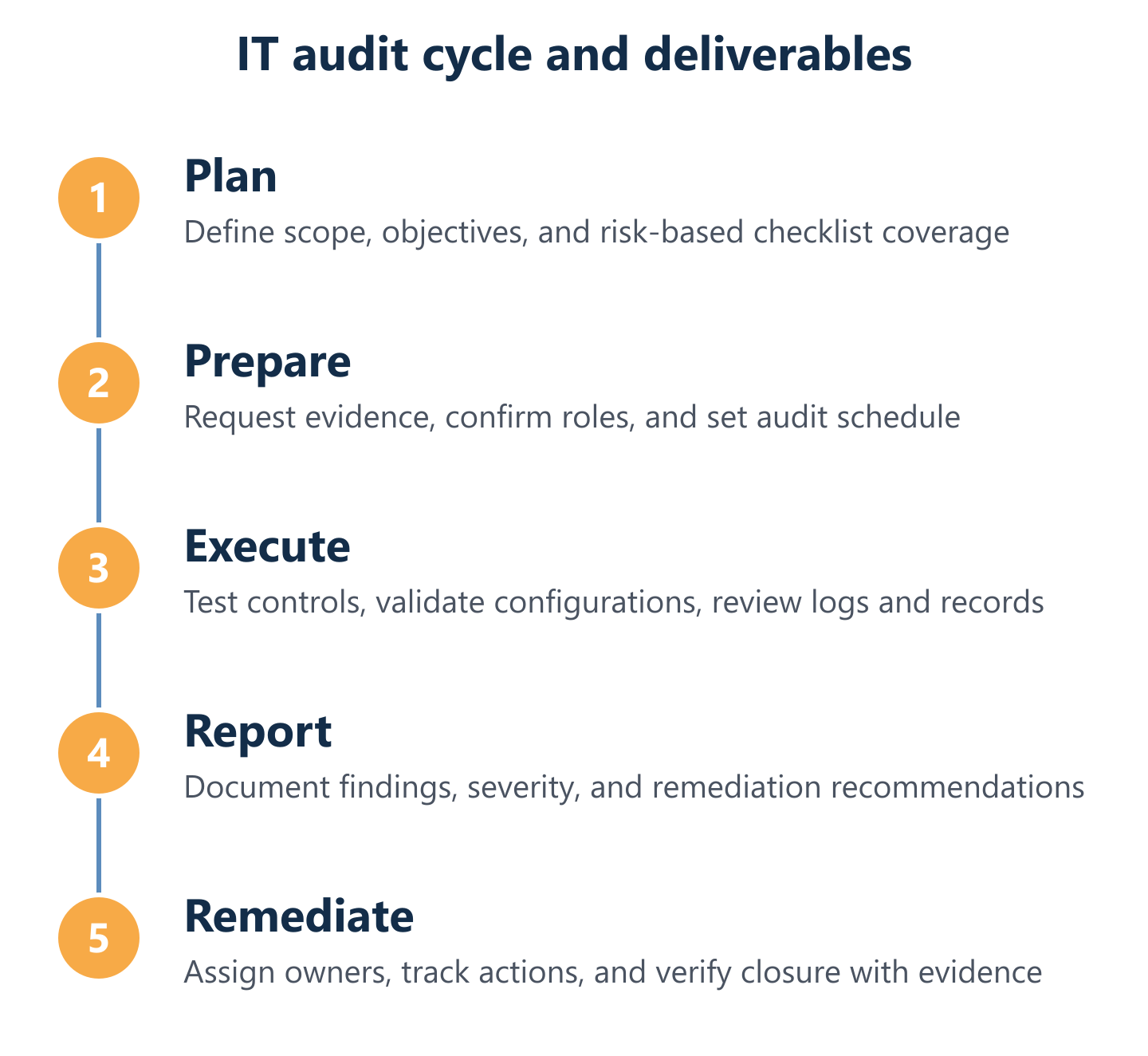
- Run the audit in a defined cycle: plan, prepare, execute, report, and remediate—with named owners at each stage.
- Prioritise findings using a risk matrix that combines likelihood and business impact, not just technical severity.
- Assign a named remediation owner and a target date to every finding before the audit report is issued.
- Schedule a follow-up review to verify that critical and high findings have been closed within the agreed timeframe.
Evidence to collect for each checklist item: what to request and where to find it
For system security items, request: user account lists with last login dates, MFA enrolment reports, endpoint management console exports showing patch status, and firewall rule exports. For standards and procedures items, request: policy documents with version dates, change request logs for the last six months, incident registers, and training completion records. For documentation and reporting items, request: the current asset register, configuration baselines, and management reporting samples.
For performance monitoring items, request: monitoring alert logs for the last 30 days, backup job completion reports, and a documented restore test result. For systems development items, request: code review records, deployment authorisation logs, and test environment access controls. The guiding principle is that IT audit evidence should be primary—exported directly from systems—rather than secondary summaries prepared by the team being audited. Where primary evidence is unavailable, that absence is itself a finding.
IT audit process in practice: deliverables, roles, and review checkpoints
A repeatable IT audit follows five stages, each with defined deliverables and responsible parties. In the planning stage, the audit lead defines scope, objectives, and the checklist version to be used, producing a signed audit plan. In the preparation stage, the team requests evidence lists from system owners and schedules interviews, producing an evidence tracker. In the execution stage, auditors test each checklist item against collected evidence, producing a working-paper file with findings and supporting evidence references.
In the reporting stage, findings are consolidated into a draft report with severity ratings, remediation recommendations, and named owners—reviewed with management before finalisation. In the remediation stage, owners implement fixes and the audit lead verifies closure, producing a findings closure register. For organisations working with Impulso Tecnológico, our managed services documentation—including ticket records, monitoring logs, and maintenance reports—feeds directly into the execution stage, reducing fieldwork time and improving evidence quality. See also our guide to IT systems audit for a deeper look at the audit lifecycle.
Common gaps and how to prioritise findings into remediation actions
The most frequently identified gaps in IT audits fall into three clusters. The first is access management: stale accounts, shared credentials, and absence of MFA on critical systems. The second is backup and recovery: backups that run but have never been tested for recoverability, or recovery time objectives that have never been documented. The third is documentation: policies that are outdated, change records that are incomplete, and incident logs that do not capture root cause or resolution.
Prioritisation should use a two-axis risk matrix: likelihood of exploitation or failure, and business impact if it occurs. Critical findings—those with high likelihood and high impact—require remediation within 30 days and a named executive owner. High findings require remediation within 90 days. Medium and low findings enter the standard improvement backlog. An IT audit remediation plan that does not include named owners, deadlines, and a verification method is not a plan—it is a list. For organisations building or strengthening their security posture, our resource on IT Security Plan provides a complementary framework for translating audit findings into sustained controls.
An IT audit checklist delivers lasting value only when it is treated as a living operational tool rather than a one-off compliance exercise. As your IT environment changes—new cloud services are adopted, staff join or leave, vendors are added—the checklist must be updated to reflect the current scope and risk profile. Schedule a full review of the checklist at least annually, and trigger an interim review whenever a significant change occurs. Impulso Tecnológico supports clients in maintaining this continuous audit readiness through managed services, proactive monitoring, and structured documentation—so that when the next audit cycle begins, the evidence is already there.