

To choose an IT support company, start by matching the support model to your operational risk, then evaluate providers against measurable KPIs, transparent pricing, layered security practices, and clear contract exit terms. The right partner acts as an extension of your team, not a reactive fix-it service.
Most businesses approach this decision backwards—they compare prices first and discover mismatched expectations only after signing. The real cost of a poor IT support choice is not the monthly invoice; it is the downtime, the unresolved recurring issues, and the security gaps that compound quietly over months. Whether you are moving away from an unreliable provider or selecting IT support for the first time, the framework matters more than the shortlist. This guide walks through eight practical criteria—from support model selection and help desk KPIs to SLA guarantees, security compliance, and contract exit terms—so you can evaluate any provider with the same rigour you would apply to any critical business supplier. Providers such as Impulso Tecnológico, with over 25 years of managed IT services experience across Spain and international remote coverage, demonstrate that the strongest differentiator is rarely technology alone—it is the combination of proactive maintenance, measurable service performance, and genuine accountability.
Start with the right support model (break-fix, managed, TaaS)
Before comparing providers, decide which support model aligns with how your business actually operates. The model determines incentives, cost predictability, and who owns the responsibility for keeping your systems stable. Choosing the wrong model—even with an excellent provider—creates structural friction from day one.
The three dominant models each carry distinct trade-offs:
| Criterion | Break-Fix (Time & Materials) | Managed IT Services | Technology as a Service (TaaS) |
|---|---|---|---|
| Cost structure | Variable; pay per incident or hour | Fixed monthly fee per device or user | Bundled monthly fee (hardware + software + support) |
| Provider incentive | More incidents = more revenue | Fewer incidents = lower cost to serve | Aligned with uptime; hardware refresh included |
| Proactive maintenance | Rarely included | Core deliverable | Included, but scope varies by contract |
| Budget predictability | Low | High | High, but long-term cost can exceed alternatives |
| Hardware ownership | Client | Client | Provider (leased or as-a-service) |
| Best fit | Very low IT dependency, minimal risk | SMEs needing reliable day-to-day operations | Organisations prioritising refresh cycles over ownership |
Impulso Tecnológico operates as a managed IT services provider, functioning as an external IT department rather than a reactive vendor. This means preventive maintenance, supplier management, and structured project delivery are built into the engagement—not billed separately when something breaks. For organisations across Spain, Portugal, or those requiring remote coverage in Europe, Asia, and America, this model delivers the operational consistency that break-fix simply cannot guarantee.
Break-fix vs managed vs TaaS: what changes in practice
Break-fix is reactive by design: you pay for hours worked, which means a provider has no financial incentive to stabilise your environment or invest time in monitoring and prevention. When a server fails at 16:45 on a Friday, the clock starts ticking—and so does the invoice. Managed IT services invert this logic entirely. The provider absorbs the cost of incidents, so their interest lies in preventing them through routine patching, monitoring, and maintenance. TaaS adds hardware and software to the bundle, which simplifies procurement and guarantees refresh cycles, but the fine print on third-party software licensing and long-term total cost of ownership deserves careful scrutiny before committing. Understanding these incentive structures is the single most important step before evaluating any specific provider.
Decision criteria: predictability, coverage, and internal IT capacity
Three questions clarify which model fits your organisation. First, how much cost variability can your finance team absorb? If unpredictable IT invoices cause planning problems, managed IT services with fixed monthly pricing per device—as offered by Impulso Tecnológico—eliminates that uncertainty and includes both remote and on-site technical assistance within a defined scope. Second, do you have any internal IT staff? If not, a managed provider effectively becomes your IT department, covering everything from routine maintenance to system migrations and network management. Third, how critical is system availability to daily revenue? Higher dependency on uptime justifies the proactive monitoring and preventive maintenance that only managed and TaaS models structurally deliver. Answering these three questions honestly narrows the model choice before a single provider conversation begins.
Pros and cons comparison to avoid mismatched expectations
Every model has legitimate use cases, and the risk is not choosing the wrong model in theory—it is signing a contract without understanding the practical implications. Break-fix suits organisations with very low IT dependency and occasional, isolated issues; it becomes expensive and unreliable the moment systems grow more complex. Managed IT services deliver predictable costs and proactive ownership, but require a provider with genuine depth across maintenance, security, and project delivery—not just a help desk that logs tickets. TaaS bundles hardware refresh into the monthly fee, which appeals to organisations that want to avoid capital expenditure cycles, but the total cost over a five-year term frequently exceeds ownership models, and third-party software licensing terms can introduce unexpected constraints. Read the fine print on software entitlements, exit clauses, and what happens to your data and devices if the relationship ends.

Define outcomes first: KPIs, customer experience and resolution
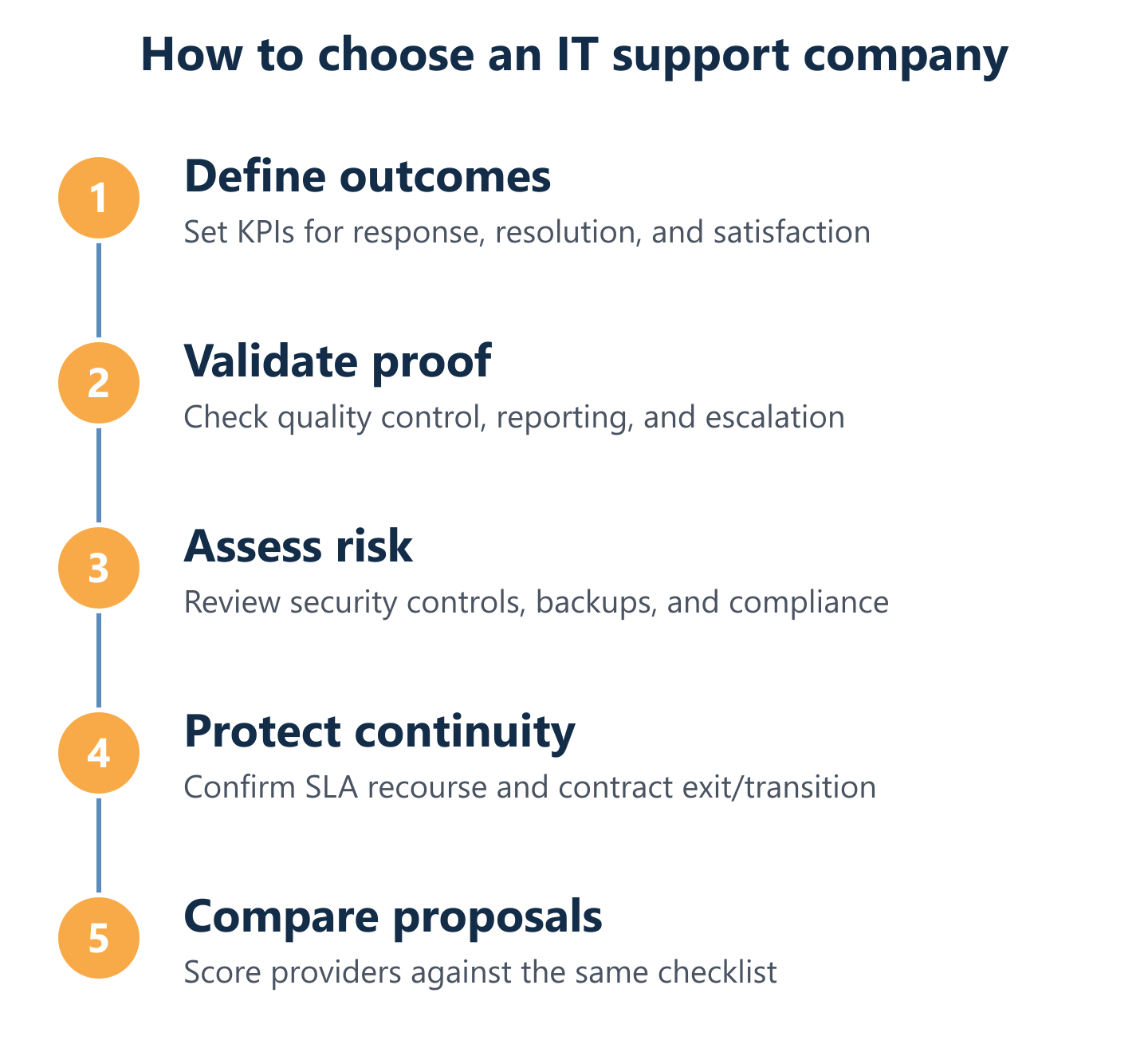
Vague promises about "fast response" and "dedicated support" are not contractual commitments. Before signing with any provider, translate their service claims into specific, measurable KPIs that appear in the contract or service schedule. Providers who resist this conversation are signalling something important.
Impulso Tecnológico publishes service performance indicators—including over 4,000 IT tickets resolved annually—and client feedback consistently highlights quick, efficient, and personalised problem-solving with clear communication. That level of transparency is what you should expect from any shortlisted provider.
- Define your baseline: Document current incident volumes, average resolution times, and recurring problem categories before approaching any provider.
- Request specific KPI commitments: Ask for first call resolution rate, average speed of answer, and customer satisfaction score targets—in writing, not in a sales deck.
- Establish reporting cadence: Agree on monthly or quarterly service reviews where KPI performance is presented alongside trend analysis and improvement actions.
- Require a continuous improvement programme: A credible provider should be able to describe how they identify recurring issues, conduct root-cause analysis, and implement fixes—not just log and close tickets.
- Validate with references: Ask for clients in a similar sector or size band and ask them specifically about communication quality, escalation handling, and whether the provider meets its stated targets consistently.
Help desk KPIs to request in writing (ASA, FCR, satisfaction)
Three help desk metrics matter most when evaluating an outsourced help desk provider. Average Speed of Answer (ASA) measures how quickly an agent picks up or responds to a ticket—industry benchmarks for managed IT services typically target under 30 seconds for phone and under four hours for non-critical email tickets, though your SLA should reflect your actual business impact thresholds. First Call Resolution (FCR) measures the percentage of issues resolved without requiring a callback or escalation; a strong provider should achieve FCR rates above 70% for standard end-user issues. Customer Satisfaction Score (CSAT) captures the end-user experience directly—request the methodology (post-ticket survey, scale, response rate) rather than accepting a headline figure. These three metrics together give you a complete picture of speed, quality, and experience.
Quality control and continuous improvement: how the provider proves it
A provider can report strong KPIs in month one and deteriorate quietly over the following year without a structured quality control process. Ask specifically how quality is maintained operationally: do they conduct regular ticket sampling and scoring? Is there a coaching programme for support agents based on call or ticket review? How are repeat incidents—the same user, same issue, recurring monthly—identified and escalated for root-cause resolution rather than repeated quick fixes? The answer reveals whether quality is a managed process or an aspiration. Providers with genuine continuous improvement programmes can show you the mechanism, not just the outcome. If the response is vague or defensive, treat it as a red flag regardless of how competitive the pricing appears.
Customer experience: communication standards, ownership, and escalation behaviour
Reporting should drive decisions, not just document history. Monthly service reports that list ticket counts without context—no trend analysis, no recurring issue identification, no improvement actions—provide visibility without accountability. Ask to see a sample report before signing. It should show ticket volume by category and priority, resolution time performance against SLA targets, recurring issues and the actions taken to address them, and any changes to the environment that affected service levels. Beyond reporting, test communication standards during the sales process itself: how quickly do they respond to your enquiries? Do they assign a named account manager or technical contact? Escalation behaviour under pressure is best assessed through references, not promises—ask specifically how the provider handled a significant incident or service failure.
SLAs, security, and contract exit: what recourse you get
An SLA is only as valuable as the recourse it provides when targets are missed. Security commitments are only as strong as the controls behind them. And a contract is only as safe as the exit terms that protect your data and continuity if the relationship ends. These three elements—SLA enforcement, security depth, and exit governance—are consistently the most under-scrutinised areas in IT support procurement.
Impulso Tecnológico applies a defence-in-depth security approach across all managed engagements: firewall and gateway protection, endpoint antivirus and intrusion prevention, security patch and vulnerability management, secure remote access via VPN, and backup and recovery services. This layered model—rather than reliance on a single control—is the standard you should expect from any provider handling business-critical infrastructure. When evaluating shortlisted providers, look for evidence across each of these dimensions:
- SLA recourse: Are there service credits or financial penalties when response or resolution targets are missed, or does the SLA simply describe targets without consequence?
- Escalation paths: Is there a documented escalation matrix with named contacts and timeframes for critical incidents?
- Security controls: Can the provider demonstrate firewall management, endpoint protection, patch management cadence, and secure remote access in practice—not just in a brochure?
- Compliance alignment: For regulated sectors, does the provider understand GDPR obligations and, where applicable, sector-specific frameworks such as HIPAA or ISO 27001?
- Backup and recovery: What is the recovery point objective (RPO) and recovery time objective (RTO) for your environment, and has the provider tested restoration recently?
- Exit terms: What is the notice period? Who owns the documentation, credentials, and configuration data? Is there a structured handover process?
- IT security compliance evidence: Ask for audit results, penetration test summaries, or third-party certifications rather than self-reported compliance claims.
SLAs and escalation: guarantees, quality assurance, and measurable recourse
Response time targets in an SLA are a starting point, not a guarantee of quality. The critical question is what happens when those targets are missed. Read the SLA for three specific elements: first, whether service credits or financial penalties apply automatically or require a formal claim process; second, whether the escalation matrix names specific contacts and timeframes rather than generic "senior support" language; and third, whether there is a quality assurance mechanism—such as ticket sampling or periodic service reviews—that creates accountability between review periods. An IT support SLA without recourse is a description of intent, not a binding commitment. Providers confident in their delivery welcome penalty clauses; those who resist them are telling you something about their operational reliability.
Security and compliance: defence-in-depth, backups, recovery, and monitoring
A single security control—even a well-configured firewall—is not a security posture. Ask every shortlisted provider to walk you through their layered approach: how is endpoint protection deployed and updated? What is the patch management cadence for operating systems and third-party applications? How is secure remote access managed, and is VPN access logged and reviewed? For backup and recovery, request specific RPO and RTO figures for your environment, and ask when restoration was last tested—not just whether backups run. Impulso Tecnológico works with Watchguard for firewall management and supports online backup services as part of its managed offering, providing the kind of documented, multi-layer approach that IT security compliance frameworks require. For GDPR-regulated environments, confirm that the provider can demonstrate data processing agreements, access controls, and incident response procedures.
Contract exit and transition: reporting continuity and handover responsibilities
Exit terms are rarely discussed during procurement and almost always matter at the end of a contract. Before signing, establish three things in writing. First, who owns the documentation: network diagrams, system configurations, credentials, and asset inventories must be yours, not the provider's leverage. Second, what is the transition support commitment: a responsible provider should offer a structured handover period—typically 30 to 60 days—during which they assist the incoming provider or internal team, rather than withdrawing access immediately on contract end. Third, how is reporting continuity managed: historical ticket data, service performance records, and security logs should be exportable in a usable format. Providers who build in fair exit terms demonstrate confidence in their ongoing service quality; those who create lock-in through documentation control or punitive exit clauses are worth reconsidering before you sign.
Choosing an IT support company is a procurement decision with operational consequences that compound over years. Once you have a shortlist, run a straightforward proof test: ask each provider to show you their KPI data from a current client engagement, walk you through their security controls with evidence, and share their standard contract exit terms. If they cannot produce metrics, demonstrate security depth, and offer fair transition terms, they are not operationally ready to be your IT partner—regardless of how competitive their pricing appears. Providers such as Impulso Tecnológico, with over 25 years of managed IT services experience and measurable client satisfaction performance, demonstrate that the strongest partnerships are built on transparency, proactive delivery, and accountability from day one. For businesses evaluating IT maintenance pricing models or looking for preventive IT maintenance as part of a managed engagement, those resources provide additional practical guidance to support your decision.