

An enterprise IT security success story documents a real security challenge, the controls implemented to address it, and the measurable outcomes achieved—covering identity, network, endpoints, and resilience. It must include before/after evidence and compliance alignment to be credible to both technical teams and executive stakeholders.
Most organisations recognise they have security gaps, but few translate those gaps into a structured narrative that demonstrates what changed, how it was proved, and what the business gained. That gap between technical action and business evidence is precisely where security investments lose boardroom credibility. A well-constructed enterprise security case study bridges that divide: it starts with a defined risk context, moves through a reproducible methodology, and closes with metrics that executives can act on. At Impulso Tecnológico, we have spent 25 years helping organisations across Spain, Portugal, and 25 client countries build exactly this kind of security posture—through proactive managed services, SLA-guaranteed support, and vendor-certified controls from partners such as Sophos, Fortinet, Veeam, and Microsoft. This blueprint shows you how to structure that story so it is auditable, repeatable, and persuasive.
The Challenge: enterprise risk, security gaps, and business impact
Security failures in enterprise environments rarely announce themselves in advance. They accumulate quietly—through unpatched endpoints, over-privileged accounts, absent monitoring baselines, and backup processes that have never been tested under real recovery conditions. By the time an incident occurs, the operational and financial consequences are already compounded. According to IBM's Cost of a Data Breach Report, the average time to identify and contain a breach in organisations without mature security controls exceeds 200 days—a window during which data exfiltration, regulatory exposure, and service disruption all escalate.
At Impulso Tecnológico, our starting point is always operational reality: reducing risk without disrupting the services the business depends on. As a Managed Services Provider with more than 25 years of experience, we embed security into day-to-day IT operations rather than treating it as a separate project. Proactive monitoring, SLA-backed support, and managed resilience mean that security controls are maintained continuously, not reviewed only after an incident. This approach changes the risk profile of the organisation in a measurable, sustainable way.
| Security Dimension | Reactive / Unmanaged Approach | Proactive MSP-Managed Approach |
|---|---|---|
| Incident detection | User-reported; often delayed days or weeks | Continuous monitoring with defined alert thresholds |
| Patch management | Ad hoc; dependent on internal resource availability | Scheduled, tested, and tracked under SLA |
| Backup validation | Assumed functional; rarely tested | Regular restore tests with documented recovery time objectives |
| Access control | Broad permissions; no regular access review | Least-privilege model with periodic IAM audits |
| Compliance evidence | Point-in-time audits; gaps discovered late | Continuous control mapping aligned to ISO 27001 / NIST / PCI DSS |
Security gaps that typically appear in enterprise environments
Enterprise exposure concentrates in five predictable areas. Identity and access management is the most exploited: credential-based attacks account for the majority of confirmed breaches, yet many organisations still rely on single-factor authentication for critical systems. Endpoint protection is the second concentration point—unmanaged or inconsistently patched devices create entry paths that perimeter controls cannot close. Network segmentation failures allow lateral movement once an attacker is inside. Data protection gaps—unencrypted storage, inconsistent backup policies, and untested recovery procedures—turn incidents into disasters. Finally, monitoring blind spots mean that even when controls exist, there is no reliable way to detect when they are being bypassed. Each of these gaps appears independently in assessments, but their combined effect multiplies operational risk significantly. A credible IT security strategy for businesses must address all five layers simultaneously.
Risk framing: from technical weaknesses to operational consequences
Translating technical vulnerabilities into business language is the step most security case studies skip—and it is the step that determines whether executives invest in remediation. A missing MFA policy is not just a technical gap; it is a direct pathway to account takeover, which translates into potential data loss, regulatory fines under GDPR, and service downtime that affects revenue. An untested backup is not just a configuration oversight; it means the organisation cannot guarantee its recovery time objective when a ransomware event occurs. Slow incident response—measured in hours rather than minutes—compounds every breach by extending the window of exposure. When security gaps are framed this way, the business case for investment becomes self-evident. Connecting each weakness to a specific operational consequence is also what makes the success story credible: it shows that the project addressed real risk, not theoretical compliance checkboxes. A thorough IT security audit is typically the tool that surfaces these connections with documented evidence.
Defining measurable success criteria for an IT security case study
Success criteria must be defined before implementation begins, not after. Without a documented baseline, any improvement claimed in the case study is unverifiable. The baseline should capture four categories of data: detection metrics (mean time to detect an anomaly), response metrics (mean time to contain and resolve an incident), resilience metrics (tested recovery time and recovery point objectives for critical systems), and compliance posture (percentage of controls mapped and evidenced against the applicable framework). Once these baselines exist, every subsequent change in the security environment can be attributed to a specific control or process improvement. This is what separates a credible enterprise security case study from a marketing narrative. It also gives the organisation a reusable measurement framework: the same criteria applied in the first engagement can be carried forward to future security reviews, making continuous improvement demonstrable and auditable over time.

The Security Approach: assessment to validation, end to end
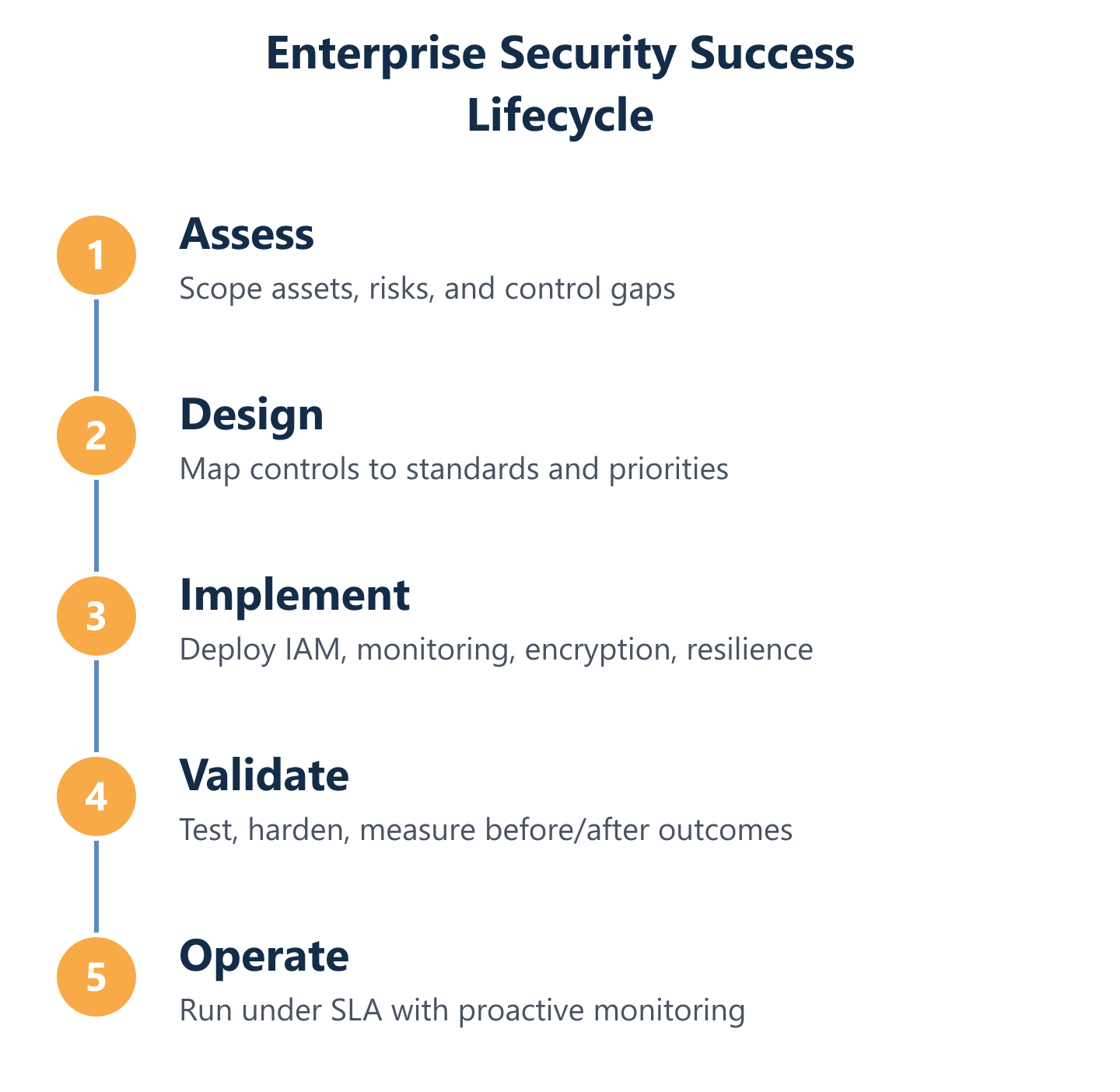
The methodology that underpins a credible enterprise IT security success story must be structured, repeatable, and evidence-driven. Vague descriptions of "security improvements" do not satisfy auditors, executives, or prospective clients reviewing the case study. What does satisfy them is a clear sequence of phases, each with defined inputs, outputs, and accountability. At Impulso Tecnológico, our managed security engagements follow exactly this kind of structured approach—combining certified vendor technologies (Sophos for endpoint and firewall, Fortinet for network security, Veeam for backup resilience, and Microsoft for identity and cloud) with a delivery model that integrates security into ongoing operations rather than treating it as a one-off project. The result is a security posture that can be demonstrated, measured, and maintained under SLA-guaranteed managed support across the client's full environment.
- Scoping and asset discovery: Identify critical systems, data flows, and existing control inventory before any assessment activity begins.
- Threat modelling and gap analysis: Map realistic attack paths against the current control set; prioritise gaps by exploitability and business impact.
- Control design and vendor selection: Define the target control architecture, selecting technologies aligned to the client's environment and compliance obligations.
- Phased implementation with operational alignment: Deploy controls in priority order, coordinating with operational teams to avoid service disruption.
- Validation and hardening: Test each control against defined success criteria; document before/after evidence and remediate residual findings.
- Ongoing managed monitoring: Transition validated controls into continuous managed service with SLA-backed monitoring, patching, and incident response support.
Assessment and design: scope, threat modelling, and control mapping
A security assessment that cannot be traced back to specific assets and attack paths produces findings that are difficult to prioritise and even harder to budget. Effective scoping starts with a structured asset inventory—servers, endpoints, network devices, cloud workloads, and third-party integrations—ranked by criticality to operations. Threat modelling then maps realistic adversary paths through that asset landscape: which entry points are exposed, which lateral movement routes exist, and which data repositories represent the highest-value targets. Control mapping follows: each identified gap is matched to a specific control from the relevant framework (ISO 27001 Annex A, NIST CSF, or PCI DSS requirements, depending on the organisation's obligations). The output of this phase is a prioritised remediation plan with clear ownership, estimated effort, and measurable acceptance criteria for each control. This document becomes the foundation of the success story—it defines what "before" looks like and sets the standard against which "after" will be measured. For organisations without an internal security function, an IT network audit provides exactly this structured starting point.
Implementation: managed security controls across identity, network, endpoints, and backup resilience
Implementation sequencing matters as much as the controls themselves. Deploying MFA across all privileged accounts delivers immediate risk reduction with minimal operational disruption—it is consistently the highest-impact, lowest-friction control in enterprise environments. Network segmentation and firewall policy hardening (using Fortinet or Cisco depending on the existing infrastructure) follow, closing lateral movement paths identified during threat modelling. Endpoint protection deployment—Sophos being the technology of choice in many Impulso Tecnológico engagements—provides visibility and response capability at the device level. Backup resilience, managed through Veeam, addresses the recovery dimension: tested restore procedures with documented recovery time objectives replace assumed-functional backups. Throughout implementation, the critical discipline is operational alignment: each control is deployed in coordination with the client's operational teams, with change management procedures that prevent security work from becoming a source of service disruption. Monthly managed contracts provide the cost predictability and continuity that ad hoc project engagements cannot.
Validation: testing, hardening checks, and measurable before/after evidence
Validation is the phase that converts implementation activity into case study evidence. Without it, the story has actions but no proof. Validation should cover three distinct layers. First, functional testing: each control is tested against the specific attack path or failure mode it was designed to address—MFA bypass attempts, firewall rule verification, endpoint detection trigger tests, and backup restore exercises under realistic conditions. Second, monitoring baseline establishment: with controls in place, a new baseline is recorded for detection time, alert volume, and false positive rate, creating a measurable "after" state. Third, residual risk review: findings that remain open after initial implementation are documented, prioritised, and tracked to closure. The combination of these three layers produces the before/after evidence that makes an enterprise security case study credible to auditors, insurers, and executive stakeholders alike. It also provides the data needed to demonstrate compliance alignment—showing not just that controls exist, but that they function as intended under test conditions.
Controls, compliance evidence, and outcomes you can measure
Connecting implemented controls to compliance frameworks and to quantified business outcomes is the final—and most persuasive—element of an enterprise IT security success story. Executives need to see that the investment produced specific, attributable changes in the organisation's risk profile. At Impulso Tecnológico, our managed service model is designed to make this connection explicit: proactive monitoring generates the data that demonstrates control effectiveness; centralised monthly contracts provide the cost visibility that makes security investment defensible; and SLA-guaranteed support ensures that the improvements achieved during implementation are maintained over time rather than degrading between review cycles.
The outcomes that matter most in this context are operational: fewer unplanned service disruptions, shorter incident resolution windows, and demonstrable compliance posture that survives external audit. Client feedback consistently highlights the practical impact of this approach—quick, efficient resolution of issues at both small and corporate scale, within agreed timeframes, with clear communication throughout. These are the signals that translate into executive confidence and, ultimately, into the kind of security success story that other enterprises want to replicate.
- Reduced mean time to detect (MTTD): Continuous monitoring with defined alert thresholds replaces user-reported incidents, shortening detection windows from days to hours.
- Shorter mean time to resolve (MTTR): SLA-backed managed support with documented escalation paths removes the ambiguity that extends incident resolution in unmanaged environments.
- Tested recovery capability: Documented backup restore results replace assumed-functional recovery, giving the organisation a verifiable recovery time objective.
- Compliance evidence package: Control mapping to ISO 27001, NIST CSF, or PCI DSS, supported by testing records and monitoring logs, provides audit-ready documentation.
- Operational stability: Fewer unplanned disruptions, predictable IT costs under monthly contracts, and a single managed provider reduce complexity and internal resource burden.
IAM and MFA, encryption, and monitoring: what was implemented and why
Three control categories consistently deliver the fastest measurable impact in enterprise security engagements. Identity and access management with MFA is first: enforcing multi-factor authentication across privileged and remote access accounts closes the credential-based attack path that accounts for the majority of confirmed breaches. The implementation effort is low relative to the risk reduction achieved, making it the standard first deployment in any security hardening programme. Encryption—at rest for sensitive data repositories and in transit for all external communications—addresses data protection obligations under GDPR and PCI DSS while reducing the impact of any future exfiltration event. Monitoring, implemented through SIEM tooling or managed detection services, provides the continuous visibility that makes all other controls auditable: without monitoring, there is no reliable way to confirm that MFA is functioning, that encryption policies are being enforced, or that anomalous activity is being detected. Together, these three control families form the minimum credible baseline for an enterprise security success story. For a broader view of how these controls fit into a comprehensive security architecture, see our guide to network security for enterprises.
Compliance & standards evidence: how to demonstrate alignment credibly
Compliance alignment is only credible when it is supported by evidence collected during normal operations, not assembled retrospectively before an audit. The most robust approach maps each implemented control to the specific requirement it satisfies within the applicable framework—ISO 27001 Annex A controls, NIST CSF subcategories, or PCI DSS requirements—and then documents the evidence source for each mapping. Evidence sources include monitoring logs showing continuous control operation, vulnerability scan results before and after remediation, backup restore test records with timestamps and recovery metrics, and access review documentation confirming that least-privilege policies are being enforced. When this evidence package is assembled systematically, it demonstrates not just that controls were deployed, but that they operate continuously and effectively. This distinction matters to auditors and to cyber insurers, both of whom are increasingly asking for operational evidence rather than policy documentation. Organisations building their first compliance evidence package will find that the IT security plan implementation guide provides a practical framework for structuring this process.
Business outcomes: metrics that executives trust in an enterprise security success story
Executives evaluate security investments through an operational lens: what disruptions were prevented, how quickly incidents were resolved, and whether the organisation can demonstrate compliance to clients, regulators, and insurers. The metrics that carry most weight in this context are mean time to detect and mean time to resolve—both of which can be tracked before and after managed security controls are deployed. Recovery time objective (RTO) and recovery point objective (RPO), validated through tested backup restore exercises, demonstrate resilience in concrete terms that business continuity planning requires. Reduction in unplanned downtime events, tracked over a rolling period, shows that proactive monitoring and patch management are functioning as intended. Compliance audit outcomes—specifically, the reduction in open findings between successive audits—demonstrate that the security programme is improving the organisation's posture over time rather than maintaining a static baseline. These metrics, taken together, form the business outcome section of a security success story that executives will find both credible and actionable.
The value of an enterprise IT security success story extends beyond the organisation that lived it. When structured with a clear methodology, documented evidence, and measurable outcomes, it becomes a decision framework that other enterprises can adapt to their own environments, technology stacks, and compliance obligations. The phases described in this blueprint—scoping, threat modelling, phased implementation, validation, and managed continuity—are repeatable by design. At Impulso Tecnológico, we apply this same structured approach across sectors including industry, logistics, education, and professional services, adapting vendor selection and control priorities to each client's specific risk profile. If your organisation is ready to build its own security success story—or to review the gaps that a structured assessment would surface—the next step is a direct conversation with our team.