

A telephone switchboard is a hardware and operational system that connects an incoming call to its intended destination by establishing a temporary circuit path. Originally managed by human operators, today that same routing logic underpins every PBX, auto-attendant, and VoIP platform in use.
For decades, businesses relied on operators sitting at cord switchboards to manually patch calls through to the right extension or line. When a caller rang in, the operator answered, identified the destination, inserted a cord into the correct jack, and held the connection until the call ended. The process was labour-intensive but effective — and it established the foundational logic of call routing that modern telephony still follows.
The challenge for organisations today is translating that legacy behaviour into a modern, automated, and cost-efficient communications setup. Whether you are managing a PBX modernisation, planning a VoIP migration, or simply trying to understand what your current system does, the principles behind telephone switchboards remain directly relevant. This guide maps historical switching concepts to current technology so you can make better-informed decisions about your business communications infrastructure.
What a Telephone Switchboard Is (and Why It Mattered)
A telephone switchboard is a centralised switching apparatus that establishes, holds, and releases call connections between two or more parties. Its core job has never changed: receive a call, determine where it needs to go, create a path, and release that path when the call ends. In the earliest implementations, that process required a human operator at a physical console. Today, the same logic runs inside a PBX or hosted telephony platform, executing routing decisions in milliseconds without any manual intervention.
The reason switchboards mattered — and still matter — is that they sit at the intersection of call traffic management and business operations. A poorly designed routing setup creates bottlenecks, missed calls, and frustrated callers. A well-designed one ensures every inbound call reaches the right person or team efficiently, regardless of whether the organisation uses a legacy telephone exchange or a fully IP-based system.
At Impulso Tecnológico, we help organisations map their existing routing requirements — however they are currently handled — onto a modern PBX or IP voice architecture that fits their structure and scale.
| Era / Technology | Switching Method | Routing Decision | Operator Involvement | Typical Use Case |
|---|---|---|---|---|
| Manual cord switchboard (pre-1920s) | Physical cord and jack | Human operator by name/request | Full — every call | Early telephone exchanges, small offices |
| Automatic telephone exchange (1920s–1970s) | Electromechanical (Strowger) | Dial pulses, no operator needed | Exceptions and long-distance only | Public telephone networks |
| Analogue/digital PBX (1970s–2000s) | Circuit switching, internal numbering | Extension dial plan, operator console | Receptionist/attendant console | Corporate offices, multi-department organisations |
| IP PBX / VoIP (2000s–present) | Packet switching over IP network | Auto-attendant, IVR, SIP trunking | Optional — auto-attendant handles most calls | Multi-site businesses, remote workforces |
Definition and call-connection purpose
At its most fundamental level, a telephone switchboard exists to establish a call path between a caller and a destination. In circuit-switched telephony, that meant physically completing an electrical circuit — a cord inserted into a jack created a temporary, dedicated connection for the duration of the call. In packet-switched IP telephony, the same intent is achieved through session initiation and media stream routing across a data network. The destination might be an extension, a hunt group, a voicemail box, or an external PSTN number, but the underlying purpose — get the call to the right place — is identical. Understanding this helps IT teams evaluate any telephony platform: what matters is not the physical medium but the quality, reliability, and flexibility of the routing logic it supports.
Operators, consoles, and assisted call workflows
In the era of manual switchboards, the operator was the routing engine. When a subscriber picked up the handset, the operator's console lit up, signalling an incoming request. The operator answered, asked for the destination (by name, not number, in the earliest systems), located the correct jack on the switchboard, and inserted a cord to complete the connection. For calls that could not be completed — busy lines, absent parties, or long-distance requests — the operator managed the exception, queued the call, or escalated to a specialist trunk operator.
This workflow maps directly onto today's attendant console and auto-attendant call routing configurations. The operator console in a modern PBX gives a receptionist a visual overview of active calls, extensions, and availability — essentially the same information a cord switchboard operator read from the lit jacks in front of them. Operator console workflows remain relevant wherever a business needs human-assisted call handling alongside automated routing.
From switch paths to today's routing logic
The transition from physical cord switching to software-defined routing did not change the underlying intent; it automated and scaled it. A modern PBX uses a dial plan — a structured set of rules that maps dialled digits to destinations — to replicate what an operator once did by hand. Trunking and dial plans define how calls enter and leave the system: SIP trunks replace the physical PSTN lines that once terminated at the switchboard, and dial plan rules replace the operator's knowledge of who sits where.
Auto-attendant call routing adds a further layer: callers are presented with menu options that direct them to the right department or extension without any human involvement. For organisations managing VoIP migration planning, understanding this mapping — cord to trunk, operator to auto-attendant, jack to extension — is the clearest way to assess whether a new system will meet operational expectations before a single handset is installed.
How Manual Telephone Switchboards Worked in Practice
Manual telephone switchboards operated through a tightly defined sequence of actions that the operator repeated for every call. The first commercial switchboard in New Haven, Connecticut (1878) handled 21 subscribers; within a few years, exchanges in major cities were managing thousands of simultaneous connections using the same fundamental process. Understanding that process matters today because it reveals which behaviours users expect from any telephony system — and which constraints shaped the design of every modern PBX.
When Impulso Tecnológico designs a migration from a legacy telephone exchange to an IP voice platform, we start by mapping the routing behaviours the organisation currently relies on — including the edge cases — so that the new system preserves them rather than breaking them during cutover.
- Subscriber signals intent: The caller lifts the handset; a lamp or drop indicator on the operator's console activates, signalling an incoming request.
- Operator answers and identifies destination: The operator plugs in a listening cord and asks for the called party — by name in early systems, by number once numbering plans were introduced.
- Operator locates the correct jack: Using the switchboard's layout (organised by subscriber or trunk group), the operator identifies the destination jack.
- Connection is established: A cord is inserted into the destination jack; the operator rings the called party to alert them to the incoming call.
- Call proceeds under supervision: The operator monitors the connection via a supervisory lamp; if either party requires assistance, the operator can intervene.
- Call is released: When both parties hang up, supervisory lamps extinguish; the operator removes the cord and the circuit is freed for reuse.
Call setup flow: request, verify, connect, and release
Every call on a manual switchboard followed a four-phase lifecycle: request, verify, connect, and release. The request phase was triggered by the caller going off-hook. Verification meant the operator confirming the destination was reachable and available — a busy lamp or the absence of a free cord indicated otherwise. Connection required the physical act of inserting a cord pair and ringing the destination. Release was confirmed by supervisory signals when both parties disconnected.
This lifecycle is directly mirrored in SIP call signalling today: INVITE (request), 100 Trying / 180 Ringing (verify), 200 OK / ACK (connect), and BYE (release). IT teams managing VoIP migration planning benefit from recognising this parallel — troubleshooting a failed SIP session is far more intuitive when you understand the logical stages it is trying to complete.
Cord, jack, and trunk concepts explained in IT terms
The cord switchboard's physical components map cleanly onto modern telephony concepts. A cord was a temporary, dedicated connection between two points — equivalent to a call session or media stream in VoIP. A jack represented a subscriber endpoint — the equivalent of a SIP extension or DDI number in a modern dial plan. A trunk was a shared line connecting one exchange to another, carrying multiple calls in sequence — directly analogous to a SIP trunk or ISDN PRI circuit today.
Trunking and dial plans in a modern PBX define how many simultaneous external calls the system can handle and how inbound numbers are mapped to internal extensions. In a cord switchboard, the number of available cord pairs set the same limit. Understanding this equivalence helps when sizing a new system: the question "how many trunks do we need?" has been relevant since the first telephone exchange opened in 1878.
Operational constraints: busy lines, exceptions, and service quality
Manual switchboards introduced the first service quality problems in telephony: busy lines, unanswered calls, and the complexity of long-distance routing. When all cords to a destination were in use, the caller received a busy signal and had to try again — there was no queuing mechanism. Long-distance calls required escalation to a specialist trunk operator who managed inter-exchange connections, sometimes across multiple relay points.
These constraints directly shaped modern telephony design. Hunt groups, call queues, and overflow routing exist specifically to address the busy-line problem. Long-distance operator assistance evolved into automated least-cost routing and SIP trunking with geographic number portability. Organisations planning a PBX modernisation should audit these edge cases — the unusual call scenarios that their current system handles — before migration, because they are the most likely source of post-cutover complaints if overlooked.
Modern Parallels: PBX, Auto-Attendant, and Migration Criteria
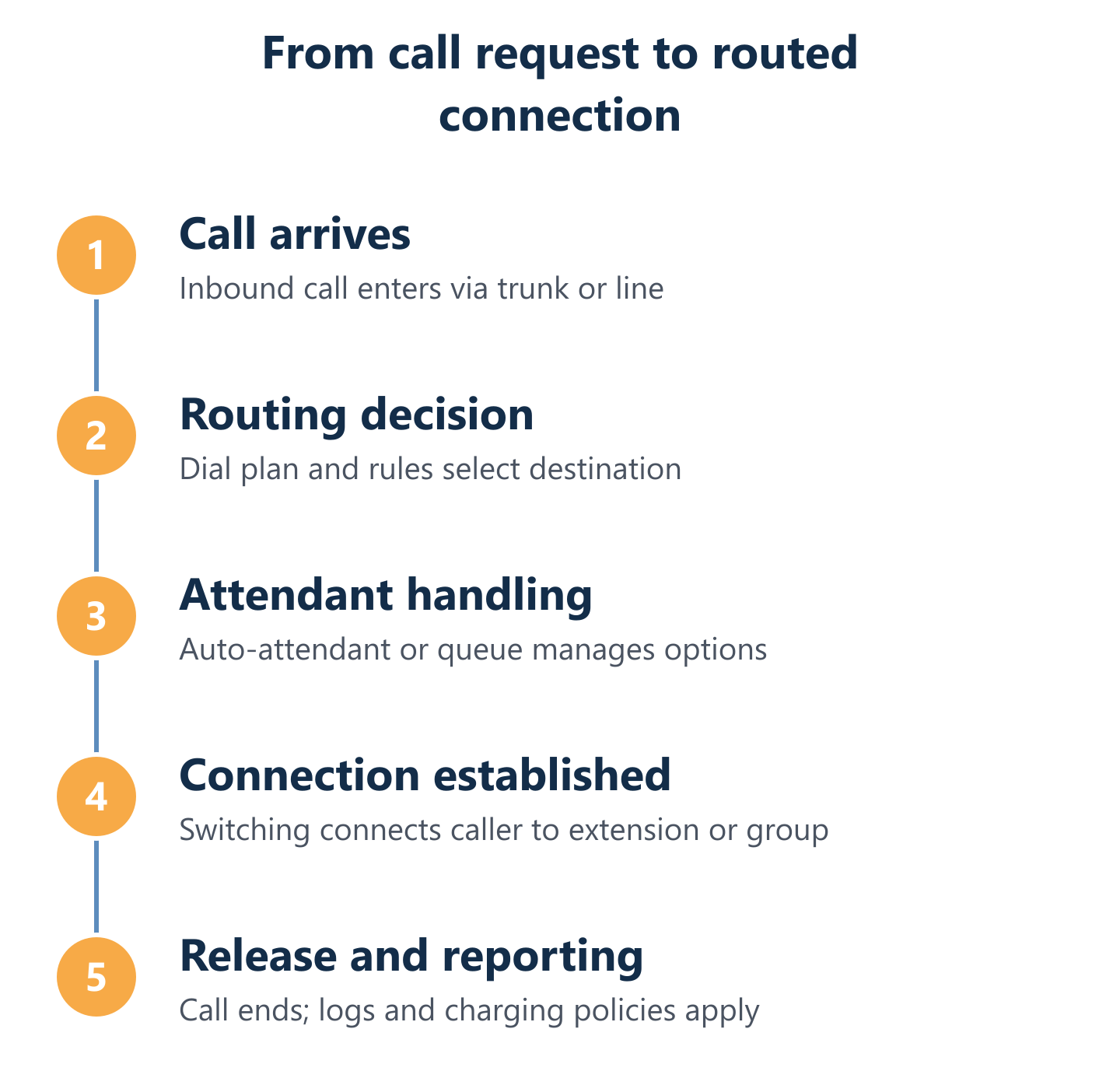
The logic of the telephone switchboard — receive, route, connect, release — is fully preserved in today's PBX and IP voice platforms. What changed is the medium, the speed, and the degree of automation. A well-configured PBX handles hundreds of simultaneous calls, applies routing rules in real time, and presents callers with self-service options through an auto-attendant, all without a single operator at a physical console.
Choosing the right platform — analogue, digital, or IP — depends on a set of practical criteria that go beyond headline features. Impulso Tecnológico installs and configures pure IP and digital IP switchboards across Spain, supporting organisations that need to transition gradually rather than in a single cutover. For distributed teams, we configure IP switchboards with mobile extensions so the system remains centralised and accessible regardless of where users are working.
For organisations that need detailed visibility into call traffic, we provide call traffic control and charging software, including cHar uTile Company, which gives management exhaustive control over switchboard usage and costs — a modern equivalent of the operator's supervisory lamp, but with full reporting and billing capability.
- Current infrastructure: Assess whether existing cabling and hardware support digital or IP endpoints before committing to a platform.
- Call volume and concurrency: Determine peak simultaneous call requirements to size trunking correctly — underprovision here and you recreate the busy-line problem of 1878.
- Routing complexity: Map all current routing rules, hunt groups, and time-of-day schedules before migration; these are the behaviours users will notice if lost.
- Mobility requirements: If users work across sites or remotely, IP voice with mobile extensions is the only architecture that delivers a consistent experience.
- Integration needs: Identify whether the telephony platform must connect to CRM, ticketing, or billing systems — this rules out most analogue-only solutions.
- Budget and pace of change: A hybrid digital IP switchboard allows gradual migration, preserving existing handsets and lines while adding IP capabilities incrementally.
PBX and auto-attendant: how they replace operator-led routing
A PBX replicates the switchboard's routing function through software-defined dial plans and trunk management. Where an operator once answered every inbound call and manually directed it, an auto-attendant presents callers with a structured menu — "Press 1 for sales, press 2 for support" — and routes the call to the correct destination without human involvement. For straightforward, high-volume call flows, this is faster and more consistent than operator-led routing.
However, operator console workflows remain valuable where call handling requires judgement: VIP callers, complex escalations, or organisations where personal service is a differentiator. Modern attendant consoles give receptionists a real-time view of extension availability, active calls, and queues — functionally identical to the supervisory panel of a cord switchboard, but delivered through a software interface. The decision between full automation and assisted routing is a business one, not a technical one.
Decision checklist for analogue, digital, and IP voice
Selecting the right switchboard technology requires an honest assessment of five variables. First, trunking: does your site use analogue PSTN lines, ISDN, or SIP? Your trunk type constrains your platform options. Second, numbering plan: how many internal extensions do you need, and do you require DDI numbers for direct inbound routing? Third, routing rules: how complex are your current call flows — simple hunt groups or multi-level time-of-day routing with overflow? Fourth, mobility: do users need to receive calls on mobile devices or at remote locations? Fifth, integration: must the system connect to other business platforms?
Analogue systems suit very small, static environments with minimal routing needs. Digital PBX suits organisations with established cabling and moderate complexity. IP voice — the architecture Impulso Tecnológico recommends and installs for most new and migrating clients — suits any organisation that needs scalability, mobility, and integration capability.
Migration priorities: trunking, routing rules, user experience, and control
A controlled VoIP migration follows a clear sequence of priorities. Trunking comes first: establish SIP trunk connectivity and confirm call quality before touching any internal routing. Routing rules come second: replicate every existing dial plan rule, hunt group, and time-of-day schedule in the new system and test them in parallel with the legacy platform. User experience comes third: train staff on new handsets and attendant consoles before cutover, not after. Call traffic control comes fourth: once live, deploy call traffic management software to monitor usage, identify anomalies, and manage costs.
Impulso Tecnológico supports this sequence across Spain, working with a multibrand portfolio that includes Amper, NEC, Alcatel, Siemens, Panasonic, and Asterisk, among others. That breadth means we can design a migration path that fits the client's existing environment rather than forcing a wholesale replacement. We also provide ongoing reprogramming and technical support as the business evolves — because a telephone exchange is never truly finished.
The cord switchboard and the modern IP PBX are separated by nearly 150 years of engineering, but they share the same operational logic: receive a call, determine its destination, establish a path, and release it cleanly. That continuity is useful. It means the lessons of manual switching — size your trunks for peak load, document your routing rules, plan for exceptions, and maintain supervisory visibility — apply directly to any PBX modernisation or VoIP migration you undertake today.
If your organisation is evaluating a move from a legacy telephone exchange to IP voice, or simply needs to bring an existing system under better control, Impulso Tecnológico has the technical depth and multibrand experience to design and implement a solution that fits your operations — without disrupting them in the process. Explore our detailed guidance on switchboard installation for businesses, learn about VoIP for businesses, or review our approach to the installation and maintenance of telephone systems.