
Telephone switchboard maintenance covers the scheduled inspection, testing, configuration control and documentation of your PBX or telephone exchange to prevent call failures, reduce downtime and keep business communications reliable. It includes physical checks, functional verification and recorded reporting after each visit.
Most organisations only call a technician when something breaks. By then, the damage is already done: missed calls, failed transfers, degraded audio and, in the worst cases, complete loss of internal and external communications. A structured maintenance programme shifts the approach from reactive to preventive — catching worn connectors, misconfigured routing tables and degraded line interfaces before they cause an outage.
At Impulso Tecnológico, we maintain analogue, digital and IP switchboards as part of our managed IT services, working with many brands and supporting both single-site and multi-location environments. The result is a communication infrastructure that behaves predictably, supports migration at the organisation's own pace and does not become a source of unplanned disruption.
What Telephone Switchboard Maintenance Actually Includes
Switchboard maintenance is not a single task — it is a structured sequence of physical, functional and administrative checks carried out at defined intervals. The goal is to verify that every component of the telephone exchange, from the trunk lines entering the building to the extensions at each desk, is operating within specification and that any deviation is recorded before it becomes a fault.
At Impulso Tecnológico, maintenance covers analogue, digital and IP switchboards under a single managed-services framework. This matters because many organisations run mixed environments: a legacy digital PBX handling internal extensions alongside SIP trunks or IP handsets. Maintaining these systems requires compatibility-aware checks, not just generic inspections.
| Maintenance area | What is checked | Frequency (typical) | Risk if skipped |
|---|---|---|---|
| Physical cabling and connectors | Condition, seating, labelling | Quarterly | Intermittent line failures |
| Line interfaces and ports | Cleanliness, continuity, signal level | Quarterly | Noise, echo, dropped calls |
| Call routing and numbering plan | Routing tables, dial plans, transfer rules | Semi-annual or after changes | Dialling errors, misrouted calls |
| Power and network infrastructure | PSU output, UPS, LAN connectivity for IP systems | Quarterly | Unexpected reboots, total outage |
| Software and firmware | Version status, pending updates, configuration backup | Semi-annual | Security exposure, incompatibility |
| Documentation | Accuracy of records, extension lists, wiring diagrams | After every visit | Slow diagnosis, unsafe changes |
When maintenance is carried out by a provider who also handles installation and reprogramming — as Impulso Tecnológico does — the technician already understands the system's configuration history, which significantly reduces diagnosis time during any incident.
Core maintenance scope: wiring, connectors and line interfaces
Physical degradation is the most common and most overlooked cause of switchboard faults. Cables develop micro-fractures, connectors oxidise, and punch-down blocks lose contact over time — particularly in environments with temperature fluctuations or high cable density. During a preventive maintenance visit, technicians inspect every accessible cable run for physical damage, verify that all connectors are fully seated and check that labelling matches the current documentation.
Line interfaces — the ports where external PSTN, ISDN or SIP lines connect to the exchange — receive particular attention. A dirty or corroded interface can introduce noise on every call passing through it, yet pass a basic continuity test. Proper telephone exchange maintenance includes cleaning interfaces, measuring signal levels where test equipment allows and comparing readings against the manufacturer's baseline. This level of detail is what separates preventive maintenance from a superficial visual check.
Functional testing: call routing, signalling and service verification
Once the physical layer is verified, functional testing confirms that the switchboard routes calls correctly under real operating conditions. This means placing test calls across every trunk group, verifying that internal extensions transfer correctly, checking that hunt groups and voicemail services respond as configured, and confirming that signalling between the PBX and the carrier is stable.
For IP-based or hybrid systems, call quality troubleshooting extends to the network layer: jitter, packet loss and latency all affect voice quality and must be measured, not assumed. Impulso Tecnológico's technicians test both the telephony configuration and the underlying IP infrastructure, which is particularly relevant when mobile extensions or remote branches are part of the same dial plan. Signalling paths that work under low load can degrade under peak traffic, so testing should replicate realistic call volumes where possible. Any deviation from expected behaviour is logged immediately and linked to the corrective action taken.
Documentation control: records that speed up diagnosis and repairs
An undocumented switchboard is a liability. When a fault occurs at a critical moment, the time spent reconstructing the system's configuration — extension assignments, trunk allocations, routing rules, firmware versions — directly extends the outage. Accurate, up-to-date documentation is therefore not an administrative formality; it is a technical asset.
Every maintenance visit should result in updated records covering the current extension list, wiring diagrams, configuration backups and a log of any changes made. For organisations managing PBX configuration reprogramming or analogue-to-IP migration, this documentation becomes the baseline for every subsequent change. Impulso Tecnológico maintains configuration records as part of its managed-services approach, meaning that when a technician attends a site — whether for routine maintenance or an urgent repair — they arrive with accurate system knowledge rather than starting from scratch. This is one of the most practical ways maintenance reduces mean time to repair.

Common Switchboard Problems and How Maintenance Prevents Them
Most switchboard failures do not appear without warning. They develop gradually through a sequence of detectable symptoms that a structured maintenance programme is specifically designed to catch. The challenge is that organisations often normalise early warning signs — a slight crackle on external calls, an occasional failed transfer — until the fault becomes severe enough to disrupt operations.
Because Impulso Tecnológico services heterogeneous environments, including systems built on Asterisk, Alcatel Lucent, Siemens, NEC, Panasonic and other major brands, maintenance checks are adapted to the specific characteristics of each platform. A fault pattern that is normal behaviour on one system may indicate a configuration error on another. This brand-aware approach reduces the risk of recurring faults, particularly in environments where mobile extensions, branch offices and IP telephony coexist on the same infrastructure.
- Identify the symptom category — noise/echo, line failure or dialling error — to direct the diagnostic sequence efficiently.
- Isolate the affected layer — physical (cabling, connectors), line interface or software/configuration — before replacing any component.
- Test under realistic conditions — replicate the fault scenario rather than testing only in idle state, since some faults appear only under load or at specific times of day.
- Apply the fix and verify — confirm the symptom is resolved across all affected extensions or trunks, not just the one reported.
- Update documentation and schedule follow-up — record the root cause, corrective action and any components replaced, and flag for re-check at the next maintenance visit.
Call quality issues: noise, echo and unstable audio paths
Noise and echo on calls are among the most frequently reported switchboard complaints, yet they are also among the most preventable. The root causes fall into three categories: physical (damaged or poorly shielded cabling picking up electromagnetic interference), interface-level (oxidised or dirty connectors introducing resistance into the audio path) and configuration-level (incorrect echo cancellation settings or mismatched codec selection in IP systems).
Preventive maintenance addresses all three. Technicians inspect cable runs for proximity to power lines or other interference sources, clean and reseat line interfaces, and verify that echo cancellation is active and correctly configured for each trunk type. For VoIP environments, jitter buffer settings and codec negotiation are reviewed as part of the same visit. When a customer reports unstable audio paths on specific extensions or at particular times, the maintenance record provides the diagnostic baseline — making it possible to correlate the symptom with a recent change or a gradual physical degradation rather than treating it as an isolated incident.
Line and circuit faults: intermittent failures and degraded signalling
Intermittent line failures are disproportionately disruptive because they are difficult to reproduce on demand and easy to dismiss as one-off events. A circuit that drops calls once or twice a day may not trigger an immediate support call, but it will erode confidence in the phone system and eventually affect customer-facing communications.
During switchboard fault diagnosis, technicians isolate each trunk circuit individually and run continuity and signal-level tests to identify degraded paths. For ISDN or analogue lines, this includes checking for correct termination impedance and verifying that the carrier's signal is arriving at the expected level. For SIP trunks, registration status, response codes and call detail records are reviewed to identify patterns. Impulso Tecnológico's approach to telephone exchange maintenance includes targeted isolation tests rather than blanket replacements, which keeps costs controlled and ensures the actual fault is addressed rather than masked.
Dialling and routing errors: numbering plan, interfaces and compatibility checks
Dialling errors — calls that reach the wrong destination, fail to connect or produce unexpected tones — are almost always configuration issues rather than hardware failures. They typically arise after a change to the numbering plan, a carrier migration, or the addition of new extensions or trunks that were not fully integrated into the existing routing logic.
Preventing these errors requires verifying the complete dial plan at regular intervals, not only after changes. Maintenance visits should include test calls across all route groups, confirmation that prefix stripping and number translation rules are correct, and a review of any recent carrier or infrastructure changes that may have affected compatibility. In mixed analogue-digital-to-IP migration environments — a common scenario for Impulso Tecnológico's customers — interface compatibility checks are particularly important, since signalling conventions differ between technologies and a misconfigured gateway can introduce systematic dialling errors that affect every call on a given trunk group.
Maintenance Checklist, Reporting and Provider Selection
A maintenance programme without a defined checklist, documented outcomes and clear provider criteria is not a programme — it is a series of unconnected visits. The three elements work together: the checklist sets the scope, reporting creates accountability and provider selection determines whether the service will actually deliver continuity.
Impulso Tecnológico structures switchboard maintenance around managed-services principles: each visit follows a defined scope, produces a written record and feeds into a configuration-controlled history of the system. This approach supports both single-site organisations and multi-location businesses where centralised telephony management is essential for controlling costs and keeping mobile users and branches connected.
- Define the checklist before the visit — agree in advance which systems, lines and functions will be tested, so nothing is omitted under time pressure.
- Separate physical, functional and configuration checks — each layer requires different tools and expertise; conflating them leads to missed faults.
- Require written reports after every visit — verbal summaries are not sufficient for audit trails or future diagnosis.
- Verify that the provider can handle your specific brands — a technician unfamiliar with your PBX platform will take longer and may miss model-specific fault patterns.
- Confirm change-control procedures — any configuration change made during maintenance should be logged, reversible and communicated to the customer before implementation.
- Assess upgrade and migration capability — the best maintenance providers can also advise on when repair is no longer cost-effective and support a controlled transition to IP telephony.
PBX and exchange maintenance checklist: what to verify and when to repair or replace
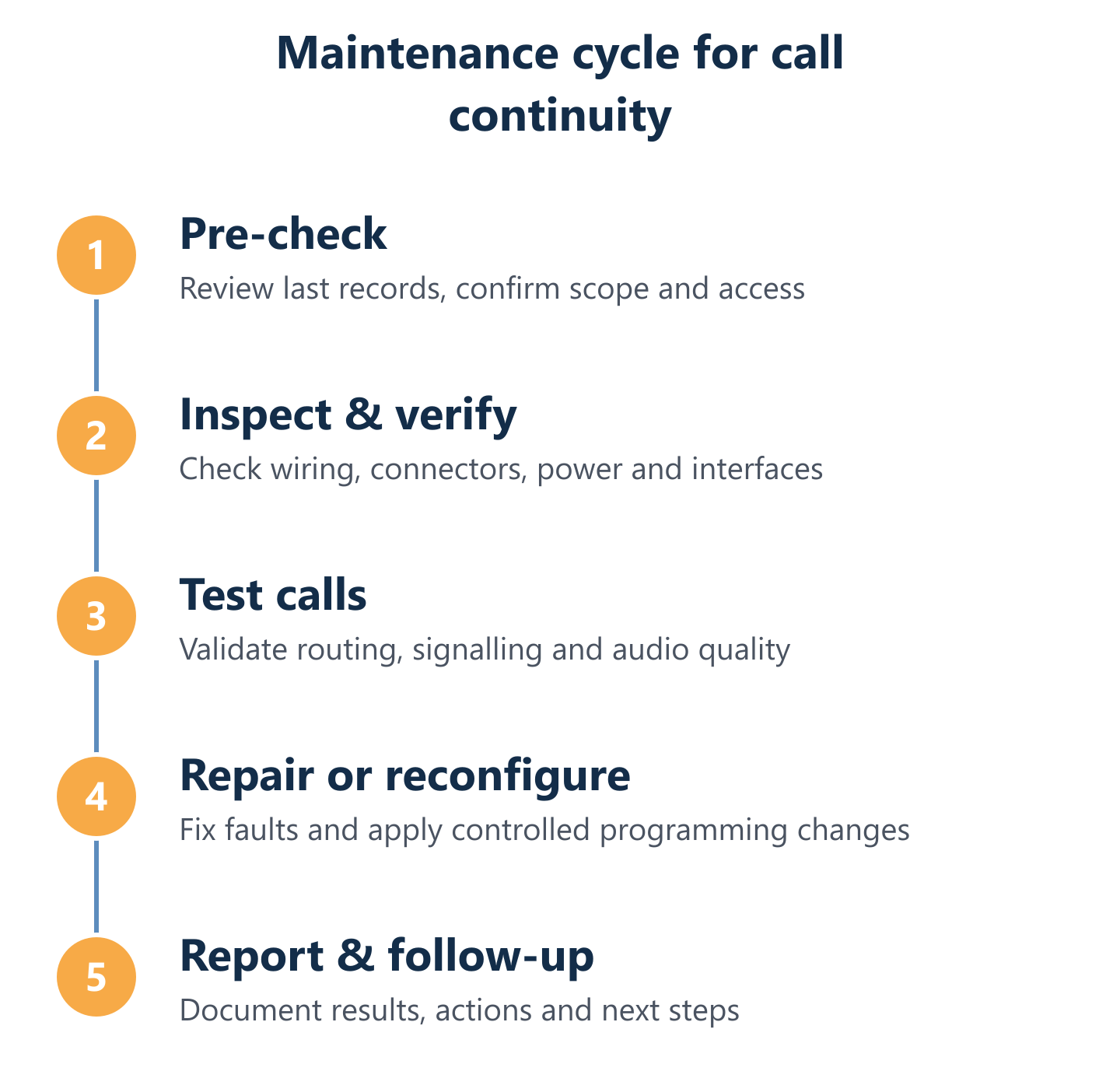
A practical PBX maintenance checklist covers five areas in sequence. First, power and network: verify PSU output voltage, check UPS battery status and confirm LAN connectivity for IP-connected components. Second, physical layer: inspect all cable runs for damage, verify connector seating, clean line interfaces and confirm labelling accuracy. Third, functional tests: place test calls on every trunk group, verify internal transfer and hunt group behaviour, and confirm voicemail and auto-attendant operation. Fourth, configuration review: compare the current dial plan and routing tables against the documented baseline and flag any undocumented changes. Fifth, repair-or-replace assessment: components showing physical degradation, repeated fault history or end-of-life firmware status should be flagged for replacement rather than further repair. Impulso Tecnológico applies this structured sequence across the brands it supports, including legacy systems where replacement parts require specialist sourcing.
Reporting and ongoing assurance: how results should be documented and followed up
A maintenance visit that produces no written record has limited value beyond the moment it occurs. Proper reporting serves three purposes: it creates an audit trail for compliance or insurance purposes, it provides the diagnostic baseline for any future fault, and it holds the provider accountable for the scope of work actually completed.
At a minimum, each visit report should include the date and duration of the visit, the systems and lines tested, the results of each functional test, any faults found and the corrective actions taken, components replaced or flagged for replacement, and any configuration changes made with before-and-after values recorded. Monthly summary reports — covering the number of issues identified, resolution status and any recurring patterns — allow management to assess the health of the telephone infrastructure over time. Impulso Tecnológico provides this level of documentation as part of its managed-services model, ensuring that switchboard maintenance is traceable and that nothing falls through the gap between visits.
Choosing a provider: comparing scope, frequency, support and change-control approach
The difference between a capable switchboard maintenance provider and a break-fix contractor comes down to four criteria. Scope: does the provider cover physical, functional and configuration layers, or only respond to reported faults? Frequency: are maintenance intervals defined by risk and system age, or simply by the cheapest contract option? Brand coverage: can the provider service your specific PBX platform, including any legacy or mixed-brand environment? Change control: does every configuration change go through a documented, reversible process, or are undocumented modifications introduced during visits?
Impulso Tecnológico's switchboard maintenance capability covers installation, programming, reprogramming, repair and configuration across brands including Amper, LG-Ericsson, NEC, Panasonic, Alcatel Lucent, Siemens and Asterisk, among others. For organisations considering a move from analogue or digital systems to IP telephony, this breadth means the same provider can maintain the current system and manage the migration — reducing handover risk and preserving configuration continuity throughout the transition. You can also explore our broader guidance on switchboard installation for businesses and VoIP for businesses to understand the full technology pathway.
When telephone switchboard maintenance is structured, documented and change-controlled, the PBX stops being a source of unplanned disruption and becomes a predictable part of business continuity. The organisations that experience the fewest communication outages are not those with the newest equipment — they are those with the most consistent maintenance disciplines. Whether your environment runs on legacy analogue hardware, a modern IP platform or a hybrid of both, the principles are the same: inspect regularly, test thoroughly, document everything and act on findings before they become failures. Impulso Tecnológico is available to assess your current switchboard environment and define a maintenance programme aligned to your operational requirements. Explore our detailed overview of maintenance of telephone switchboards or learn more about telephone exchange repair when faults require more than routine servicing.