
Installation and maintenance of telephone systems covers the full lifecycle of a business communications setup: site survey, system design, switchboard configuration, commissioning, user handover, and ongoing preventive and corrective support. A properly managed service prevents downtime, reduces fault resolution time, and keeps communications aligned with how the business actually operates.
Many organisations treat installation as a one-off project and maintenance as an afterthought — until a line goes down or a configuration error disrupts operations across multiple sites. The consequences range from missed calls and lost productivity to compliance gaps when call logging or messaging services fail unexpectedly. The businesses that avoid these problems are those that select a provider capable of handling both phases under a single accountable service model.
At Impulso Tecnológico, we have spent over 25 years supporting companies across Spain with the installation, programming, configuration, repair, and ongoing technical service of telephone switchboards — covering analog, digital, and IP/VoIP environments. Our approach treats deployment and maintenance as a continuous service, not two separate purchases, which means clients benefit from consistent expertise from day one through to long-term operation.
What Installation And Maintenance Of Telephone Systems Includes
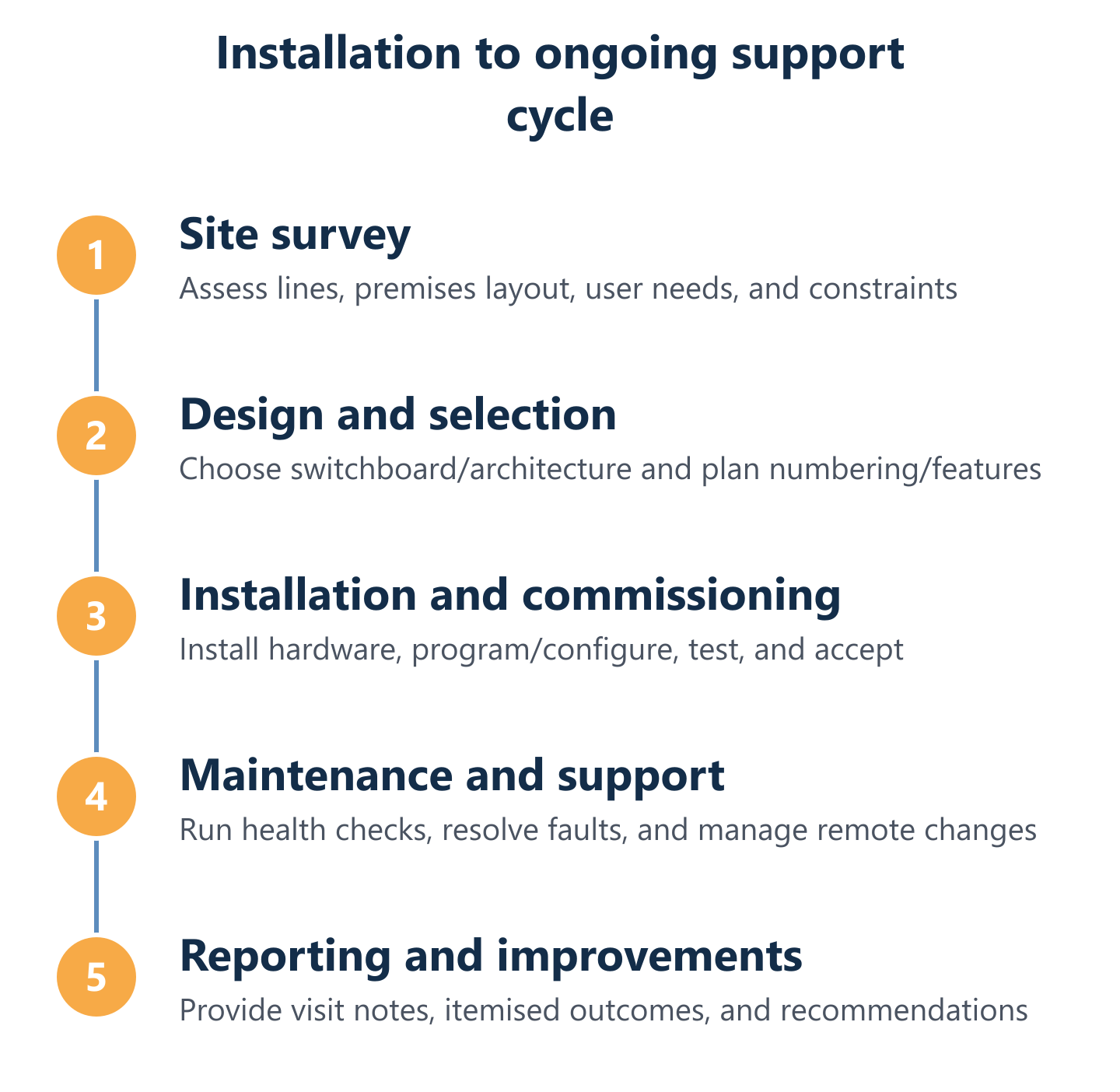
A telephone system project that starts and ends at the point of hardware delivery is a project waiting to fail. The full scope of installation and maintenance of telephone systems spans two distinct but interdependent phases: the deployment phase (survey, design, configuration, commissioning, and handover) and the operational phase (preventive health checks, corrective fault resolution, remote support, and contract-based coverage).
Understanding what each phase delivers helps businesses compare provider proposals on equal terms. A quote that covers only hardware installation without addressing programming, user training, or post-go-live support will almost always generate hidden costs later — particularly when configuration changes are needed as the business grows or restructures.
Impulso Tecnológico provides an end-to-end service that covers both phases for single-site and multi-site businesses across Spain. From initial survey and switchboard programming through to ongoing technical service and reprogramming, the same team handles the full lifecycle — which eliminates the coordination gaps that arise when installation and maintenance are handled by different providers.
| Phase | Key Deliverables | Typical Risk If Skipped |
|---|---|---|
| Site Survey & Design | Infrastructure assessment, system specification, cabling plan | Incompatible equipment, under-specified capacity |
| Configuration & Programming | Switchboard programming, extension mapping, feature setup | Misconfigured extensions, call routing errors |
| Commissioning & Testing | End-to-end call testing, failover checks, acceptance sign-off | Undiscovered faults surfacing at go-live |
| User Handover & Training | Operator and extension user training, documentation pack | Low adoption, recurring support calls for basic tasks |
| Preventive Maintenance | Scheduled health checks, firmware updates, configuration review | Accumulated risk, undetected degradation |
| Corrective Support | Fault diagnosis, line restoration, emergency call-out | Extended downtime, unresolved root causes |
From site survey to system design: what gets assessed
Every reliable telephone switchboard installation begins with a structured site survey — not a catalogue selection. During the survey, a qualified technician assesses the existing cabling infrastructure, the number and location of extensions required, the volume and type of external lines (analogue, ISDN, SIP/VoIP), and any integration requirements with existing IT systems or network equipment.
The output of this phase is a system design specification: the recommended switchboard model and capacity, the cabling and patching plan, any infrastructure upgrades needed before installation can proceed, and a clear statement of what the finished system will deliver. At Impulso Tecnológico, this assessment also considers whether the organisation needs a purely traditional switchboard, an IP-capable hybrid, or a full VoIP architecture — a decision that directly affects the maintenance model and future flexibility.
Commissioning and go-live: configuration, testing, and acceptance
Commissioning is where design becomes operation. Once the switchboard is physically installed and cabled, the configuration and programming phase begins — and this is where technical depth matters most. Extension numbering plans, call routing logic, hunt groups, voicemail, auto-attendant scripts, and direct dial (DDI) assignments all need to be programmed accurately before any call is made.
Impulso Tecnológico programmes switchboards using either factory-originating configurations or fully tailored reprogramming approaches, depending on the client's existing setup and operational requirements. After programming, a structured testing sequence verifies internal calls, external inbound and outbound routing, failover behaviour, and any advanced features. Acceptance sign-off — confirming that the system performs against the agreed specification — marks the formal end of the installation phase and the beginning of the maintenance relationship.
Handover and user enablement: extensions, features, and documentation
A commissioned system that users do not know how to operate generates unnecessary support calls and erodes confidence in the technology. Effective handover covers two audiences: operators (receptionists and administrators who manage the system day-to-day) and extension users (staff who need to transfer calls, access voicemail, use mobile extensions, or activate features like do-not-disturb).
Handover documentation should include an as-built configuration record, an extension directory, a quick-reference guide for common tasks, and clear escalation contacts for faults. This documentation also serves as the baseline for future maintenance visits — technicians can compare current configuration against the as-built record to identify unauthorised changes or configuration drift. Impulso Tecnológico provides this practical, hands-on handover as part of its telephone system installation service, ensuring clients are operationally self-sufficient from day one.

Design Consultancy, System Selection, And Project Management
Choosing a telephone switchboard without a structured consultancy process typically results in either over-specified systems that are expensive to maintain or under-specified ones that require costly upgrades within two to three years. The selection decision should be driven by current call volumes, planned headcount growth, site topology, existing network infrastructure, and the organisation's appetite for VoIP migration.
Impulso Tecnológico's multi-brand service — covering established switchboard ecosystems from manufacturers including Alcatel, Panasonic, NEC, Siemens, Ericsson, LG-Nortel, and Asterisk, among others — means clients are not steered towards a single vendor for commercial reasons. Instead, the recommendation reflects the technical fit. Project management then coordinates equipment procurement, infrastructure preparation, programming, and cutover planning to minimise disruption during upgrades or premises moves.
- Needs assessment: Define call volumes, extension count, site topology, and integration requirements before any system is specified.
- Architecture selection: Evaluate analog, digital, IP/VoIP, or hybrid options against current needs and a realistic three-to-five-year growth horizon.
- Vendor and brand matching: Match system capabilities to the existing infrastructure ecosystem, avoiding unnecessary replacement of functional equipment.
- Cutover planning: Schedule the go-live transition to minimise call disruption — typically outside peak business hours with a tested rollback procedure in place.
- Post-installation review: Confirm configuration accuracy, document the as-built state, and establish the maintenance baseline before the project is formally closed.
For organisations considering VoIP migration planning, this structured approach allows a phased transition — combining traditional switchboard lines with IP telephony capabilities — so the business moves at its own pace without risking communications continuity. You can explore the full scope of this journey in our dedicated guide to VoIP for businesses.
Choosing the right telephone switchboard: analog, digital, IP/VoIP
The three principal switchboard architectures each carry different implications for installation complexity, ongoing maintenance cost, and future scalability. Analog systems are straightforward and resilient but offer limited features and no native support for remote or mobile extensions. Digital systems provide richer functionality and better call quality over traditional lines but are increasingly difficult to extend as ISDN infrastructure is retired across Europe. IP/VoIP switchboards — including hybrid models that support both traditional and IP lines — offer the greatest flexibility: remote extensions, mobile integration, software-based administration, and significantly lower call costs for multi-site organisations.
For businesses that are not ready for a full VoIP migration, Impulso Tecnológico supports hybrid deployments that preserve existing analog or digital infrastructure while introducing IP capabilities progressively. This protects capital investment and reduces the risk of a disruptive cutover. Detailed guidance on switchboard options is available in our article on business telephone switchboards for companies.
Cutover planning for upgrades and migrations: continuity first
Upgrading or replacing a live telephone system carries real operational risk if the cutover is not planned carefully. A poorly timed switchover — during peak call periods, without a tested fallback, or before staff have been trained — can result in missed calls, lost customer contact, and reputational damage that outlasts the technical problem.
Effective cutover planning identifies the lowest-risk transition window, confirms that all programming has been validated in a staging environment where possible, and establishes a clear rollback procedure if critical issues emerge at go-live. For multi-site organisations, the cutover sequence matters: sites with the highest call volumes or most complex routing should typically be migrated last, once the process has been validated at smaller locations. Impulso Tecnológico coordinates this process across equipment suppliers, network providers, and internal IT teams to keep disruption to an absolute minimum.
Multi-site and mobile extensions: keeping users connected
Organisations with multiple headquarters, branch offices, or significant numbers of mobile workers face a connectivity challenge that a single-site switchboard cannot address. IP telephone switchboards with mobile extension support allow users to make and receive calls on their business number regardless of physical location — from a branch office, a home workstation, or a mobile device — while the system administrator retains centralised control over routing, permissions, and call recording.
Impulso Tecnológico implements these configurations for clients across Spain, including scenarios where centralised connectivity is required between geographically dispersed sites. Post-deployment, remote programming support means that adding new extensions, adjusting call routing, or activating features for new staff does not require an on-site visit — reducing both response time and cost. This capability is particularly relevant for growing businesses where the telephone system needs to scale alongside headcount without a full reinstallation. For further detail on installation approaches, see our complete guide to switchboard installation for businesses.
Preventive Maintenance, Fault Response, And Contract Coverage
Once a telephone system is live, the question is no longer whether it will require maintenance — it is whether problems are caught proactively or reactively. Preventive maintenance health checks reduce the probability of unexpected failures; corrective support determines how quickly the business recovers when failures do occur. A well-structured maintenance contract defines both, along with the reporting and communication standards that make the service accountable.
When evaluating telecoms support contracts, the following criteria should be assessed explicitly:
- Health check frequency and scope: How often are scheduled visits or remote reviews conducted, and what does each check cover (power supply, line status, firmware, configuration integrity)?
- Fault categories and response commitments: Does the contract distinguish between total system failure, partial outages, and configuration faults — and does each category carry a defined response time?
- Remote support availability: Can the provider access and resolve programming or configuration issues remotely, without requiring an on-site visit for every fault?
- Handset and software maintenance: Are individual handset faults, firmware updates, and software licensing covered, or are these billed separately?
- Call features coverage: Does the contract include support for call transferring, voicemail, messaging services, and auto-attendant configuration changes?
- Itemised reporting: After each maintenance visit or health check, does the client receive a written report detailing what was reviewed, what was found, and what action was taken?
- Emergency call-out provision: For critical failures, is there a defined escalation path that includes on-site attendance within an agreed timeframe?
Impulso Tecnológico applies the same proactive, contract-based service model to telephone systems that it uses across its broader managed IT services portfolio. Programming changes, repairs, reprogramming, and technical service are available beyond the initial deployment, ensuring that day-to-day continuity is maintained as the business evolves.
Health checks and proactive risk reduction: what is typically reviewed
A structured preventive maintenance health check for a telephone switchboard covers more than a visual inspection. A thorough review examines power supply integrity (including UPS or battery backup where fitted), the status of all active lines (analogue, ISDN, or SIP trunks), firmware and software version currency, configuration accuracy against the as-built baseline, extension registration status, voicemail storage capacity, and call log integrity.
For IP and hybrid switchboards, the health check also includes network-layer verification: QoS settings, VLAN configuration for voice traffic, and SIP trunk registration status. These checks identify degradation before it becomes a fault — for example, a SIP trunk that is intermittently dropping registrations may not cause an obvious outage immediately, but it will produce call quality problems that are difficult to diagnose reactively. Scheduled health checks convert these latent risks into documented, addressable items.
Corrective support: diagnosing system errors, line issues, and power faults
Corrective fault resolution begins with accurate diagnosis — and the most common fault categories in business telephone systems are well understood: system software errors that prevent the switchboard from routing calls correctly; line faults caused by carrier-side issues, physical damage, or SIP trunk misconfiguration; power supply failures that take the system offline entirely; programming faults that misdirect calls or disable features; and handset faults affecting individual extensions.
Each category carries a different resolution path. Line faults may require coordination with the network carrier; power faults may need hardware replacement; programming faults can often be resolved remotely. A maintenance contract that does not distinguish between these categories — and does not define response times for each — gives the client no reliable basis for planning around a failure. Impulso Tecnológico's technical service covers diagnosis, repair, and reprogramming across the switchboard brands it supports, with nationwide availability across Spain.
Cloud vs on-prem maintenance: remote support and itemised reporting
Cloud-hosted telephone systems shift the maintenance model significantly. Hardware maintenance at the client site is reduced — there is no physical switchboard to service — but configuration management, software updates, user administration, and integration support remain active responsibilities. Remote support for Cloud telephony means that a provider can access the system's administration portal, adjust routing, add or remove extensions, and resolve configuration faults without visiting the premises.
For on-premises switchboards, remote access via a secure management interface enables the same category of support for programming changes and diagnostics, reserving on-site visits for hardware faults that cannot be resolved remotely. In both cases, itemised reporting after each intervention — detailing what was reviewed, what was changed, and what remains outstanding — creates an auditable service record. This reporting is not a cosmetic addition; it is the mechanism by which a client can verify that the maintenance contract is being delivered as agreed, and it provides the historical data needed to justify infrastructure investment decisions. For detailed guidance on maintaining switchboard systems, see our resource on maintenance of telephone switchboards.
Installation and maintenance of telephone systems are most effective — and most cost-efficient — when they are treated as a single continuous service rather than two separate procurement decisions. The provider who installs the system understands its configuration, its quirks, and its baseline state. That knowledge directly reduces fault resolution time and makes preventive maintenance more accurate. Businesses that separate these phases often find themselves explaining the same system history to different engineers at every incident.
Impulso Tecnológico offers precisely this continuity: the same team that installs and programmes your switchboard provides the ongoing technical service, reprogramming, and support — across analog, digital, and IP/VoIP environments, and across single or multiple sites throughout Spain. If you want fewer disruptions and faster recovery, the conversation starts with a single provider who owns the full lifecycle.