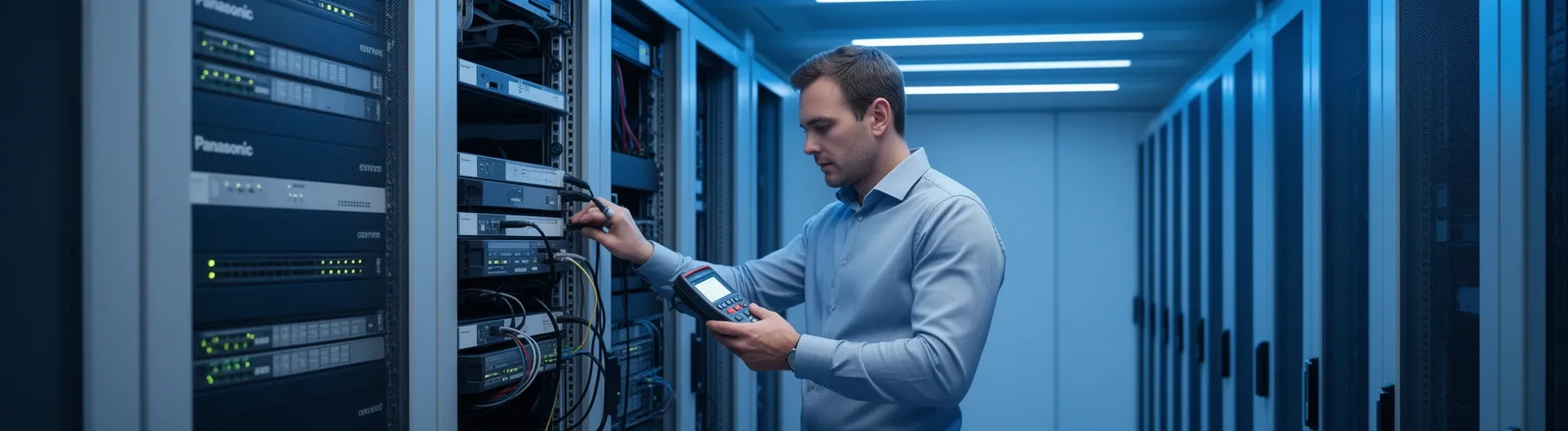

Panasonic switchboard technical service covers fault diagnosis, component-level repair, configuration checks, and parts management for business telephone systems. It addresses line failures, call quality degradation, and programming errors across analogue, digital, and IP-based environments, restoring voice communications with minimal operational disruption.
When a switchboard fails or degrades, the impact is immediate: missed calls, dropped connections, and stalled internal communications. The challenge for most organisations is that Panasonic's general support channels are designed for consumer products, leaving businesses without a clear path to switchboard-specific diagnosis and repair. The gap between logging a generic ticket and getting a qualified engineer to assess your PBX infrastructure can cost hours or days of disrupted operations.
At Impulso Tecnológico, we approach Panasonic switchboard technical support as a structured process: baseline assessment, layered fault isolation, targeted intervention, and preventive routines to reduce recurrence. With over 25 years of experience in IT-managed services and telephony infrastructure, we support organisations across Spain and internationally, handling everything from legacy analogue systems to hybrid VoIP environments. The result is faster resolution, fewer emergency call-outs, and measurable continuity for your voice operations.
What Panasonic Switchboard Technical Service Covers
Switchboard technical service is not a single action — it is a structured set of interventions that spans diagnosis, physical repair, software configuration, and parts coordination. For Panasonic PBX systems, this means addressing the full stack: hardware integrity, firmware state, programming logic, and integration with connected infrastructure such as PSTN lines, IP trunks, or internal wiring.
At Impulso Tecnológico, we frame switchboard maintenance as a business communications reliability challenge rather than a break-fix transaction. Our structured testing protocols verify power levels, signal integrity, and protocol compliance across layers before any intervention is made. This prevents misdiagnosis and avoids replacing components that are not actually faulty — a common and costly mistake in unstructured repair approaches.
The table below outlines the core service areas and what each one involves in practice:
| Service Area | What It Covers | Typical Trigger |
|---|---|---|
| Fault Diagnosis | Power, signal, and protocol layer testing; fault source isolation | Line failure, no dial tone, system freeze |
| Component Repair | Board-level or module-level repair; replacement of degraded parts | Recurring faults, physical damage, component failure |
| Configuration Review | Routing tables, extension programming, trunk settings, dial plans | Dialling errors, missed routing, post-migration issues |
| Call Quality Restoration | Echo, noise, and dropout investigation; wiring and impedance checks | User complaints, intermittent audio issues |
| Parts & Compatibility | Sourcing compatible modules, cards, or replacement units | End-of-life components, failed modules |
| Preventive Maintenance | Scheduled inspections, ventilation checks, firmware updates, config backups | Managed service contracts, post-incident reviews |
Switchboard fault categories: connectivity, power stability, and recurring errors
Switchboard faults cluster into three broad categories, and correctly identifying which category applies determines the entire diagnostic path. Connectivity faults — such as dead lines, dropped extensions, or trunk failures — typically originate in physical wiring, termination quality, or port-level hardware degradation. Power stability faults manifest as unexpected reboots, partial system failures, or corrupted configuration states, and are often linked to power supply irregularities or inadequate surge protection. Recurring errors — such as repeated dialling failures or phantom alarms — usually point to programming inconsistencies, routing table conflicts, or firmware bugs that persist until the root cause is isolated and corrected. Misclassifying a fault at this stage leads to wasted interventions. Our diagnostic process always begins with fault categorisation before any physical or software action is taken.
Call quality troubleshooting: echo, noise, intermittent dropouts, and likely root causes
Call quality problems are among the most reported — and most misdiagnosed — issues in switchboard environments. Echo on calls commonly indicates an impedance mismatch between the switchboard and the connected line, or a feedback loop in analogue trunk interfaces. Persistent background noise often traces back to electromagnetic interference caused by power cables routed alongside network or telephony cabling — a wiring practice issue rather than a hardware fault. Intermittent dropouts in hybrid or VoIP-connected environments frequently point to network congestion, jitter, or packet loss rather than the switchboard itself. Resolving these issues requires testing at multiple points: the switchboard port, the cabling run, the trunk interface, and — in IP environments — the network path. Targeted repair actions follow only after the root cause layer is confirmed, preventing repeat incidents.
Configuration and integration checks for hybrid legacy and VoIP environments
Hybrid environments — where a Panasonic PBX handles both traditional analogue or digital lines and SIP/VoIP trunks simultaneously — introduce configuration complexity that purely reactive repair cannot address. Dial plan conflicts, codec mismatches, and trunk group prioritisation errors are common sources of failure that only appear under specific call conditions. Configuration checks must cover routing logic, trunk failover rules, extension numbering consistency, and integration parameters with any connected IP telephony platform. Parts handling in these environments also requires compatibility verification: a replacement card or module must match not only the physical slot specification but also the firmware version running on the system. At Impulso Tecnológico, we maintain compatibility records for the Panasonic systems we service and coordinate parts sourcing through verified channels to avoid introducing new incompatibilities during repair.
How to Request Panasonic Switchboard Technical Service
The quality of a support request directly determines how quickly a fault gets resolved. A vague description — "the phones aren't working" — triggers a lengthy back-and-forth that delays triage. A well-prepared request, by contrast, allows an experienced engineer to begin remote diagnosis within the first interaction, often resolving issues without an onsite visit.
At Impulso Tecnológico, our intake process is designed to minimise that back-and-forth. We combine baseline monitoring data with structured testing protocols, so when a request arrives with sufficient technical context, we can triage it accurately and assign the right intervention — remote or onsite — from the outset. For Panasonic PBX technical support, the following steps will make your request faster to process and more likely to reach the right specialist without unnecessary escalation delays:
- Identify your equipment: Confirm the exact Panasonic switchboard model, serial number, and installed firmware version before contacting support.
- Document the fault: Record when the issue first appeared, how frequently it occurs, which extensions or trunks are affected, and any error codes displayed on the system.
- Describe your environment: Note whether your setup is analogue, digital, IP, or hybrid, and identify any recent changes (new lines, configuration edits, power events).
- Gather supporting evidence: Export system logs, capture screenshots of error states, and note any call recordings or timestamps that illustrate the fault pattern.
- Choose your contact route: Submit via ticket for non-urgent faults requiring detailed review, or contact directly by phone for active outages requiring immediate remote diagnosis.
- Confirm access availability: If onsite intervention may be required, confirm physical access to the switchboard room and availability of a local contact during the scheduled visit window.
Information checklist: model/serial, topology, firmware context, and fault description
Before submitting a Panasonic switchboard service request, prepare the following data points to avoid delays during triage. The switchboard model and serial number are essential for identifying compatible parts and firmware baselines — without them, a technician cannot verify whether a proposed fix is appropriate for your specific unit. Your network topology context matters too: document how many extensions are connected, which trunk types are in use (PSTN, ISDN, SIP), and whether any IP integration is active. Firmware version information helps identify known bugs or configuration constraints relevant to your fault. Finally, a fault description should include timestamps, affected channels, and observable symptoms rather than conclusions — "extension 204 drops calls after 90 seconds on outbound PSTN calls since Tuesday" is far more actionable than "calls keep dropping."
Routing and escalation: remote diagnosis first, then targeted onsite service
Not every switchboard fault requires a physical visit. A structured escalation path — remote diagnosis first, onsite intervention only when necessary — reduces resolution time and avoids unnecessary disruption to your site. Remote triage covers configuration checks, log analysis, firmware verification, and guided testing that a local contact can perform with clear instructions. If the fault is isolated to a software or programming issue, it is frequently resolved at this stage. Onsite intervention becomes necessary when physical component failure is confirmed, wiring inspection is required, or hardware replacement cannot be performed remotely. At Impulso Tecnológico, we provide both remote and onsite technical intervention across Spain, with remote support coverage for clients in Europe, Asia, and America. Our escalation decisions are evidence-based, not default.
What to expect during triage: testing sequence, isolation of the fault source, and next steps
During triage, a qualified engineer follows a defined testing sequence rather than attempting fixes at random. The process begins with power and hardware verification — confirming that the switchboard is receiving stable power and that no physical alarms are active. It then moves to line and port testing to identify which specific channels or trunks are affected. Configuration integrity is checked next, comparing current settings against the last known-good baseline or standard for the model. If a software or programming fault is identified, correction and verification follow immediately. If a hardware fault is confirmed, the next step is parts assessment and repair planning. Throughout this process, you should expect clear communication at each stage: what was tested, what was found, and what action is proposed. Ambiguity at this stage is a service quality failure, not an acceptable norm.
Service Options, Warranty Considerations, and Ongoing Coverage
Choosing the right service model for your Panasonic switchboard depends on your organisation's risk tolerance, the criticality of voice communications to daily operations, and the age of your installed equipment. Reactive repair — contacting support only when something breaks — is the lowest-cost option in the short term but consistently produces the highest total cost when emergency interventions, extended downtime, and expedited parts sourcing are factored in.
At Impulso Tecnológico, we support organisations that cannot afford prolonged downtime by offering structured preventive maintenance alongside reactive repair capability. Our experience shows that organisations implementing preventive maintenance programmes have consistently reduced service interruptions by up to 40%, and typically see significantly fewer emergency call-outs compared to purely reactive approaches. When evaluating your service options, consider the following factors:
- Equipment age: Older Panasonic PBX models may have limited parts availability, making preventive maintenance more critical to avoid unplanned failures.
- Integration complexity: Hybrid analogue/digital/VoIP environments require more frequent configuration reviews to remain stable as connected systems change.
- Operational criticality: If voice communications are essential to revenue or safety, a managed service contract with guaranteed response times is more appropriate than ad-hoc support.
- Internal IT capacity: Organisations without dedicated telephony expertise benefit from outsourced monitoring and first-response capability to reduce resolution time.
- Warranty status: In-warranty equipment may have specific repair routing requirements; out-of-warranty systems need a clearly defined parts and repair strategy.
- Geographic coverage: Multi-site organisations need a service partner with consistent coverage across locations, not just a local repair shop.
Repair workflow and turnaround drivers: parts availability, diagnostics depth, and integration complexity
The time from fault report to return-to-service depends on three primary variables: how quickly the fault is isolated, whether compatible parts are immediately available, and how complex the integration environment is. A straightforward configuration error on a standalone Panasonic PBX can be resolved remotely within hours. A failed line card on an older model with limited parts availability may require sourcing from specialist channels, extending the timeline to several business days. Integration complexity adds a further variable: in hybrid environments where the switchboard connects to SIP trunks, IP phones, and legacy analogue lines simultaneously, post-repair verification must confirm that all connected systems are functioning correctly before the service is signed off. Our service depot and repair coordination process includes a defined return-to-service checklist to prevent partial resolutions that generate repeat call-outs.
Warranty and documentation: what information to keep for smoother approvals and traceability
Warranty claims and service approvals move faster when documentation is maintained proactively rather than assembled under pressure during an outage. For Panasonic switchboard systems, the minimum documentation set should include: the original purchase invoice with model and serial number, the installation record (date, configuration baseline, and installer details), a log of all previous service interventions with dates and outcomes, and the current firmware version. Configuration backups — stored securely and updated after any programming change — are equally important: they allow rapid restoration after hardware replacement and serve as evidence of the system state prior to a fault. For organisations subject to GDPR or sector-specific compliance requirements, call logging and access records may also need to be retained as part of the service audit trail. Keeping this documentation current costs very little effort but can save significant time during warranty processing or escalated fault investigations.
Managed service models: preventive maintenance, remote visibility, and flexible onsite coverage
A managed service model for switchboard support replaces unpredictable emergency costs with a structured, predictable programme of preventive care and defined response commitments. For Panasonic PBX environments, this typically includes scheduled maintenance visits (covering physical inspections, ventilation checks, firmware updates, and configuration backups), remote monitoring to detect performance anomalies before they escalate into failures, and guaranteed response times for fault reports during business hours. At Impulso Tecnológico, our managed service agreements are flexible — no rigid contracts or generic packages — and are designed around the specific architecture and operational requirements of each client. This model is particularly well-suited to organisations managing hybrid telephony environments or multi-site deployments, where consistent oversight across the full infrastructure is more effective than site-by-site reactive repair. For further context on broader telephony infrastructure management, our resources on telephone switchboard maintenance and installation and maintenance of telephone systems cover complementary service considerations.
Aligning your internal process with a switchboard-specific support workflow is the most direct way to shorten resolution time and protect daily voice operations. That means having your equipment documentation ready, understanding your escalation path before a fault occurs, and choosing a service model that matches your operational risk — not just your immediate budget. If your Panasonic switchboard is already showing signs of instability, or if you are managing a hybrid environment without a structured maintenance programme in place, now is the right time to review your coverage. Impulso Tecnológico is available to assess your current setup and recommend a service approach tailored to your architecture. You can also explore our guidance on telephone exchange repair and VoIP for businesses for related technical considerations.