

Telephone switchboards in Madrid cover the full stack: hardware or cloud PBX, extension configuration, call routing, line management, and ongoing technical support. The right system depends on your site count, voice environment (analogue, digital, VoIP or hybrid), and how much control you need over call traffic and costs.
For many Madrid businesses, choosing a telephone switchboard is not a straightforward hardware decision — it is a commitment that shapes how every call enters, routes through and exits the organisation. Get it wrong and you face dropped calls, inflexible routing, and support gaps that surface at the worst possible moment. Get it right and you gain a communication backbone that scales with headcount, integrates with your CRM or ERP, and gives you clear visibility over call traffic and charges.
At Impulso Tecnológico, we have spent over 25 years installing, configuring, maintaining and reprogramming telephone switchboards across Madrid and Spain. Our approach covers analogue, digital, IP (VoIP) and hybrid environments — because most organisations do not migrate overnight. This guide walks through what a switchboard service in Madrid actually includes, how to compare cloud versus on-premise options, and what to check before signing with any provider.
What "Telephone Switchboards Madrid" typically includes
When a Madrid business searches for telephone switchboards, the intent usually spans several layers: the physical or virtual PBX unit, the extensions connected to it, the trunk lines linking it to the public network, and the programming that determines how calls are handled. Beyond the core hardware or platform, a complete switchboard service also covers configuration, ongoing maintenance, repair, reprogramming when the organisation changes, and — increasingly — software tools for call traffic analysis and cost control.
Impulso Tecnológico designs routing to match how each organisation actually operates, whether that is a single Madrid office or a multi-site setup requiring centralised connectivity. The service covers analogue, digital, IP (VoIP) and hybrid environments, and includes ongoing technical service and reprogramming as needs evolve. The table below maps the main service layers to what buyers typically need at each stage.
| Service layer | What it covers | Typical need |
|---|---|---|
| Hardware / platform | PBX unit or cloud PBX licence, handsets, gateways | All deployments |
| Extensions & trunks | Internal extensions, SIP trunks, analogue/ISDN lines | All deployments |
| Call routing & IVR | Incoming call flows, auto-attendant, time-based rules | Multi-user or multi-site |
| Installation & configuration | Physical or remote setup, programming, testing | New deployments & migrations |
| Maintenance & repair | Preventive checks, fault diagnosis, part replacement | Ongoing operations |
| Traffic control & reporting | Call logs, tariffication, cost allocation by extension | Cost-conscious or regulated environments |
| Integrations | CRM/ERP connectivity, mobile extensions, softphones | Modern workflows & remote teams |
Switchboard scope: extensions, routing and call handling
At its core, a business telephone system consists of four elements: the PBX (the switching engine, physical or virtual), the extensions assigned to users or departments, the trunk lines connecting the system to the public telephone network, and the routing logic that decides what happens to each call. Routing logic is where most of the operational value lives — defining which extension rings first, how long before a call diverts, what happens outside office hours, and how calls are queued or transferred between departments. For a Madrid business with multiple teams or locations, well-designed call routing directly reduces missed calls and improves response times. Impulso Tecnológico programmes routing to reflect each organisation's actual structure, not a generic template.
Line types and voice environments: analog, digital, IP and hybrid
Madrid businesses operate across a wide spectrum of voice environments. Older installations rely on analogue lines (POTS) or digital ISDN circuits (BRI/PRI); newer deployments use SIP trunks over broadband for VoIP switchboard connectivity. Each has different cost profiles, reliability characteristics and compatibility requirements. Analogue lines are simple and resilient but limited in capacity; ISDN offers more channels but is being phased out by carriers; SIP trunks scale easily and reduce per-call costs but depend on network quality. Hybrid setups — where a PBX bridges analogue or digital lines with IP extensions — are common in organisations that cannot migrate everything at once. Impulso Tecnológico supports all four environments and helps clients transition to IP voice at a pace that does not risk operational continuity.
Service coverage: installation, configuration, maintenance and reprogramming
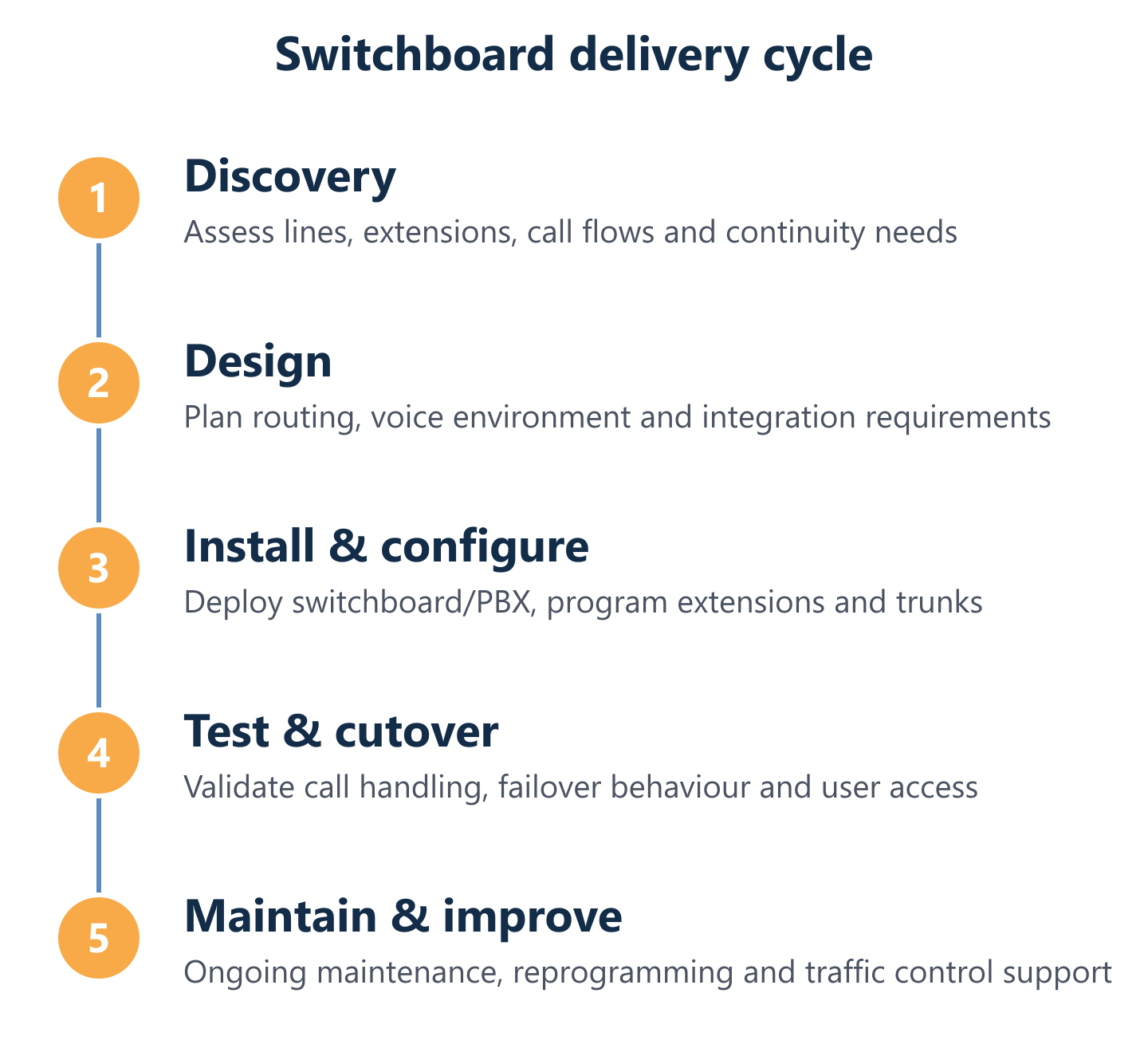
A switchboard project does not end at installation. Once the system is live, it needs configuration that matches the organisation's call flows, followed by ongoing maintenance to prevent faults and reprogramming whenever the business changes — new staff, restructured departments, additional sites. For organisations that need visibility over call volumes and costs, an additional software layer handles call reporting and traffic control. Impulso Tecnológico's cHar uTile Company solution, for example, provides exhaustive control of switchboard traffic and supports tariffication needs across Madrid and Spain. This operational software layer is often overlooked in initial procurement but becomes critical for finance teams and compliance requirements. Linking telephony to broader IT management — including installation and maintenance of telephone systems — ensures the switchboard remains aligned with the rest of the infrastructure.

Cloud PBX vs on-premise switchboards for Madrid businesses
The choice between a cloud PBX and an on-premise switchboard is not simply a technology preference — it is a risk and operations decision. Cloud PBX platforms deliver extensions and routing over the internet, requiring no local hardware beyond handsets or softphone clients. On-premise systems place the switching engine inside the building, giving direct control over call handling and independence from internet availability. Neither model is universally superior; the right answer depends on site count, internet reliability, budget structure and how much internal IT capacity the organisation has.
Impulso Tecnológico supports hybrid migrations precisely because most Madrid businesses sit between these two poles. A company with a legacy Alcatel-Lucent or Panasonic PBX may not be ready to abandon it, but can add SIP trunks and IP extensions to gain VoIP benefits without a full replacement. The key is matching the deployment model to operational reality:
- Assess your internet reliability — cloud PBX depends entirely on broadband uptime; on-premise does not.
- Map your site structure — single-site organisations have more flexibility; multi-site setups often benefit from centralised cloud management.
- Evaluate your existing hardware — if your current PBX is serviceable, a hybrid approach extends its life while adding IP capabilities.
- Define your support model — cloud platforms shift maintenance to the provider; on-premise keeps it with your IT team or MSP.
- Consider growth trajectory — cloud scales by adding licences; on-premise scales by adding cards or gateways, which has physical limits.
- Plan for continuity — both models need a documented failover plan; the mechanism differs significantly between them.
For organisations that need integration-friendly approaches between traditional and modern systems, Impulso Tecnológico aligns telephony decisions with the broader IT environment, ensuring the PBX installation and maintenance model fits the company's long-term roadmap rather than creating a new silo.
Pros and cons: cloud PBX for speed vs on-premise for control
Cloud PBX platforms provision new extensions in minutes, require no on-site hardware investment, and allow remote management from any location — a clear advantage for distributed teams or organisations with mobile users. Updates and security patches are applied by the provider, reducing the maintenance burden on internal IT. The trade-off is dependency: if the internet connection or the provider's platform goes down, so does telephony. On-premise switchboards invert this profile. The hardware is local, call handling continues independently of internet availability, and the organisation retains direct control over programming and routing. The downside is higher upfront cost, physical space requirements, and the need for qualified technicians — such as those at Impulso Tecnológico — for maintenance, repair and reprogramming. For Madrid businesses in regulated sectors or with strict continuity requirements, on-premise control often outweighs the convenience of cloud provisioning.
Continuity planning: backup lines, failover and outage behaviour
Every telephone switchboard deployment needs a documented answer to one question: what happens when the primary connection fails? For cloud PBX systems, this typically means configuring automatic call forwarding to mobile numbers or a secondary SIP trunk provider when the main internet circuit drops. Some platforms offer WebRTC-based fallback or backup lines that activate without manual intervention. For on-premise switchboards, continuity depends on having analogue backup lines or a secondary ISDN/SIP trunk that the PBX can route calls through automatically. Hybrid setups can combine both approaches — the on-premise PBX handles local calls independently while cloud trunks provide geographic redundancy. Impulso Tecnológico builds continuity planning into every switchboard project, ensuring that failover behaviour is tested before go-live, not discovered during an outage. This is particularly relevant for Madrid businesses in logistics, healthcare or professional services where call availability is operationally critical.
Integrations and workflow fit: CRM/ERP, mobile extensions and call reporting
A modern business telephone system should connect to the tools your teams already use. CRM integration — linking incoming calls to customer records automatically — reduces handling time and improves service quality. ERP connectivity enables call cost allocation by department or project, which is valuable for professional services firms billing time. Mobile extensions allow staff to receive and make calls through the company's number from a smartphone, maintaining a professional identity regardless of location. Call reporting and traffic control software adds another layer: managers can analyse call volumes by extension, identify peak hours, and allocate costs accurately. Impulso Tecnológico's approach to VoIP for businesses includes integration-friendly implementations that connect telephony to broader workflows, rather than treating the switchboard as an isolated system. For organisations exploring automation, these integrations can also feed into wider workflow tools, improving how calls trigger actions in other business systems.
Choosing a provider in Madrid: checklist and pricing factors
Selecting a telephone switchboard provider in Madrid requires evaluating more than the headline price. The total cost of ownership includes hardware, software licences, installation, programming, ongoing maintenance, and the support model that covers you when something goes wrong. Providers who quote only the hardware often leave configuration, reprogramming and traffic control software as billable extras — which adds up quickly in the first year.
Impulso Tecnológico's multi-brand experience — covering Alcatel-Lucent, LG Nortel, Panasonic, NEC Philips, Neris, Siemens and Asterisk — means the recommendation is driven by what fits the client's environment, not by a single vendor relationship. Nationwide maintenance coverage and authorised technicians reduce migration risk and ensure that reprogramming is available as the organisation evolves.
Use the following criteria to evaluate any provider before requesting a formal quote:
- Brand coverage: Can they work with your existing hardware, or will they push a full replacement regardless of its condition?
- Service scope: Does the offer include installation, configuration, programming, maintenance and repair — or only some of these?
- SLA clarity: What are the committed response and resolution times? Are they differentiated by fault severity?
- Support model: Is ongoing technical support included, or billed per incident? What is the escalation path for complex faults?
- Migration approach: Do they support hybrid deployments, or require a full cutover? Can they handle number portability?
- Traffic control: Is call reporting and tariffication software included, or an optional add-on?
- Scalability: How does the system grow — additional licences, hardware cards, or a platform change?
- Testing before go-live: Is there a formal acceptance test before the old system is decommissioned?
- Contract flexibility: Are you locked into a multi-year term, or can the service model adapt as your needs change?
For a deeper look at what the installation process involves, the guide on switchboard installation for businesses covers the technical steps in detail.
Provider checklist: support model, SLAs, testing and escalation paths
The support model is where most switchboard contracts reveal their true cost. A provider who offers fast installation but slow fault response creates operational risk every time an extension fails or a routing rule breaks. Before signing, confirm the following: What is the guaranteed response time for a total system outage versus a single extension fault? Is support delivered remotely, on-site, or both? Who is the escalation contact for unresolved issues, and what is the maximum resolution time? Does the contract include a formal acceptance test after installation, with documented call routing verification? Are software updates and reprogramming included, or billed separately? Impulso Tecnológico structures its service agreements to answer these questions clearly, with SLA-backed response commitments and a defined escalation path — avoiding the ambiguity that often surfaces when a fault occurs outside normal business hours.
Migration and onboarding: timelines, number portability and risk controls
Number portability is non-negotiable for most Madrid businesses: keeping existing DDI numbers avoids reprinting materials and preserves customer recognition. The portability process in Spain typically takes between five and fifteen working days depending on the carrier and number type, so migration timelines must account for this window. A well-managed switchboard migration runs in parallel — the new system is configured and tested while the old one remains live, with a defined cutover point agreed in advance. Risk controls include a rollback plan if the cutover fails, a documented test script covering all call flows, and staff briefing before go-live. Impulso Tecnológico manages this process for clients transitioning between analogue, digital and IP environments, ensuring that the migration does not create a gap in call handling. For organisations with complex multi-site setups, a phased migration — site by site — further reduces exposure.
Pricing factors: what should be included in a complete switchboard offer
A complete switchboard offer for a Madrid business should itemise at minimum: hardware or platform licence, installation and physical cabling (if applicable), initial programming and routing configuration, user training, first-year maintenance, and the support model. Anything not listed is likely to appear as a billable extra. Common omissions include reprogramming when staff or departments change, call reporting software, and on-site visits beyond the initial installation. For cloud PBX, check whether the monthly fee includes the SIP trunks and number of concurrent calls, or whether these are metered separately. For on-premise systems, factor in hardware warranty terms and the cost of spare parts. Impulso Tecnológico provides transparent service agreements that define what is included in ongoing managed services — aligned with the broader business telephone switchboard solutions model — so clients can budget accurately from the outset.
Matching the switchboard type, features and support model to your Madrid operations reduces risk from the moment calls go live. Whether you are replacing ageing hardware, migrating from analogue to VoIP, or evaluating a cloud PBX for the first time, the decisions made during provider selection and system design shape call quality, cost visibility and operational flexibility for years ahead. Impulso Tecnológico combines over 25 years of switchboard expertise with a multi-brand, multi-environment approach — so the recommendation you receive is based on your actual infrastructure, not a preferred vendor catalogue. Contact us to discuss your requirements and receive a tailored assessment.