

Telephone switchboard configuration in Madrid means programming your PBX system so that call routing, extension plans, user permissions, and trunk assignments match how your organisation actually works—not just connecting cables and powering on hardware.
Many Madrid businesses discover this distinction only after a failed installation: the switchboard is physically in place, but calls land on the wrong extensions, permissions are misconfigured, and no one can explain the billing. The root cause is almost always incomplete configuration rather than faulty hardware. A properly configured system defines every inbound, internal, and outbound call flow, assigns permissions by user role, and integrates analog, digital, or IP/VoIP lines into a coherent whole.
At Impulso Tecnológico, we have spent over 25 years resolving exactly these scenarios across Spain, including extensive work in Madrid districts such as Chamartín, Salamanca, Tetuán, and Centro. Our approach covers the full configuration lifecycle—from initial design and programming through ongoing reprogramming and maintenance—so your system stays aligned with your teams as they grow and change.
What "Telephone Switchboard Configuration Madrid" really includes
When a Madrid company requests telephone switchboard configuration, the scope is frequently underestimated. Configuration is not synonymous with installation. Installation places hardware; configuration defines behaviour. A fully configured PBX determines how every call enters the system, which extension or group it reaches, what happens when no one answers, which users can dial external numbers, and how the system responds outside business hours.
For a single-site office in Madrid, this means programming inbound routing rules, building an extension plan, assigning trunk groups to outgoing call profiles, and setting time-based schedules. For multi-site organisations—a head office in Salamanca district plus a warehouse in Arganzuela, for example—configuration also covers inter-site connectivity, centralised attendant services, and consistent dialling plans across locations.
Impulso Tecnológico aligns every configuration decision with the client's operating model before touching the system. After go-live, we continue with reprogramming support so that staff changes, departmental reorganisations, or new branch openings do not leave the switchboard out of sync with reality.
| Configuration Element | Single-Site Setup | Multi-Site / Branch Setup |
|---|---|---|
| Inbound call routing | DID to extension or hunt group | Centralised routing with site-based overflow |
| Extension plan | Sequential numbering (e.g., 100–199) | Site-prefixed plan (e.g., 1xx Madrid, 2xx Barcelona) |
| Trunk assignment | Single trunk group for all outbound | Per-site trunks with centralised failover |
| User permissions | Role-based (reception, staff, management) | Role + site matrix with inter-site free calls |
| Out-of-hours handling | Voicemail or announcement | Redirect to duty site or mobile group |
| Technology layer | Analog, digital, IP, or hybrid | IP/VoIP preferred; hybrid for legacy lines |
Core components: switchboard, extensions, trunks, and routing tables
Every PBX configuration in Madrid rests on four interdependent components. The switchboard (PBX or IP-PBX) is the processing core that applies all rules. Extensions are the internal endpoints—desk phones, softphones, or mobile apps—each with a unique number and permission profile. Trunks are the external connections: analog PSTN lines, ISDN PRI circuits, or SIP trunks for VoIP. Routing tables tie everything together, specifying which trunk handles which outbound call category (local, national, international, mobile) and which extension or group receives each inbound call.
Misconfiguring any one of these layers creates operational problems: calls that drop, extensions that cannot reach outside lines, or international calls routed through expensive trunks when cheaper SIP alternatives exist. Correct call routing configuration is therefore the foundation of a functional and cost-efficient telephony system.
Configuration outcomes: consistent call handling and predictable behaviour
A well-configured switchboard produces measurable, predictable outcomes: every inbound call reaches the right person or group on the first attempt, every outbound call uses the correct trunk and permission level, and the system behaves identically whether it is Monday morning or Friday afternoon. This predictability is what separates a configured system from a merely installed one.
User permissions and the extension plan are central to this. Defining who can call what—and when—prevents unauthorised international calls, controls costs, and ensures that reception staff, field teams, and executives each have a telephony profile that matches their role. A structured extension plan also simplifies future reprogramming: adding a new employee or department does not require redesigning the entire dial plan, only inserting a new record into an already logical structure.
Ongoing support expectations: programming, reprogramming, and maintenance
Configuration is not a one-time event. Madrid businesses reorganise teams, open new offices, change operators, and adopt new devices—each change potentially invalidating part of the original programming. Ongoing reprogramming support ensures the switchboard reflects the current state of the organisation rather than a snapshot from the installation date.
For hybrid environments that combine analog or digital lines with IP/VoIP extensions, this is especially important. A hybrid configuration may use traditional PSTN trunks for outbound reliability while routing internal calls over IP, and adding a SIP trunk or a new IP extension requires updating routing tables, codec profiles, and permission groups simultaneously. Impulso Tecnológico provides this programming and reprogramming service as part of its technical support offering, covering analog, digital, and IP switchboards from brands including Alcatel Lucent, Panasonic, NEC-Philips, and Asterisk.

Choosing the right configuration approach for your business
Selecting a configuration path is a technical and operational decision, not a purchasing one. The right approach depends on your current infrastructure, your continuity requirements, your growth plans, and the degree of flexibility you need. Impulso Tecnológico uses a multibrand methodology—working with Alcatel Lucent, Panasonic, NEC-Philips, LG Nortel, Siemens, and Asterisk, among others—so the recommendation is always driven by fit rather than stock availability.
- Audit your existing lines and hardware. Identify which trunks are analog, ISDN, or SIP, and which extensions are physical versus softphone. This determines what can be reused and what must be replaced.
- Define your continuity threshold. If a telephony outage costs more than the migration investment, a phased hybrid approach is safer than a full IP cutover.
- Map your routing complexity. A single-site office with ten extensions has different configuration needs than a Madrid headquarters managing calls for five regional branches.
- Assess mobility requirements. Teams that work across locations or from home need IP extensions or mobile integration; analog-only configurations cannot support this reliably.
- Establish cost control targets. Decide whether call traffic and billing control software is required from day one—particularly relevant for Madrid businesses with high outbound call volumes or multiple cost centres.
- Choose the technology layer. Based on the above, select analog, digital, IP/VoIP, or hybrid as the primary configuration model, with a clear roadmap for future migration if starting from a legacy base.
Analog vs digital vs IP/VoIP: pros, cons, and typical use cases
Analog configurations are the most resilient during power or network failures but offer the fewest features and the highest per-call costs for long-distance traffic. They suit very small offices or backup line scenarios. Digital (ISDN BRI/PRI) configurations deliver better call quality and more simultaneous channels than analog, but ISDN is being phased out across Spain, making new digital deployments a short-term solution at best.
IP/VoIP configurations deliver the strongest feature set—mobile extensions, softphones, call recording, unified communications—at lower per-minute costs, particularly for inter-site and international traffic. The migration strategy that Impulso Tecnológico recommends for most Madrid businesses is a structured move to IP voice, preserving at least one analog or digital trunk as a fallback during the transition period to maintain business continuity throughout the cutover.
Hybrid configurations: when you need continuity and gradual modernisation
A hybrid configuration runs analog or digital trunks alongside SIP trunks and IP extensions on the same PBX. This is the most common scenario Impulso Tecnológico encounters in Madrid: a company with an existing Panasonic or Alcatel Lucent system that wants to add IP extensions for remote workers without replacing the entire infrastructure.
The practical benefit is risk reduction. If the SIP provider experiences an outage, calls automatically fail over to the PSTN trunk. Cost flexibility also improves: local and national calls can be routed over SIP to reduce charges, while critical lines retain PSTN reliability. Scalability is straightforward—new IP extensions are added without cabling, and SIP trunk capacity can be increased within hours. For organisations with multiple Madrid locations, a hybrid model allows each site to modernise at its own pace while sharing a centralised dial plan.
Decision checklist: routing complexity, mobility needs, and branch connectivity
Before committing to a configuration model, verify these criteria against your actual requirements. Routing complexity: if you need time-based routing, multi-level IVR, or skill-based call distribution, only IP or hybrid configurations can support this reliably. Mobility needs: remote or mobile workers require IP extensions or a mobile integration module; this rules out pure analog setups. Branch connectivity: linking two or more Madrid offices under a single dial plan requires IP trunking between sites, which is far more cost-effective than traditional leased lines.
Vendor and feature fit matter too. Impulso Tecnológico's multibrand approach—covering Alcatel Lucent, Panasonic, NEC-Philips, LG Nortel, Siemens, and open-source Asterisk—means the configuration recommendation is matched to the platform that best supports your specific routing and permission requirements, rather than defaulting to a single vendor's catalogue. For further context on full switchboard installation projects, our guide on switchboard installation for businesses covers hardware selection in detail.
Implementation and optimisation: from design to stable operations
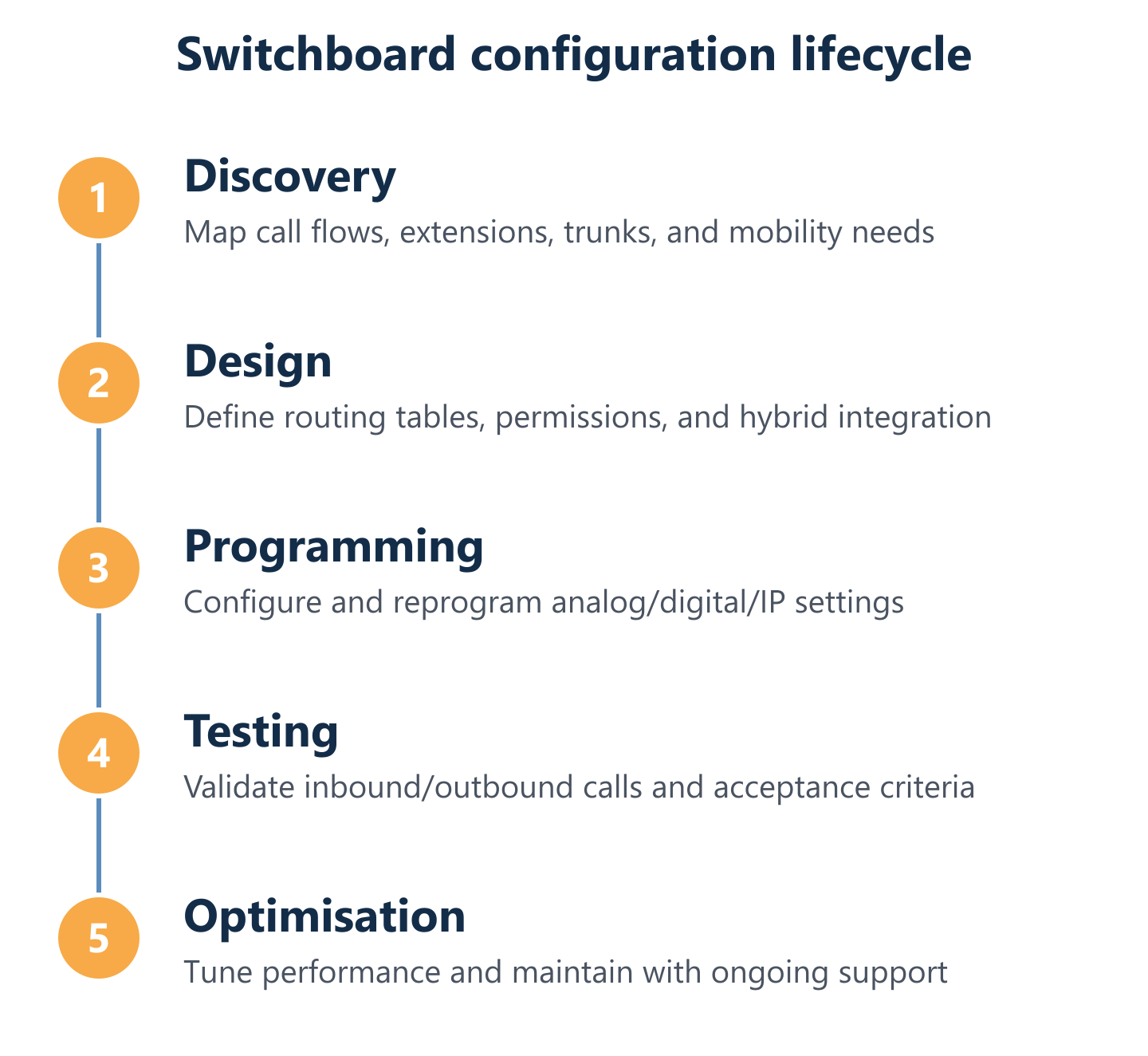
A reliable PBX configuration follows a defined lifecycle. Skipping any phase—particularly testing and post-launch optimisation—is the most common reason Madrid businesses end up with systems that work on paper but fail in daily use. Impulso Tecnológico structures every engagement around this lifecycle, continuing with configuration updates, maintenance, and repairs well after the initial go-live.
- Discovery: Document current trunks, extensions, call volumes, routing requirements, and any existing hardware or contracts that must be preserved.
- Design: Produce a written configuration specification covering the extension plan, trunk groups, routing tables, permission profiles, and time schedules before touching the system.
- Programming: Enter the configuration into the PBX in a controlled environment, following the specification. For IP systems, this includes SIP trunk registration, codec selection, and QoS parameters.
- Testing: Validate every call flow defined in the specification—inbound, internal, outbound, out-of-hours, and failover scenarios—against documented acceptance criteria.
- Go-live: Cut over with a fallback plan in place. For hybrid migrations, keep legacy lines active for a defined period to catch any routing gaps.
- Post-launch optimisation: Review call traffic reports, adjust routing rules based on real usage patterns, and update permissions as the organisation evolves.
- Ongoing maintenance: Schedule preventive checks, apply firmware updates, and respond to repair requests to protect daily operations across Madrid and the rest of Spain.
- Call traffic and billing control: Deploy software tools—such as cHar uTile Company, which Impulso Tecnológico supports—to give management exhaustive visibility over switchboard usage and charges, enabling cost centre reporting and anomaly detection.
Configuration workflow: design, programming, testing, and acceptance criteria
The configuration workflow begins with a written specification, not with a screwdriver. Every routing rule, extension number, permission level, and time schedule must be agreed and documented before programming starts. This document becomes the acceptance criteria: at the end of testing, every item in the specification is verified against live system behaviour.
Reprogramming follows the same discipline. When an organisation changes—a new department, a restructured team, a new Madrid branch—the specification is updated first, then the changes are applied and retested. This approach prevents the accumulation of undocumented configuration changes that eventually make the system impossible to troubleshoot. Impulso Tecnológico maintains configuration records for all managed clients, so reprogramming requests are executed against a known baseline rather than an unknown state. For businesses considering a broader telephony upgrade, our resource on VoIP for businesses explains the IP migration process in full.
Optimisation after go-live: tuning routing, permissions, and performance
The first two to four weeks after go-live reveal routing assumptions that did not survive contact with real call patterns. Common findings include hunt groups that are too large (calls queue unnecessarily), permission profiles that are too restrictive (sales staff cannot reach mobile numbers), and time schedules that do not match actual business hours. Post-launch optimisation addresses these gaps systematically.
Call traffic and billing control software is the primary tool for this phase. By analysing call logs—volume by extension, cost by trunk, unanswered call rates by time of day—it becomes possible to make data-driven routing adjustments rather than guesses. Impulso Tecnológico supports cHar uTile Company for this purpose, giving Madrid clients granular visibility over switchboard traffic and charges across all sites and cost centres, which directly supports both cost reduction and operational accountability.
Operational governance: documentation, change management, and support
A switchboard without documentation is a liability. When the engineer who configured the system is unavailable and a routing fault occurs at a critical moment, undocumented configurations can take hours to diagnose. Operational governance means maintaining an up-to-date configuration record, a change log, and a defined process for requesting and approving modifications.
For Madrid businesses, this governance also covers physical maintenance and repair. PBX hardware requires periodic checks—power supply health, card seating, firmware currency—to prevent failures that disrupt daily operations. Impulso Tecnológico provides maintenance and repair services for the switchboard brands it supports, ensuring that both the configuration and the hardware remain in a known, reliable state. Clients managing multiple Madrid locations or hybrid analog/IP environments will find further operational detail in our article on installation and maintenance of telephone systems.
Telephone switchboard configuration in Madrid is a technical discipline that extends well beyond the installation day. The routing rules, extension plans, permissions, and traffic controls you put in place at the start will need to evolve as your organisation does—and the quality of your ongoing support determines whether the system keeps pace or falls behind. Impulso Tecnológico combines technical depth across analog, digital, and IP telephony with a flexible service model, so your configuration stays accurate, your costs stay visible, and your teams stay reachable. If you are ready to review your current setup or plan a new configuration, the next step is a direct conversation about your specific requirements.