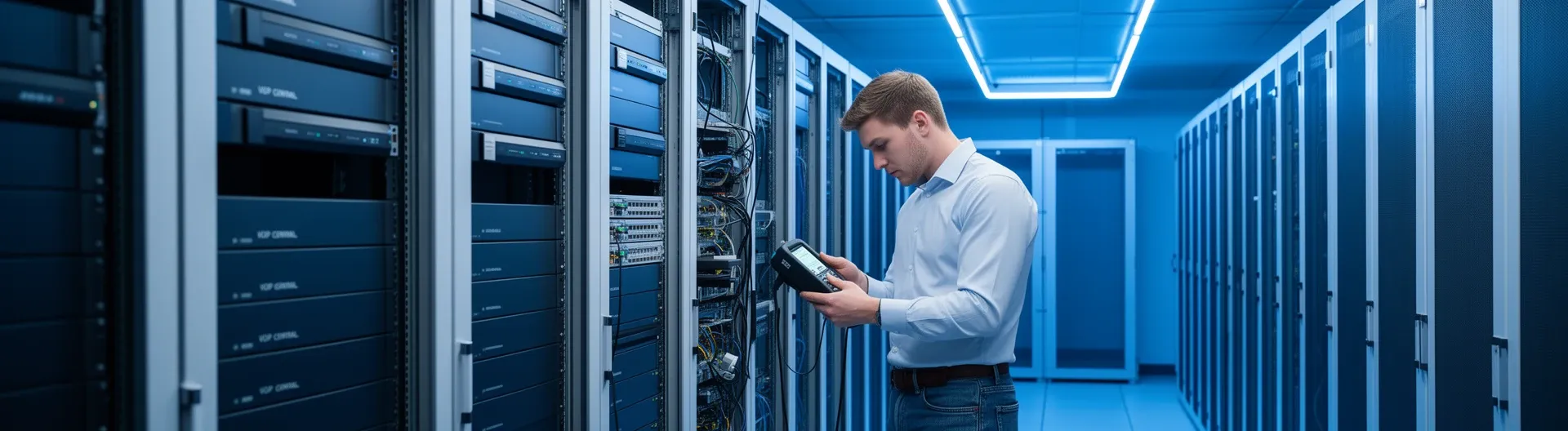

Telephone exchange repair restores business communication by identifying the root cause of a fault—whether in power supply, line interface, wiring, or software—then applying a controlled intervention followed by end-to-end verification testing to confirm full call functionality before the system returns to service.
A failed dial tone, persistent call drops, or intermittent echo rarely points to a single obvious component. In practice, these symptoms can originate at any layer of the system: physical wiring degradation, power irregularities, module failure, programming corruption, or conflicts introduced by VoIP integration. Without structured diagnosis, technicians risk replacing parts that were never faulty—wasting time and budget while leaving the actual fault unresolved.
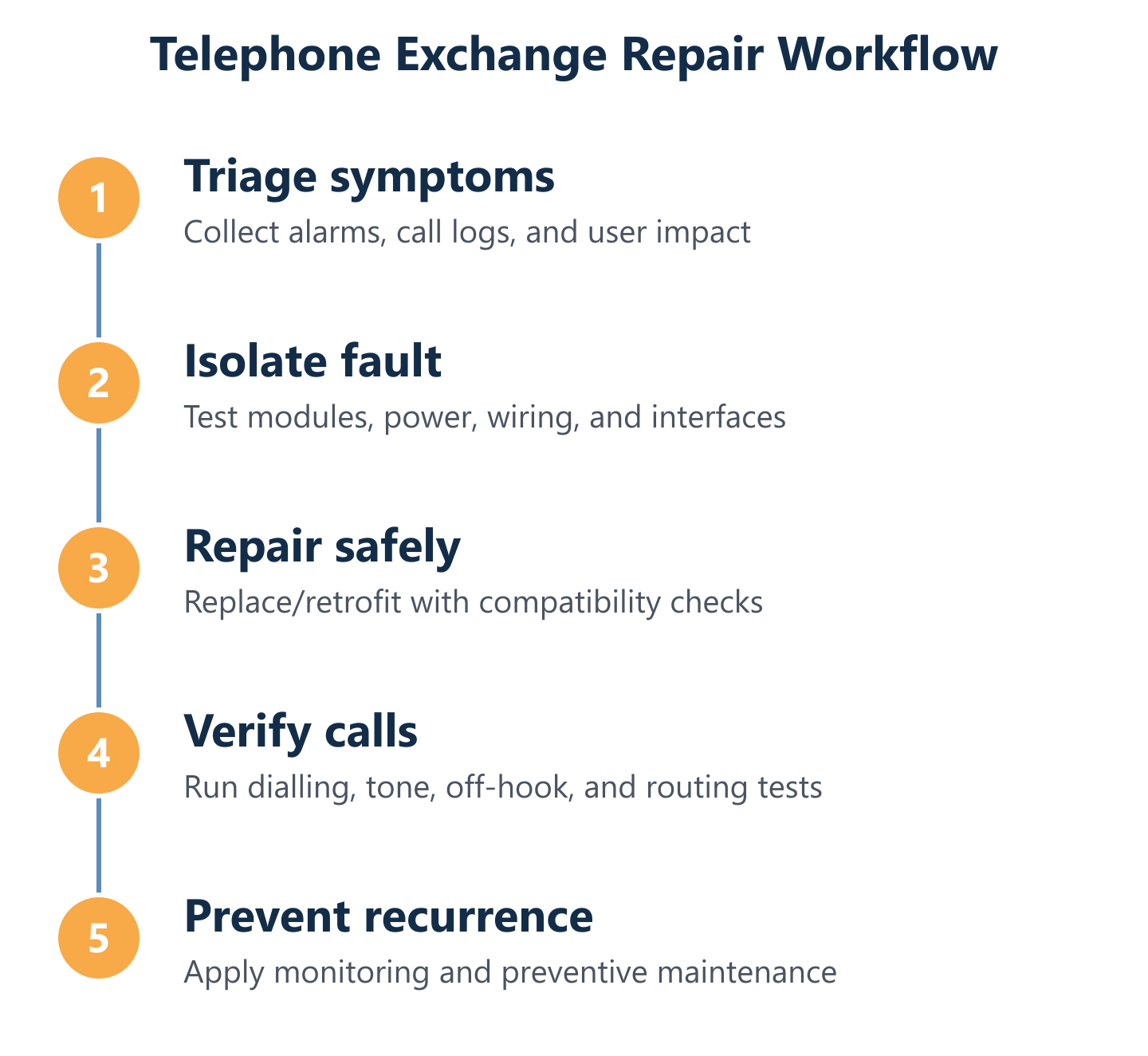
At Impulso Tecnológico, telephone exchange repair follows a methodical process: isolate the fault source, apply the right intervention, verify functionality end-to-end, and implement preventive monitoring so the same pattern does not recur. With over 25 years supporting telephony infrastructure across analog, digital, and IP-based environments, our team handles everything from legacy switchboard faults to hybrid architecture conflicts—across Spain, Portugal, and remote locations internationally.
Diagnosing Telephone Exchange Repair Faults (Step-by-Step)
Effective telephone exchange repair begins before any component is touched. Technicians who skip structured diagnosis and move straight to part replacement routinely resolve the visible symptom while leaving the underlying cause intact—resulting in repeat failures within weeks. The diagnostic phase maps reported symptoms to the system layer most likely responsible, narrows the fault through isolation testing, and documents findings so that any subsequent intervention is targeted and traceable.
Impulso Tecnológico applies this structured approach across analog, digital, and IP-based environments, including hybrid switchboard deployments where a VoIP integration conflict can produce symptoms that closely resemble a hardware fault. Distinguishing between the two requires protocol-level verification, not just visual inspection.
| Symptom | Most Likely Fault Layer | Primary Diagnostic Action | Risk if Skipped |
|---|---|---|---|
| No dial tone on all extensions | Power supply or main switching module | Measure DC rail voltages; check system LEDs and alarm log | Replacing line cards when PSU is the root cause |
| No dial tone on specific extensions | Line interface card or individual port | Swap extension to known-good port; test card in isolation | Replacing the exchange when only one card is faulty |
| Call drops after 30–90 seconds | Routing table, trunk configuration, or VoIP session timer | Capture call logs; verify SIP session parameters and routing entries | Physical repair work on a software/configuration fault |
| Echo or noise on calls | Wiring (impedance mismatch, EMI) or hybrid balance | Inspect cable routing, shielding, and termination quality | Replacing handsets or cards without resolving wiring interference |
| Dialling errors or incorrect routing | Dial plan / programming / routing table corruption | Review dial plan configuration; compare against last known-good backup | Hardware intervention on a purely software fault |
Common symptoms: no dial tone, call drops, echo, and dialling errors
Every symptom in a telephone exchange maps to one or more system layers: power, line interface, switching fabric, wiring infrastructure, or software and configuration. A complete loss of dial tone across all extensions points immediately to the power supply or the central switching module, whereas the same symptom on a single extension narrows the search to a specific line interface card or port. Call drops that occur at a consistent interval—commonly 30 or 90 seconds—are almost always a routing or session-timer issue rather than a hardware failure. Echo and noise complaints require wiring investigation: impedance mismatches, electromagnetic interference from nearby power cables, and poor terminations are the most frequent causes. Dialling errors, such as calls reaching the wrong destination or failing mid-dial, indicate dial plan corruption or routing table inconsistencies, which become more common after software updates or partial VoIP migrations. Mapping symptoms to layers before opening any equipment is the first discipline of professional telephone exchange repair.
Initial checks: power stability, LEDs/alarms, and physical connection verification
Before any module is removed, three initial checks establish the baseline condition of the exchange. First, measure the power supply output rails against the manufacturer's specified tolerances—voltage sag or ripple under load is a common cause of intermittent faults that are otherwise invisible during a static inspection. Second, read the system's LED indicators and alarm log: most digital PBX platforms record fault codes that pinpoint the affected card slot, trunk, or software process. Third, inspect all physical connections—backplane connectors, trunk terminations, and earthing points—for corrosion, looseness, or mechanical damage. These three steps take less time than a module swap and frequently identify the fault without any further intervention. Isolation by modules—disabling or substituting one card at a time while monitoring system behaviour—then confirms which component is responsible, preventing unnecessary replacements and keeping the repair scope controlled and cost-efficient.
Fault isolation: module-by-module testing and wiring/environment checks
Once initial checks have narrowed the likely fault layer, module-by-module isolation confirms the diagnosis. Each card or trunk interface is tested individually—substituted with a known-good unit where available—while call completion and signal integrity are monitored at each stage. For wiring faults, the inspection extends beyond the exchange cabinet: cable routing is checked for proximity to fluorescent lighting, electric motors, and high-voltage equipment, all of which introduce electromagnetic interference. Twisted-pair cabling is verified for correct shielding continuity and termination impedance, following manufacturer specifications. Loose or corroded terminations are a frequent source of intermittent faults that only appear under load or temperature variation. Signal integrity testing—measuring loop current, insulation resistance, and noise floor—confirms whether the physical plant meets the exchange's requirements before any software or configuration work begins. Only after passing these physical and electrical checks is the system considered ready for functional verification.
Repair, Spares, and Verification Testing That Restores Calls
A telephone exchange repair is only complete when calls work correctly end-to-end—not when a component has been swapped. The intervention phase must be structured, compatibility-aware, and followed by systematic verification testing that covers every function the business depends on. Impulso Tecnológico combines expert intervention with methodical verification across the brands we support, including Panasonic, NEC, Philips, LG Nortel, Alcatel Lucent, Siemens, and Asterisk, ensuring that restored functionality is confirmed before the system is returned to live service.
- Confirm diagnosis before ordering parts — verify the fault is reproducible and isolated to a specific module, card, or wiring segment.
- Assess compatibility — check firmware version, hardware revision, and slot compatibility before sourcing a replacement component, particularly for discontinued models.
- Source and document the replacement — record the part number, origin, and condition of every component introduced into the system.
- Perform the controlled intervention — replace or repair the identified component following electrostatic discharge (ESD) precautions and manufacturer procedures.
- Restore and verify configuration — reload programming from a verified backup or manually restore dial plan, routing tables, and extension settings.
- Run end-to-end verification tests — confirm dial tone generation, off-hook detection, DTMF recognition, internal and external call completion, and voice quality across representative extensions and trunks.
- Document and hand over — provide the client with a written record of the fault found, work carried out, parts used, and test results, including any recommendations for preventive action.
Repairing legacy and discontinued switchboards: what to check before swapping modules
Legacy and discontinued switchboards present a specific repair challenge: replacement modules may no longer be available from the original manufacturer, and third-party alternatives vary considerably in quality and compatibility. Before any module is swapped, three checks are mandatory. First, confirm the hardware revision of the existing card—many legacy platforms used multiple revisions of the same module with different firmware requirements, and fitting the wrong revision can introduce new faults. Second, verify the firmware version running on the exchange: a replacement card that ships with a different firmware baseline may require a controlled update before it will initialise correctly in the system. Third, assess whether the fault is genuinely in the module or in the backplane connector and associated wiring—connector oxidation on older equipment frequently mimics card failure. Impulso Tecnológico maintains experience with the technical documentation and fault patterns of major legacy platforms, allowing us to make compatibility-aware decisions rather than trial-and-error replacements.
Spares strategy and retrofitting: compatibility, risk control, and traceable documentation
When original spare parts are scarce, a structured spares strategy prevents the repair from creating new risks. Compatible substitutes must be evaluated against three criteria: electrical specification equivalence, firmware or software compatibility with the installed system version, and physical form factor for correct seating and connector alignment. Any substitution that deviates from the original specification must be documented with a risk assessment and the client's informed agreement before installation. Retrofitting—replacing a legacy module with a functionally equivalent but newer component—requires particular care in hybrid environments where analog telephone exchange repair intersects with VoIP integration: a new interface card may present different impedance characteristics or signalling behaviour that affects call quality on connected IP trunks. All parts introduced during a repair are recorded in a traceable change log that includes the part number, source, installation date, and the technician responsible, forming part of the system's maintenance history for future reference.
Post-repair verification: functional tests for dialling, voice quality, and routing stability
Verification testing after a telephone exchange repair must be functional, not just visual. A card that seats correctly and shows a green LED has not been proven to work until calls complete successfully. The verification sequence covers four areas. Dial tone generation and off-hook detection confirm that line interface cards are responding correctly to handset state. DTMF recognition testing—dialling a sequence of digits and confirming correct interpretation by the exchange—validates that the switching layer is processing signalling accurately. Internal and external call completion tests verify that routing tables are intact and that trunk interfaces are passing calls in both directions. Finally, voice quality assessment—listening for echo, noise, clipping, or level imbalance on a representative sample of extensions and trunks—confirms that the wiring and hybrid balance are within acceptable parameters. Results from each test are recorded and included in the handover documentation provided to the client.

Service Options, SLA, and Preventive Maintenance to Prevent Recurrence
Choosing a telephone exchange repair provider on price alone routinely leads to repeated call-outs for the same fault. The criteria that determine whether a repair actually holds are the depth of the diagnostic process, the provider's approach to spares compatibility, the clarity of their warranty terms, and whether they offer a preventive maintenance programme that addresses the conditions that caused the fault in the first place.
Impulso Tecnológico coordinates both remote and onsite support, centralises IT management across multi-site clients, and uses real-time monitoring to surface emerging issues—such as rising error event frequency or declining call completion rates—before they escalate into service outages. Our preventive maintenance programmes have delivered measurable reductions in emergency service calls and service interruptions for clients operating structured programmes; exact outcomes depend on the starting condition of the environment, but the principle is consistent: monitored infrastructure fails less often than unmonitored infrastructure.
- Remote diagnostics capability — can the provider access system logs, alarms, and configuration remotely, or does every fault require an onsite visit?
- Onsite response scope — is onsite attendance available for your location, and under what conditions is it triggered?
- Spares availability — does the provider hold or have reliable access to compatible parts for your specific exchange model, including legacy and discontinued equipment?
- Preventive programme structure — are scheduled inspections, configuration backups, and monitoring included, or is the service purely reactive?
- Multi-site and hybrid environment experience — can the provider handle digital PBX fault diagnosis alongside VoIP integration troubleshooting within the same engagement?
- Documentation and transparency — will you receive a written record of every fault, intervention, part used, and test result?
How to evaluate providers: diagnostics depth, testing evidence, and spare-part handling
The clearest differentiator between a reactive repair service and a managed maintenance model is what happens between failures. A reactive provider attends when called, replaces the obvious faulty component, and closes the job. A managed maintenance provider monitors performance metrics—call completion rates, trunk utilisation, error event frequency—and uses automated alarms to identify deteriorating conditions before they cause an outage. When evaluating providers for switchboard maintenance and repair, ask for evidence of their diagnostic process: do they document fault isolation steps, or do they replace parts until the symptom disappears? Ask how they handle spare parts for discontinued models—do they assess compatibility formally, or source whatever is available? And ask what testing they perform after repair: a provider who cannot describe a structured verification sequence is unlikely to confirm that the repair has actually resolved the fault at every system layer.
SLA and warranty clarity: what "done" means and how updates are communicated
Before any telephone exchange repair begins, the service agreement should define three things explicitly. First, the response expectation: what is the maximum time between fault report and the start of diagnostic work, and is that commitment differentiated between remote and onsite response? Second, the definition of completion: a repair is not complete when a technician leaves the site—it is complete when verification testing confirms that all affected functions are working correctly and the results have been documented. Third, the warranty period: what faults or recurrences are covered, for how long, and under what conditions? Communication during the repair matters equally: clients should receive a fault summary at the start, progress updates if the repair extends beyond the agreed timeframe, and a written handover report at close. Impulso Tecnológico structures its service agreements around these principles, ensuring that clients always know the status of their telephony infrastructure and what has been done to restore it.
Preventive maintenance programme: monitoring metrics, alarms, and structured checks
A preventive maintenance programme for a telephone exchange addresses the conditions that cause faults before those conditions become failures. Scheduled physical inspections cover connection integrity, equipment ventilation cleaning, and power supply stability measurements—all of which degrade gradually and invisibly until they cause an outage. Configuration and programming backups are maintained on a regular cycle so that, if a software fault or failed update corrupts the system, recovery is a matter of minutes rather than hours of manual re-entry. Real-time monitoring tracks call completion rates, trunk utilisation, and error event frequency, with automated alarms configured to alert the support team when metrics move outside acceptable thresholds. This visibility allows telephone line fault finding to begin before users report a problem. For clients operating hybrid environments—where legacy analog infrastructure coexists with VoIP trunks—monitoring also covers network-layer metrics such as jitter, packet loss, and latency, which directly affect call quality on IP-connected extensions. Impulso Tecnológico integrates this monitoring into its managed services contracts, giving clients continuous visibility without requiring dedicated internal IT resource.
When diagnosis, repair, and verification are aligned with an ongoing preventive monitoring programme, telephone exchange repair stops being a recurring emergency and becomes a predictable, manageable service. The organisations that experience the fewest telephony outages are not those with the newest equipment—they are those with the most disciplined maintenance processes. If your exchange is showing early warning signs, or if you have already experienced a fault and want to ensure it does not return, Impulso Tecnológico can assess your current environment, carry out the necessary repair work, and put the right monitoring and preventive routine in place to protect your communications going forward.
For related context, see our guide to telephone switchboard maintenance.