

Structured cabling services cover the design, installation, testing, and documentation of a building's physical network infrastructure — including copper twisted pair, fibre optic, and associated pathways — to support voice, data, wireless, and AV systems from a single, organised framework.
Many businesses discover their network limitations only when something breaks: a dropped call, a failed access point, or a server room that can't support a new rack. The root cause is often the same — cabling that was installed reactively, without a coherent design or proper certification. Patching it becomes harder every year, and the risk to operations grows with each workaround.
A properly scoped structured cabling service eliminates that risk. It starts with understanding what the network must carry today and where it needs to go tomorrow, then delivers a certified, documented infrastructure that IT teams can manage, extend, and troubleshoot with confidence. The result is a network foundation that supports business continuity rather than threatening it.
What Structured Cabling Services Cover (and why it matters)
Structured cabling is not simply pulling cable from a patch panel to a desk. A genuine end-to-end service encompasses site survey, topology design, media selection, physical installation, pathway management, testing, certification, and a documented handover — each stage building on the last. Skip any one of them and you introduce a weakness that compounds over time.
The distinction between a properly scoped service and a basic installation matters most when the network needs to change. Adds, moves, and changes in a well-structured environment take hours; in a poorly documented one, they take days and carry real risk of outage. Certified cabling also provides measurable performance guarantees — channel attenuation, return loss, delay skew — that matter for applications running at 1 Gbps or 10 Gbps.
At Impulso Tecnológico, structured network cabling is delivered with an IT-services mindset built on over 15 years of project experience. That means the team designing your cabling also understands how it will interact with your switches, wireless controllers, and security systems — not just how to terminate a connector.
| Service element | Basic installation only | Full structured cabling service |
|---|---|---|
| Site survey & requirements analysis | Rarely included | Standard starting point |
| Topology & media design | Generic layout reused | Tailored to site and growth plan |
| Cable categories covered | Cat 6 only, typically | Cat 5e / Cat 6 / Cat 7 / Fibre optic |
| PoE capacity planning | Not considered | Integrated into design phase |
| Testing & certification | Visual check at best | Certified per-link test results |
| Documentation handover | None or minimal | As-built drawings, cut-sheets, labelling schedule |
| Ongoing maintenance | Not offered | Available as managed service |
Service scope: from site survey to handover pack
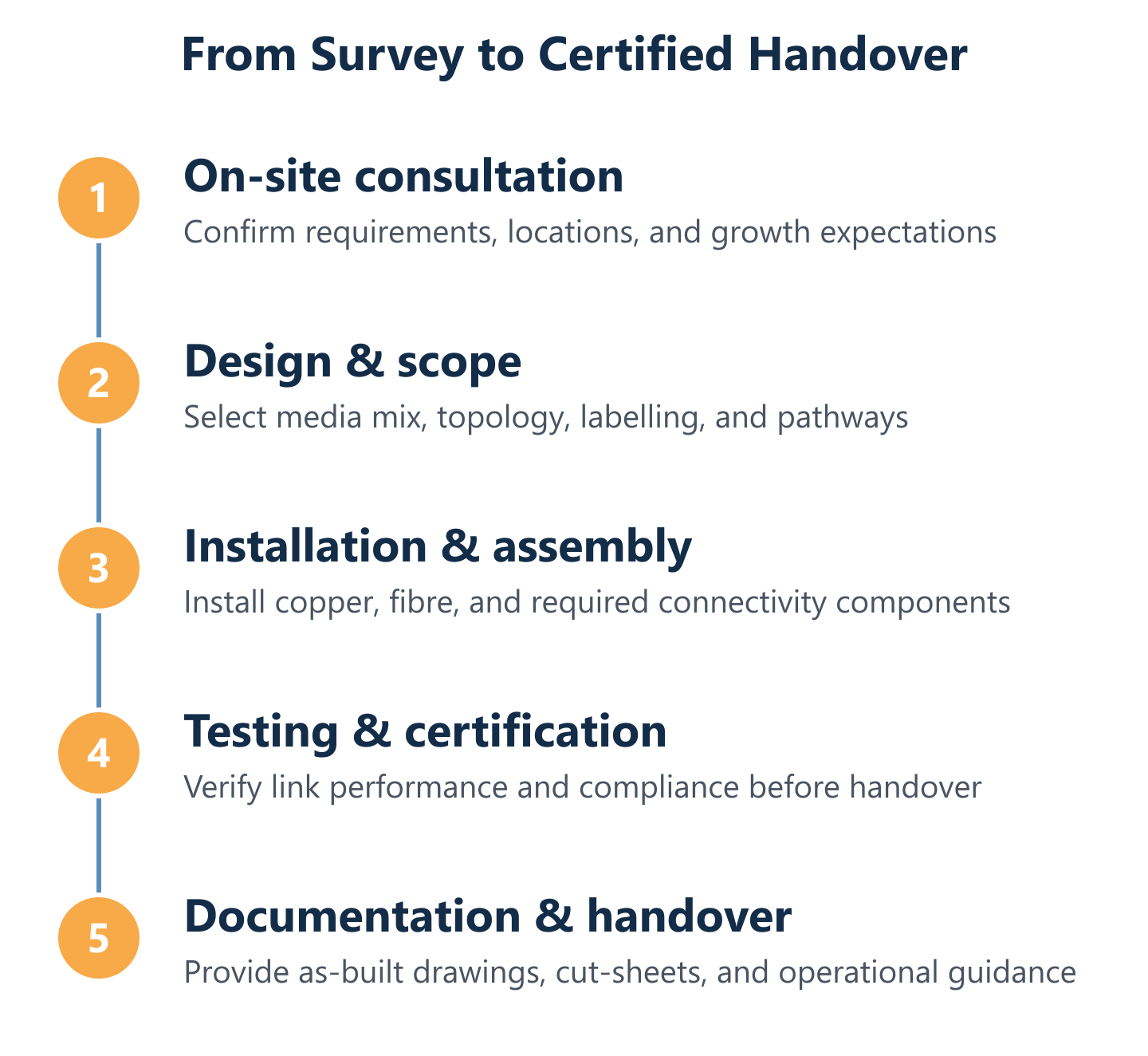
A structured cabling engagement should follow a clear lifecycle. It begins with a free on-site consultation to assess the existing environment, understand traffic requirements, and identify constraints — ceiling heights, fire compartments, existing conduit, and power distribution. From there, engineers produce a design and a fixed-price quotation, removing budget uncertainty before a single cable is pulled.
Installation follows the approved design, with pathway management and labelling applied consistently throughout. Once physical work is complete, every link is tested against the relevant performance standard. The project closes with a handover pack containing all test results, as-built drawings, and a labelling schedule — giving the client a complete record of what was installed and how it performs.
Connectivity outcomes: voice, data, wireless backhaul, and AV/security links
A single structured cabling infrastructure can carry multiple traffic types simultaneously, provided the design accounts for each. Copper twisted pair — Cat 6 or Cat 7 — handles voice telephony, workstation data, and wireless access point backhaul. Fibre optic links provide the high-bandwidth backbone between distribution frames, server rooms, and remote buildings, supporting 10 Gbps and beyond without distance limitations that constrain copper.
Where CCTV or legacy AV systems require it, coaxial cabling can be incorporated within the same project scope. Access control readers, IP intercoms, and digital signage displays are increasingly powered and connected over the same structured cabling plant, provided PoE capacity is planned correctly. The result is one coherent infrastructure serving every connected system in the building.
Scalability and future-ready pathways (capacity, pathways, and organisation)
The single biggest long-term cost of poor cabling is the inability to change quickly. When outlets are unlabelled, pathways are full, and no as-built record exists, even a simple desk move requires a physical trace. A structured installation avoids this by building in spare capacity — typically 20–25% headroom in cable trays and conduit — and applying a consistent labelling convention from day one.
Organised cabling in server rooms and communication racks also reduces troubleshooting time significantly. When every patch lead is the correct length and every port is labelled, faults are isolated in minutes rather than hours. Impulso Tecnológico removes redundant and abandoned cables as part of CPD clean-up work, restoring airflow and visibility in environments where years of unmanaged growth have created risk. Our guide to assembly of server rooms and communication racks covers this in further detail.

Design & Installation: copper, fibre, and PoE-ready planning
Every structured cabling project that Impulso Tecnológico undertakes starts from the same principle: the infrastructure must match the client's actual operational requirements, not a generic template. That means the design phase carries as much weight as the installation itself.
- Initial consultation: Understand traffic volumes, device counts, application requirements, and planned growth over a three-to-five-year horizon.
- Site survey: Walk the building to identify pathway routes, riser locations, existing infrastructure to retain or remove, and any environmental constraints.
- Topology design: Select single-point or multi-point connectivity models; define distribution frame locations, backbone routes, and horizontal cabling zones.
- Media specification: Choose the appropriate cable category and fibre type for each segment based on distance, bandwidth, and PoE requirements.
- PoE capacity planning: Calculate total power budget per switch port and per cable run to ensure thermal performance is maintained under full load.
- Installation: Pull, terminate, and dress cables according to the approved design, applying labelling and pathway management throughout.
- Testing & certification: Verify every link against the relevant performance standard before handover.
- Documentation & handover: Deliver as-built drawings, test reports, and a labelling schedule to the client.
Because Impulso Tecnológico works across a diversity of manufacturers and supplies quality materials as part of each engagement, clients are not locked into a single vendor's ecosystem. The design serves the network, not the other way around.
Design & planning: topology, labelling, and expansion strategy
Topology decisions made at the design stage have consequences that last for the life of the installation. A single-point star topology — all horizontal runs terminating at one central distribution frame — suits smaller buildings where cable lengths remain within the 90-metre channel limit for copper. Multi-point designs, with intermediate distribution frames on each floor, are necessary for larger campuses and allow future expansion without re-cabling entire sections.
Labelling conventions should be defined before installation begins, not applied retrospectively. A consistent scheme — typically encoding the floor, zone, and outlet number — means any engineer arriving on site years later can understand the infrastructure without needing to trace cables physically. Impulso Tecnológico incorporates expansion capacity into pathway sizing and frame population from the outset, so adding outlets or upgrading to a higher category does not require a complete rip-and-replace.
Installation across media types: twisted pair, fibre optic, and coax where required
Copper twisted pair remains the dominant medium for horizontal cabling. Cat 6 supports 1 Gbps to 100 metres and 10 Gbps to 55 metres, making it the practical choice for most office and light-industrial environments. Cat 7 adds shielding and extends 10 Gbps capability to the full 100-metre channel, which matters in electrically noisy environments such as manufacturing floors or plant rooms. Cat 5e is still appropriate for voice-only or low-bandwidth legacy systems where budget constraints apply.
Fibre optic cabling — both multimode for intra-building backbones and single-mode for campus or inter-building links — removes distance and bandwidth constraints entirely. Impulso Tecnológico handles fibre optic installations including fusion splicing and termination, supporting 10 Gbps and higher backbone speeds. Where legacy CCTV or AV systems require it, coaxial cabling can be integrated within the same project scope, keeping the entire physical layer under one managed installation.
Supporting PoE and remote powering: practical design considerations
Power over Ethernet has moved from a convenience feature to a core design requirement. IEEE 802.3af delivers up to 15.4 W per port, 802.3at (PoE+) reaches 30 W, and 802.3bt (PoE++) extends to 90 W — enough to power PTZ cameras, multi-radio wireless access points, thin clients, and even small displays from the cabling plant alone. The cable category and installation quality directly affect how much of that power budget reaches the device.
High-resistance terminations, damaged pairs, or cables bundled too tightly in trays generate heat under PoE load, degrading both power delivery and data performance. A structured cabling design that accounts for PoE specifies the correct cable category, limits bundle sizes in trays, and calculates the total power draw per switch to avoid thermal runaway. Impulso Tecnológico integrates these considerations into the design phase, ensuring the cabling plant supports IP phones, wireless access points, access control readers, and security cameras without compromise.
Testing, Certification & Ongoing Support for Continuity
Installation quality is only provable through testing. Visual inspection confirms physical workmanship; certification testing confirms electrical and optical performance against a defined standard. The two are not interchangeable, and any provider that offers only the former is leaving the client without proof that the infrastructure will perform as specified.
Impulso Tecnológico treats structured cabling as a long-term asset within the broader IT environment. That means the relationship does not end at handover. Ongoing maintenance, fault location, and emergency cabling response are available to protect the investment and maintain operational continuity. With thousands of IT support tickets resolved annually across the client base, the team brings the same diagnostic discipline to cabling faults that it applies to server and network incidents.
- Per-link certification: Every copper and fibre run is tested against the relevant performance standard, with pass/fail results recorded for each outlet.
- Documented test reports: Results are delivered as part of the handover pack, providing an auditable baseline for future comparison.
- As-built drawings: Reflect the actual installation, including any changes made during the build phase.
- Cut-sheets and labelling schedules: Enable rapid identification of any port, panel, or run without physical tracing.
- Ongoing maintenance: Scheduled inspections, patch lead management, and cable tray audits to maintain performance over time.
- Fault location: Time-domain reflectometry and other diagnostic techniques to isolate faults quickly and minimise disruption.
- Emergency cabling response: Rapid intervention for urgent network cabling problems that cannot wait for a scheduled visit.
Testing & certification: what to verify before handover
For copper cabling, certification testing measures the parameters that determine real-world performance: insertion loss, near-end crosstalk (NEXT), return loss, propagation delay, and delay skew. A Cat 6 channel must pass all parameters simultaneously; a single failure means the link cannot be signed off until the fault is located and rectified. This level of rigour is what separates certified cabling from a basic installation.
For fibre optic links, optical loss testing verifies that each splice and connector contributes acceptable attenuation across the installed length. Impulso Tecnológico's network cabling is certified by different manufacturers, and the team works with quality materials and components as part of each project commitment. Clients should always request printed or digital test results — not just a verbal assurance — before accepting handover of any structured cabling installation.
Documentation deliverables: as-built, cut-sheets, and cabling management support
The documentation package is what transforms a completed installation into a manageable asset. As-built drawings reflect the actual cable routes, tray positions, and termination points — including any deviations from the original design that occurred during installation. Without them, the next engineer on site is effectively starting from scratch.
Cut-sheets provide a port-by-port record of each patch panel: which outlet it serves, the cable identifier, and the test result reference. Combined with a consistent labelling schedule applied to every outlet, panel port, and patch lead, they reduce the time required for moves, adds, and changes from hours to minutes. Impulso Tecnológico also implements cabling management systems in server rooms and data centres, including cabling trays and rack organisation, so the physical layer remains ordered as the environment evolves. For further context on rack and CPD organisation, see our resource on network infrastructure maintenance.
Maintenance & fault location: proactive support and faster recovery
Cabling faults rarely announce themselves in advance. A damaged pair, a corroded connector, or a patch lead pulled at an angle can degrade performance gradually before causing an outage. Scheduled maintenance visits — checking patch lead condition, verifying tray fill levels, and auditing labelling integrity — catch these issues before they affect operations.
When a fault does occur, structured documentation dramatically reduces diagnostic time. A technician with accurate as-built drawings and test baseline data can use time-domain reflectometry to locate a cable fault to within a metre, rather than spending hours tracing unlabelled runs. Impulso Tecnológico provides ongoing network maintenance and emergency cabling response, treating the physical layer with the same operational discipline applied to the rest of the IT environment. Our broader approach to IT network management for businesses explains how cabling maintenance fits within a wider managed services framework.
The physical network is the foundation every application, device, and user depends on. A structured cabling service that stops at installation — without certified test results, complete documentation, and a clear maintenance path — leaves that foundation unverifiable and harder to manage over time. Choose a provider that delivers certified workmanship, transparent fixed-price scoping, and PoE-ready planning from the outset. Impulso Tecnológico combines over 15 years of structured cabling experience with an IT-services mindset, so your network infrastructure is built to perform today and scale reliably as your business grows. Explore our dedicated resource on structured cabling in Madrid for location-specific project information.