

A computer network company designs, installs, secures, and manages the connectivity infrastructure that keeps your business running. Services typically include structured cabling, wireless deployment, VPN and secure remote access, firewall configuration, and ongoing managed network support—delivered as a project, a retainer, or both.
Most businesses reach a point where their network can no longer be managed informally. Devices multiply, remote workers need reliable VPN access, compliance requirements tighten, and a single outage costs real money. The problem is not always a lack of technology—it is the absence of a structured approach that ties infrastructure, security, and operations together from day one.
A qualified computer network company addresses this by starting with a thorough assessment of your current environment, designing a solution that matches your scale and risk profile, implementing it to certified standards, and then maintaining it proactively. The result is a network that performs consistently, can be audited, and does not become a liability as your organisation grows. At Impulso Tecnológico, this end-to-end model—combining IT consultancy with Managed Services Provider capabilities—has been the foundation of our work with clients across Spain, Portugal, and internationally for over 25 years.
What a Computer Network Company Actually Delivers
The term "computer network company" covers a broad spectrum of providers, from cabling contractors who install infrastructure and leave, to full Managed Services Providers who design, deploy, secure, and operate your network under a defined SLA. Understanding where a provider sits on that spectrum—and whether their scope matches your needs—is the first commercial decision you need to make.
At Impulso Tecnológico, our focus is on reliable, secure, and maintainable connectivity end to end. That means combining IT consultancy with MSP capabilities: we handle the physical infrastructure, the logical configuration, the security controls, and the ongoing administration. We support projects across Spain and provide on-site coverage in Portugal under agreement, with remote support for clients across Europe, Asia, and America.
| Service Scope | Project-Only Provider | Full MSP / Network Partner |
|---|---|---|
| Structured cabling & fibre installation | Yes | Yes |
| Network design & architecture | Sometimes | Yes |
| Wireless deployment & optimisation | Sometimes | Yes |
| Firewall & security configuration | Rarely | Yes |
| VPN & secure remote access | Rarely | Yes |
| Network monitoring & incident response | No | Yes |
| Preventive maintenance & patching | No | Yes |
| Documentation & certified handover | Variable | Yes (standard) |
| Compliance & security auditing | No | Yes |
Core services: design, installation, and managed network support
Every network engagement starts with understanding what the business actually needs—traffic volumes, redundancy requirements, security constraints, and growth plans. From there, a professional computer network company produces a design that accounts for both current capacity and future scalability, selects appropriate hardware and topology, and manages the installation to a certified standard.
But installation alone is not the finish line. Managed network support—covering configuration management, firmware updates, performance monitoring, and incident response—is what keeps the infrastructure valuable over time. IT managed services delivered under a clear SLA give businesses predictable costs and a defined response commitment, replacing reactive break-fix calls with a proactive operational model that catches problems before they become outages. Impulso Tecnológico structures engagements this way as standard, whether the client needs a single-site deployment or a multi-location rollout.
Connectivity use cases: structured cabling, wireless, VPN, and VoIP
Different connectivity challenges require different technical responses. Structured cabling and fibre form the physical foundation: without a certified, well-documented cabling plant, every layer above it is less reliable. Wireless connectivity solutions add mobility and coverage for open-plan offices, warehouses, or campus environments—but require proper RF planning to avoid interference and coverage gaps. VPN and secure remote access extend the corporate network safely to remote workers and branch offices, ensuring that traffic is encrypted and access is controlled. VoIP and telephony systems depend on low-latency, prioritised network paths to deliver call quality that meets business expectations.
Impulso Tecnológico has been delivering voice and data cabling and fibre cabling services across Spain for over 15 years, supporting both small single-workplace jobs and full-scale multi-site deployments, all with certified finishes and quality-assured materials.
Deliverables you should expect: documentation, handover, and SLAs
A network project without proper documentation is a liability. At minimum, a professional computer network company should hand over: as-built diagrams showing physical and logical topology, cable test certification reports for all structured cabling runs, device configuration backups, IP address and VLAN registers, and a signed-off acceptance test record. These documents are not administrative overhead—they are the baseline for every future change, troubleshooting session, and security audit.
On the managed services side, SLAs should define response and resolution times by incident severity, escalation paths, reporting frequency, and what constitutes a breach. Impulso Tecnológico includes administration and maintenance services after installation precisely to protect this baseline: keeping systems available, minimising downtime, and ensuring that the network you built remains the network you are operating six months later. For further context on maintaining these standards over time, see our guidance on network infrastructure maintenance.

End-to-End Delivery Process: From Assessment to Ongoing Management
The difference between a network that performs reliably for years and one that requires constant firefighting usually comes down to process discipline at the start. A structured delivery methodology—one that moves deliberately from discovery through design, implementation, and into continuous operations—produces outcomes that can be measured, reported, and improved.
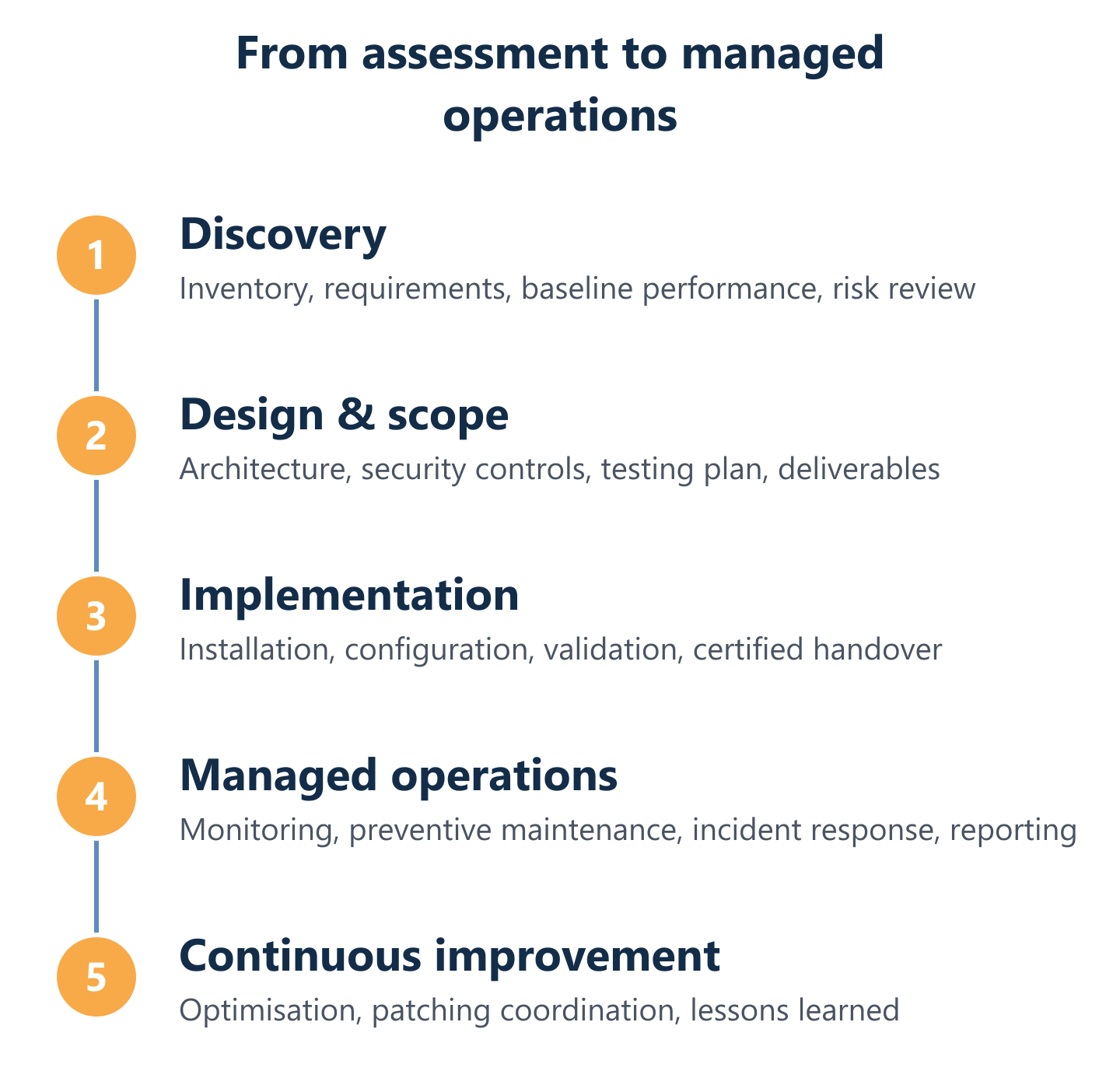
At Impulso Tecnológico, our layered methodology combines infrastructure and operations. For structured cabling and network cabling projects across Spain, we begin with design and site survey, deliver a certified wired network finish using quality materials, and then continue with administration and maintenance to minimise downtime. For security, we apply a defence-in-depth approach and explain the risk implications of skipping any layer—so the strategy is calibrated to your actual context rather than a generic template. The five phases below describe how a typical engagement unfolds:
- Discovery & requirements gathering: Inventory existing infrastructure, document traffic patterns, identify compliance constraints, and agree on success criteria with stakeholders.
- Risk and gap assessment: Evaluate current security posture, single points of failure, cabling quality, and capacity headroom against the requirements baseline.
- Solution design & sign-off: Produce logical and physical design documents, select hardware and vendors, confirm budget and timeline, and obtain formal client approval before any work begins.
- Implementation & testing: Deploy infrastructure to certified standards, run acceptance tests, validate security controls, and produce handover documentation.
- Managed operations & continuous improvement: Monitor performance, apply patches and firmware updates, handle incidents within SLA, and review the environment periodically to recommend improvements as the business evolves.
Assessment and discovery: what to measure before you design
Skipping a proper assessment is the single most common cause of network projects that go over budget or fail to meet expectations. Before any design work begins, a competent computer network company will inventory every active and passive component in the environment, document current bandwidth utilisation and peak-load patterns, identify existing security gaps and compliance obligations, and establish clear success criteria that both sides agree on.
This baseline serves two purposes: it prevents over-engineering (buying capacity you do not need) and under-engineering (deploying infrastructure that cannot support your workloads within 12 months). At Impulso Tecnológico, the discovery phase also includes a review of physical site conditions—cable routes, rack space, power availability, and environmental factors—so that the design we produce is grounded in what the site can actually support, not just what looks good on paper. Our work on IT network management for businesses covers how this baseline feeds into ongoing optimisation.
Design and implementation: scope, testing, and certified infrastructure handover
A signed design document is a commitment—it defines scope, bill of materials, topology, security architecture, and acceptance criteria before a single cable is pulled or a single device is configured. This protects both the client and the provider from scope creep and misaligned expectations. Implementation then follows the design, with structured cabling runs tested and certified to the appropriate standard (typically ISO/IEC 11801 or TIA-568), wireless coverage validated against the RF design, and firewall and switching configurations peer-reviewed before go-live.
Handover is not just handing over a set of passwords. It includes as-built documentation, test certification reports, device configuration exports, and a walkthrough session so that the client's team—or their ongoing MSP—understands what has been built and why. Impulso Tecnológico treats certified handover as a contractual deliverable, not an optional extra. You can explore the specifics of our structured cabling services for a detailed view of what this looks like in practice.
Managed operations: monitoring, maintenance, and continuous improvement
Once the network is live, the operational phase determines whether the investment holds its value. Network monitoring and incident response should be proactive: detecting anomalies in traffic patterns, identifying devices that are approaching capacity limits, and flagging security events before they escalate—rather than waiting for a user to report that something is broken. Preventive maintenance—scheduled firmware updates, configuration audits, and hardware health checks—reduces the frequency and severity of incidents.
Impulso Tecnológico's managed services model covers all of these elements under a monthly contract with guaranteed SLAs, giving clients a predictable cost structure and a clear escalation path. Continuous improvement is built into the cycle: periodic environment reviews identify where the network needs to evolve as the business changes, whether that means adding wireless access points, extending VPN capacity, or tightening security controls in response to new threat intelligence. This is what separates secure networking from a one-time installation.
How to Evaluate and Choose the Right Network Partner
Not every computer network company is equipped to handle both the build and the ongoing operation of a business-critical environment. Evaluating providers on technical capability alone is not enough—you also need to assess their operational maturity, their approach to security, and whether their commercial model aligns with how your IT budget works.
When clients choose Impulso Tecnológico, they gain a partner that reduces operational risk and improves control of IT costs. We can act as an external IT department, covering network deployment and ongoing support as the environment grows. Our firewall work is primarily based on WatchGuard, selected for its versatility, stability, and cost-effectiveness—a deliberate choice we can explain and justify, not a default recommendation. Security planning is integrated from the outset, not bolted on afterwards.
Use the following criteria to compare any network provider you are evaluating:
- Security capability: Do they offer defence-in-depth—covering perimeter, endpoint, access control, and vulnerability management—or only perimeter firewalling?
- Vendor certifications: Are they certified by the manufacturers whose equipment they install (cabling, switching, wireless, firewall)?
- Operational maturity: Do they provide defined SLAs with response and resolution times, and can they demonstrate a monitoring and incident response process?
- Documentation standards: Will they deliver as-built diagrams, cable test certifications, and configuration backups as standard deliverables?
- Scope flexibility: Can they handle both a one-off project and an ongoing managed services engagement, scaling with your needs?
- Geographic coverage: If you have multiple sites or remote workers, can they support on-site intervention and remote support across all locations?
- Pricing transparency: Is the pricing model clearly defined—fixed scope for projects, monthly retainer for managed services—with no hidden escalation clauses?
- Track record: Can they provide references or case studies from businesses of comparable size and sector?
Security and compliance deliverables: what "secure networking" should include
"Secure networking" is not a product you buy—it is a set of controls you implement and maintain across multiple layers. A professional computer network company should deliver, as a minimum: perimeter firewall configuration with secure web filtering and intrusion detection or prevention; endpoint protection at the device level; a documented patch and vulnerability management process; VPN and secure remote access with access identity management; and a backup and recovery capability that meets your RTO and RPO requirements.
At Impulso Tecnológico, we apply a defence-in-depth strategy and explain the risk implications of each layer to clients, so they can make informed decisions about their security posture rather than accepting a generic configuration. Compliance considerations—including GDPR data handling obligations—are factored into network design from the start, not addressed retrospectively when an audit is imminent. Security policies, hardening checklists, and access control documentation are delivered as part of the engagement.
Pros and cons of different provider models: project-only vs managed services
A project-only engagement gives you a defined scope, a fixed cost, and a clear end date. It works well when you have an internal IT team capable of taking over operations after handover, and when the network environment is relatively stable. The risk is that without ongoing management, configuration drift, unpatched vulnerabilities, and capacity issues accumulate silently until they cause an incident.
A managed services model transfers operational responsibility to the provider under a monthly retainer. You gain proactive monitoring, preventive maintenance, and a defined incident response process—but you also take on a recurring cost and a dependency on the provider's responsiveness. The right choice depends on your internal IT capacity and your tolerance for operational risk. Many Impulso Tecnológico clients start with a project engagement and move to IT managed services once they see the value of having a dedicated team monitoring their environment and resolving issues before they escalate.
Pricing and timeline expectations: fixed scope vs ongoing retainer
Network project pricing is typically structured in one of two ways: a fixed-scope quote covering design, materials, installation, and handover; or a time-and-materials arrangement for more complex or exploratory engagements. Fixed-scope quotes provide budget certainty but require a thorough assessment upfront—if the scope is poorly defined, change requests will erode the cost advantage. Timelines for a structured cabling installation in a single office might run two to five days; a multi-site network migration with security controls and wireless deployment could take several weeks.
Managed services are priced as a monthly retainer, typically based on the number of devices or users under management and the SLA tier selected. Impulso Tecnológico's monthly contracts are designed to give clients full cost visibility with no unexpected escalations—what is agreed is what is invoiced. Before committing, ask any provider to show you a sample SLA document and a breakdown of what is and is not included in the monthly fee.
Connectivity problems rarely announce themselves in advance—they surface as outages, security incidents, or compliance failures that cost far more to fix than to prevent. Choosing a computer network company that can deliver both the initial build and the ongoing operational care means your infrastructure stays aligned with your business as it grows, your security posture is maintained rather than left to drift, and your IT costs remain predictable. If you want a network that stays secure and dependable day after day, the right time to establish that partnership is before the next incident, not after it.