

Structured cabling in Madrid refers to a standardised physical network infrastructure—copper and fibre optic cabling, patch panels, rack cabinets and outlet points—installed to recognised standards such as TIA-568 and ISO/IEC 11801, enabling voice, data and video services to run over a single, manageable system.
Many Madrid businesses operate on legacy or ad hoc wiring that made sense when first installed but now creates real friction: adding a workstation means tracing unlabelled cables, moving a team requires rewiring rather than repatching, and fault-finding takes hours instead of minutes. The underlying problem is not the age of the cables—it is the absence of a coherent architecture.
A properly designed structured wiring system resolves this by centralising all connections at a distribution point, routing horizontal cabling to clearly labelled outlet points, and enabling any move, add or change through a single patch operation. The result is a network that is faster to troubleshoot, easier to expand and less disruptive to maintain—whether your site is a single-floor office or a multi-storey business premises. Impulso Tecnológico has been delivering certified structured cabling projects across Madrid for over fifteen years, from individual workstation installations to full-site deployments with fibre optic backbone and rack infrastructure.
What "Structured Cabling Madrid" includes and why it matters
Structured cabling is a building-wide cabling system that consolidates all low-voltage communications infrastructure—voice, data, video and control signals—into a single, standards-compliant architecture. Unlike proprietary or ad hoc wiring, it uses a defined topology: a central distribution area (rack or communications cabinet), horizontal cabling runs to outlet points, and patch panels that act as the connection interface between active equipment and end points.
For businesses in Madrid, this matters because it directly affects how quickly and cheaply the network can adapt. Adding a new workstation, relocating a team or integrating a new IP camera should not require pulling new cable from scratch. With a structured wiring system, it is a patch-panel operation.
Impulso Tecnológico designs, installs, assembles, certifies and maintains structured cabling infrastructure across Madrid and the wider Spanish market. Our scope covers copper categories (Cat5e, Cat6, Cat6a, Cat7) and fibre optic cabling, with full documentation and maintenance-ready organisation—including removal of redundant cables that accumulate over time and make infrastructure harder to manage.
| Criterion | Non-structured wiring | Structured cabling system |
|---|---|---|
| Adding a workstation | New cable run from switch to desk | Patch cable change at the panel |
| Fault identification | Manual tracing of unlabelled runs | Port-to-outlet mapping via documentation |
| Moves and team changes | Rewiring required; potential downtime | Repatching at the rack; minimal disruption |
| Standards compliance | Typically none; varies by installer | TIA-568 / ISO/IEC 11801 certified |
| Long-term maintenance cost | Higher; accumulation of redundant cables | Lower; labelled, documented and auditable |
Scope: voice, data, video and building automation cabling
A structured cabling system is not limited to data. A correctly specified installation supports voice telephony (IP and analogue), data networking, video surveillance (IP cameras), audiovisual distribution and building automation signals—all over the same physical infrastructure. Copper twisted-pair categories handle most of these services; fibre optic cabling is used for backbone runs, high-bandwidth links or where electrical interference is a concern.
For Madrid offices integrating access control, IP cameras or environmental sensors alongside standard workstation networking, structured cabling provides the standardised outlet points and cabling pathways that reduce disruption during future moves, technology upgrades or system expansions. Rather than running separate cable plants for each service, a unified structured system simplifies both installation and long-term management.
Structured vs non-structured wiring: cost and complexity trade-offs
The real cost difference between structured and non-structured wiring becomes visible at the point of change, not at initial installation. A non-structured network—where cables run directly from switches to desks without a centralised patch point—appears cheaper upfront. The problem emerges when a team moves floor, a switch fails, or a new VLAN needs to be segmented: each change requires physical rewiring rather than a patch-panel reconfiguration.
Centralised patching enables faster changes without replacing entire cable runs. In practice, this means a network administrator or engineer can redirect a port, isolate a fault or reassign a connection in minutes rather than hours. Over a three-to-five-year horizon, the labour savings from avoided rewiring typically outweigh the additional upfront investment in a properly structured installation. For Madrid businesses undergoing growth or office reorganisation, this is a material operational advantage.
Centralised patching and cabling management for easier future changes
Patch panels are the operational heart of a structured cabling system. Every outlet point on the floor connects back to a numbered port on the patch panel in the rack cabinet. Active equipment—switches, routers, telephony systems—connects to the same panel via short patch cables. To move a device, change a VLAN assignment or redirect a connection, the engineer works at the rack, not at the desk or inside the ceiling.
This architecture also supports voice, data, video and automation on the same physical plant. A Cat6a run that today carries data to a workstation can tomorrow carry PoE power to an IP camera or a VoIP handset—without rewiring. Impulso Tecnológico includes cabling management systems and full port-to-outlet documentation as standard deliverables, so future changes are fast and low-risk regardless of who manages the network.

Typical structured cabling architecture for offices and business sites
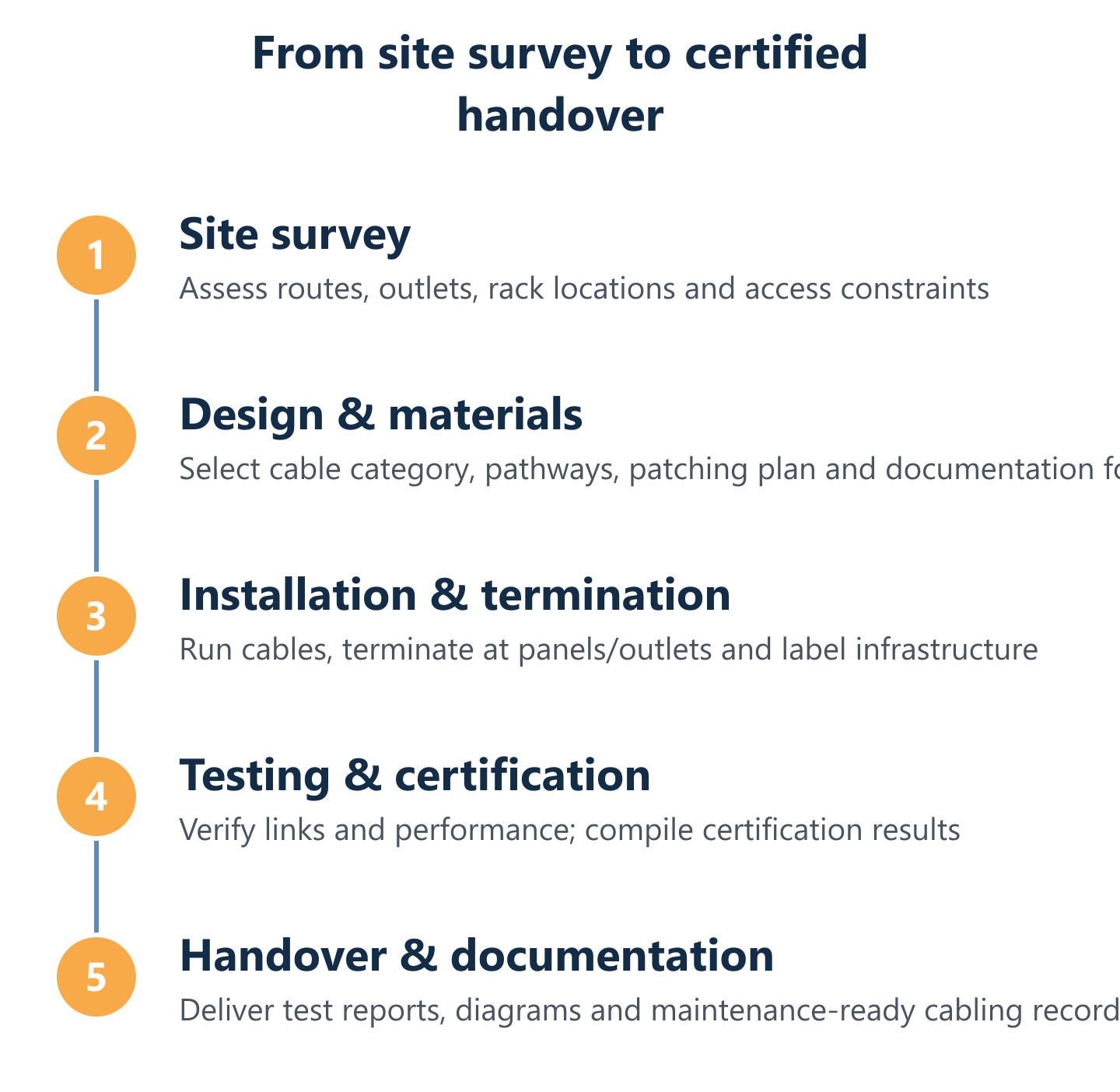
A structured cabling installation follows a defined architecture regardless of site size. Understanding the sequence helps project managers and IT leads plan accurately, anticipate disruption and validate what their installer is delivering. Impulso Tecnológico has executed this process across projects ranging from single-workstation setups to multi-site deployments with fibre optic backbone, rack infrastructure and links between cabling areas and communications booths.
- Site survey and route planning: Engineers assess floor plans, ceiling voids, trunking paths and existing infrastructure to define optimal cabling routes and rack locations before any installation begins.
- Distribution area design: The rack cabinet location is confirmed, patch panel capacity is specified, and power and cooling requirements for active equipment are assessed.
- Horizontal cabling installation: Copper or fibre runs are pulled from the rack to each outlet point using cable trays, conduits or trunking, maintaining separation from power circuits throughout.
- Termination and labelling: Each cable is terminated at the patch panel and at the outlet, then labelled consistently using a port-to-outlet numbering scheme documented in the handover pack.
- Rack assembly and active equipment links: Server rack installation, patch panel dressing and links between cabling areas and communications booths are completed and cable-managed.
- Redundant cable removal: Abandoned or legacy cables are identified and removed where applicable, keeping the infrastructure tidy and reducing fire load and maintenance complexity.
- Testing, certification and handover: Each link is tested to the specified standard; results are documented and handed over alongside the full cabling schedule and rack diagrams.
Distribution areas: rack cabinets, patch panels and outlet points
The distribution area—commonly a rack cabinet or wall-mounted enclosure—is where horizontal cabling from the floor terminates at the patch panel, and where active equipment connects to the network. Rack cabinet and patch panel installation must account for cable management (front and rear), airflow, physical security and future capacity. A rack that is 70% populated at installation leaves headroom for growth without a forklift upgrade.
Outlet points on the floor are typically dual-port faceplates, giving each workstation position two independent connections—one for data, one for voice or a secondary device. For Madrid offices using PoE-powered devices such as IP phones, access points or cameras, outlet positioning and cable category selection must align with the PoE class requirements of the connected equipment. Impulso Tecnológico specifies rack and outlet capacity based on the site survey, not on generic assumptions.
Horizontal cabling routes: pathways, segregation and labelling
Horizontal cabling—the runs between the rack and each outlet point—must follow defined pathways that maintain cable bend radius, avoid electromagnetic interference sources and comply with separation requirements from power circuits. In practice, this means using dedicated cable trays, conduits or surface trunking routed through ceiling voids, raised floors or wall channels depending on the building's construction.
Segregation from electrical cabling is not optional under TIA-568 and ISO/IEC 11801; it is a compliance requirement that also has a direct impact on signal integrity, particularly for Cat6a and above. Labelling at both ends of every run—using a consistent alphanumeric scheme tied to the patch panel port map—is what makes the cabling serviceable by any competent engineer in the future, not just the original installer. Impulso Tecnológico delivers full labelling and a port-to-outlet schedule as part of every installation.
Change enablement: how patching supports moves, adds and upgrades
The patch panel is where the operational value of structured cabling is realised day-to-day. When a team moves desks, an IT administrator repatches the relevant ports at the rack—a task that takes minutes and requires no access to ceiling voids or floor trunking. When a new application requires a dedicated VLAN or a higher-bandwidth uplink, the change is made at the switch and patch panel, not in the cable plant.
Cable trays, racks and CPD-style management keep infrastructure tidy and serviceable between changes. Impulso Tecnológico also addresses the accumulation of redundant cables—a common problem in offices that have grown organically—by removing abandoned runs as part of the installation scope where required. This reduces clutter, simplifies airflow management in rack enclosures and makes future audits significantly faster. A well-managed physical layer is not a cosmetic concern; it directly affects how quickly faults are resolved and how confidently changes can be made.
Choosing cable categories, standards and delivery: testing, documentation and quotes
Selecting the right cable category, understanding what standards compliance actually requires, and knowing what a professional installer should deliver at handover are the three decisions that most directly affect the long-term value of a structured cabling investment. Getting any one of them wrong—specifying Cat5e for a PoE++ deployment, accepting an installation without certified test results, or receiving no documentation at handover—creates costs that accumulate over the life of the network.
Impulso Tecnológico operates a fixed-price quotation model: after a free consultation and site survey, we provide a detailed quote covering design, installation, assembly, certification and documentation. Our installations are fully insured and certified by manufacturers, and we work with a range of hardware partners to match the right materials to each project's requirements.
- Cable category selection: Determined by PoE class, bandwidth target, maximum run length and growth horizon—not by upfront cost alone.
- Standards compliance (TIA-568 / ISO/IEC 11801): Reflected in installation practices (bend radius, segregation, termination quality) and in the test results delivered at handover.
- Testing and certification: Every link should be tested with a calibrated cable analyser; results should be provided as a digital report, not a verbal assurance.
- Handover documentation: Patch panel schedule, outlet map, rack diagrams and test reports—sufficient for any IT team to manage the network without calling the original installer for basic queries.
- Cost drivers: Cable category, total outlet count, site access conditions, backbone type (copper vs fibre optic), rack specification and whether redundant cable removal is in scope.
Cable category guide for Madrid offices: PoE, speeds, distances and future growth
Selecting cable category based on PoE needs, bandwidth targets, distances and growth plans is the correct starting point—not simply choosing the cheapest option available.
| Category | Max speed | Max distance | PoE suitability | Typical use case |
|---|---|---|---|---|
| Cat5e | 1 Gbps | 100 m | PoE / PoE+ | Legacy refresh; low-density offices |
| Cat6 | 1 Gbps (10G to 55 m) | 100 m | PoE / PoE+ | Standard office deployments |
| Cat6a | 10 Gbps | 100 m | PoE++ (90 W) | High-density Wi-Fi 6, IP cameras, modern offices |
| Cat7 | 10 Gbps | 100 m | PoE+ | Data centre links; shielded environments |
| Fibre optic | Up to 100 Gbps+ | 300 m–40 km (type-dependent) | N/A (passive) | Backbone runs, inter-floor, inter-building |
For most Madrid offices built or refurbished today, Cat6a PoE cabling is the practical minimum for future-proofing: it supports 10 Gbps to the full 100-metre channel length and handles the highest PoE classes without the thermal management concerns that affect Cat6 under sustained high-power loads.
Standards in practice: ISO/EIC and TIA deliverables, documentation and workmanship
Compliance with LAN cabling standards—TIA-568 in North America and ISO/IEC 11801 in Europe—should be reflected in installation practices and final documentation, not just cable labels. In practice, this means the installer must maintain specified bend radii during pulling, avoid untwisting pairs beyond the permitted length at termination points, maintain cable segregation from power circuits and use components (jacks, patch panels, cable) that are rated to the same category throughout the channel.
The deliverable that confirms compliance is a certified test report from a calibrated cable analyser (such as a Fluke DSX or equivalent), showing that each permanent link or channel passes the relevant standard's parameters: insertion loss, return loss, NEXT, PS-NEXT and propagation delay, among others. Network cabling certification of this kind is what allows the IT team—or a future managed services provider—to rely on the physical layer rather than suspect it every time a performance issue arises.
Testing, certification and quote drivers: what you should receive and why it matters
Testing and certification reduce maintenance risk and speed up handover for IT teams. At project completion, a professional structured cabling installer should provide: a digital test report for every installed link (pass/fail per parameter), a patch panel schedule mapping each port to its corresponding outlet, rack elevation diagrams, and a labelling scheme that matches physical labels to the documentation.
This documentation is not administrative overhead—it is what enables a network engineer to fault-find in minutes rather than hours, and what allows a future upgrade or expansion to be scoped accurately without a full re-survey. Impulso Tecnológico includes testing, certification and full handover documentation as standard across all structured cabling projects in Madrid, from small office installations to data centre cabling and CPD cable management. Fixed-price quotations are issued after a free consultation and site survey, so there are no surprises on scope or cost once work begins. For businesses that also need ongoing support, our network infrastructure maintenance services and IT network management cover the active layer above the cabling foundation we install.
A structured cabling system is not a one-time cost—it is the physical foundation that determines how efficiently your network operates, how quickly faults are resolved and how smoothly your infrastructure scales as the business changes. Starting with a design built for testing, documentation and long-term operability means every future IT decision—adding users, upgrading switching, integrating new services—is made on solid ground rather than unknown wiring.
Impulso Tecnológico offers a free initial consultation and fixed-price quotation for structured cabling projects in Madrid. Whether you are wiring a new office, overhauling an existing installation or extending an existing structured cabling infrastructure, our engineers will assess your site, recommend the right cable categories and architecture, and deliver a certified, documented result. You can also explore our computer network installation services in Madrid for a broader view of how we approach network projects from the physical layer upwards.