

IT solutions in Spain and Portugal span managed services, cloud infrastructure, cybersecurity, outsourcing, and on-site support — delivered either as ongoing managed contracts, project engagements, or staff augmentation. The right model depends on your organisation's size, risk tolerance, and operational footprint across the Iberian Peninsula.
Many businesses operating across Spain and Portugal face the same structural challenge: they need reliable, scalable technology support without the overhead of building and managing an internal IT department in each country. Generic proposals from large vendors rarely address local compliance requirements, language nuances, or the practical reality of coordinating on-site engineers across two jurisdictions.
The solution is a technology partner that combines local presence with a proven service framework — one that sets clear SLA expectations, adapts commercially to your needs, and covers the full stack from network security to cloud-based data backup. When those elements align, organisations gain operational continuity, reduced incident frequency, and predictable IT costs. Impulso Tecnológico has built its model around exactly this approach, supporting clients across Spain, Portugal, and beyond for over 25 years.
IT solutions across Spain & Portugal: scope and delivery models
The term "IT solutions" is frequently used to mean very different things depending on who is selling them. For businesses sourcing providers in Spain and Portugal, it is worth establishing a working definition before comparing options. At its broadest, IT solutions covers everything from day-to-day helpdesk and device management to cloud migration, structured cabling, cybersecurity architecture, and business process automation.
Delivery models vary equally. You may encounter providers who work exclusively on fixed-scope projects, others who operate on a fully managed basis with SLA-backed response times, and others who offer staff augmentation — placing engineers within your team on a temporary or indefinite basis. Each model carries different cost structures, risk profiles, and governance requirements.
Impulso Tecnológico operates as a Managed Services Provider (MSP) with SLA-based delivery at its core. Rather than reacting to incidents after they occur, the model is built around proactive monitoring and prevention. Outsourcing engagements can be structured by day, week, or month — including indefinite arrangements and cover for internal staff absence — and support is available both on-site across Spain and remotely in Spanish and English, with on-site coverage in Portugal available under agreement.
| Delivery Model | Typical Use Case | Cost Structure | SLA Applicability |
|---|---|---|---|
| Managed Services (MSP) | Ongoing IT operations, monitoring, support | Fixed monthly fee per device or user | Yes — response and resolution times defined |
| Project-Based Delivery | Cloud migration, infrastructure rollout, security audit | Fixed price or time & materials | Milestone-based, not ongoing SLA |
| Staff Augmentation | Temporary cover, team extension, specialist skills | Daily or monthly rate | Effort-based, not outcome SLA |
| Hybrid (MSP + Project) | Managed operations with periodic transformation projects | Mixed: retainer + project budget | Yes for managed layer; milestone for projects |
What counts as IT solutions (beyond helpdesk)
Helpdesk and device support are the visible surface of IT solutions, but the scope extends considerably further. A competent IT partner in Spain or Portugal should be able to cover managed IT support, full or partial IT outsourcing, cloud-based data backup and disaster recovery, network security services, structured cabling and wireless infrastructure, access control and video surveillance installation, and application integration or automation.
For organisations that have outgrown a break-fix model, this breadth matters. A provider handling only tickets cannot advise on cloud architecture or respond to a security incident with the same depth as one managing your full environment. When evaluating providers, map their stated capabilities against your actual technology stack — not just the services listed on their website. Impulso Tecnológico's portfolio, for instance, spans all of these areas under a single contract, reducing the coordination overhead that comes with managing multiple specialist vendors.
Managed services vs project delivery vs staff augmentation
Choosing the wrong delivery model is one of the most common and costly mistakes organisations make when sourcing IT support. Managed services — the MSP model — suits organisations that need continuous coverage, predictable costs, and a provider accountable for outcomes over time. IT support with SLA guarantees is the defining feature here: response times, escalation paths, and resolution targets are contractually defined.
Project-based delivery works well for discrete, time-bounded initiatives such as a cloud migration, a network redesign, or a security assessment. The risk is scope creep and a lack of accountability once the project closes. Staff augmentation fills specific skill gaps or covers absence, but it places the management burden back on your internal team. For most SMEs and mid-market businesses operating across Spain and Portugal, a managed services foundation — with project capacity available when needed — delivers the best balance of cost control and operational resilience.
Hybrid coverage across Iberia: on-site and remote coordination
Operating across both Spain and Portugal introduces a coordination challenge that purely remote providers cannot fully resolve. Some incidents — hardware failures, cabling faults, physical security installations — require an engineer on-site. Others, such as software configuration, monitoring, and user support, are handled efficiently and cost-effectively via remote tools.
Impulso Tecnológico provides on-site coverage across Spain and can deploy on-site in Portugal under a specific service agreement, complemented by remote support in both Spanish and English. This hybrid model means clients with offices in Madrid and Lisbon, for example, do not need to manage separate local vendors in each country. Remote support extends beyond Iberia to clients in Europe, Asia, and the Americas — making it a practical option for multinational organisations that need a single coordinating partner with local knowledge. Support hours run Monday to Friday, 09:00–17:00 CET, and this is communicated transparently from the outset.

How to choose the right IT partner in Spain vs Portugal
Selecting an IT managed services provider across two countries requires more than reviewing a list of company names. The evaluation process should be structured around comparable criteria applied consistently to every candidate — otherwise you end up comparing a project integrator in Barcelona against a managed services firm in Porto using incompatible benchmarks.
Impulso Tecnológico differentiates itself through operational clarity: all IT services are centralised under a single provider, proposals are tailored to actual client needs rather than templated, and the support model (Monday to Friday, 09:00–17:00 CET) is stated upfront — so there are no misaligned expectations about availability. Communication is direct, contracts avoid unnecessary complexity, and the focus is on preventing incidents rather than accumulating billable resolution hours.
- Define your scope first: List every IT function you need covered — support, cloud, security, infrastructure — before approaching any vendor.
- Verify geographic capability: Confirm whether on-site coverage in both Spain and Portugal is available, or only one country.
- Assess technical depth by area: Ask specifically about cloud, cybersecurity, network security services, and application development — not just general "IT support".
- Evaluate SLA terms in detail: Response time, resolution time, escalation path, and reporting cadence should all be contractually defined.
- Check commercial flexibility: Can the contract scale up or down? Are there exit clauses? Is pricing per device, per user, or project-based?
- Request references from comparable organisations: Sector, size, and complexity should match your own profile as closely as possible.
- Confirm language and communication standards: Especially relevant for multinational teams where English-language support is required alongside Spanish or Portuguese.
Decision criteria that work for both Spain and Portugal
When comparing providers across both countries, the most reliable framework maps each candidate against four solution areas: cloud infrastructure and migration capability, data management and backup resilience, cybersecurity depth (including network security services and endpoint protection), and application development or integration capacity — including DevOps and automation.
A provider strong in cloud but weak in security is a liability for organisations handling sensitive data. Equally, a firm with excellent cybersecurity credentials but no cloud-based data backup offering will leave gaps in your continuity planning. Build a simple scoring matrix with these four areas as columns, and assess each candidate honestly. For the Iberian market specifically, also evaluate whether the provider has demonstrated experience with GDPR compliance and local data residency requirements — both countries operate under EU regulation, but implementation practices vary by provider.
Pros and cons of local vs cross-border delivery
A locally based provider in Spain offers faster on-site response, cultural familiarity, and easier contract negotiation. The trade-off is that purely local firms may lack the infrastructure or headcount to scale into Portugal without introducing a second vendor relationship. Cross-border providers — those with operational presence in both countries — reduce coordination overhead but must demonstrate genuine local capability rather than a nominal address.
For IT managed services specifically, the critical operational factors are SLA response times, monitoring coverage, and escalation clarity. A provider operating across Iberia should be able to answer: who responds on-site in Lisbon if your primary contact is in Madrid? What is the escalation path for a critical incident at 16:45 on a Friday? How is monitoring handled when the support team is not available? These are not abstract questions — they define whether the service actually works under pressure.
Commercial alignment: pricing structure, SLAs, and contract flexibility
Pricing transparency is a reliable signal of provider quality. Managed IT services are most commonly priced on a per-device or per-user basis with a fixed monthly fee, which gives finance teams a predictable cost line and removes the incentive for providers to generate unnecessary incidents. Be cautious of proposals that bundle everything into a single opaque monthly figure without itemising what is and is not included.
Contract flexibility matters as much as price. Organisations whose headcount fluctuates, or who are expanding into new markets, need a provider that can adjust scope without penalty. Impulso Tecnológico structures its outsourcing engagements flexibly — by day, week, or month, with indefinite options available — precisely to accommodate this. On SLA terms, insist on written definitions of response time, resolution time, and reporting frequency. A technology partner selection process that skips this step almost always results in disputes later.
Security, compliance, and an engagement checklist for Iberia
Security is not a feature to be added once the managed services contract is signed — it should be a foundational requirement in the selection process. Organisations operating in Spain and Portugal are subject to GDPR, and any IT provider handling your data or managing your infrastructure carries shared responsibility for how that data is protected, processed, and recovered in the event of an incident.
Impulso Tecnológico addresses this through a layered security architecture built on certified technology partners:
- Network security services delivered via Fortinet and Sophos — covering firewall management, intrusion detection, and endpoint protection.
- Cloud-based data backup and disaster recovery using Veeam, ensuring data is protected, versioned, and recoverable within defined recovery time objectives.
- Access control systems and video surveillance installation across Spain and Portugal, integrating physical and digital security through platforms including Verkada.
- Structured cabling and network infrastructure built on Cisco and Aruba, providing the reliable physical layer that security tools depend on.
- Cloud identity and collaboration through Microsoft 365 and Azure, with licence management and access governance included.
- Environmental monitoring and hardware infrastructure supported by Schneider Electric / APC and QNAP, protecting critical systems from physical risk.
- Hardware supply and lifecycle management through Dell, Lenovo, and HP — ensuring devices meet security baseline requirements from deployment.
This partner ecosystem is not a list of logos — it represents certified, operationally tested integrations that Impulso Tecnológico deploys across client environments daily.
Security and compliance questions to ask before contracting
Before signing any managed IT contract in Spain or Portugal, ask every candidate provider these specific questions. Their answers will reveal more about operational maturity than any brochure:
How is network security managed — reactively or through continuous monitoring? Which endpoint protection platform is used, and how are definitions and policies maintained? What is the backup architecture — where is data stored, how frequently is it tested, and what is the recovery time objective? How are access rights managed when an employee leaves? What physical security measures (access control, video surveillance) can be integrated with the IT environment? How does the provider demonstrate GDPR compliance in its own operations, and what documentation can it provide for audit purposes? The quality and specificity of answers to these questions is itself a selection criterion.
What to expect from managed IT support (SLA, monitoring, escalation)
A well-structured managed IT support contract defines three things clearly: what is monitored, what triggers an escalation, and who resolves it within what timeframe. Monitoring should cover servers, network devices, endpoints, and backup jobs as a minimum — with alerts routed to a defined response team, not a generic inbox.
SLA terms should distinguish between response time (when the provider acknowledges the incident) and resolution time (when the issue is closed). These should vary by severity: a critical outage affecting all users warrants a different response target than a single-user software issue. Escalation paths must be named — not just described in abstract tiers. Compliance readiness adds another layer: ask how the provider logs incidents, retains audit evidence, and communicates data breaches in line with GDPR notification obligations. Providers who cannot answer these questions in writing are not ready to manage your environment.
Shortlisting workflow: from requirements to proposal comparison
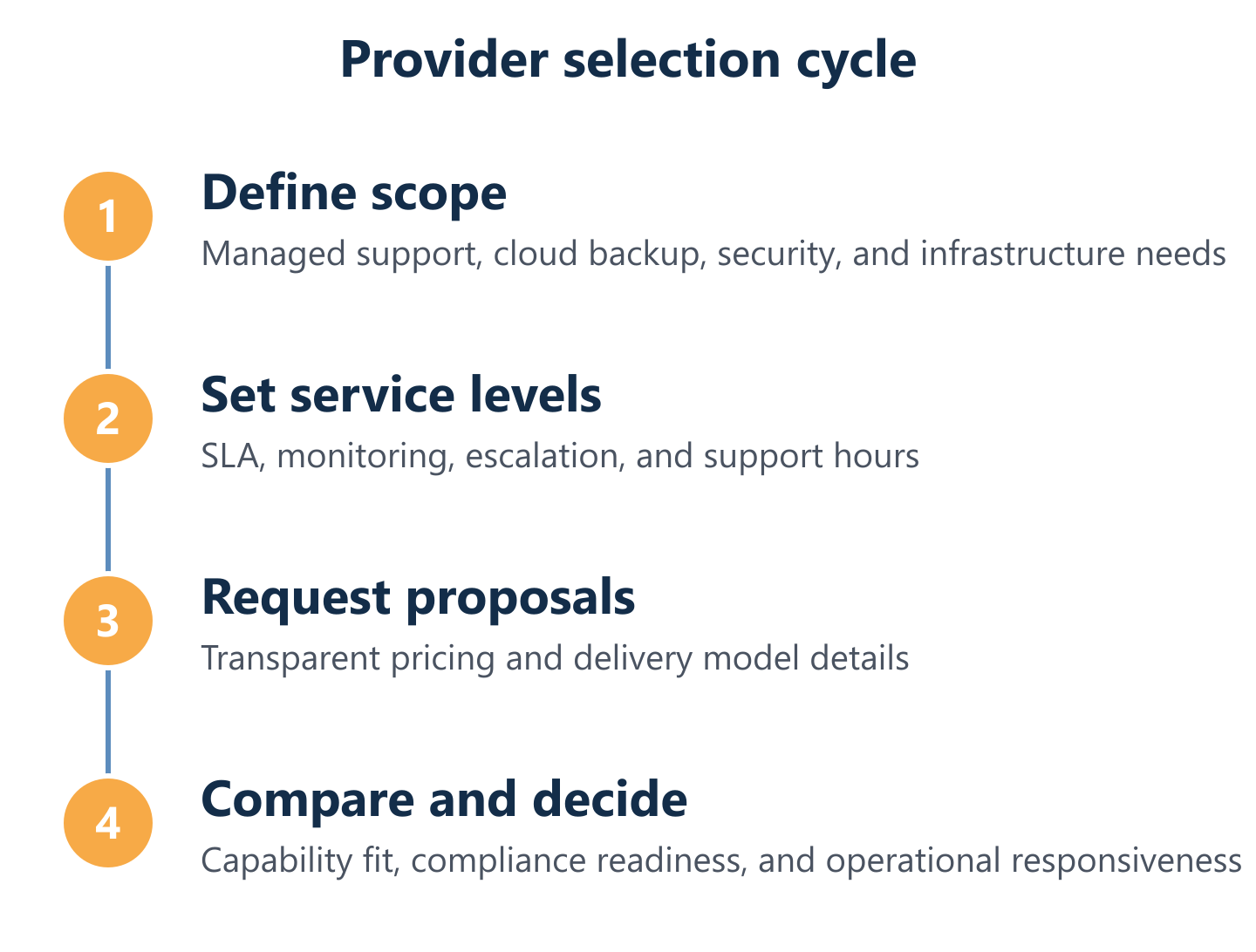
A structured shortlisting process saves time and produces better decisions. Follow these steps to move from initial requirements to a final provider comparison without losing momentum:
First, document your current IT environment — number of devices, users, locations in Spain and Portugal, existing contracts, and known gaps. Second, define your non-negotiables: on-site coverage requirements, language, SLA minimums, and security baseline. Third, issue a consistent requirements brief to all candidates — the same document, so responses are comparable. Fourth, score each proposal against your criteria matrix (solution areas, SLA terms, pricing structure, references, and contract flexibility). Fifth, conduct a short technical interview with each shortlisted provider, using the security and compliance questions above. Sixth, request a written proposal with itemised pricing and draft SLA terms before making a final decision. Impulso Tecnológico welcomes this process — transparency is built into how the service is sold, not just how it is delivered. You may also find it useful to review our IT consulting services in Spain and Portugal overview and our detailed IT services for businesses page before preparing your brief.
When scope, delivery model, and security expectations are aligned before you start talking to vendors, selecting IT solutions in Spain and Portugal becomes a faster, lower-risk decision. The organisations that struggle are those who approach the market without a defined requirements baseline — and end up comparing proposals that are structured entirely differently. Use the criteria and checklist in this guide to build that baseline, and you will find the shortlisting process significantly more productive. If you want to understand how Impulso Tecnológico approaches a specific requirement — whether that is managed support, cloud infrastructure, network security, or physical security integration — the most efficient next step is a direct conversation. Explore our IT solutions for businesses page or our IT consulting service to see how the model works in practice.