

IT consulting services in Spain and Portugal cover a broad spectrum—from technology strategy and cloud migration to cybersecurity, managed support, and process automation. Organisations working across the Iberian market need providers who understand both local regulatory requirements and the operational realities of each country.
Many businesses in Spain and Portugal face a common challenge: their IT infrastructure has grown organically, creating gaps in security, compliance, and operational efficiency. Legacy systems sit alongside newer cloud tools without a coherent architecture, and internal teams lack the bandwidth to address strategic improvements while keeping day-to-day operations running. The result is increased risk, unpredictable costs, and slower response to market demands.
A structured IT consulting engagement addresses this by mapping the current state, defining a realistic roadmap, and delivering improvements in phases—whether through a project-based approach or an ongoing managed service model. Impulso Tecnológico, with over 25 years of experience serving clients across Spain, Portugal, and 25 countries, applies this methodology to help organisations stabilise operations, modernise their technology landscape, and reduce risk without disrupting the business.
IT Consulting Services: panorama in Spain and Portugal (what gets bought and why)
Spain and Portugal together represent one of the most active IT consulting markets in Southern Europe. Spain's ICT sector employs over 600,000 professionals and has benefited from significant EU Next Generation funds directed at digital transformation. Portugal, meanwhile, has built a reputation as a cost-competitive, EU-compliant technology hub, with a growing ecosystem of technology firms and a strong outsourcing track record. Despite their proximity, the two markets have distinct procurement cultures, skills availability, and regulatory enforcement contexts—factors that directly affect how IT consulting services are scoped and delivered.
Organisations buying IT consulting services in this region typically fall into one of three categories: those modernising legacy infrastructure, those achieving compliance (primarily GDPR and sector-specific regulation), and those seeking operational efficiency through outsourcing or automation. Understanding which category applies to your organisation determines the service mix you need.
| Business Driver | Primary Service Category | Typical Outcome | Relevant in Spain | Relevant in Portugal |
|---|---|---|---|---|
| Digital transformation | IT strategy, cloud migration, architecture design | Modernised infrastructure, reduced technical debt | High (EU funding available) | High (cost-driven adoption) |
| Compliance readiness | GDPR consulting, cybersecurity controls, access management | Reduced regulatory risk, audit readiness | High (AEPD enforcement active) | High (CNPD enforcement increasing) |
| Cost control | IT outsourcing, managed services, device-based support | Predictable spend, reduced internal headcount dependency | Medium–High | High (primary outsourcing driver) |
| Operational resilience | Backup, disaster recovery, network security, monitoring | Business continuity, faster incident resolution | High | Medium–High |
| Productivity improvement | Integration, automation, AI-assisted workflows | Reduced manual effort, faster processes | Medium | Medium (growing) |
Impulso Tecnológico aligns its consulting scope directly to these drivers—starting with a clear assessment of where the organisation stands, then building a tailored plan that addresses the most pressing operational and security needs without over-engineering the solution.
From transformation goals to consulting scope
Four drivers consistently shape IT consulting demand across Spain and Portugal: digital transformation ambitions, compliance obligations, cost control pressure, and the need for operational resilience. Each driver maps to a different consulting scope. A company pursuing digital transformation needs strategy, architecture, and cloud migration expertise. A business under regulatory scrutiny needs security assessment, GDPR gap analysis, and access control implementation. An organisation focused on cost control needs a managed service model with predictable pricing—such as fixed monthly support per device. And a company that has experienced outages or data loss needs backup, disaster recovery, and network security work. Identifying the primary driver before engaging a provider prevents scope misalignment and ensures the consulting engagement produces measurable results rather than generic recommendations.
Compliance and security as delivery requirements (GDPR, access control, resilience)
GDPR compliance is not optional for organisations operating in Spain or Portugal—both countries have active data protection authorities (Spain's AEPD and Portugal's CNPD) that investigate and fine non-compliant organisations. Any IT consulting engagement that touches data processing, cloud storage, or user access management must incorporate GDPR and security controls as core deliverables, not afterthoughts. This means the service taxonomy for a credible provider should include: security architecture review, endpoint protection, firewall configuration, access control systems, encrypted backup and disaster recovery, and documented data processing procedures. Impulso Tecnológico works with Sophos, Fortinet, and Veeam to deliver these controls, and also implements physical access control and video surveillance systems—areas that intersect with both security and compliance requirements in premises-based environments. For a broader view of how these services integrate, see our overview of IT solutions for businesses covering security, backup, and cloud.
Managed IT operations vs project-based consulting: when each fits
The distinction between managed IT operations and project-based consulting is one of the most practical decisions a buyer needs to make. Project-based consulting fits well when the organisation has a defined objective with a clear start and end—a cloud migration, an ERP implementation, or a security audit. Managed IT operations, by contrast, suit organisations that need continuous support, monitoring, and maintenance without building an internal IT team. A well-structured managed service agreement includes guaranteed SLAs, proactive monitoring, and a predictable cost model—for example, a fixed monthly fee per device covering unlimited on-site and remote support. The best outcomes often come from combining both: a project-based engagement to design and implement improvements, followed by a managed service to sustain and evolve the environment. "Good" looks like measurable resolution times, documented incident history, and a delivery plan aligned to the organisation's actual risk profile.

Key service areas and expected deliverables (strategy to execution)
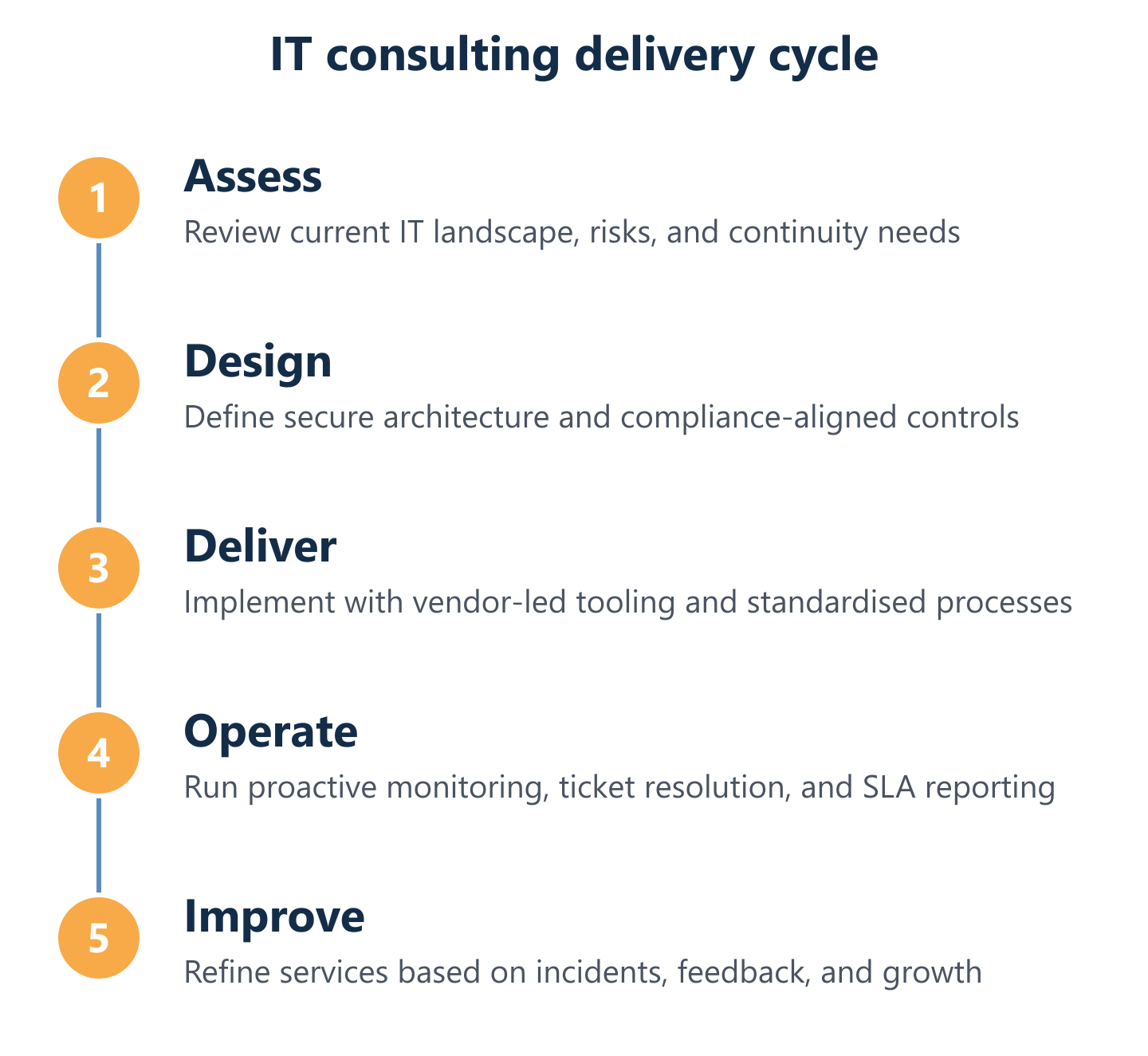
Vague proposals are one of the most common sources of dissatisfaction in IT consulting engagements. A proposal that promises "digital transformation" without specifying deliverables, timelines, and acceptance criteria is a risk indicator. Each service category should produce tangible outputs that can be reviewed, tested, and handed over. The following sequence reflects how a well-structured IT consulting engagement typically progresses from initial assessment to operational steady state—and what you should expect at each stage.
- IT Assessment and Current-State Audit: A documented inventory of infrastructure, security posture, and operational gaps, with a prioritised list of risks and recommendations.
- Technology Roadmap and Architecture Design: A phased plan aligned to business objectives, including target architecture diagrams, budget estimates, and dependency mapping.
- Cloud Migration and Environment Setup: Detailed migration plan, environment configuration (e.g., Microsoft 365 or Azure), data transfer protocols, and post-migration validation report.
- Cybersecurity Controls Implementation: Firewall configuration, endpoint protection deployment, access control setup, backup and disaster recovery testing, and a security baseline document.
- Integration and Automation Delivery: Configured workflows connecting business systems (e.g., via Odoo, n8n, or Make.com), with documented logic, test results, and operational handover notes.
- Managed Support and Ongoing Maintenance: Active monitoring, incident response within agreed SLAs, regular updates, and monthly or quarterly service reports showing resolution metrics and system health.
Impulso Tecnológico structures its IT consulting engagements around this progression, ensuring that each phase produces verifiable outputs rather than effort-based billing.
IT assessments, roadmaps, and architecture design
An IT assessment is the foundation of any credible consulting engagement. Without an accurate picture of the current environment—hardware inventory, software licences, network topology, security posture, and data flows—any roadmap is built on assumptions. A thorough assessment should produce a written report with findings categorised by risk level (critical, high, medium, low), a gap analysis against relevant standards (ISO 27001, GDPR, or sector-specific frameworks), and a prioritised list of actions. From this, the architecture design phase defines the target operating model: what the environment should look like in 12–36 months, which technologies will be retained, replaced, or added, and how the transition will be sequenced to minimise disruption. Deliverables at this stage include network diagrams, system architecture blueprints, and a phased roadmap with cost estimates and resource requirements.
Cloud services, data management, and cybersecurity controls
Cloud migration consulting in Spain and Portugal most commonly centres on Microsoft 365 and Azure—both for their market penetration and their compliance tooling relevant to GDPR. A credible cloud migration plan specifies data classification, migration sequencing, identity and access management configuration, and a rollback procedure. Data management deliverables should include a backup policy, recovery time objectives (RTO) and recovery point objectives (RPO) defined in writing, and tested restore procedures—not just backup configuration. On the cybersecurity side, endpoint protection, firewall rules, and access control systems need to be documented and validated against the organisation's threat model. Impulso Tecnológico deploys solutions from Sophos, Fortinet, and Veeam across these areas, and also implements online backup and cloud-based data protection as standalone services for organisations that need to address resilience without a full infrastructure overhaul.
Integration, automation, and ongoing support/maintenance
Integration and automation work is increasingly central to IT consulting engagements in the Iberian market, particularly for organisations running multiple disconnected platforms—ERP, CRM, communication tools, and cloud storage. A well-delivered integration project produces documented API connections or workflow logic (using tools such as Odoo, n8n, or Make.com), test results confirming data accuracy across systems, and an operational handover document that enables internal teams to maintain or modify workflows without full dependency on the consultant. Automation initiatives should include a clear business case with time-saving estimates and a monitoring mechanism to detect failures. Ongoing support and maintenance—the final phase—should be governed by a service agreement that specifies response times, escalation paths, and reporting frequency. Impulso Tecnológico's managed service model covers infrastructure, support, and maintenance under a single provider, reducing the coordination overhead that comes with multiple vendors. For more on how these services are structured, see our IT services overview.
How to choose a provider: evaluation criteria, engagement models, and risk checks
Choosing an IT consulting provider in Spain or Portugal requires more than reviewing a company profile or checking a directory ranking. The practical question is whether the provider can deliver the specific outcomes your organisation needs, within your budget and timeline, with sufficient transparency to manage risk throughout the engagement. Three areas deserve structured evaluation: delivery capability (can they actually do the work?), security and compliance readiness (are they a risk to your data?), and commercial clarity (do they commit to measurable outcomes?).
A managed-service mindset—where the provider thinks proactively about preventing problems rather than reacting to them—is a meaningful differentiator. Impulso Tecnológico resolves over 4,000 IT tickets annually across its client base, which reflects operational maturity rather than theoretical capability. The provider's vendor ecosystem also matters: a firm that works with established technology partners such as Sophos, Fortinet, Veeam, Cisco, and Microsoft can ground its recommendations in real deployment experience rather than generic advice.
- Delivery capability: Ask for case studies or references from organisations of similar size and sector. Verify that the provider has hands-on experience with the specific technologies in your environment.
- Security and compliance posture: Confirm the provider follows GDPR-compliant data handling practices and can document their own security controls—a provider with weak internal security is a supply chain risk.
- Scope clarity: Require a written scope of work with defined deliverables, acceptance criteria, and exclusions before signing any agreement.
- SLA transparency: Ensure response and resolution times are contractually defined, not just stated in a brochure. Understand what happens when SLAs are missed.
- Geographic coverage: For Iberian operations, confirm whether on-site support is available in both Spain and Portugal, and under what conditions.
- Escalation paths: Know who your escalation contact is and how issues are tracked and reported.
- Vendor certifications: Verify that the provider holds current certifications from the technology vendors they recommend—this affects both quality and warranty eligibility.
Provider evaluation checklist (capabilities, references, and delivery maturity)
Delivery maturity is the factor most often underweighted in provider selection. A firm may have strong sales materials but limited operational depth. Use the following checklist to assess maturity before shortlisting:
- Can the provider supply at least two references from comparable engagements (similar industry, size, or technology stack)?
- Do they have documented processes for incident management, change control, and service reporting?
- Are their security controls auditable—can they share their own data processing agreements and security policies?
- Do they hold current certifications from the vendors they propose (e.g., Microsoft Partner, Sophos, Fortinet)?
- Can they demonstrate proactive monitoring capability—not just reactive support?
- Is their pricing model transparent, with a clear breakdown of what is and is not included?
- Do they have a defined onboarding process that includes knowledge transfer and documentation handover?
A provider that hesitates on any of these points warrants further scrutiny before engagement.
Engagement models and how to define SLAs, timelines, and quality gates
Three engagement models dominate IT consulting procurement in Spain and Portugal. Staff augmentation places individual specialists within your team on a temporary basis—useful for specific skill gaps but requires strong internal management. Project-based delivery defines a fixed scope, timeline, and budget for a discrete objective such as a cloud migration or security audit; it suits organisations with clear requirements and internal capacity to manage the vendor. Managed services (outsourcing) transfers ongoing IT operations to the provider under a contractual SLA—the right model when the organisation lacks internal IT capacity or wants predictable costs. For SLAs, define at minimum: initial response time, resolution time by priority level, reporting frequency, and escalation procedure. Quality gates—formal checkpoints where deliverables are reviewed and approved before the next phase begins—are essential for project-based work and should be written into the contract, not assumed.
First scoping call questions and documentation to request
The first scoping call is a risk assessment opportunity, not just a sales conversation. Use it to surface assumptions, clarify scope boundaries, and evaluate the provider's communication style. Key questions to ask:
- What information do you need from us before you can define scope and estimate effort?
- How do you handle scope changes once the engagement has started?
- Who will be our primary technical contact, and what is the escalation path if issues arise?
- Can you describe a recent engagement where the original timeline or scope changed, and how you managed it?
- What documentation will you produce at the end of the engagement, and in what format?
Documentation to request before signing: a written scope of work, a data processing agreement (DPA) confirming GDPR compliance, references or case study summaries, the provider's incident response procedure, and a sample service report from an existing managed services client. Providers who cannot supply these documents promptly are signalling operational immaturity.
Aligning service categories, deliverables, and engagement models from the outset is the single most effective way to reduce risk in an IT consulting engagement. Organisations that invest time in structured evaluation—defining what "done" looks like before work begins—consistently achieve faster implementation, lower rework costs, and technology improvements that hold up over time. Whether you are modernising infrastructure in Spain, extending operations into Portugal, or managing a distributed Iberian environment, the principles are the same: clear scope, measurable outcomes, and a provider with the operational depth to deliver. Impulso Tecnológico offers a direct starting point—contact us to discuss your specific requirements and receive a tailored assessment of how we can support your technology objectives. You can also explore our computer consulting services and our contact page to speak with our team directly.