

IT consulting in Madrid means partnering with a local team that takes full ownership of your technology strategy, infrastructure, and day-to-day operations—so your organisation can focus on its core business rather than managing systems, vendors, or recurring incidents.
Many Madrid-based businesses reach a point where internal IT capacity no longer matches operational demands. Systems grow fragmented, security gaps widen, and reporting remains unreliable—yet hiring a full in-house IT department is neither practical nor cost-effective for most small and mid-sized organisations. The result is a familiar pattern: reactive firefighting instead of strategic planning, and technology that slows the business rather than enabling it.
The answer is a structured IT consulting engagement that begins with an honest diagnosis, produces a clear roadmap, and transitions into proactive managed services once implementation is complete. At Impulso Tecnológico, we have operated this model from Madrid since 2000, expanding nationally in 2006 and now supporting clients across 25 countries. With 476 active clients and more than 4,000 IT tickets resolved annually, our approach is built on measurable outcomes—not generic recommendations. Explore our broader IT consulting service overview or our dedicated IT consulting services in Spain and Portugal page for further context.
IT Consulting Madrid: what a real consultancy delivers
The term "IT consulting" is used loosely—sometimes to describe a single technician fixing a server, and sometimes to describe a multi-year digital transformation programme. For businesses in Madrid evaluating providers, the distinction matters enormously. A genuine IT consulting engagement produces tangible deliverables: a documented assessment of your current environment, a prioritised technology roadmap, an implementation plan with defined phases and owners, and an operational handover that leaves your team with working systems and clear governance.
Impulso Tecnológico operates as an external IT department—not a project-only contractor. This means clients receive both the specialist knowledge required for complex initiatives (network architecture, ERP alignment, security design) and the ongoing day-to-day coverage that prevents small issues from becoming costly incidents. Because we are independent from any manufacturer or distributor, our recommendations are driven by your business objectives and budget, not by commercial agreements with vendors.
| Engagement type | Typical deliverables | Ongoing coverage | Vendor independence |
|---|---|---|---|
| Break-fix / ad hoc support | Incident resolution only | None | Variable |
| Project-only consultancy | Report or implementation | None after handover | Often tied to preferred stack |
| Managed IT partner (MSP) | Assessment, roadmap, implementation, monitoring | Proactive, SLA-backed | Varies by provider |
| External IT department (Impulso model) | Full lifecycle: strategy → operations → governance | Continuous, fixed monthly cost per device | Fully independent |
What "IT consulting" includes beyond support tickets
Support tickets resolve symptoms; IT consulting addresses root causes. A structured engagement starts with a formal assessment of your infrastructure, processes, and security posture—producing a baseline that makes every subsequent recommendation defensible. From that baseline, the consultancy develops a technology roadmap: a prioritised sequence of initiatives aligned to business goals, with realistic timelines and budget estimates. The implementation plan then breaks each initiative into phases with defined owners, milestones, and acceptance criteria. Finally, an operational handover ensures that systems are documented, teams are trained, and monitoring is in place before the consultancy steps back from active delivery. Without these four components, an engagement is advice—not consulting.
Deliverables you should expect in a Madrid engagement
For a Madrid-based business, the external IT department model offers a practical alternative to building an in-house team. Rather than hiring multiple specialists—network engineer, security analyst, systems architect, helpdesk—you access a multidisciplinary team under a single contract. At Impulso Tecnológico, our consulting engineers hold industry certifications and have collectively managed more than 200 large networks for small and mid-sized companies. Deliverables in a typical Madrid engagement include: a written infrastructure assessment with identified risks and priorities; a 12–24 month technology roadmap; a security and compliance review aligned with GDPR requirements; implementation project management with defined milestones; and post-implementation monitoring with documented escalation procedures. Each deliverable is owned, not delegated to a third party.
How independence from vendors reduces lock-in risk
Vendor lock-in is one of the most underestimated risks in IT procurement. When a consultancy is commercially tied to a specific manufacturer, the recommended solution is rarely the most appropriate one—it is the one that generates the best margin. Impulso Tecnológico maintains strong relationships with major technology partners including Sophos, Fortinet, Veeam, Microsoft, Cisco, Aruba, HP, Lenovo, Dell, Schneider Electric/APC, QNAP, and Verkada, but our contractual independence means we select from this ecosystem based on fit, not incentive. In practice, this protects clients from proprietary architectures that become expensive to exit, and ensures that infrastructure decisions remain reversible as business requirements evolve. Independence also simplifies multi-vendor environments—common in Madrid enterprises that have accumulated technology debt over several years.

Core IT consulting services in Madrid (ERP, Oracle, BI, security)
Madrid's business landscape—spanning manufacturing, logistics, professional services, energy, and healthcare—generates demand for a specific cluster of IT consulting services. The following service lines represent the most frequently requested engagements, each with distinct decision criteria and operational implications.
- ERP implementation and process alignment: Selecting and deploying an ERP that matches your workflows, not the other way around—covering fit analysis, data migration, integration, and user adoption.
- Oracle consulting: Optimising existing Oracle environments or managing new deployments, with a focus on licensing efficiency, performance tuning, and integration with adjacent systems.
- Business Intelligence and advanced reporting: Designing reporting architectures that produce reliable, governed data—so dashboards reflect reality and decisions are based on accurate metrics.
- Network security design and audit: Assessing current security posture, identifying vulnerabilities, and implementing layered protection aligned with GDPR and operational continuity requirements.
- Managed services and proactive monitoring: Continuous system oversight under fixed monthly pricing—preventing incidents before they affect operations and resolving issues faster when they occur.
- Backup, disaster recovery, and business continuity: Structured planning and implementation of recovery systems, tested regularly to ensure RTO and RPO targets are achievable.
Impulso Tecnológico covers all six lines from a single point of contact in Madrid, reducing coordination overhead and ensuring that security and data governance are embedded across every engagement—not treated as afterthoughts.
ERP and Oracle consulting: fit, integration, and process alignment
ERP implementation failures rarely stem from technical deficiencies—they stem from poor fit between the system's default logic and the company's actual processes. Effective ERP consulting in Madrid begins with a process mapping exercise that documents how work actually flows, identifies the gaps between current state and system capabilities, and produces a configuration specification before a single line of code is touched. For Oracle environments specifically, this extends to licensing audits (Oracle's licensing model is notoriously complex and over-licensing is common), performance benchmarking, and integration design with adjacent platforms. Impulso Tecnológico's partner ecosystem—including Microsoft and Odoo alongside Oracle-adjacent tools—means clients can evaluate multiple ERP options against objective criteria rather than being steered toward a preferred vendor. Post-go-live, our managed services layer maintains system health and captures adoption issues early.
BI and advanced reporting: governance, adoption, and measurable value
Business Intelligence reporting delivers value only when the underlying data is trustworthy and the end users actually use the dashboards. Both conditions are harder to achieve than most organisations expect. Data governance—defining ownership, quality standards, and lineage for each data source—must be established before reporting architecture is designed, not retrofitted afterwards. At the adoption end, dashboards that require specialist knowledge to interpret are abandoned within weeks of deployment. Impulso Tecnológico approaches BI engagements with a data governance framework as the foundation, followed by reporting design that prioritises clarity and self-service capability. Advanced reporting and dashboards are built to answer specific operational questions—stock turns, project margins, service levels—rather than to display every available metric. This focus on measurable value means clients can trace reporting investment directly to decision quality.
Security and operations: monitoring, backup/recovery, and audit readiness
A network security audit in Madrid typically uncovers three categories of risk: misconfigured perimeter controls, unpatched internal systems, and inadequate backup and recovery procedures. Impulso Tecnológico's security engagements address all three through a structured audit process that includes vulnerability assessment and penetration testing, followed by a prioritised remediation plan. On the technology side, we implement layered protection using Sophos and Fortinet for endpoint and firewall coverage, Veeam for backup and disaster recovery, and Verkada for physical security integration where required. GDPR-aligned data protection is embedded across every security design—not treated as a compliance checkbox. Post-implementation, proactive monitoring ensures that new threats are detected and contained before they escalate, and that backup integrity is verified on a scheduled basis rather than discovered to be faulty during an actual recovery event.
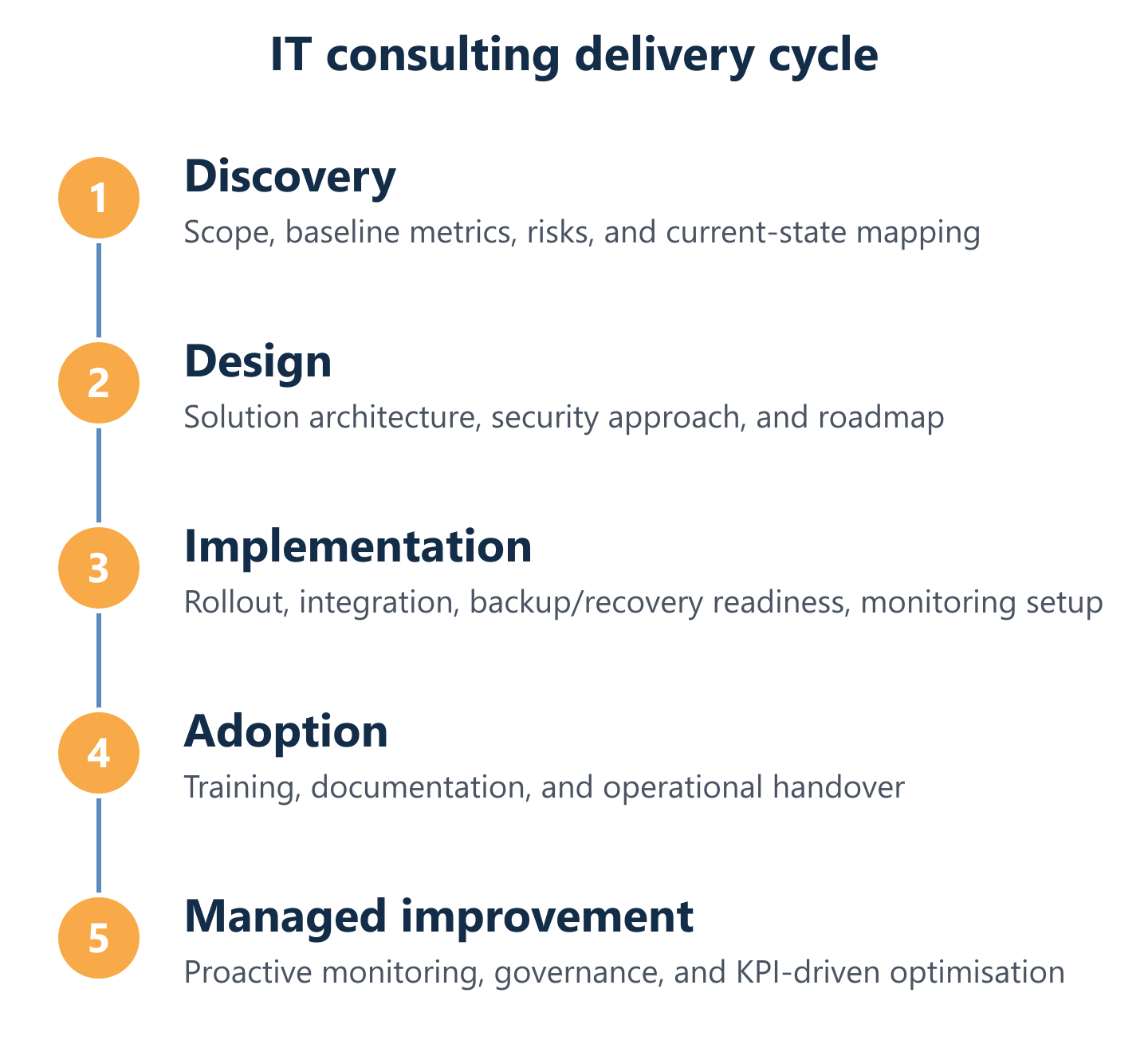
How a typical IT consulting project works (phases, timelines, outcomes)
Understanding the structure of a consulting engagement helps organisations set realistic expectations and evaluate providers on substance rather than sales pitch. A well-run IT consulting project in Madrid follows a consistent sequence regardless of the specific service line involved.
- Discovery and diagnosis (weeks 1–3): Structured assessment of current infrastructure, processes, security posture, and business objectives. Output: a written baseline with identified risks, dependencies, and priorities.
- Solution design (weeks 3–6): Architecture and implementation plan developed against the baseline. Includes technology selection, integration design, resource requirements, and a phased timeline with milestones.
- Implementation (variable, typically 4–16 weeks depending on scope): Phased rollout with defined acceptance criteria at each stage. Change management and stakeholder communication are built into the plan, not added later.
- Training and adoption (overlapping with implementation): Role-specific training delivered before go-live, with documented procedures and escalation paths for the operational team.
- Managed services and continuous improvement (ongoing): Proactive monitoring, incident prevention, and regular service reviews to track KPIs and adapt the environment as business needs evolve.
At Impulso Tecnológico, the transition from implementation to managed services is seamless—the same team that delivered the project takes operational responsibility. With more than 4,000 IT tickets resolved annually across our client base and a consistently high client satisfaction ratio, this continuity is one of the most valued aspects of our Madrid IT support and managed services model. For a detailed view of how this translates into practice, see our IT consulting success story.
Discovery and diagnosis: scope, risks, and baseline metrics
The discovery phase is where the quality of an IT consulting engagement is determined. A superficial assessment produces a generic roadmap; a rigorous one surfaces the specific risks and constraints that will define the project's success. At Impulso Tecnológico, discovery covers four dimensions: infrastructure inventory (hardware, software, network topology, and licences); security posture (firewall configuration, patch status, access controls, and backup integrity); process alignment (how technology supports or hinders core workflows); and compliance status (GDPR obligations, data residency, and retention policies). The output is a written baseline document with quantified risks—not a slide deck of observations. This baseline becomes the reference point for measuring project outcomes and for holding the consultancy accountable to the improvements it recommended.
Implementation and change: rollout, training, and adoption support
Technology implementation succeeds or fails at the human layer. A new ERP, BI platform, or security architecture delivers zero value if the people who depend on it revert to previous habits within a month of go-live. Effective implementation planning therefore treats training and adoption as parallel workstreams, not post-project activities. At Impulso Tecnológico, we deliver role-specific training before each phase goes live, produce documented procedures that remain with the client, and maintain an escalation path for operational questions during the stabilisation period. For larger rollouts, we apply structured change management: identifying stakeholder groups, communicating changes in advance, and capturing adoption metrics to identify where additional support is needed. Operational readiness—confirmed monitoring, tested backup and recovery, and documented incident response—is a formal sign-off condition before any phase is considered complete.
Managed services and continuous improvement: monitoring and governance
The post-implementation phase is where most consulting engagements either prove or lose their value. Without proactive monitoring and a structured improvement cycle, environments degrade: patches are missed, configurations drift, and the business intelligence reporting that was accurate at go-live becomes unreliable as data sources change. Impulso Tecnológico's managed services layer provides continuous system monitoring, scheduled maintenance, and regular service reviews that track agreed KPIs—ticket volume, resolution time, system availability, and backup success rates. Under our fixed monthly pricing model (per device), clients have full cost visibility and no surprise invoices. Governance is maintained through quarterly reviews that assess whether the technology roadmap remains aligned with evolving business objectives, and whether data governance and GDPR-aligned security controls continue to meet current requirements. This is what transforms a one-time project into a long-term IT partnership. Learn more about our IT services and computer services for businesses.
Choosing an IT consulting partner in Madrid is a decision with long-term operational consequences. The right partner brings structured methodology, measurable deliverables, and the technical depth to cover every layer—from network security audits and ERP implementation to Business Intelligence governance and managed services. Impulso Tecnológico has delivered this model for over 25 years, working with 476 active clients across 25 countries from our Madrid base. If your organisation needs a clear diagnosis of its current IT environment and a prioritised action plan you can act on immediately, the next step is straightforward: request an initial assessment and receive a concrete set of recommendations tailored to your specific situation.