

IT consulting is the practice of aligning an organisation's technology decisions with its business objectives — covering strategy, architecture, implementation and governance — so that technology investments produce measurable operational outcomes rather than isolated fixes.
Most organisations reach a point where their IT infrastructure no longer matches the pace of their operations. Systems are patched rather than designed, security is reactive, and no single person has a clear view of what the environment actually costs or risks. IT consulting addresses this by starting with a structured assessment of where the business stands, defining a realistic roadmap, and guiding delivery so that new capabilities integrate cleanly with existing ones.
The result is not just a technology upgrade — it is a reduction in technical debt, a clearer governance model, and an infrastructure that can scale without accumulating hidden risk. At Impulso Tecnológico, this is precisely the model we have applied across more than 476 active clients in Spain, Portugal and beyond: strategy that becomes execution, not just a report.
What IT Consulting Is (and what it isn't)
IT consulting is the structured process of advising organisations on how to use technology to achieve specific business goals — and then guiding or executing the implementation of those decisions. It sits at the intersection of business strategy and technical delivery, which is why the best engagements combine advisory capability with hands-on implementation experience.
The boundary matters. IT consulting is not the same as break-fix support, device procurement, or recurring helpdesk services. Those are transactional or operational activities. Consulting begins when an organisation needs to answer a strategic question: Which cloud model fits our risk profile? How do we redesign our ERP without disrupting operations? What security architecture do we need to meet compliance requirements?
At Impulso Tecnológico, our IT consulting approach is deliberately practical. We combine technology advisory with managed execution across Spain and Portugal, ensuring that the strategy we define is the same one we implement and maintain — with clear service governance from day one.
| Activity | IT Consulting | Managed Services | Transactional IT |
|---|---|---|---|
| Technology roadmap and strategy | ✔ Core deliverable | ✘ Not included | ✘ Not included |
| Architecture design and integration | ✔ Core deliverable | Partial (operational) | ✘ Not included |
| Implementation and project delivery | ✔ Guided or executed | Partial (maintenance) | ✘ Not included |
| Ongoing monitoring and support | ✘ Not core scope | ✔ Core deliverable | ✘ Not included |
| Device procurement and replacement | ✘ Not core scope | Partial (asset mgmt) | ✔ Primary activity |
| SLA-governed service continuity | Defined in scope | ✔ Core deliverable | ✘ Not included |
Core purpose: aligning IT with business outcomes
Every IT consulting engagement starts from the same premise: technology should serve the business, not the other way around. This means translating operational needs — reduce downtime, accelerate a product launch, meet a compliance deadline — into a coherent technology plan with clear priorities and investment logic.
The deliverable is not a list of tools. It is a roadmap that sequences decisions, assigns ownership and defines what success looks like at each stage. When information technology consulting is done well, the organisation ends up with an architecture that supports its current operations and can absorb future growth without requiring a full redesign. That alignment between IT capability and business direction is the core value that separates consulting from generic technology advice.
What it isn't: avoiding purely transactional or ad-hoc fixes
One of the most common sources of wasted IT spend is confusing reactive support with strategic consulting. Replacing a failed server, renewing a software licence, or resolving a connectivity issue are necessary activities — but they do not constitute an IT consulting engagement. They address symptoms rather than root causes.
IT consulting specifically excludes purely transactional work: activities that can be completed without understanding the broader technology environment or business strategy. When organisations treat every IT interaction as a one-off transaction, they accumulate technical debt — a growing gap between what their infrastructure can do and what the business actually needs. A proper IT consulting engagement is designed to close that gap systematically, with defined scope, a realistic budget and a timeline that accounts for organisational constraints, not just technical ones.
Advisory vs implementation: where value is created
The most durable value in IT consulting comes from the point where advisory and implementation meet. A strategy document that never reaches deployment is an expensive PDF. Equally, implementation without a clear architectural rationale produces systems that work in isolation but fail to integrate — creating new technical debt faster than the old debt was resolved.
A well-structured IT consulting engagement defines scope and governance before delivery begins: what is in scope, what is out, who approves decisions, how progress is measured, and what constitutes a successful outcome. This governance layer is what prevents scope creep, budget overruns and the common scenario where a project is technically delivered but operationally unused. At Impulso Tecnológico, we build this governance into every engagement so that consulting translates directly into a running, maintained environment — not a handover document.

Core IT Consulting Services (mapped to real business needs)
The IT consulting market encompasses several distinct disciplines, each addressing a different category of business problem. Understanding which discipline applies to your situation is the first step in defining a realistic scope and budget for an IT consulting engagement. The following overview maps each service area to the business need it addresses, the typical deliverable and the success measure that matters most.
- IT Strategy and Planning: Addresses the question of where to invest and in what sequence. Deliverable: a prioritised technology roadmap aligned with business objectives. Success measure: investment decisions are traceable to operational outcomes.
- IT Architecture and Integration: Addresses fragmented systems that cannot share data or scale reliably. Deliverable: a documented architecture design with integration patterns. Success measure: new systems connect without manual workarounds.
- ERP Consulting and Redesign: Addresses operational inefficiency caused by misaligned or over-customised ERP platforms. Deliverable: a business case, redesign specification and implementation plan. Success measure: process cycle times and error rates improve post-deployment.
- Cybersecurity Design: Addresses exposure to threats and compliance gaps. Deliverable: a security architecture covering endpoint, network, identity and data protection. Success measure: measurable reduction in attack surface and audit readiness.
- Cloud Migration and Management: Addresses infrastructure cost, scalability and remote access limitations. Deliverable: a migration plan and target-state cloud environment. Success measure: uptime, cost per workload and user productivity after migration.
- Data Analytics and Predictive Modelling: Addresses decisions made on incomplete or delayed information. Deliverable: a data architecture, reporting layer and, where applicable, predictive models. Success measure: decision cycle times and forecast accuracy.
- Software and Asset Management: Addresses licence sprawl, shadow IT and compliance risk. Deliverable: an inventory, rationalisation plan and governance policy. Success measure: licence cost reduction and compliance posture.
At Impulso Tecnológico, our capability spans all of these disciplines. We conduct IT assessments, build customised IT strategies, and implement cloud, security, backup and network environments using partners including Microsoft, Sophos, Fortinet, Veeam, Cisco and Aruba — ensuring each component integrates as a coherent whole rather than a collection of independent tools.
IT Strategy, architecture and systems integration
IT strategy is the discipline most often requested and most often misunderstood. Its output is not a vision statement — it is a prioritised investment plan that connects technology decisions to business objectives, with a clear rationale for sequencing. A typical IT strategy engagement runs between six weeks and three months, depending on organisational complexity.
IT architecture and systems integration follow directly from strategy. Once the direction is set, the architecture defines how systems will be structured, how they will communicate, and how new components will be introduced without destabilising existing operations. Integration projects — particularly those involving service-oriented architectures or hybrid cloud environments — typically run six to twelve months. At Impulso Tecnológico, we design these environments with our technology partners to ensure that security, networking and cloud layers are planned together, not bolted on after the fact. This is what makes IT architecture and integration a genuine consulting deliverable rather than a technical afterthought.
ERP, data analytics and software management
ERP consulting and redesign engagements are among the highest-stakes IT consulting projects an organisation will undertake. They typically begin with a business case — a structured analysis of current process inefficiencies, integration gaps and the cost of inaction — before any redesign work begins. Skipping this step is one of the primary reasons ERP projects overrun budget and timeline.
Data analytics and predictive modelling have moved from specialist capability to operational necessity across industries including logistics, energy and healthcare. An IT consulting engagement in this area starts by mapping existing data sources, assessing data quality, and defining the decisions the organisation needs to make faster or more accurately. The output is an architecture that supports both current reporting and future predictive modelling. Software management — covering licence rationalisation, version control and compliance — is often addressed in parallel, since ERP and analytics projects frequently surface shadow IT and redundant tooling that inflates cost without adding capability.
Cybersecurity, cloud, backup and continuity design
Security and continuity are no longer optional layers added at the end of an IT project — they are design constraints that shape every other decision. An IT consulting engagement that ignores security architecture produces a plan that will require expensive remediation before it can be operated safely.
At Impulso Tecnológico, we integrate cybersecurity design into every consulting engagement from the outset. Working with Sophos and Fortinet for endpoint and network protection, Veeam for backup and disaster recovery, and Microsoft Azure for cloud identity and workload management, we ensure that the security posture is defined before infrastructure is deployed — not after. Cloud migration consulting follows the same logic: the target architecture must account for data residency, access control, backup frequency and recovery time objectives before a single workload moves. This approach, combined with GDPR compliance considerations, means our clients receive a continuity design that is both technically sound and operationally realistic.
Typical Engagement Lifecycle and How to Choose a Partner
Understanding how an IT consulting engagement actually progresses — and what to look for in a provider — prevents the most common failures: undefined scope, misaligned expectations and delivery that produces documentation rather than operational change.
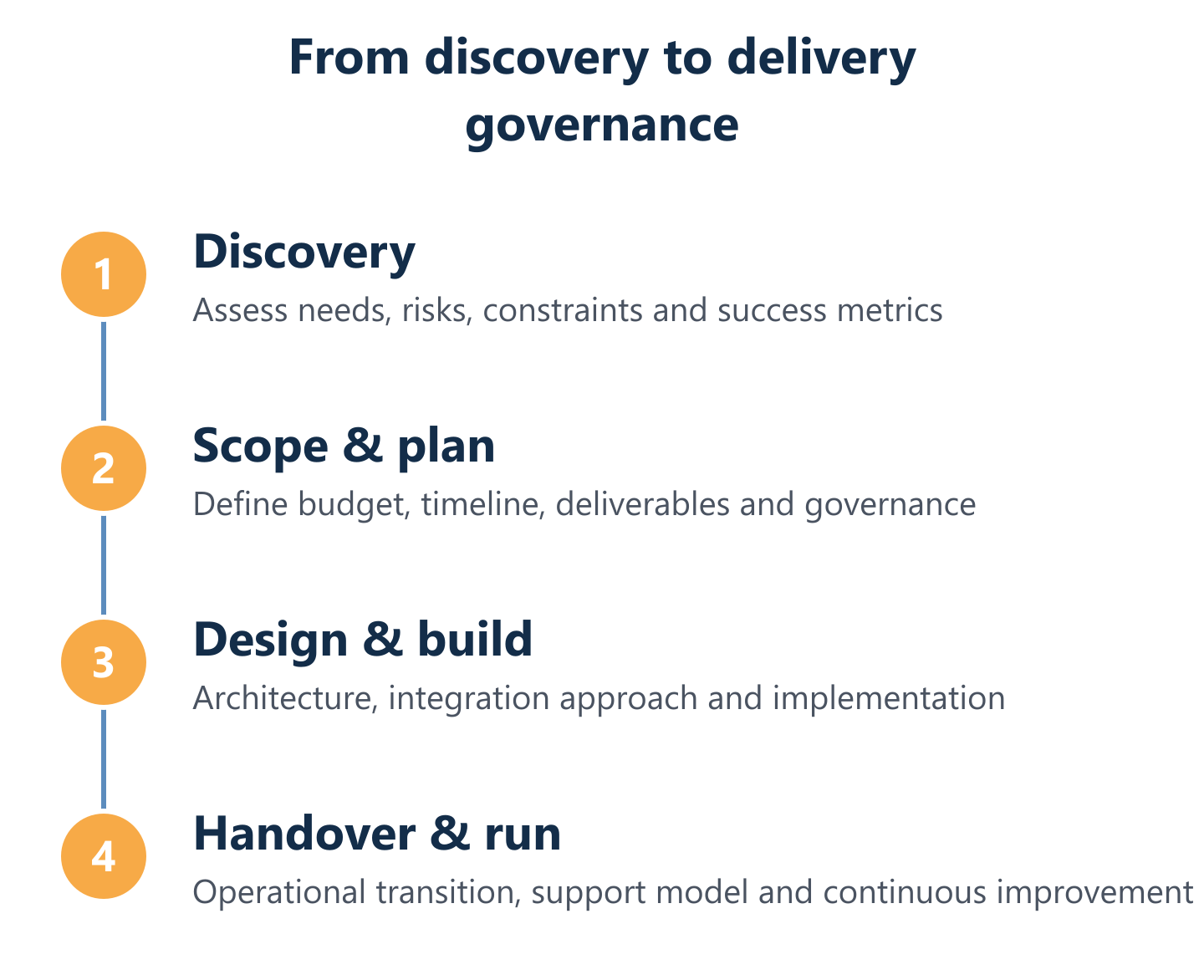
A well-run engagement moves through four broad phases: discovery and assessment, scope and budget definition, implementation and delivery, and handover with governance transfer. The duration varies by discipline — IT strategy engagements typically complete in six to twelve weeks; architecture and integration projects run six to twelve months — but the structure remains consistent.
When evaluating providers, the following signals distinguish a genuine technology advisory and delivery partner from a firm that produces reports:
- They start with discovery, not proposals. A credible partner asks to understand your environment before quoting a solution.
- They define scope in writing, with exclusions. Ambiguous scope is the primary cause of cost overruns and disappointment.
- They can implement what they advise. Advisory-only firms create dependency; end-to-end capability means the plan becomes operational.
- They integrate security from the start. Security retrofitted after delivery is more expensive and less effective.
- They offer SLA-governed continuity. Post-delivery support with defined service levels protects the investment made during the engagement.
- They communicate in your language and timezone. Particularly relevant for organisations operating across multiple countries or languages.
- They have verifiable technology partnerships. Certifications with vendors such as Microsoft, Cisco, Sophos or Fortinet indicate real implementation capability, not just familiarity.
Impulso Tecnológico's differentiation in this space is the combination of proactive managed services with SLA-driven governance. We do not hand over a strategy document and disengage — we implement, monitor and maintain the environment, resolving over 4,000 IT tickets annually for our active clients across Spain, Portugal and international locations.
First 4–12 weeks: discovery, assessment and scope definition
The discovery phase is where most IT consulting engagements succeed or fail. Its purpose is to establish a shared, documented understanding of the current state — infrastructure inventory, security posture, integration dependencies, business constraints and strategic priorities — before any delivery commitment is made.
A structured discovery typically produces three outputs: an IT assessment report identifying gaps and risks; a scope definition document that specifies what the engagement will and will not address; and a budget and timeline estimate grounded in real findings rather than assumptions. For organisations that have never conducted a formal IT assessment, this phase alone often surfaces issues that change the priority order of subsequent work. Defining the IT consulting scope and budget at this stage — rather than mid-project — is the single most effective way to prevent overruns and ensure that the engagement delivers what the business actually needs.
Choosing criteria: firm type, end-to-end capability and security fit
Service governance — the set of processes that track progress, manage risk and ensure accountability throughout an engagement — is what separates a consulting relationship from a series of disconnected projects. Without it, even technically competent delivery can produce outcomes that the organisation cannot operate, maintain or build upon.
When assessing a potential IT consulting partner, evaluate their governance model explicitly: How are decisions documented and approved? How are scope changes handled? What reporting is provided during delivery, and at what frequency? Who is the accountable contact for the engagement? For organisations with existing managed service relationships, the governance model should also define how consulting outputs integrate with ongoing operational support — so that the environment delivered by the consulting engagement is immediately covered by the service framework, without a gap between project close and operational handover.
Pros and cons: global vs generalist vs niche delivery models
The IT consulting market divides broadly into three firm types, each with distinct trade-offs:
Global firms (large multinational consultancies) offer broad capability and brand recognition, but typically operate with higher day rates, longer mobilisation times and less flexibility for mid-market organisations. They suit complex, multi-country programmes with large budgets.
Generalist firms with IT units offer cross-functional perspective — combining business process and technology advisory — but the IT depth can be inconsistent depending on the team assigned.
Niche IT consulting firms offer deep technical expertise, faster mobilisation and closer client relationships, but may have limited capacity for very large programmes or highly specialised verticals.
For most small and mid-sized organisations, a niche or regional IT consulting partner with end-to-end delivery capability — covering strategy, implementation, security and ongoing managed services — provides the best combination of technical depth, responsiveness and cost efficiency. This is the model that Impulso Tecnológico has refined across more than 25 years of engagements in Spain, Portugal and internationally, supporting clients in industries from logistics and energy to education and healthcare.
IT consulting only delivers lasting value when the strategy it produces becomes a running, maintained environment — not a document waiting to be implemented. The organisations that see the clearest returns are those that choose a partner capable of both designing the plan and executing it with clear governance, integrated security and continuity practices built in from the start. If you are ready to move from reactive IT management to a structured, forward-looking technology approach, the next step is a discovery conversation. Explore our IT Consulting Services in Spain and Portugal or review a real IT Consulting Success Story to see how this approach translates into measurable operational results.