

The most critical cybersecurity trends for businesses right now are AI-assisted attacks, identity deception, shadow AI governance gaps, and supply chain vulnerabilities. Each one exploits delays in patching, monitoring, and response — meaning the organisations most at risk are those still treating security as a periodic task rather than a continuous operational discipline.
Over the past two years, the attack surface for most businesses has expanded faster than internal IT teams can manage. Attackers are using AI to craft convincing phishing campaigns at scale, deepfakes to impersonate executives in financial approval workflows, and automated tools to probe third-party suppliers for weaknesses. At the same time, employees are adopting AI tools without IT oversight — creating shadow AI risks that compliance teams are only beginning to quantify.
The practical response is not to chase every trend simultaneously. It is to build a layered security programme with clear ownership, measurable targets such as time to remediate, and tested recovery capabilities. Impulso Tecnológico has spent over 25 years helping businesses across Spain, Portugal, and internationally do exactly that — combining proactive monitoring, certified technology partners, and transparent SLAs to convert security investment into measurable operational resilience.
Why cybersecurity trends are accelerating for businesses
Cyber risk is accelerating because the conditions that create it are compounding simultaneously. The number of disclosed vulnerabilities exceeded 30,000 in a single year — a 17% increase year-on-year — while IT environments have grown more complex through hybrid cloud adoption, remote endpoints, and third-party integrations. Each layer added to a technology stack is also a potential entry point if left unmonitored or unpatched.
For businesses, the financial and reputational consequences of slow detection are no longer theoretical. Gartner data shows IT security spending rising sharply as boards recognise that a single incident can trigger regulatory fines, customer attrition, and operational downtime simultaneously. The shift from reactive to proactive security is therefore not a technology preference — it is a business continuity requirement.
Impulso Tecnológico addresses this directly through its managed services model: continuous system monitoring detects anomalies before they escalate, scheduled maintenance windows keep patches current, and a layered security stack — combining Fortinet next-generation firewalls, Sophos endpoint protection, and Veeam backup and disaster recovery — ensures that when threats do materialise, containment and recovery are fast and structured.
| Security approach | Reactive (break-fix) | Periodic (quarterly reviews) | Continuous managed monitoring |
|---|---|---|---|
| Patch latency | Weeks to months | Days to weeks | Hours (scheduled windows) |
| Threat detection speed | After incident reported | At next review cycle | Near real-time anomaly alerts |
| Compliance evidence | Difficult to reconstruct | Partial audit trail | Continuous, auditable logs |
| Recovery time objective | Unpredictable | Partially tested | Defined by SLA and tested recovery plans |
| Cost predictability | High variance (incident-driven) | Moderate | Fixed monthly cost with SLA guarantees |
From vulnerabilities to operational risk: why "time to remediate" matters
Every unpatched vulnerability is an open window with a known address. Attackers scan for these systematically — and the gap between a vulnerability being disclosed and being actively exploited has narrowed from weeks to days in many cases. For businesses, this means patch latency is no longer just a technical metric; it is a direct measure of operational exposure.
Time to remediate — the elapsed time between identifying a vulnerability or incident and resolving it — has become one of the most meaningful indicators of security programme maturity. Organisations that can demonstrate a consistent, short remediation window are better positioned for compliance audits, cyber insurance assessments, and board-level risk reporting. Achieving this requires visibility into all assets, a clear prioritisation framework based on exploitability and business impact, and a support model that can act quickly — not one that waits for a quarterly review cycle.
Why monitoring must cover endpoints, networks, and data flows
A monitoring strategy that covers only the network perimeter misses the majority of where modern attacks succeed. Endpoint devices — laptops, mobile devices, servers — are the most common initial access point, particularly in hybrid working environments where devices connect from outside corporate network controls. Cloud workloads introduce additional blind spots if logging and alerting are not configured correctly from deployment.
Effective continuous monitoring requires coverage across four layers: endpoints (device health, process behaviour, and software inventory), network traffic (lateral movement, unusual outbound connections), cloud environments (identity events, configuration drift, and data access patterns), and third-party data flows (API integrations, supplier connections). Without visibility across all four, attackers can move between layers undetected. Impulso Tecnológico's managed monitoring approach is designed to address this multi-layer requirement, using proactive oversight to surface anomalies — such as unusual performance patterns or abnormal network behaviour — before they become operational disruptions.
Compliance pressure: turning security activity into auditable evidence
GDPR enforcement actions have demonstrated that regulators assess not just whether a breach occurred, but whether the organisation had reasonable controls in place and responded promptly. The same logic applies to sector-specific frameworks such as HIPAA, NIS2, and ISO 27001. For businesses, this means security activity must generate auditable evidence — not just operational outcomes.
Logs, patch records, incident timelines, access reviews, and backup test results are all artefacts that compliance auditors and cyber insurers request. Organisations that run security reactively often struggle to reconstruct this evidence after the fact. A managed services model with structured SLAs, scheduled maintenance windows, and documented response processes creates this audit trail as a by-product of normal operations — reducing the additional effort required at audit time. For businesses building or reviewing their IT security plan, embedding evidence generation from the outset is significantly more efficient than retrofitting it.

The biggest business-impacting trends (without the hype)
Not every cybersecurity trend demands equal urgency. The ones listed below are selected because they directly affect business processes, budgets, and risk ownership — not because they generate headlines. Each represents a shift in attacker capability or organisational exposure that requires a deliberate response rather than a one-off fix.
Impulso Tecnológico's layered security stack — Fortinet firewalls, Sophos endpoint protection, and Veeam backup and disaster recovery — is designed to address the resilience and containment requirements that these trends create. Managed support with SLA-backed response times reduces the remediation delays that attackers rely on, while proactive monitoring ensures that incidents are detected before they escalate into full operational disruptions.
- AI-assisted phishing and social engineering — attackers now generate highly personalised, contextually accurate lures at scale, bypassing traditional awareness training.
- Deepfakes and identity deception — synthetic voice and video are being used to impersonate executives in financial approval and HR processes.
- Shadow AI and governance gaps — employees using unapproved AI tools introduce data leakage and compliance risks that most IT teams cannot yet see.
- Supply chain vulnerabilities — third-party software and service providers remain a primary attack vector, with weaknesses in one supplier cascading across client organisations.
- Ransomware resilience and time to remediate — the focus has shifted from prevention alone to how quickly an organisation can contain, recover, and resume operations after an incident.
- Nation-state and persistent threat activity — critical infrastructure, logistics, and energy sectors are increasingly targeted by state-affiliated actors using sophisticated, patient techniques.
Agentic AI and AI-assisted social engineering: where attackers gain leverage
AI-assisted phishing has moved well beyond grammar-corrected bulk emails. Agentic AI systems can now research a target organisation's public communications, identify key personnel, and generate contextually accurate messages that reference real projects, colleagues, or recent events. This reduces the cognitive cues that trained employees previously used to identify suspicious messages — making awareness training alone an insufficient defence.
The more sophisticated threat involves AI agents that can autonomously execute multi-step attacks: initiating contact, building rapport over several exchanges, and then requesting credential input or financial action. For businesses, the defensive response requires layered controls rather than relying on human detection. This includes email filtering with behavioural analysis, strict verification procedures for any request involving credentials or financial transfers, and endpoint protection capable of detecting anomalous process behaviour — capabilities that Sophos endpoint protection and Fortinet firewall policies are specifically configured to address within Impulso Tecnológico's managed security deployments.
Deepfakes, identity deception, and credential risk: impact on finance and HR workflows
Credential theft increased by 71% year-on-year in recent threat intelligence reporting — and deepfake technology has now made impersonation attacks viable even in video call environments. Finance teams have processed fraudulent payment instructions after receiving what appeared to be a live video call from a senior executive. HR departments have been targeted with synthetic identity applications designed to gain insider access.
The practical defence requires hardening identity verification at every step where a decision carries financial or access consequences. This means implementing MFA across all systems — not just email — enforcing out-of-band verification for any payment or access request above a defined threshold, and establishing trust codes or pre-agreed challenge phrases for sensitive approvals. IBM research identifies an identity-first security strategy as the most effective structural response, treating identity as the primary security perimeter rather than the network edge. For a detailed framework on implementing these controls, our guide to cybersecurity for businesses covers identity hardening in practical depth.
Supply chain vulnerabilities and resilience: reducing blast radius with recovery planning
Supply chain attacks succeed because they exploit trusted relationships. When a software vendor or managed service provider is compromised, the attacker inherits access to every organisation that trusts that vendor's updates or credentials. The SolarWinds and MOVEit incidents demonstrated this at scale — and the pattern has continued with smaller, sector-specific suppliers being targeted precisely because their clients have lower scrutiny of third-party connections.
For businesses, the response has two components. First, vendor assessment: mapping which third parties have network access, data access, or software deployment rights, and applying minimum-privilege controls to each. Second, recovery planning: accepting that some supply chain incidents will succeed and ensuring that backup integrity, network segmentation, and tested incident response procedures limit the blast radius. Veeam-based backup and disaster recovery, as deployed by Impulso Tecnológico, directly addresses this second component — ensuring that even when a supply chain compromise triggers a ransomware payload, recovery is measured in hours rather than days.
A practical 90-day roadmap for businesses
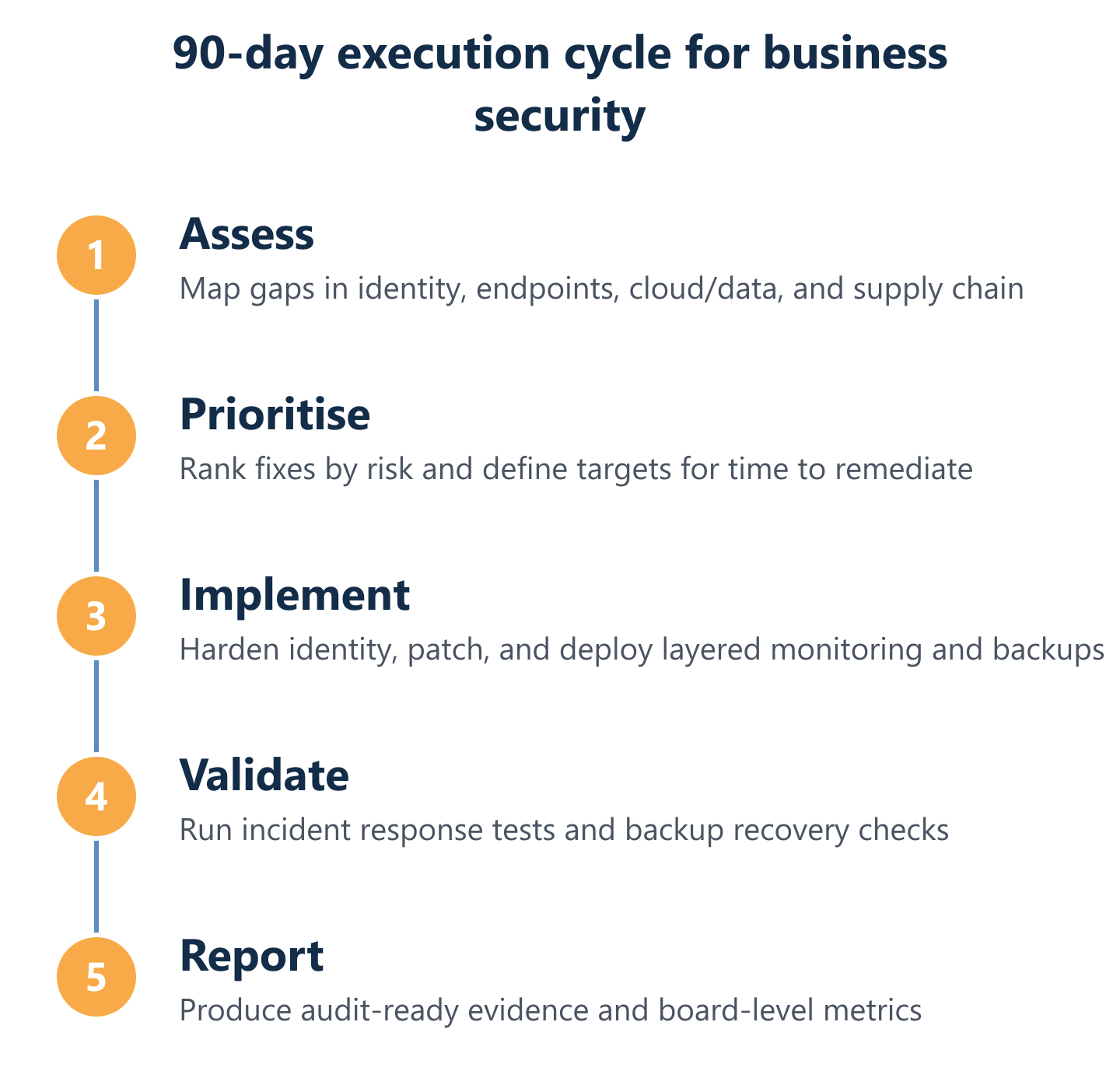
Turning a list of cybersecurity trends into an operational programme requires sequencing. Attempting to address everything simultaneously leads to partial implementations that create false confidence without closing real gaps. The 90-day structure below prioritises actions by their impact on the most exploited weaknesses: patch latency, identity exposure, AI governance, and recovery readiness.
Impulso Tecnológico can operationalise each phase of this roadmap through its managed services model. Scheduled maintenance windows address patching systematically. Proactive monitoring baselines normal behaviour so anomalies are detectable. SLA-backed response times — under four hours for critical server issues — ensure that when incidents occur, containment begins immediately rather than waiting for internal escalation. Proactive advisory and audit services support the governance and reporting phases.
- Assign clear ownership: each control area (identity, endpoints, cloud, supply chain, backups) needs a named owner and a measurable target — not a shared responsibility that defaults to no one.
- Establish a baseline before adding new tools: audit current asset inventory, patch status, and access rights before deploying additional security products; gaps in visibility are more dangerous than gaps in tooling.
- Prioritise by exploitability, not severity score alone: a medium-severity vulnerability in an internet-facing system is higher priority than a critical vulnerability in an isolated internal system.
- Test recovery before you need it: backup systems that have never been tested are not recovery systems — schedule quarterly restore tests and document the results as compliance evidence.
- Build board-ready reporting from operational data: time to remediate, open vulnerability age, and incident containment speed are metrics that translate security activity into business risk language.
- Review third-party access quarterly: supplier credentials and API integrations accumulate over time; a scheduled review removes access that is no longer needed and reduces supply chain exposure.
Week-by-week priorities: patching, endpoint hardening, and visibility baselines
Weeks one to four should focus on establishing a complete and accurate asset inventory — you cannot patch or monitor what you cannot see. This means cataloguing every endpoint, server, cloud workload, and network device, then cross-referencing against current patch status. Prioritise internet-facing systems and those handling sensitive data or financial transactions first.
Weeks five to eight shift to hardening: disable unused services and ports, enforce application whitelisting where feasible, and ensure endpoint protection is deployed and reporting consistently across all devices. Set a target for mean time to patch critical vulnerabilities — industry benchmarks suggest under 15 days for critical, under 30 days for high severity as a starting point. Weeks nine to twelve focus on validating visibility: confirm that monitoring covers all four layers (endpoints, network, cloud, third-party flows) and that alerts are routing to someone with the authority and process to act on them within defined timeframes. A structured IT security audit at this stage provides an independent baseline against which progress can be measured.
Identity and AI governance: MFA, verification steps, and shadow AI controls
MFA deployment is the single highest-return identity control available to most businesses — yet many organisations still have gaps in coverage, particularly for legacy applications, VPN access, and administrative accounts. The 90-day identity phase should map every authentication point and enforce MFA universally, with phishing-resistant methods (hardware keys or passkey-based authentication) applied to the highest-privilege accounts.
Shadow AI detection and governance requires a different approach. Start by surveying which AI tools employees are actually using — browser extensions, SaaS AI assistants, and code generation tools are the most common categories. Classify each by data access risk: tools that can access, process, or transmit business data require formal approval, data handling agreements, and usage policies. Block unapproved tools at the network or endpoint layer, and communicate the policy clearly so employees understand the risk rationale rather than simply experiencing a restriction. This governance framework also supports GDPR compliance, since personal data processed by an unapproved third-party AI tool may constitute an unlawful transfer.
Resilience and reporting: time to remediate, containment metrics, and audit-ready outputs
Resilience is demonstrated through testing, not documentation. A business continuity plan that has never been exercised is a hypothesis. The 90-day roadmap should include at least one tabletop incident response exercise — walking key stakeholders through a realistic scenario (ransomware activation via a phishing email, for example) to identify gaps in communication, decision authority, and technical recovery steps.
Backup validation is equally non-negotiable: test restores from each backup tier, document the recovery time achieved, and compare it against the recovery time objective defined in your continuity plan. These test results become compliance evidence for GDPR, NIS2, and cyber insurance renewals. For board and executive reporting, translate technical metrics into business language: time to remediate (average and worst-case), percentage of assets with current patches, and number of incidents contained before data exfiltration. These three metrics give leadership an accurate and actionable view of security programme maturity without requiring technical expertise to interpret them. Our network security audit service provides the independent validation that makes these metrics credible to auditors and insurers.
Cybersecurity trends will continue to evolve — but the organisations that respond most effectively are not those that chase every new threat. They are those that build a security programme with clear ownership, measurable metrics, and tested recovery capabilities. By treating time to remediate, monitoring coverage, and incident readiness as operational KPIs rather than IT concerns, businesses convert security investment into demonstrable resilience. Impulso Tecnológico's managed services model is designed to support exactly this: combining proactive monitoring, layered controls, and structured SLA-backed support so that your technology infrastructure remains secure, efficient, and ready for whatever comes next.