

Cybersecurity for businesses means implementing layered technical controls, clear governance, and a tested incident response plan—so that threats are detected early, disruption is minimised, and customer data remains protected. It is not a one-time purchase; it is an ongoing operational discipline.
Most organisations that suffer significant breaches share a common pattern: security was treated as a technology problem rather than a business one. Firewalls and antivirus software were in place, yet no one had defined who owned the risk, how incidents would be communicated, or whether backups had ever been successfully restored. The result is predictable—extended downtime, regulatory exposure, and damaged client relationships.
This guide provides a practical blueprint that moves beyond checklists. It covers how to assign governance responsibilities, implement high-impact controls, harden networks and endpoints, prepare for incidents, and map all activity to the NIST Cybersecurity Framework (CSF) 2.0. Whether you are building a programme from scratch or strengthening an existing one, the structure here is designed to reduce cyber risk in a measurable, repeatable way.
Why Cybersecurity For Businesses must be business-led
Organisations that treat cybersecurity as a purely technical function consistently underperform those that embed it into business planning. The reason is structural: when security decisions live only inside the IT team, they compete with operational priorities and rarely receive the budget, visibility, or cross-departmental cooperation they require. Breaches do not stay inside the server room—they affect revenue, contracts, regulatory standing, and customer trust.
The shift required is from reactive tool deployment to proactive programme management. This means the board or senior leadership approves a security strategy, a named individual owns the programme, and progress is reported against agreed metrics—not just incident counts. For mid-sized companies in particular, this governance layer is often the missing element that leaves controls inconsistent across departments or sites.
At Impulso Tecnológico, we have seen this pattern across more than 25 years of IT services delivery in Spain, Portugal, and internationally. Our managed support model translates leadership intent into operational controls: defined SLA response windows, proactive audits, and continuous monitoring that surfaces anomalies before they become incidents. The table below illustrates how a business-led approach differs from a tool-centric one across key dimensions.
| Dimension | Tool-centric approach | Business-led programme |
|---|---|---|
| Ownership | IT team only | CEO/board + Security Manager + IT lead |
| Budget allocation | Reactive, incident-driven | Annual risk-based planning |
| Incident response | Ad hoc, undocumented | Documented IRP, tested quarterly |
| Control coverage | Perimeter-focused | Layered: endpoint, network, identity, data |
| Reporting | Ticket counts | MFA coverage %, patching rate, restore success |
| Compliance alignment | Checkbox exercise | Continuous GDPR/NIST CSF 2.0 mapping |
Security as a business planning requirement (not just IT)
Security is a business risk discipline. Every significant cyber incident carries a direct financial cost—recovery time, regulatory fines, legal liability, and reputational damage that affects future revenue. The IBM Cost of a Data Breach Report consistently places average breach costs in the millions for mid-sized organisations, yet the majority of those costs are avoidable with structured preventive controls.
Including cybersecurity in annual business planning means setting a risk appetite, allocating budget proportionate to the assets being protected, and reviewing security posture alongside financial and operational objectives. This is not about spending more—it is about spending deliberately. When leadership understands what is being protected and why, security investments align with the operations that generate value: customer data, production systems, intellectual property, and supply chain continuity.
Building a security culture with measurable commitments
Technical controls fail when employee behaviour is not part of the security model. Phishing remains the most common initial access vector in business breaches precisely because it bypasses perimeter defences by targeting people. A security culture is not built through annual awareness videos—it requires regular, role-specific training, clear policies that employees understand and accept, and visible leadership commitment.
Measurable commitments matter here. Define what good looks like: 100% of staff completing phishing simulation training quarterly, zero shared credentials across administrative accounts, and a documented process for reporting suspicious activity without fear of blame. Shadow IT—employees using unapproved tools or cloud services—drops significantly when staff understand the risks and have approved alternatives. Accountability at every level, from the CEO to front-line staff, is what makes culture a genuine security control rather than a compliance formality.
Choosing the right scope for your business size and risk
Cybersecurity for mid-sized companies requires a different scope than a ten-person startup or a global enterprise. Mid-sized organisations typically have multiple sites or remote workers, third-party integrations, and regulatory obligations—but lack the internal security team depth of a large corporation. This creates gaps between what IT manages, what operations uses, and what leadership has approved.
Defining scope means identifying your critical assets (customer data, financial systems, production infrastructure), mapping the threats most relevant to your sector, and setting a realistic coverage model. A manufacturing company faces different risks from a professional services firm. Scoping the programme correctly prevents over-investment in low-risk areas while leaving high-value assets exposed. A managed cybersecurity services partner can accelerate this scoping process through a structured IT security audit that maps current controls against actual risk exposure—providing a foundation for prioritised action rather than generic recommendations.

Build a cybersecurity programme by roles and governance
A cybersecurity programme without defined roles is a policy document that no one owns. Governance means assigning decision rights, establishing a regular operating cadence, and creating accountability structures that survive staff changes and incident pressure. For most businesses, this requires three distinct roles working in coordination: a senior leader who owns risk appetite, a Security Programme Manager who runs the programme day to day, and an IT lead who implements and maintains controls.
At Impulso Tecnológico, our managed support model provides the operational backbone for this governance structure. Continuous monitoring surfaces anomalies before they escalate, and our defined response windows—under four hours for critical server issues—ensure that when incidents do occur, the response is structured rather than improvised. Regular audits feed directly into programme reviews, so governance is not a theoretical exercise but a measurable, repeatable cycle.
- Define roles and decision rights: assign the CEO/board as risk owners, a Security Programme Manager as programme lead, and the IT lead as control implementer.
- Establish a governance cadence: monthly operational reviews, quarterly programme reviews, and annual strategy alignment with leadership.
- Document and approve the Incident Response Plan (IRP): the Security Programme Manager drafts; the CEO/board approves; IT lead maintains the technical runbooks.
- Run tabletop exercises: simulate ransomware, data breach, and supply chain compromise scenarios at least twice per year to test the IRP under realistic conditions.
- Track and report metrics: MFA coverage, patching completion rate, and backup restore success are reported to leadership at each quarterly review.
- Review after incidents and near-misses: every significant event triggers a post-incident review within five business days, with findings fed back into programme improvements.
Role-based responsibilities and governance cadence
Clear role definition prevents the most common governance failure: everyone assuming someone else owns the risk. The CEO or equivalent senior leader sets the risk appetite and approves the security strategy and IRP—this is not delegable. The Security Programme Manager translates that strategy into an operational plan, tracks metrics, manages the training programme, and chairs governance reviews. The IT lead implements technical controls, manages patching and vulnerability remediation, and maintains the technical components of the IRP including contact lists and system inventories.
Governance cadence should be structured but proportionate. Monthly operational check-ins between the Security Manager and IT lead keep controls on track. Quarterly programme reviews bring in senior leadership to assess metrics and approve changes. Annual strategy reviews align the security programme with business direction and emerging threats. This cadence ensures security remains a live discipline rather than an annual audit event.
Incident response readiness: IRP, tabletop exercises, and communications
An Incident Response Plan is only useful if it has been tested before an incident occurs. The IRP should define at minimum: incident classification criteria, roles and contact details (including out-of-hours escalation paths), containment and eradication steps for the most likely scenarios (ransomware, data breach, account compromise), and communication protocols for internal stakeholders, customers, and regulators.
Tabletop exercises bring the IRP to life. A realistic scenario—for example, a ransomware attack encrypting file servers on a Monday morning—forces the team to work through decision points under simulated pressure. Near-miss reviews are equally valuable: when a phishing email is caught before a credential is compromised, that event should be reviewed to understand why it nearly succeeded. CISA recommends reviewing the IRP quarterly and after every significant incident or near-miss. This cadence keeps the plan current and the team practised.
Operational metrics that prove security is improving
Metrics transform security governance from a narrative into evidence. Three metrics deliver the clearest signal of programme health: MFA coverage (the percentage of user and administrator accounts with multi-factor authentication enforced), patching cadence (the percentage of critical and high-severity vulnerabilities remediated within defined windows—typically 14 days for critical), and backup restore success rate (the percentage of restore tests completed successfully within the defined recovery time objective).
These three metrics directly address the most common attack paths: credential theft, unpatched vulnerabilities, and ransomware impact. Reporting them monthly to the Security Programme Manager and quarterly to leadership creates accountability and surfaces trends. When MFA coverage drops below 95% or a restore test fails, that is a programme signal requiring immediate action—not a note for the next annual review. Impulso Tecnológico incorporates these metrics into its managed cybersecurity services reporting, giving clients a clear view of security programme maturity over time.
Implement essentials and map them to NIST CSF 2.0
The NIST Cybersecurity Framework 2.0 organises security activity across six functions: Govern, Identify, Protect, Detect, Respond, and Recover. Mapping your controls to this framework does two things: it reveals gaps in coverage, and it provides a reporting structure that communicates programme maturity to leadership and auditors without requiring deep technical knowledge.
Before mapping, however, the controls themselves must be implemented correctly. The highest-impact controls for most businesses—multi-factor authentication, systematic patching, encryption of data at rest and in transit, and regularly tested backups—address the attack vectors responsible for the majority of successful breaches. These are not advanced capabilities; they are foundational, and their absence is the single most common finding in post-breach investigations.
Impulso Tecnológico implements layered protection using Sophos for endpoint and email security, Fortinet for network and firewall controls, and Veeam for backup and disaster recovery. This technology stack covers the Protect, Detect, and Recover functions of NIST CSF 2.0, and our proactive advisory service ensures controls remain aligned with GDPR requirements—including documented security measures, incident response readiness, and appropriate data protection safeguards. For organisations looking to understand their current posture before implementing controls, a structured IT security audit provides the gap analysis needed to prioritise investment.
- MFA rollout: enforce on all user accounts first, then administrator and privileged accounts—prioritise email and remote access as the highest-risk entry points.
- Patching cadence: critical vulnerabilities within 14 days, high-severity within 30 days; use a known exploited vulnerabilities catalogue to prioritise when resources are constrained.
- Encryption: enforce full-disk encryption on all endpoints and laptops; encrypt data in transit using TLS 1.2 or higher; ensure data shared with third parties is encrypted at rest.
- Backup restore testing: backups that have never been restored are not backups—schedule restore tests monthly for critical systems and document results.
- Network segmentation: isolate payment systems, production environments, and guest Wi-Fi on separate network segments to limit lateral movement.
- Endpoint protection: deploy managed endpoint detection and response (EDR) across all devices, including those used for remote access.
- Access control: apply least-privilege principles; remove stale accounts within 24 hours of staff departure; review privileged access quarterly.
Core controls checklist: MFA, patching, encryption, and backup testing
Multi-factor authentication rollout is the single control with the highest return on investment in cyber risk reduction. Microsoft's own data indicates that MFA blocks over 99% of automated credential attacks. Despite this, many organisations still have gaps in MFA coverage—particularly for legacy applications, shared accounts, and administrator access. A complete rollout requires an inventory of all accounts, enforcement through identity management policies, and phishing-resistant MFA methods (such as FIDO2 keys or authenticator apps) for privileged users.
Patching must be systematic, not opportunistic. Maintain an asset inventory so no system is forgotten, subscribe to vendor security advisories, and define remediation windows by severity. Encryption protects data when other controls fail—a stolen laptop with full-disk encryption is a recoverable incident rather than a notifiable breach. Backup restore testing closes the loop: without a successful restore, a backup is an untested assumption. Test restores monthly for critical systems and document the recovery time achieved against your defined objective.
Secure networks and endpoints: Wi‑Fi, remote access, and access control
Network security failures frequently originate from configurations that were set up quickly and never reviewed. Default router credentials, open guest Wi-Fi networks sharing the same segment as internal systems, and remote access solutions without MFA are among the most exploited entry points in business environments. Addressing these requires a structured hardening process rather than ad hoc fixes.
For Wi-Fi, use WPA3 where supported (WPA2 as a minimum), change default administrative credentials, disable remote management unless explicitly required, and maintain a separate SSID for guest and IoT devices on an isolated VLAN. For secure remote access, require MFA on all VPN and remote desktop connections, and restrict access to the minimum systems required for each role. Endpoint hardening includes disabling unused ports and services, enforcing application allow-listing on high-risk systems, and deploying EDR solutions capable of detecting behavioural anomalies. Impulso Tecnológico designs and maintains network infrastructure using Cisco, Aruba, and Fortinet technologies, ensuring that hardening is applied consistently across wired, wireless, and remote access environments. For a deeper look at network-layer controls, our guide on network security for businesses covers architecture and segmentation in detail.
NIST CSF 2.0 mapping for measurable progress and reporting
The NIST Cybersecurity Framework 2.0 introduced a sixth function—Govern—that formalises what many organisations were missing: the strategic and accountability layer that makes the other five functions coherent. Mapping your controls to all six functions gives leadership a structured view of programme maturity and surfaces coverage gaps that a simple control checklist would miss.
A practical mapping looks like this: Govern covers your risk strategy, policies, and role assignments. Identify covers asset inventory and risk assessment. Protect covers MFA, patching, encryption, access control, and training. Detect covers monitoring, anomaly detection, and log review. Respond covers your IRP, communication protocols, and containment procedures. Recover covers backup restore testing, business continuity plans, and post-incident reviews. Reporting against this framework quarterly allows leadership to see not just what controls are in place, but whether the programme is improving. For organisations building or formalising their security programme, a structured IT security plan provides the documented foundation needed for both internal governance and regulatory alignment.
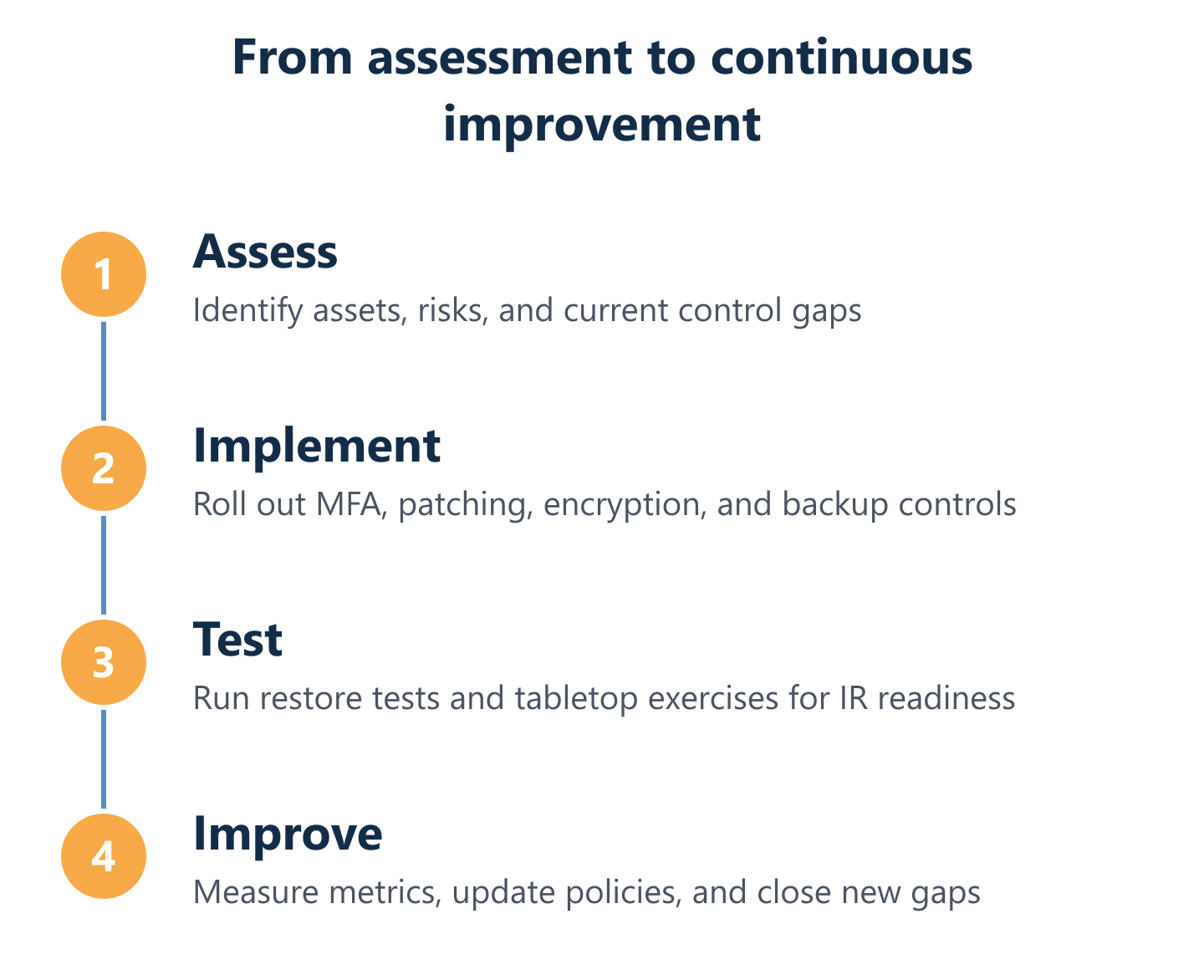
Cybersecurity for businesses is not a destination—it is a cycle of assessment, implementation, testing, and improvement. The blueprint in this guide gives you the structure: governance by roles, high-impact controls implemented correctly, networks and endpoints hardened systematically, incidents prepared for rather than improvised around, and all activity mapped to NIST CSF 2.0 for clear reporting. The next step is to turn this into a short, prioritised roadmap with named owners and defined timelines, reviewed with leadership at each quarterly governance meeting. Impulso Tecnológico supports businesses at every stage of this journey—from initial security audit through to ongoing managed cybersecurity services—ensuring that security remains measurable, operational, and aligned with how your business actually runs.