

A corporate network service is a managed set of connectivity, security, and operational capabilities that keeps every site, user, and cloud resource reliably connected under defined service levels. Unlike a one-off router installation, it covers design, deployment, ongoing management, and accountability for outcomes.
Most organisations reach a tipping point where patched-together connectivity—a broadband line here, a VPN there, a firewall nobody monitors—starts costing more in downtime and risk than a structured service would. The symptoms are familiar: slow remote access, security gaps between sites, no visibility into what is actually happening on the network, and IT teams firefighting instead of planning.
A well-specified corporate network service replaces that fragmentation with a single, governed framework. It defines what is connected, how it is protected, who is responsible for each layer, and what performance you can expect. The result is predictable operations, measurable security posture, and a network that scales when the business does—rather than one that breaks when it does.
What "Corporate Network Service" means for modern businesses
The term "corporate network service" is used loosely by vendors, which creates real confusion at procurement stage. For a business decision-maker, it should mean a contracted, outcome-oriented service that combines physical or virtual connectivity infrastructure with security controls and operational management—delivered under agreed service levels and with clear ownership boundaries.
This is fundamentally different from buying a broadband circuit or hiring a contractor to pull cable. Those are inputs. A corporate network service is accountable for outputs: uptime, latency, security incident response, and user experience across every location and device in scope.
At Impulso Tecnológico, we support the full lifecycle of corporate connectivity—from structured cabling and network deployment through to day-to-day managed IT support and multi-layer security hardening. That end-to-end model is what separates a genuine corporate network service from a collection of disconnected contracts.
| Criterion | Generic connectivity purchase | Corporate Network Service |
|---|---|---|
| Scope definition | Circuit or device only | Sites, users, cloud access, and security layers |
| Accountability | Provider delivers the line; you manage the rest | Single provider or MSP owns end-to-end outcomes |
| Performance measurement | Uptime of the circuit | Network SLAs covering latency, availability, and incident response |
| Security | Optional add-on or separate contract | Integrated: firewall, endpoint, patching, and access control |
| Ongoing management | Reactive break-fix | Proactive monitoring, preventive maintenance, and reporting |
| Multi-site connectivity | Separate contracts per site | Unified architecture with consistent policy across all locations |
Business-ready definition: outcomes, ownership, and service boundaries
A business-ready corporate network service combines connectivity, security, and operational ownership into a single contracted framework. The provider—whether a managed services provider (MSP) or a specialist network operator—takes responsibility not just for delivering infrastructure but for the outcomes that infrastructure enables: reliable access for users, controlled traffic between sites, secure remote sessions, and measurable performance against agreed network SLAs.
Service boundaries matter as much as the definition. A well-structured contract specifies exactly which devices, locations, and user groups are in scope; who handles incidents at each layer; and how changes are requested and approved. Without those boundaries, accountability gaps emerge—and those gaps are where most corporate network failures originate. Clarity at contract stage prevents operational disputes later.
Typical components: connectivity, security, and managed operations
A complete corporate network service typically spans three layers. First, connectivity: internet access circuits, private links between sites (MPLS or SD-WAN overlays), cloud on-ramps to platforms such as Microsoft Azure, and the physical or wireless infrastructure that carries traffic within each location—including certified network cabling for data and voice. Second, security: perimeter firewalling, endpoint protection, patch and vulnerability management, and secure remote access for mobile or home-based workers. Third, managed operations: proactive monitoring of devices and links, incident detection and response, capacity reporting, and scheduled maintenance windows that prevent disruption rather than react to it. Each layer depends on the others; specifying all three in a single scope is what makes a service genuinely "corporate" rather than simply "connected."
How it differs from generic internet, cabling, or one-off VPN
Generic internet access delivers a circuit with a headline speed and a basic uptime guarantee. One-off cabling installs physical infrastructure but provides no ongoing assurance. A standalone VPN gives remote users a tunnel but leaves firewall policy, endpoint security, and network performance entirely unmanaged. None of these arrangements include the governance, reporting, or operational accountability that a corporate environment requires.
The distinguishing feature of a corporate network service is measured outcomes via SLAs, structured reporting, and defined governance. You should be able to see, at any point, how the network is performing, who is responsible for each component, and what the escalation path looks like when something goes wrong. That visibility and accountability structure is what justifies the investment—and what protects the business when incidents occur.

Core service components (connectivity, security, and performance)
Breaking a corporate network service into its practical building blocks helps buyers write a specification that avoids scope gaps. The three domains—connectivity, security, and performance—are interdependent, but each has distinct procurement considerations and trade-offs worth understanding before you issue a request for proposal.
At Impulso Tecnológico, our multi-layer methodology integrates all three domains from day one. Physical infrastructure—certified network cabling and deployment using Cisco, Aruba, and Fortinet equipment—forms the foundation. Operational IT support with preventive maintenance keeps it running. Security hardening with Sophos and Fortinet platforms (firewall, antivirus, patch and vulnerability management, and secure remote access) protects it. This integrated approach means clients avoid the accountability gaps that arise when connectivity, security, and operations are managed by separate vendors with separate contracts.
- Connectivity: Define circuits, site interconnects, cloud access paths, and physical cabling requirements before selecting a technology model.
- Security: Specify firewalling, endpoint protection, patch cadence, and secure remote access as mandatory scope—not optional add-ons.
- Performance monitoring: Require network observability tooling, defined network SLAs, and regular reporting as contractual deliverables.
- Managed operations: Confirm who handles incidents at each layer, response time commitments, and how changes are requested and approved.
- Voice and unified communications: If PBX or VoIP is in scope, include it explicitly to avoid separate contracts and integration failures.
Connectivity building blocks: internet, cloud access, and site interconnect
Connectivity for a multi-site business involves at least three distinct layers. Internet access circuits provide the primary path to cloud services, SaaS applications, and remote users; redundant circuits at critical sites protect against single-point failures. Cloud access paths—dedicated or virtual connections to platforms such as Microsoft Azure or Microsoft 365—reduce latency and improve reliability compared with routing cloud traffic over general internet. Site interconnect links branch offices and headquarters: traditional MPLS offers predictable performance but limited flexibility, while SD-WAN overlays provide dynamic path selection and centralised policy management across diverse circuits. Underlying all of this is physical infrastructure: certified network cabling and wireless access points that determine the maximum performance any software-defined layer can deliver. Specifying each layer separately at procurement stage prevents vendors from bundling components that do not fit your architecture.
Security building blocks: multi-layer defence and controlled remote access
Security in a corporate network service is not a single product—it is a layered model where each control compensates for gaps in the others. Perimeter firewalling (using platforms such as Fortinet or Sophos) filters traffic entering and leaving each site. Endpoint protection covers the devices connecting to the network, including laptops, desktops, and servers. Patch and vulnerability management ensures that known weaknesses are closed before they are exploited—a discipline that requires a defined cadence and ownership, not ad hoc updates. Secure remote access, whether implemented via traditional VPN or a zero-trust network access (ZTNA) approach, controls which users and devices can reach which resources from outside the perimeter. Access control policies and regular compliance checks complete the model. Each layer should be specified in the service contract with clear ownership and response commitments.
Performance building blocks: monitoring, SLAs, and continuous improvement
Network observability—the ability to see what is happening across every link, device, and application path in real time—has become a baseline expectation in corporate network services. Without it, SLAs are unverifiable and root-cause analysis after incidents is guesswork. A credible provider should offer continuous monitoring of circuit availability, latency, packet loss, and device health, with alerting thresholds that trigger proactive response before users notice a problem.
Network SLAs should specify availability targets per site tier, maximum incident response times, and resolution time commitments. Monthly or quarterly reporting translates raw monitoring data into business-relevant metrics: which sites experienced degradation, how quickly incidents were resolved, and whether capacity is approaching limits. That reporting cadence also creates the evidence base for continuous improvement decisions—circuit upgrades, topology changes, or security policy adjustments—grounded in actual performance data rather than assumptions.
Modern service models and how to select a provider
Three service models have reshaped what corporate network buyers need to evaluate: SASE (Secure Access Service Edge), NaaS (Network as a Service), and CDN (Content Delivery Network). Each addresses a different operational problem, and choosing between them—or combining them—depends on your organisation's user locations, cloud adoption level, and security requirements.
Selecting the right provider requires more than comparing headline prices. At Impulso Tecnológico, we advise clients through the full evaluation process: defining scope, managing technology supplier relationships, planning office moves or infrastructure upgrades, and ensuring operational coverage remains consistent throughout. Our teams work in both Spanish and English, which matters for organisations with cross-border operations across Europe, Asia, or the Americas.
Key considerations when evaluating providers and models:
- Scope completeness: Does the proposal cover connectivity, security, and managed operations—or only one layer?
- Model fit: Is SASE, NaaS, or a hybrid of SD-WAN and on-premises security the right architecture for your user distribution and cloud footprint?
- Multiple quotes: Obtain at least three comparable proposals; ensure scope definitions are identical before comparing costs.
- SLA specificity: Reject proposals that reference availability without defining measurement methodology, exclusions, and remedies.
- Migration plan: Any credible provider should supply a phased cutover plan that protects business continuity during transition.
- Billing transparency: Confirm how usage-based charges, overage fees, and licence changes are invoiced and audited.
- Governance structure: Identify the named escalation contacts, change management process, and review cadence before signing.
- Partner ecosystem: Providers certified by Cisco, Fortinet, Aruba, or Microsoft bring vendor-validated expertise that reduces implementation risk.
SASE, NaaS, and CDNs: what they are and when each fits
SASE (Secure Access Service Edge) converges wide-area networking and security functions—firewall, secure web gateway, ZTNA, and cloud access security broker—into a single cloud-delivered service. It fits organisations with distributed users, heavy SaaS adoption, and a need to enforce consistent security policy regardless of where users connect. The traditional SASE vs VPN question resolves simply: VPN secures a tunnel; SASE secures the user, the device, and the application simultaneously.
NaaS (Network as a Service) lets organisations consume network infrastructure—switching, routing, wireless—as a subscription rather than owning hardware. It suits businesses that want predictable monthly costs and vendor-managed hardware refresh cycles. A NaaS managed network reduces capital expenditure but requires careful SLA negotiation to ensure performance accountability.
CDNs (Content Delivery Networks) replicate content at edge nodes close to users, reducing latency for web applications and media. They are relevant for corporate networks when internal applications are accessed globally or when bandwidth optimisation across international sites is a priority.
Provider selection framework: scope, quotes, governance, and cost controls
A structured evaluation prevents the most common procurement mistake: selecting a provider on price before confirming scope equivalence. Use this checklist when comparing proposals:
First, standardise scope: every proposal must cover the same sites, user counts, security layers, and managed internet requirements. Second, validate network SLAs: request the exact availability percentage, measurement window, exclusions, and financial remedy for each tier of site. Third, assess migration methodology: ask for a written phased cutover plan, including parallel-run periods and rollback procedures. Fourth, audit billing structure: identify all usage-based charges, licence fees, and conditions that trigger cost increases mid-contract. Fifth, confirm governance: named service manager, monthly reporting format, change request process, and escalation matrix. Sixth, check partner certifications: a provider holding active Cisco, Fortinet, or Microsoft certifications has demonstrated technical competence against a vendor-defined standard—not just a self-declared claim.
Implementation and migration: installation steps, billing checks, and continuity
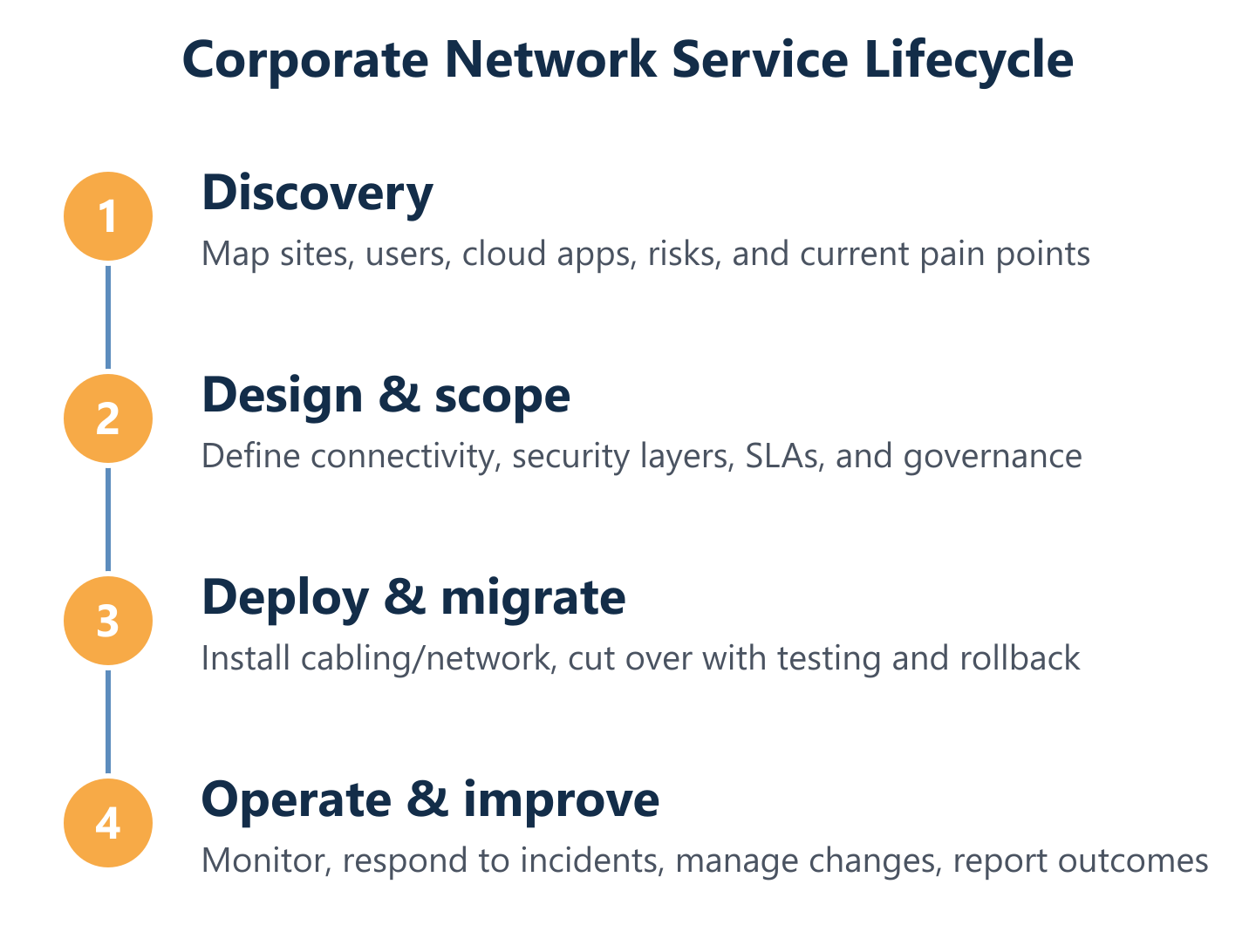
Implementation is where most corporate network projects encounter avoidable problems: overlapping contracts, billing errors during cutover, and gaps in operational coverage between the old and new service. A provider that offers genuine end-to-end ownership manages all three risks explicitly.
Physical installation—network cabling and deployment—should be completed and certified before any live traffic cutover. Parallel running of old and new circuits during a defined transition window protects continuity. Billing checks at cutover should confirm that legacy circuit cancellations are processed on the correct dates to avoid double-payment, and that new service invoices reflect the contracted scope exactly. Post-go-live, the first 30 to 60 days of monitoring data are the most valuable: they reveal whether performance matches the SLA baseline and whether any architectural adjustments are needed before the service stabilises into normal operations.
Specifying outcomes, network SLAs, and governance before you sign a contract is the single most effective way to ensure your corporate network service remains reliable long after go-live. The organisations that struggle most with corporate connectivity are not those that chose the wrong technology—they are those that left accountability undefined. Whether you are upgrading a single-site infrastructure, connecting multiple offices, or migrating to a cloud-first architecture, the principles are the same: define scope clearly, demand measurable performance commitments, and work with a provider that takes end-to-end ownership. Impulso Tecnológico has supported businesses across Spain, Portugal, and internationally through exactly this process—combining infrastructure delivery, managed operations, and security hardening under a single, transparent service model.