

To contact an IT company effectively, identify your need first — sales for new projects or managed services, support for incidents, and partnerships for integrations or referrals. Then prepare a short brief covering scope, environment, and compliance requirements before you reach out. This approach cuts response times and moves you straight to the right specialist.
Most organisations waste days in back-and-forth simply because their initial message lands in the wrong queue or lacks the context the technical team needs to respond meaningfully. Whether you are planning a network migration, evaluating managed IT services, or responding to a security incident, the channel you choose and the information you provide in that first contact directly determines how quickly you receive a qualified proposal or a discovery call. At Impulso Tecnológico, we see this pattern repeatedly: clients who arrive with a clear brief — even a rough one — move from first contact to a concrete plan in a fraction of the time compared to those who send a generic enquiry. This guide walks through every stage of that process, from selecting the right route to structuring a message that generates a real reply.
Choose the right contact channel for your IT need
Sending a project enquiry to a technical support inbox, or raising an urgent incident through a sales contact form, is one of the most common reasons IT outreach stalls. Each team within an IT company is optimised for a different type of request, and routing errors add hours or even days to response times. Before you contact an IT company, spend two minutes classifying your need: is this a new project, an ongoing incident, or a commercial relationship you want to explore?
The table below maps the most common scenarios to the appropriate contact route:
| Your situation | Correct channel | What to expect |
|---|---|---|
| New project, audit, or managed services enquiry | Sales / IT consulting sales enquiry form | Discovery call, scoping, and proposal |
| Active system incident or service disruption | IT support ticket or helpdesk | Triage, escalation, and resolution |
| Referral, co-delivery, or vendor integration | Partnerships or alliances contact | Commercial alignment and agreement |
| IT security compliance questions or risk assessment | Security or consulting team via sales | Assessment scope and compliance review |
| Managed IT services request for ongoing support | Sales (for onboarding) or support (if existing client) | SLA discussion and service agreement |
At Impulso Tecnológico, incoming requests are routed to the appropriate specialist from the outset — whether that is an IT consulting team for a new infrastructure project, a managed services coordinator for ongoing support across Spain and Portugal, or a bilingual contact for multi-country teams operating in English and Spanish.
Sales vs support: what each team typically handles
The sales or consulting team handles everything that does not yet exist as a live service agreement: new project scoping, system audits, infrastructure migrations, office relocations with IT planning, network builds, firewall deployments, and managed IT services onboarding. If you are evaluating whether an IT company can meet your needs — or requesting a proposal for a specific deliverable — this is the team you need. A managed IT services request, for example, begins with a sales conversation that defines scope, SLA expectations, and commercial terms before any technical work starts.
The support team, by contrast, handles incidents, troubleshooting, and maintenance requests for existing clients. Raising a new project through a support ticket delays it; the ticket will eventually be redirected, but time is lost. Knowing this distinction before you contact an IT company is the single most effective way to accelerate your first response.
Partnership routes: when to contact alliances or integrators
Partnership or alliance contacts serve a specific purpose: co-delivery arrangements, referral agreements, vendor relationships, and technology integration work. If your organisation is a software vendor, a systems integrator, or a consultancy looking to collaborate on a client engagement, the standard sales or support route is not appropriate — and using it signals unfamiliarity with how IT companies structure their commercial relationships.
When reaching out via a partnership route, lead with your organisation's technical profile, the type of collaboration you are proposing, and the client context if relevant. IT companies with established partner ecosystems — such as those holding certifications from Sophos, Fortinet, Microsoft, Cisco, or Aruba — will typically have a dedicated alliances contact or a partner portal. Identifying this route early avoids your enquiry being treated as a standard sales lead and ensures it reaches someone with the authority to discuss commercial terms.
How to spot the right contact page or form quickly
Most IT company websites separate contact routes by purpose, but the labelling varies. Look for these signals: a page titled "Contact" or "Get in touch" with dropdown options for enquiry type is the clearest indicator of a segmented routing system. If the form has a free-text field only, add a clear subject line in your opening sentence — "Sales enquiry: managed IT services for 80-user office" — so the team can route it without asking.
If you cannot find a dedicated IT consulting sales enquiry form, check the "Services" or "Solutions" pages — many IT companies embed contact CTAs directly within service descriptions, which connect to the relevant team rather than a general inbox. Avoid using generic contact emails listed in website footers for project-level requests; these are typically monitored for administrative queries, not technical discovery. When in doubt, call the main number and ask to be directed to the consulting or projects team.

Prepare what the IT company needs before you contact
A first message that contains the right information does not just save time — it signals to the IT company that you are a serious prospect with a real project, which directly affects the quality and speed of the response you receive. You do not need a fully written specification; a structured brief of eight to ten lines is enough to allow a competent consulting team to prepare a relevant first response.
Consider the most common project types: a network migration requires knowledge of your current topology, number of sites, and connectivity dependencies. A structured cabling installation needs floor count, approximate cable runs, and whether voice, data, and fibre are all in scope. A VoIP or telephone switchboard transition requires the number of extensions, existing analogue or digital lines, and whether the move to IP telephony is phased or immediate. A firewall deployment — for example, using WatchGuard, which Impulso Tecnológico works with extensively — requires your current perimeter setup and any remote access or VPN requirements.
Prepare the following before you reach out:
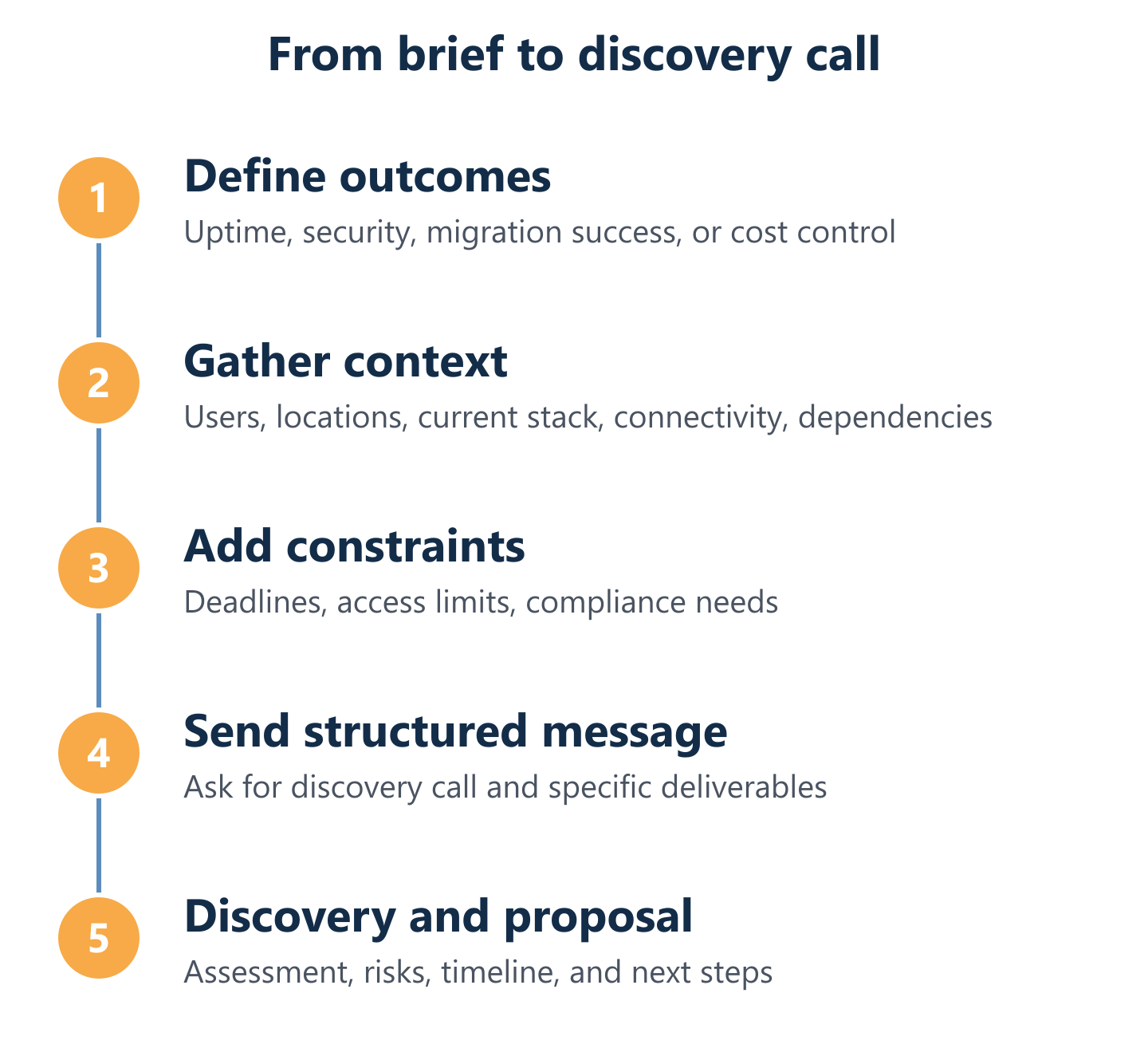
- Define your primary objective — migration, security improvement, cost reduction, or compliance.
- Describe your current environment — technology stack, number of users, sites, and key dependencies.
- State your constraints — deadlines, budget range (even approximate), and access limitations.
- Identify compliance requirements — GDPR, sector-specific regulations, or data residency rules.
- Clarify your expected output — proposal, discovery call, technical assessment, or ballpark estimate.
For organisations exploring IT consulting services in Spain and Portugal, Impulso Tecnológico uses this kind of structured brief to plan discovery efficiently and propose a practical, risk-reducing engagement path from the first conversation.
Project brief checklist: goals, scope, and success criteria
Before you contact an IT consultant, write down what success looks like in measurable terms. Vague goals — "improve our IT" or "make things more secure" — produce vague proposals. Specific outcomes produce specific plans. Examples of well-defined success criteria include: achieving a target uptime for critical systems after a migration, reaching a defined security posture (such as endpoint protection across all devices and patched vulnerability exposure), completing a data centre or office move within a fixed window with zero data loss, or reducing IT support costs by consolidating to a single managed services provider.
Also define the scope boundary: which systems, locations, and user groups are in scope, and which are explicitly excluded. This prevents scope creep in the proposal stage and allows the IT company to price accurately. If you are unsure of the boundary, say so — a good consulting team will help you define it during discovery.
Technical and operational details to include (without oversharing)
Share enough technical context for the IT company to assess complexity, but do not include sensitive credentials, internal IP schemas, or detailed network diagrams in an initial message. The right level of detail covers: your current technology stack (operating systems, key applications, cloud platforms such as Microsoft 365 or Azure), number of users and physical locations, primary connectivity type (MPLS, broadband, SD-WAN), and any known dependencies between systems that would affect migration sequencing.
Operational details matter too: whether your team works remotely, in-office, or hybrid affects how a managed IT services request is scoped. If you have existing vendor contracts with notice periods, mention them — this affects project timelines. For multi-site organisations, note whether each location has local IT staff or relies entirely on remote support. This level of context allows a provider like Impulso Tecnológico to determine whether onsite intervention in Spain or Portugal is needed, or whether remote IT support can handle the engagement.
Security and compliance inputs to request early (GDPR, access, retention)
IT security compliance questions should be raised in the first or second interaction, not after a contract is signed. Ask the IT company directly: how do they handle personal data processed on your behalf under GDPR? What access controls govern their engineers' access to your systems? How long do they retain logs, and under what conditions? Do they hold relevant certifications (ISO 27001, for example) or operate under a formal information security policy?
From your side, include in your brief any sector-specific compliance obligations — healthcare data handling, financial services regulations, or public sector requirements — so the IT company can confirm capability before the discovery call. Impulso Tecnológico works within GDPR frameworks and applies layered security principles, including endpoint protection, secure remote access and VPN, and backup and recovery practices, making these conversations straightforward for clients with compliance-sensitive environments.
Write a first message that gets a reply and moves forward
The majority of unanswered IT enquiries share a common problem: they describe a situation without stating what they need the IT company to do next. A message that ends with "please let us know if you can help" gives the recipient no clear action. A message that ends with "we would like to schedule a 30-minute discovery call this week to assess feasibility" generates a calendar invite.
Structure your message to answer four questions in sequence: what is our context, what is the specific problem or project, what outcome do we need, and what is our question or requested next step. Keep the total length under 250 words for an initial outreach — detail can follow in a brief attachment or during the call itself.
When referencing your desired outcomes, be specific about the operational impact you are trying to achieve. Impulso Tecnológico's consulting team, for example, responds most effectively to messages that reference concrete goals:
- Reduced unplanned downtime through proactive monitoring and preventive maintenance
- Secure remote access and VPN for a distributed or hybrid workforce
- Backup and recovery readiness with defined recovery time objectives
- Firewall deployment or network segmentation to control inbound and outbound traffic
- Managed IT services onboarding to replace or supplement an internal IT department
- IT security compliance alignment with GDPR or sector-specific requirements
Referencing outcomes like these signals that you understand the value of the service, not just the technology — and that accelerates the path from first contact to a qualified proposal. For organisations looking for broader context on what IT consulting covers, our IT consulting and IT services pages provide a detailed breakdown of service areas.
Message structure: context → need → expected outcome → questions
Start with a subject line that identifies the project type and scale: "Managed IT services enquiry — 120-user office, Madrid" is infinitely more actionable than "IT enquiry". In the opening sentence, state who you are and what your organisation does in one line — this gives the IT company immediate context for the type of infrastructure they are likely dealing with.
Paragraph one: context (two to three sentences on your current situation and what has changed or what is driving the project). Paragraph two: the specific need (what you want the IT company to do or assess). Paragraph three: expected outcome (what a successful engagement looks like, and by when). Close with a single, direct question or a specific request — "Can you confirm availability for a 30-minute call this week?" — so the recipient has one clear action to take.
Follow-up strategy: timing, cadence, and what to change in the second email
If you have not received a reply within two business days, send a follow-up — but do not simply forward the original message with "just checking in". That adds no value and signals that you have nothing new to offer. Instead, add one piece of relevant information you omitted from the first message: a tighter deadline, a specific compliance requirement, or a clarification of scope. This gives the recipient a reason to open and respond.
For IT consulting sales enquiries, a cadence of day one, day three, and day seven is appropriate before exploring alternative contacts within the organisation. After the third attempt with no response, try a different channel — phone or LinkedIn — referencing your previous messages. Keep the tone professional and direct; urgency is communicated through specifics, not through pressure.
What happens after you reach out: discovery call, proposal, and next steps
A well-structured initial message typically leads to a discovery call within two to five business days at a responsive IT company. The discovery call — usually 30 to 45 minutes — is not a sales pitch; it is a structured conversation in which the IT company validates your brief, asks clarifying questions about your environment and constraints, and identifies whether additional technical assessment is needed before a proposal can be prepared.
After discovery, expect a written proposal that outlines scope, approach, timelines, and commercial terms. For complex projects — multi-site migrations, layered security deployments, or managed services onboarding — a brief technical assessment or site visit may precede the proposal. Impulso Tecnológico follows this model across its IT consulting services in Spain and Portugal, ensuring that proposals reflect the actual environment rather than generic assumptions. Understanding this flow helps you set realistic internal expectations and brief your own stakeholders accordingly.
When your outreach is structured and channel-appropriate, the contact becomes a fast discovery that leads to a clear plan. The difference between an enquiry that stalls and one that converts into a project within a week is rarely about budget or technology — it is about clarity. Prepare your brief, choose the right route, write a message with a specific next step, and follow up with added information rather than empty reminders. If you are evaluating IT support or consulting options, the computer services section of the Impulso Tecnológico site covers the full range of managed and project-based engagements available across Spain, Portugal, and internationally.