

Computer networks in Madrid are the operational backbone of every business that relies on connectivity, data exchange, and secure access. A well-designed network reduces downtime, controls security risks, and supports growth — a poorly designed one creates recurring incidents that consume IT resources and erode productivity.
Most organisations searching for computer network services in Madrid face the same underlying challenge: their infrastructure has grown organically, without a documented architecture, consistent segmentation, or proactive monitoring. The result is unpredictable performance, security gaps, and change cycles that take far longer than they should.
At Impulso Tecnológico, we approach computer networks in Madrid as a structured discipline — starting from a clear layer-by-layer scope, moving through audit and design, and embedding security and managed monitoring from day one. With over 25 years of experience and more than 200 large networks managed for small and mid-sized companies, our team delivers network projects that are documented, testable, and built to last — not just to pass a deadline.
Computer Networks Madrid: what the layers really cover
Before commissioning any network project, it is worth establishing a shared technical vocabulary — because "computer networks" means different things to different stakeholders. For a business in Madrid, the relevant scope runs from physical cabling and link-layer addressing all the way up to application-layer protocols that your staff use every day. Each layer introduces its own failure modes, security considerations, and performance constraints.
At Impulso Tecnológico, we use this layer map as the starting point for every engagement. Networks are not just cabling or switches: they are the backbone of day-to-day operations, security, and business continuity. Scoping the work correctly at the outset prevents the common mistake of fixing symptoms (slow Wi-Fi, intermittent drops) without addressing root causes (misconfigured NAT, flat network topology, undocumented IP addressing).
| Network Layer | Key Technologies | Common Business Impact | Consulting Scope |
|---|---|---|---|
| Application | HTTP/S, DNS, SMTP, VoIP | Service availability, data leakage risk | Protocol audit, firewall policy review |
| Transport | TCP, UDP | Latency, packet loss, session reliability | QoS design, traffic shaping |
| Network (IP) | IPv4/IPv6, NAT, routing | Segmentation, access control, scalability | IP plan, NAT configuration, routing design |
| Link | Ethernet, Wi-Fi, VLANs | Broadcast storms, addressing conflicts | VLAN design, switch configuration |
| Physical | Structured cabling, fibre, patch panels | Physical failures, interference, capacity limits | Cabling audit, infrastructure upgrade |
TCP/IP stack explained for business networks
The TCP/IP model describes how data travels from one device to another across a network — and understanding it is not an academic exercise. Every packet your business sends passes through these layers, and a misconfiguration at any point introduces latency, packet loss, or a security exposure.
In practice, TCP/IP network design for a business environment means making deliberate choices: which IP address ranges to assign, how routing between sites is handled, whether traffic is prioritised by application type, and how DNS resolution is managed internally versus externally. When these decisions are undocumented or inconsistent, troubleshooting becomes reactive and time-consuming. A structured approach to TCP/IP design produces a network that behaves predictably — and that can be audited and modified without risk.
Link layer and addressing: why it affects stability
The link layer is where physical infrastructure meets logical addressing. Ethernet switches, Wi-Fi access points, and VLANs all operate here — and decisions made at this layer have a direct impact on broadcast domain size, collision behaviour, and the reliability of the connections your applications depend on.
MAC addressing, VLAN segmentation, and spanning tree configuration are the three most common sources of instability in business networks that have grown without a formal design. A flat network — where all devices share a single broadcast domain — creates unnecessary traffic, complicates security policy enforcement, and makes it harder to isolate faults. Translating IP addressing and link-layer topology into a documented, segmented design is one of the highest-value interventions available in a network audit and optimisation engagement.
IP routing, NAT, and segmentation fundamentals
IP routing and NAT configuration for enterprises are where network design decisions become directly visible to end users and security teams. NAT (Network Address Translation) controls how internal IP addresses are mapped to external ones — a misconfigured NAT policy can expose internal services, break application connectivity, or create compliance gaps under GDPR if data traverses unintended paths.
Network segmentation — dividing the infrastructure into separate IP subnets with controlled routing between them — is the foundational technique for limiting the blast radius of a security incident. When a workstation is compromised, segmentation determines whether the attacker can reach servers, printers, or operational technology on the same site. Framing the consulting scope around these fundamentals ensures that the project delivers a network that is not only functional but defensible. This layer-by-layer clarity also informs our structured cabling and installation work, where physical topology must align with logical design from the start.

Network IT consulting in Madrid: audit, design and optimisation
Knowing the layers is necessary — but translating that knowledge into a consulting engagement with clear deliverables and measurable outcomes requires a structured process. At Impulso Tecnológico, we operate as a team rather than sending a single consultant, which means continuity, documentation, and proactive monitoring are built into every phase rather than treated as afterthoughts.
Our independence from any single manufacturer or distributor is a deliberate differentiator: we recommend Cisco, Aruba, Fortinet, or alternative technologies based on the client's objectives, budget, and operational context — not on a fixed product roadmap. This matters in network projects because the right topology for a 50-person office in Madrid is not the same as the right topology for a multi-site industrial client.
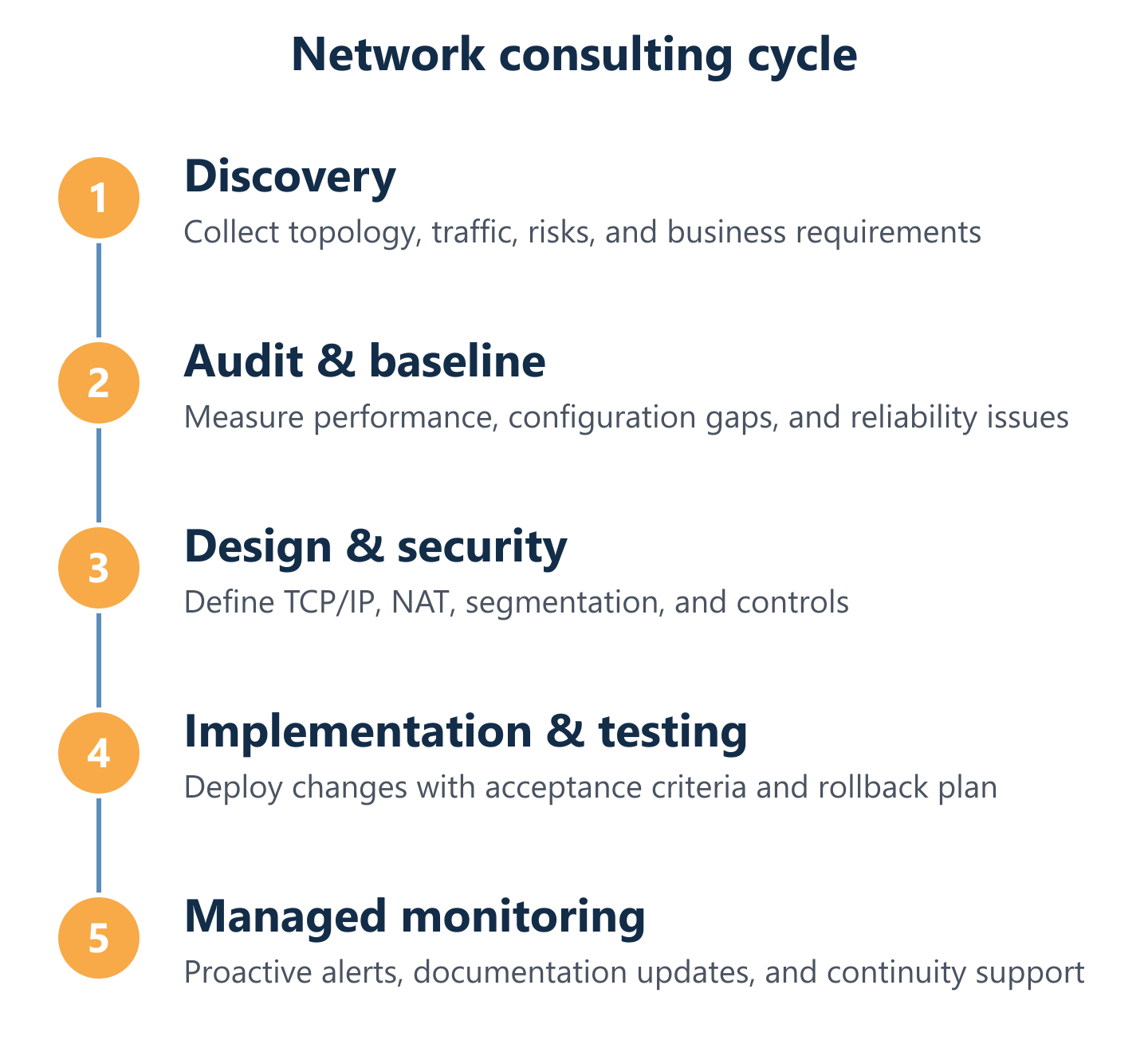
The consulting cycle follows a repeatable structure:
- Discovery and scoping: Inventory existing devices, document IP addressing, identify undocumented changes and configuration drift.
- Audit and analysis: Review performance data, security posture, and alignment between physical and logical topology.
- Design and recommendations: Produce a documented target architecture with trade-off analysis covering reliability, cost, and maintainability.
- Implementation: Deploy changes in a controlled sequence with rollback procedures and change documentation.
- Validation and testing: Confirm performance baselines, verify security controls, and sign off against agreed acceptance criteria.
- Managed operations handover: Transition to ongoing monitoring and managed services with SLA-backed support, eliminating recurring incidents.
This process has been refined across more than 200 networks managed for businesses across Spain, and it integrates backup and recovery planning so that network changes do not create continuity risks.
Audit deliverables: what you should receive after discovery
A network audit that produces only a verbal summary is not an audit — it is an opinion. The deliverables from a properly scoped discovery engagement should include a full device inventory with firmware versions, a documented IP addressing scheme, VLAN and routing maps, a configuration backup of all managed devices, and a prioritised list of findings categorised by risk and effort.
Performance data — latency baselines, packet loss rates, bandwidth utilisation per segment — should accompany the findings so that post-implementation comparisons are possible. Security observations, including open ports, weak authentication configurations, and unpatched firmware, belong in a separate section with remediation guidance. At Impulso Tecnológico, audit deliverables are structured to be actionable: each finding maps to a recommended action, an estimated effort, and a business impact description, so clients can make informed prioritisation decisions without needing to interpret raw technical data.
Design trade-offs: reliability, cost, and maintainability
Network design is an exercise in managing trade-offs. A fully redundant topology with dual uplinks, stacked switches, and automatic failover delivers high reliability — but it also doubles hardware costs and increases configuration complexity. For most small and mid-sized businesses in Madrid, the right answer sits between a single point of failure and an over-engineered architecture that the internal team cannot maintain.
Capacity planning is equally important: designing for current traffic volumes without headroom for growth creates a network that needs redesigning within two or three years. Documentation is the third variable that is consistently undervalued. A well-documented network — with topology diagrams, IP address management records, and change logs — reduces mean time to resolution for incidents by an order of magnitude compared to an undocumented one. Our design process produces living documentation that is updated as part of every managed services engagement, not filed away after project close.
Managed operations: monitoring, documentation, and continuity
Proactive monitoring is the mechanism that converts a well-designed network into a reliably operating one. Without continuous visibility into device health, traffic anomalies, and configuration changes, even a correctly designed network will degrade over time as undocumented modifications accumulate and firmware falls behind.
Our managed services for IT support for networks include system monitoring with alerting thresholds calibrated to the client's environment, scheduled maintenance windows for firmware and security updates, and regular configuration audits to detect drift. Continuity planning is integrated from the start: backup and recovery solutions are sized and tested so that a network failure does not become a data loss event. For clients with multiple sites or hybrid cloud environments on Microsoft Azure, managed services monitoring extends across all segments, providing a unified view of network health. This approach resolves the recurring incidents that consume disproportionate IT time — and the results are measurable in reduced ticket volumes and faster change cycles.
Security, performance and provider selection for Computer Networks Madrid
Network security and segmentation are not add-ons to a network project — they are design constraints that must be present from the first topology decision. Transport and application-layer choices have direct security and performance implications that become visible only under load or during an incident, which is precisely the wrong time to discover them.
For businesses in Madrid operating under GDPR, network design decisions — particularly around data flows, access paths, and logging — have compliance consequences. Impulso Tecnológico integrates security controls using partner technologies including Sophos, Fortinet, and Cisco, selected based on the client's risk profile rather than a default product preference.
When evaluating a network provider, the following signals distinguish a capable partner from a vendor selling hardware:
- Independence from manufacturers: Can they recommend competing products based on your requirements, or do they default to a single brand?
- Documentation standards: Do they deliver topology diagrams, IP address management records, and configuration backups as standard deliverables?
- Security integration: Is network security and segmentation designed in from the start, or proposed as an upsell after implementation?
- Monitoring model: Do they offer proactive managed services monitoring, or only reactive break-fix support?
- Continuity planning: Is backup and disaster recovery scoped as part of the network project, or treated as a separate engagement?
- Team continuity: Will the same engineers who designed your network also support it, or will knowledge transfer to a generic helpdesk?
- Compliance awareness: Can they articulate how network design decisions affect GDPR data flow obligations?
Security controls tied to NAT, segmentation and access paths
NAT configuration and network segmentation are the two most operationally significant security controls in a typical enterprise network. NAT determines which internal services are reachable from external networks and under what conditions — a permissive or undocumented NAT policy is one of the most common findings in network security audits. Segmentation controls lateral movement: once an attacker or malware is inside the perimeter, VLAN boundaries and inter-segment firewall rules determine how far the compromise can spread.
At Impulso Tecnológico, we implement network security as a layered posture: firewall policies aligned with segmentation design, access control systems that enforce least-privilege connectivity, and vulnerability assessments to identify exposure before it is exploited. Penetration testing and audit services are available as part of a broader security engagement, and all controls are documented so that changes can be reviewed and tested without introducing new gaps.
UDP/TCP and application protocols: performance and risk implications
TCP and UDP serve different purposes, and choosing the wrong transport behaviour for an application has measurable consequences. TCP provides reliable, ordered delivery with retransmission — appropriate for file transfers, email, and most business applications. UDP prioritises low latency over reliability — appropriate for VoIP, video conferencing, and real-time monitoring systems. When UDP traffic is not properly prioritised through QoS policies, voice and video quality degrades under load. When TCP retransmission rates are high due to packet loss on a poorly maintained link, application response times increase in ways that are often misattributed to server performance.
Application-layer protocols introduce additional risk: unencrypted HTTP, legacy FTP, or improperly configured DNS can expose data or provide attack vectors. A network audit that covers transport and application behaviour — not just physical connectivity — identifies these risks before they affect operations or trigger a compliance finding.
How to choose a Madrid network provider: questions to ask
Selecting a network IT provider in Madrid on price alone is a reliable way to inherit someone else's undocumented infrastructure. The questions that separate capable providers from commodity vendors are practical and specific. Ask for examples of audit deliverables — actual topology diagrams and IP address management documents, not slide decks. Ask how configuration changes are tracked and who holds the configuration backups. Ask whether the same team that implements the network will also support it under managed services. Ask how they handle firmware updates and security patches across managed devices, and what the process is when a critical vulnerability is disclosed.
For enterprise connectivity reliability, ask about their monitoring platform, alerting thresholds, and escalation procedures. Impulso Tecnológico provides on-demand IT support alongside managed services contracts, with system monitoring and continuous management designed to eliminate the recurring incidents that consume disproportionate time in under-managed environments. You can explore our approach to ongoing network management in our guide to IT network management for businesses.
Fewer incidents and faster change cycles are not the result of better hardware — they are the result of a network that was designed by layers, documented thoroughly, and monitored continuously. Start by scoping your infrastructure correctly: identify what you have, map it against what you need, and validate the design against both security controls and operational monitoring requirements. Whether you are planning a new deployment, recovering from a poorly documented legacy environment, or looking to consolidate network and security management under a single managed services provider in Madrid, the right starting point is a structured audit with clear deliverables. Impulso Tecnológico is ready to scope that engagement with you.