

A computer network audit is a systematic review of an organisation's network infrastructure, configurations, access controls, and operational health to identify vulnerabilities, verify compliance, and confirm the environment is stable, secure, and fit for growth. It covers both physical and logical layers, producing evidence-backed findings and a clear remediation path.
Most organisations discover their network weaknesses only after an incident: a misconfigured firewall rule that exposes internal services, a user account with excessive privileges that goes unnoticed for months, or a backup process that has silently been failing. By the time these issues surface, the cost—operational, reputational, and financial—is already significant. The IBM Cost of a Data Breach Report 2024 puts the average breach cost at $4.88 million, and misconfigured infrastructure consistently ranks among the leading root causes.
A well-executed computer network audit changes this dynamic. Rather than reacting, you gain a documented baseline of your network's current state, a prioritised list of risks, and a structured plan to close gaps before they become incidents. The result is a more resilient infrastructure, clearer compliance posture, and a foundation for ongoing managed operations.
What a Computer Network Audit Is (and isn't)
A computer network audit is not a single tool scan or a one-page checklist. It is a structured, evidence-driven process that evaluates every layer of your network—physical cabling, device configuration, user access, firewall rules, segmentation, and operational health—against defined benchmarks and business requirements. The goal is to produce a verified picture of what exists, what is correctly configured, what is exposed, and what needs to change.
What it is not: a network audit is not exclusively a penetration test, nor is it limited to security. It encompasses operational integrity—bandwidth and availability checks, change management records, and infrastructure readiness—alongside security controls. Confusing the two leads organisations to either over-invest in offensive testing when basic configuration hygiene is still missing, or to run compliance-only reviews that miss live operational risks.
At Impulso Tecnológico, our approach to computer network auditing covers both the infrastructure layer (structured cabling, server room conditions, electricity installation, physical access) and the technical/operational layer (user privilege levels, antivirus coverage, system updates, backup validation, and device inventory). This end-to-end scope ensures that findings connect directly to managed operations, so remediation is not left as an open action item but is tracked through to verified closure.
| Audit Dimension | What It Covers | Primary Output |
|---|---|---|
| Infrastructure / Physical | Cabling, server room, power, physical access controls | Physical risk register, remediation tasks |
| Configuration Review | Device configs, firewall rules, protocol versions, patch levels | Configuration gap report, hardening recommendations |
| Access Control Audit | User privileges, role assignments, authentication methods | Privilege excess findings, access policy recommendations |
| Network Segmentation Assessment | VLAN design, zone boundaries, lateral movement paths | Segmentation map, isolation gaps |
| Operational Health | Bandwidth and availability checks, uptime, change records | Performance baseline, change impact analysis |
| Compliance Mapping | GDPR, PCI-DSS, ISO 27001, NIST controls alignment | Compliance gap matrix, audit-readiness evidence pack |
Network audit vs network security audit: scope boundaries
The terms are often used interchangeably, but the scope boundaries matter. A network security audit focuses specifically on security controls: firewall rule audit, access control audit, vulnerability exposure, encryption standards, and incident response readiness. It answers the question: "Are our defences adequate?"
A computer network audit is broader. It includes security but also evaluates operational continuity—whether the network is correctly sized, whether change management records are maintained, whether backup and recovery processes are functional, and whether the physical infrastructure supports the services running on top of it. It answers both "Are we secure?" and "Is this network fit for purpose?"
For most organisations, a full computer network audit is the right starting point. It surfaces security gaps alongside operational risks, which is where the most immediate business impact typically lies. Security-only reviews are better suited as a follow-up once the baseline is established.
Common audit types and when each one is needed
Choosing the wrong audit type wastes time and produces findings you cannot act on. The four main types serve distinct purposes:
- Configuration audit: Reviews device settings, firmware versions, firewall rules, and protocol choices against hardening benchmarks (CIS, NIST). Run this first—it reveals the most remediable risks at the lowest cost.
- Vulnerability audit: Uses automated scanning tools (such as Nessus or Qualys) to identify known CVEs across network devices and endpoints. Appropriate after configuration baselines are in place.
- Compliance audit: Maps controls to a specific standard—GDPR, PCI-DSS, ISO 27001, HIPAA—and produces evidence for auditors. Required when regulatory obligations exist or when a client or partner demands it.
- Change management audit: Validates that all configuration changes were authorised, documented, and tested. Essential in environments where undocumented changes are a known risk factor.
Many organisations need a combination. Impulso Tecnológico tailors the scope to what is actually missing rather than applying a fixed template.
Audit outcomes: evidence, risk rating, and closure criteria
An audit that produces a list of findings without closure criteria is an incomplete audit. Three outcomes define a well-executed computer network audit:
First, documented evidence: every finding must be supported by captured data—configuration exports, scan results, access logs, or physical inspection records. Evidence transforms observations into defensible facts that can be presented to management, regulators, or insurers.
Second, risk rating: each finding should be assigned a severity level (critical, high, medium, low) based on the likelihood of exploitation and the potential business impact. This prioritises remediation effort and prevents teams from spending time on low-impact issues while critical exposures remain open.
Third, closure criteria: define in advance what "fixed" looks like for each finding category. A firewall rule remediation is closed when the rule is removed and a re-test confirms the traffic is blocked—not when the ticket is marked resolved. This re-test loop is what separates a genuine audit from a compliance exercise.

How to Prepare and Run the Audit: Evidence to Findings
Audit quality is determined before the first scan runs. Organisations that skip preparation end up with incomplete inventories, undefined scope, and findings they cannot map to business risk. The preparation phase is where Impulso Tecnológico's experience makes the most immediate difference: we approach each audit with a clear methodology that covers both the physical environment and the technical controls, tailored to the client's actual infrastructure rather than a generic template.
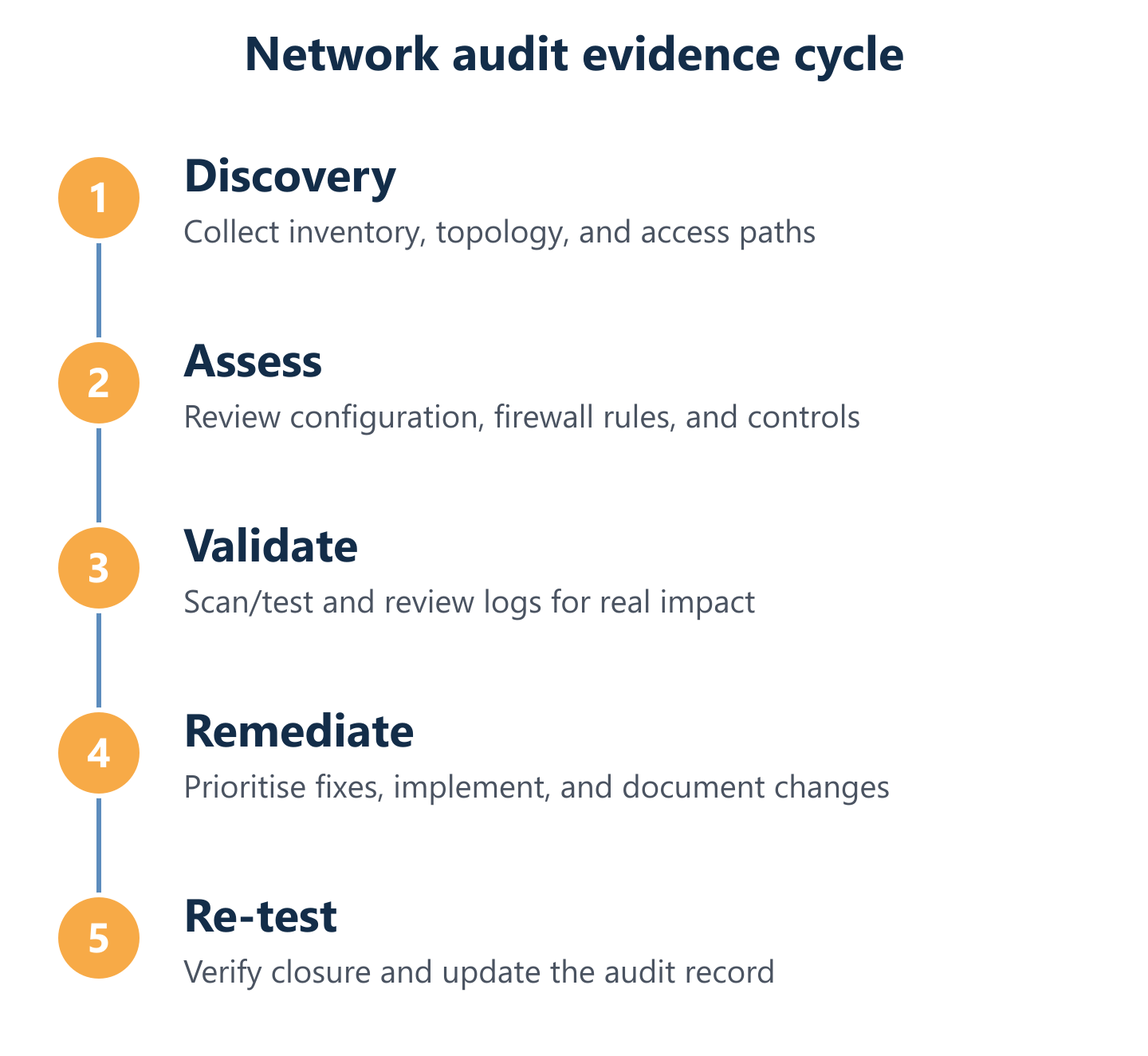
The following phases structure a repeatable, evidence-based audit process:
- Scope definition: Agree on which network segments, sites, and systems are in scope, and which are explicitly excluded. Document the applicable standards (GDPR, PCI-DSS, ISO 27001) and the business context.
- Discovery and inventory: Identify all active devices, users, services, and data flows. This includes physical inspection of cabling and server room conditions alongside automated network discovery.
- Evidence collection: Capture configuration exports, access control lists, firewall rule sets, patch status reports, backup logs, and change records. Each piece of evidence is tagged to a control requirement.
- Assessment and testing: Run configuration reviews, access control audits, vulnerability scans, and—where scope permits—targeted penetration tests or log analysis.
- Finding prioritisation: Rate each finding by risk likelihood, business impact, and remediation effort. Produce a prioritised action list, not a flat catalogue of issues.
- Reporting and handover: Deliver structured findings with evidence references, compliance mappings, and a re-test plan so remediation can be tracked to verified closure.
This structured approach ensures the audit produces actionable intelligence rather than a document that sits unread on a shared drive.
Inventory and discovery: devices, users, services, and data flows
Blind spots in the inventory become blind spots in the audit. Before any configuration review or vulnerability scan, you need a complete and accurate picture of what is connected to the network. This means identifying every managed and unmanaged device—switches, routers, firewalls, access points, servers, endpoints, and IoT devices—along with the services running on them and the data flows between them.
At Impulso Tecnológico, inventory creation is a core deliverable of the network audit. We combine automated discovery with physical inspection to catch devices that do not respond to standard scans: legacy equipment, out-of-band management interfaces, and physically connected but logically isolated assets. User accounts and privilege assignments are inventoried in parallel, because an accurate device list without a corresponding user and service map leaves access control gaps unaddressed. The result is a verified asset register that becomes the foundation for every subsequent assessment step and for ongoing managed services.
Scope, standards, and evidence collection (what to capture and why)
Scope creep and undefined standards are the two most common reasons network audits produce unusable results. Defining scope means specifying which network segments, geographic sites, and system types are included—and explicitly documenting what is excluded and why. This prevents disputes at the reporting stage and ensures the audit effort is concentrated where business risk is highest.
Standards alignment should be agreed before evidence collection begins. Whether the benchmark is CIS Controls, NIST SP 800-53, ISO 27001, or a regulatory framework such as GDPR or PCI-DSS, each control requirement determines what evidence must be captured. For a firewall rule audit, evidence includes the full rule set export with timestamps and change history. For an access control audit, it includes role assignment records and authentication logs. Capturing the right evidence at the right level of detail is what makes findings defensible—and what makes the compliance mapping in the final report credible rather than approximate.
Prioritisation framework: risk likelihood, impact, and remediation effort
Not all findings carry equal weight, and treating them as if they do leads to misallocated remediation effort. A practical prioritisation framework uses three axes: the likelihood that a vulnerability will be exploited given the current threat landscape, the potential business impact if it is (data loss, service outage, regulatory penalty), and the effort required to remediate it.
Findings that score high on likelihood and impact but low on remediation effort—such as disabling an unused remote management protocol or removing an overly permissive firewall rule—should be addressed immediately. High-impact findings that require significant effort (network re-segmentation, privilege model redesign) need a planned remediation project with interim mitigating controls. Low-impact, low-effort findings can be batched into routine maintenance cycles. This three-axis model, applied consistently across the IT network audit checklist, ensures that the organisation's remediation resources are directed where they reduce the most risk per unit of effort.
Core Assessment Areas, Validation Methods, and Deliverables
Once preparation is complete, the audit moves into its technical core. This is where the actual state of the network is compared against the defined benchmarks, and where evidence is transformed into findings. The assessment spans security configuration, access control, network segmentation, encryption, and operational health—with validation methods chosen to match the risk profile and scope of each area.
Impulso Tecnológico's managed-services background shapes how we approach this phase. Findings are not isolated observations; they are connected to the operational practices that will keep the environment secure after the audit closes. A misconfigured backup process is not just a finding—it is a continuity risk that needs to be linked to a verified, monitored backup solution. An outdated firmware version is not just a vulnerability—it needs to connect to a patch governance process that prevents recurrence. This is why our network audits feed directly into proactive monitoring and maintenance programmes, using technologies such as Sophos and Fortinet for security controls, and Veeam for backup and disaster recovery validation.
The key assessment areas and what each one examines:
- Network configuration review: Device hardening, protocol versions (e.g., disabling Telnet in favour of SSH), unused service deactivation, and firmware patch levels.
- Firewall rule audit: Rule set analysis for overly permissive rules, shadowed rules, any-any policies, and rules without documented business justification.
- Access control audit: User privilege levels, least-privilege compliance, multi-factor authentication coverage, and dormant account identification.
- Network segmentation assessment: VLAN design, zone isolation, east-west traffic controls, and lateral movement exposure.
- Bandwidth and availability checks: Utilisation baselines, bottleneck identification, and uptime record review.
- Backup and update governance: Backup job verification, recovery testing records, and patch management cycle compliance.
Security configuration and access control checks (firewall, privileges, segmentation)
Configuration errors and excessive privileges are the two most consistently exploited weaknesses in enterprise networks. A thorough network configuration review examines every managed device against a hardening baseline: are default credentials changed, are unnecessary services disabled, are management interfaces restricted to authorised IP ranges, and are encryption standards current (TLS 1.2 or higher, no SSLv3 or TLS 1.0 in production)?
The firewall rule audit goes beyond counting rules. It analyses rule logic: are there any rules that permit traffic from any source to any destination? Are rules ordered to prevent shadowing? Are there rules that were added for a temporary project and never removed? These are common findings in environments that have grown organically without formal change management.
The access control audit and network segmentation assessment work together. Excessive user privileges combined with flat network architecture create conditions where a single compromised endpoint can reach critical systems. Identifying and closing these lateral movement paths is one of the highest-value outcomes of a computer network audit, and it directly informs the segmentation redesign recommendations in the final report.
Validation methods: scanning, penetration testing, and log review (periodic vs continuous)
Validation confirms that controls work as intended, not just that they are configured. Three methods serve different validation purposes and should be selected based on audit scope and risk appetite.
Vulnerability scanning (using tools such as Nessus, Qualys, or Rapid7 InsightVM) provides automated identification of known CVEs across network devices and endpoints. It is fast, repeatable, and suitable for periodic audits and continuous network monitoring programmes. It does not confirm exploitability—it identifies exposure.
Penetration testing confirms exploitability by simulating an attacker's approach. It is appropriate when the configuration baseline is already established and the organisation needs to validate whether residual risks can be chained into a real attack path. It is not a substitute for configuration review—it is a validation layer on top of it.
Log review examines authentication logs, firewall logs, and change records to identify anomalies that scanning cannot detect: unusual access patterns, failed authentication spikes, or configuration changes made outside approved windows. Periodic log review is a minimum; continuous network monitoring with automated alerting is the more robust model for environments with higher risk profiles.
Deliverables and compliance mapping: report structure and re-testing workflow
A computer network audit produces specific, structured deliverables—not a single document, but a set of artefacts that serve different audiences and purposes. The standard deliverable set should include:
- Executive summary: A concise overview of the audit scope, overall risk posture, and top-priority findings for management and board-level review.
- Technical findings report: Detailed findings with evidence references, risk ratings (critical/high/medium/low), affected assets, and specific remediation guidance.
- Compliance gap matrix: A mapping of findings to the relevant control requirements (GDPR, PCI-DSS, ISO 27001, NIST), showing which obligations are met, which are partially met, and which have open gaps.
- Asset and configuration inventory: The verified device register and configuration baseline produced during the audit, which serves as the reference point for future change management.
- Re-test plan: A schedule and methodology for verifying that remediated findings are genuinely closed—not just marked resolved in a ticketing system.
The re-test workflow is what closes the audit loop: evidence of the original finding, evidence of the remediation action, and evidence from the re-test confirming closure. This chain of evidence is what makes the audit defensible to regulators and auditors.
A computer network audit is only as valuable as what happens after the report is delivered. The findings, risk ratings, and compliance mappings produced through a structured audit create a clear operating rhythm: remediate prioritised gaps, verify each fix through re-testing, and feed the results into ongoing monitoring and maintenance cycles. Impulso Tecnológico connects audit outcomes directly to managed services—proactive monitoring, patch governance, and backup validation—so the improvements made after an audit are sustained rather than eroded by the next undocumented change. If you want to move from a reactive posture to a verified, continuously improving network security baseline, a well-scoped computer network audit is the right starting point. Explore our approach to IT security for businesses, our broader security IT audit methodology, and our guidance on building a robust IT security plan.