
Computer consulting is the structured practice of advising, planning, and implementing technology solutions aligned with business objectives—going beyond reactive fixes to deliver documented assessments, security improvements, infrastructure design, and ongoing managed services with defined outcomes and accountability.
Many organisations reach a tipping point where ad-hoc IT support no longer scales. Systems grow without a coherent architecture, security gaps accumulate, and the IT budget becomes unpredictable. The result is recurring incidents, lost productivity, and decisions made without a clear technology roadmap. Computer consulting addresses this by replacing reactive firefighting with a structured, proactive model: one that starts with understanding your environment, defines priorities and risks, and delivers solutions—whether project-based or as a continuous managed service—with agreed success criteria.
At Impulso Tecnológico, we have operated as an external IT department for clients across Spain and beyond since 2000, resolving around 4,000 IT tickets annually across more than 476 active clients in 25 countries. The approach is not to sell technology for its own sake, but to align every recommendation with operational constraints and business goals—then take ownership of delivery.
What computer consulting is (and what it isn't)
Computer consulting is not a helpdesk call when something breaks. It is a structured engagement in which a qualified team assesses your technology environment, identifies risks and opportunities, and delivers a documented plan—then, where agreed, executes and manages that plan on an ongoing basis. The distinction matters because organisations that treat IT as a reactive cost centre consistently face higher incident rates, unplanned expenditure, and security exposure.
Impulso Tecnológico acts as an extension of your IT team rather than a vendor you call in emergencies. That means advising on architecture decisions, executing implementation projects, continuously monitoring systems, integrating new technologies as they become relevant, and eliminating the recurring problems that drain internal resource. Clients receive both strategic guidance and operational coverage from a certified team that has managed more than 200 large networks for small and mid-sized companies.
| Dimension | Break-fix IT support | Computer consulting (MSP model) |
|---|---|---|
| Trigger | Reactive — after failure | Proactive — continuous monitoring |
| Scope | Single incident resolution | Environment-wide assessment and roadmap |
| Deliverables | Fix applied, ticket closed | Assessment report, roadmap, SLA documentation |
| Cost model | Variable, unpredictable | Predictable IT costs via monthly contract |
| Ownership | Client retains all responsibility | Shared or full IT department extension |
| Security posture | Addressed when breached | Continuously managed and tested |
Consulting vs break-fix IT support: the difference that matters
Computer consulting aligns IT decisions with business priorities, not just technical fixes. When a server fails, break-fix support restores it. When computer consulting is in place, that failure is anticipated through monitoring, mitigated through redundancy planning, and documented so it does not recur. The commercial difference is significant: organisations relying on reactive support typically face higher cumulative costs, longer recovery times, and no visibility into systemic risk. IT consulting and advisory, by contrast, produces a prioritised view of where investment delivers the greatest operational return—before incidents force the decision.
Typical deliverables: assessment, roadmap, documentation, and handover
A well-structured engagement produces tangible outputs at each stage. The assessment phase delivers a documented review of your current environment—hardware, software, network topology, security posture, and licensing compliance. From this, a technology roadmap is produced: a prioritised plan with timelines, budget estimates, and risk ratings. Where implementation is in scope, the consulting team delivers configuration documentation, runbooks, and handover materials so that knowledge is retained within your organisation. When the engagement transitions to managed services, SLA terms, escalation paths, and monitoring parameters are agreed in writing—ensuring accountability is clear from day one.
How "external IT department" ownership reduces recurring issues
Recurring IT problems—the same printer failing, the same VPN dropping, the same backup job silently not running—are almost always symptoms of an environment that has never been fully documented or systematically maintained. An IT department extension model addresses this by assigning continuous ownership: systems are monitored, configurations are standardised, and changes are tracked. At Impulso Tecnológico, engineers work as a team rather than as isolated consultants, which means coverage is not dependent on a single individual's availability. The result is a measurable reduction in repeat incidents and a technology environment that improves incrementally rather than degrading between crises.

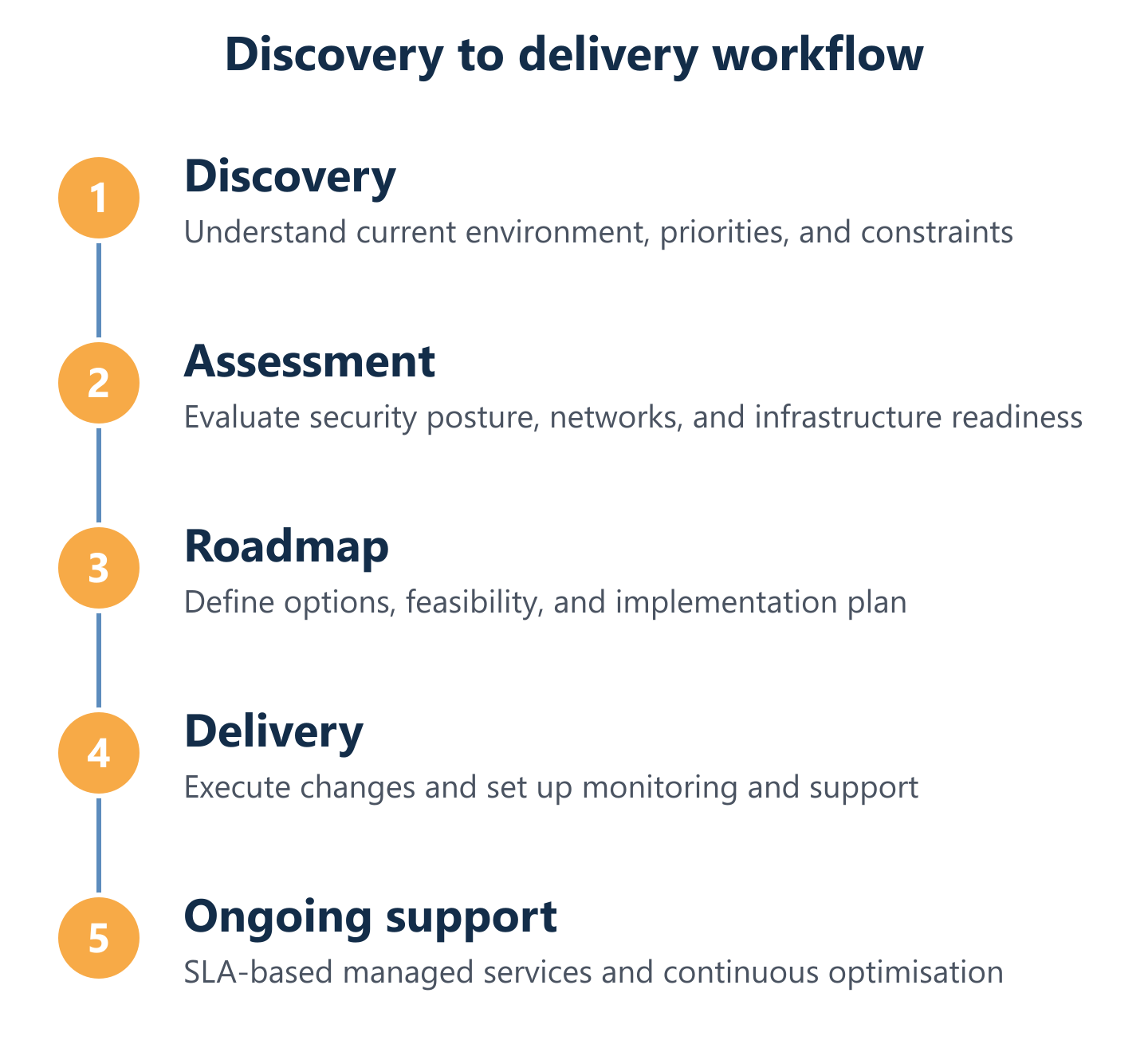
Typical engagement process (discovery to delivery)
Every computer consulting engagement at Impulso Tecnológico begins with understanding your current environment and priorities—not with a pre-packaged proposal. The offer is then adapted to your operational needs and budget, rather than forcing a generic solution onto a specific context. Depending on the agreed scope, the engagement can cover on-demand IT support, technical implementation projects, strategic planning, system monitoring, and fully managed services with SLA-based cost control. The following phases describe how a typical engagement progresses from first contact to ongoing service delivery:
- Initial contact and qualification: Understand the organisation's size, sector, current IT setup, and primary pain points.
- Discovery and scoping: Conduct a structured review of the environment, define priorities, identify risks, and agree success criteria.
- Assessment and feasibility: Evaluate security posture, network architecture, infrastructure readiness, and licensing status; produce a documented findings report.
- Roadmap and proposal: Deliver a prioritised technology roadmap with options, timelines, and cost estimates aligned to business objectives.
- Implementation: Execute agreed projects—network design, security deployment, cloud migration, system configuration—with full documentation.
- Managed services and continuous optimisation: Transition to proactive monitoring, SLA-based support, and scheduled reviews to keep the environment current and secure.
Being independent from any single manufacturer or distributor means recommendations reflect your requirements, not a sales target—a critical distinction when evaluating managed service provider consulting options.
Discovery and scoping: priorities, risks, and success criteria
Discovery and scoping confirm priorities, constraints, and the right engagement model before any resource is committed. This phase typically involves structured interviews with key stakeholders, a review of existing documentation (network diagrams, asset inventories, incident logs), and a preliminary walk-through of the environment. The output is a scoping document that defines what is in and out of scope, identifies the highest-risk areas, and agrees measurable success criteria—so both parties can evaluate outcomes objectively. For computer consulting for SMEs in particular, this phase often surfaces undocumented dependencies and legacy configurations that would otherwise cause delays during implementation.
Assessment and feasibility: security posture, networks, infrastructure readiness
Assessment and feasibility translate your environment into a clear roadmap and implementation plan. A technical assessment covers security posture (firewall rules, endpoint protection status, patch levels, access controls), network architecture (topology, segmentation, wireless coverage, bandwidth utilisation), and infrastructure readiness (server capacity, storage, backup integrity, and hardware lifecycle). Where applicable to the agreed scope, this phase can include vulnerability and penetration testing to surface exploitable weaknesses before they are discovered by external actors. Feasibility analysis then maps findings against budget and operational constraints, producing a ranked set of recommendations with realistic effort and cost estimates—so decisions are grounded in evidence rather than vendor preference.
Implementation and managed services: monitoring, support, and continuous optimisation
Delivery includes execution, monitoring, and SLA-based managed services where required. Implementation covers the agreed technical scope—deploying Sophos or Fortinet security solutions, configuring Cisco or Aruba network infrastructure, migrating workloads to Microsoft 365 or Azure, or implementing Veeam backup and disaster recovery. Each project is documented so that configurations are reproducible and auditable. Once live, the environment transitions to proactive managed services: continuous monitoring, scheduled maintenance, patch management, and a defined support model with agreed response times. Monthly contractual terms keep IT costs predictable and eliminate the budget uncertainty that characterises reactive support models—a core requirement for any organisation serious about business continuity planning.
Core consulting areas and how to measure success
Across more than 476 active clients and 25 countries, Impulso Tecnológico's computer consulting work consistently spans four interconnected domains: feasibility and strategic planning, cybersecurity, network and communications infrastructure, and systems and operational continuity. Treating these as separate silos is a common mistake—a security gap in the network layer undermines even the best endpoint protection, and a poorly designed infrastructure makes business continuity planning theoretical rather than operational.
Measuring success in each domain requires moving beyond vague outcomes like "better IT" and agreeing specific indicators before work begins. The following signals indicate a consulting engagement is delivering real value:
- Incident reduction: Fewer repeat tickets for the same root cause, tracked month-on-month against a baseline established during discovery.
- Ticket resolution speed: Average time-to-resolution improving as documentation and monitoring mature.
- Security posture score: Reduction in open vulnerabilities identified during periodic assessments or penetration testing.
- Backup and recovery readiness: Successful test restores completed within agreed recovery time objectives (RTOs).
- Uptime and availability: System availability tracked against SLA thresholds, with documented root-cause analysis for any breach.
- Budget predictability: Variance between planned and actual IT spend decreasing as the managed services model matures.
- Client satisfaction: Structured feedback from internal users confirming that response times, communication, and resolution quality meet expectations.
For organisations exploring IT consulting for the first time, establishing this measurement framework during scoping—rather than after delivery—is what separates a consulting engagement from an expensive project with no accountability.
Feasibility, security, networks, and infrastructure: a scannable service taxonomy
Computer consulting covers four primary service domains, each with distinct deliverables and measurable outcomes. Feasibility and strategic planning includes technology roadmaps, vendor-neutral solution selection, and budget modelling—ensuring investment decisions are grounded in operational reality. Cybersecurity encompasses firewall configuration (Fortinet, Sophos), endpoint protection, access control, GDPR compliance, and where in scope, vulnerability and penetration testing. Network and communications covers LAN/WAN design, wireless infrastructure (Cisco, Aruba), segmentation, and performance optimisation. Systems and infrastructure includes server environments, storage (QNAP, Schneider Electric/APC), virtualisation, and hardware lifecycle management across Dell, Lenovo, and HP platforms. Each domain connects to the others: a network redesign without a security review, for instance, typically introduces new exposure rather than reducing it.
Security and continuity outcomes: data protection, recovery readiness, reduced downtime
Network and infrastructure consulting improves performance, reliability, and operational efficiency—but security and continuity outcomes are where the business case is most concrete. A well-implemented backup and disaster recovery solution using Veeam, for example, transforms business continuity planning from a policy document into a tested, operational capability with defined recovery time and recovery point objectives. Data protection under GDPR requires not just technical controls but documented processes and audit trails—deliverables that a structured consulting engagement produces as standard. Reduced downtime is the cumulative result: fewer unplanned outages, faster recovery when incidents do occur, and a security posture that prevents the majority of incidents from materialising in the first place. These outcomes are trackable, and they directly affect operational costs and revenue continuity.
KPIs and ROI examples: tickets, uptime, response times, and client satisfaction
KPIs turn "better IT" into measurable results such as incident reduction and ticket resolution speed. Concrete examples from managed IT consulting engagements include: a reduction in monthly ticket volume as recurring root causes are eliminated; mean time to resolution (MTTR) falling from hours to minutes as monitoring and runbooks mature; system uptime moving from untracked to consistently above agreed SLA thresholds; and backup success rates reaching 100% verified restores on a scheduled testing cadence. Impulso Tecnológico resolves around 4,000 IT tickets annually across its client base—a volume that generates statistically meaningful data on resolution patterns, enabling continuous service improvement. For a practical illustration of how these outcomes translate in a real engagement, the IT consulting success story on our site provides a documented example.
Secure, stable IT that supports rather than disrupts operations does not happen by accident—it is the result of structured consulting, documented decisions, and a partner that takes ownership of outcomes rather than just tasks. The starting point is a scoped discovery: understanding your current environment, agreeing priorities, and defining what success looks like in measurable terms. Whether you need a project-based engagement, a fully managed IT service, or an extension of your existing team, Impulso Tecnológico's computer services and IT consulting services across Spain and Portugal are designed to deliver exactly that accountability. The next step is a conversation.